Category: Costa Rica

  • Vascular epiphyte restoration using bromeliad transplants in Southern Costa Rica

    Vascular epiphyte restoration using bromeliad transplants in Southern Costa Rica

    Estefania Fernandez is a Bascom Fellow who recently finished her master’s thesis at the University of Montpelier, France. Last year, Estefania wrote about her preliminary results on tropical forest restoration and vascular epiphyte reintroductions in Costa Rica. Here, she describes the final results, recently published in Restoration Ecology.

    img_0055-001
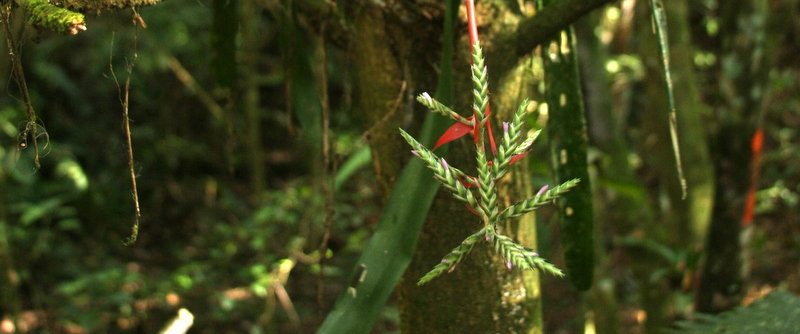
    A transplanted bromeliad, Aechmea dactylina flowering in a 10-year old tree plantation.

    Vascular epiphytes are plants that germinate and root on other plants without taking their nourishment from their host plant, and they represent 50% of the flora in some tropical forests and 9% of all vascular plants worldwide. If you are a plant lover, then you most likely have one or several vascular epiphytes in your house. Some of the most appreciated horticultural families include orchids (Orchidaceae), aroids (Araceae), and bromeliads (Bromeliaceae).

    Vascular epiphytes also play key roles in our ecosystems. They are crucial to forest water and mineral recycling as they intercept rainfall and prevent rapid run-off and nutrient leaching. Vascular epiphytes are also exceptional microhabitats where invertebrate communities find refugia and birds and arboreal mammals forage.

    ef-bromeliad-jg1-001
    Transplanted individual of Werauhia gladioliflora

    Despite their importance in forest ecosystems, vascular epiphytes are rarely taken into account in forest restoration. This is problematic because vascular epiphytes are often among the slowest plants to recolonize regenerating forests.

    In 2015-2016, I tested whether transplanting epiphytes into young restoration sites could be a viable strategy to accelerate their reestablishment. I used a bromeliad for my experiment, Werauhia gladioliflora (H. Wendl.) J.R. Grant, which was common in remnant forest but had not been found during epiphyte surveys in nearby restoration areas. In March-June 2015, I transplanted 60 bromeliads into three restoration plantations near Las Cruces Biological Station in southern Costa Rica. I revisited the sites in January-February 2016, nine months after transplantation, to monitor survival and arthropod recolonization.

    Happily, over 75% bromeliads survived and the number of arthropods on branches with bromeliads was seven times greater than in branches without bromeliads. Additionally, I observed that bromeliads buffered the local microclimate; during the driest and hottest times of the day, the interior of the bromeliads was moister and cooler than ambient air.

    merge_pic
    Transplanted individuals of Werauhia gladioliflora (left) hosted considerably more arthropods in their rosettes than could be found on the stems of trees that had not received a transplant. GN, JG, and MM are three study sites near Las Cruces Biological Station in southern Costa Rica. Photo by Dave Janas.

    Restoring arboreal refugia

    My research suggests that transplanting fallen epiphytes onto trees in restored sites contributes to the recovery of vascular epiphyte diversity in these ecosystems and has the additional benefits of bringing back arthropod diversity to these sites. Epiphytes, and specifically “tank” epiphytes that retain water in their rosettes, help stabilize microclimatic conditions, a critical function in light of climate change, which may put arboreal communities at special risk. Indeed, the body temperature of many animals such as invertebrates entirely depends on ambient temperatures but rising temperatures could push arboreal animal communities to the ground. Epiphytes offer ideal refugia from high temperatures and drought and their presence in tree canopies and understory is critical to preserve arboreal animal communities. Transplanting other epiphyte families or even entire epiphyte communities found on fallen branches could be tested in the future to broaden this strategy.

    img_0053
    Estefania inspects a flowering individual of an Aechmea dactylina transplant
    This work was supported by a grant from the National Science Foundation.
  • Tree islands for tropical forest restoration: the outlook is rosy after 10 years

    Tree islands for tropical forest restoration: the outlook is rosy after 10 years

    Planting tree islands has many of the benefits of larger plantations, but entails significantly less cost. Karen Holl (University of California, Santa Cruz), Leighton Reid (Missouri Botanical Garden), and Zak Zahawi (American University of Beirut) describe recent findings on tree seedling recruitment in a long-term experiment in southern Costa Rica.

    Over the past few years there have been a growing number of commitments at the global, national and regional scale to restore forests because of their importance to conserve biodiversity, sequester carbon, reduce erosion, and provide goods and services to people. For example, Initiative 20×20, led by the International Union for the Conservation of Nature, aims to restore 20 million hectares of tropical forest by 2020, an area roughly equivalent to the size of Uruguay or Nebraska.

    A common strategy to restore forests is to plant trees. But, the big question is: where will the money come from to plant billions of trees when there are so many pressing needs? As restoration ecologists, we started thinking about how we could most efficiently allocate resources to get the best bang for the buck and restore the largest area of forest.

    expdesignnher
    Trade-offs in forest restoration strategies. Planting fewer trees leaves more to chance and can require more time, but tree plantations are more expensive and leave a bigger ecological footprint. Our study tests an intermediate option, and after 10 years it appears to provide a good balance. Figure modified from Corbin & Holl (2012).

    Starting over 10 years ago, we set up a large-scale tropical forest restoration experiment in southern Costa Rica to test two ideas.

    First, we tried planting tree “islands”. The idea is to plant groups of trees that attract birds and bats, which disperse most tropical forest tree seeds. The tree canopy also shades out light-demanding grasses that can outcompete tree seedlings. In one experimental treatment, we planted tree islands that covered about 20% of 50 × 50 m plot of former cattle pasture. We compared that to plots where no trees were planted (natural recovery) and to the more intensive (and more typical) restoration strategy of planting trees in rows throughout the plot (plantation).

    Second, we asked: is it only possible to restore forest near remnant forests or can you restore forest anywhere in the landscape? This is important information to help guide forest restoration efforts. To do this we set up our entire experiment at 13 sites, some of which were mostly surrounded by agricultural land and some of which were adjacent to the largest remaining forests in the region.

    Then we monitored establishment of new tree seedlings in our research plots over a decade. We compared the number of seedlings, number of species, and types of species in the restoration plots with those found in the nearby forest to evaluate how well the forest is recovering.

    The tree island planting method not only saves money on buying, planting, and maintaining seedlings, but it also results in a more heterogeneous distribution of trees, so it looks more like a natural forest.

    om-i3
    Profuse tree seedling and sapling recruitment in the understory between two tree islands in southern Costa Rica.

    We counted over 6000 tree seedlings, 88% of which have seeds that are dispersed by animals. On average there were many more tree seedlings in the tree island and plantation treatments than in the natural recovery plots. These results suggests that some tree planting helps the forest to recover faster, but that it is not necessary to plant the whole area with trees. The tree island planting method not only saves money on buying, planting, and maintaining seedlings, but it also results in a more heterogeneous distribution of trees, so it looks more like a natural forest.

    Even though there were many tree seedlings in the island and plantation plots, on average there were less seedlings of tree species that have big seeds (>0.5 cm/0.2 inches across) compared to mature, reference forests. It seems that the larger-seeded species that are common in mature forests are much slower to colonize restored sites, likely because they are eaten and dispersed by a small number of larger animals, such trogons and agoutis. Many of those dispersers are less likely to visit early successional forest.

    wheelwright_nher
    Small frugivores, small seeds. Most of the birds we see in these experimental plots are small-gaped omnivores (e.g., Yellow-bellied Elaenia, Elaenia flavogaster, left), but it usually takes large-gaped species to disperse larger seeds1. The figure at right shows the maximum fruit size that a bird species with a given gape size was able to consume in a cloud forest in central Costa Rica (modified from Wheelwright (1985)). In our experiment, small seeds were ubiquitous, but large seeds were mostly absent.

    We were surprised that the amount of forest cover around the experimental plots had a weak effect on the number of seedlings establishing. In other words, isolated plots had just as many tree seedlings as plots right next to old-growth forests. We think that this is likely due to the fact that there are many trees in the agricultural landscape surrounding our plots; these trees include remnant trees, living fence rows, and riparian corridors. Trees in the landscape can serve an important role in both providing sources of seeds and stepping stones for the movement of seed-dispersing fauna. We anticipate that having forest nearby will be more important in future years as these forests build up greater diversity of rare, large-seeded species. Nonetheless, our results suggest that there are good prospects for restoring forests in many locations in this landscape.

    Our key finding is that planting tree islands can be a cost-effective way to restore tropical forests at our study site in Costa Rica, but we hasten to note that the strategy should be tested in other locations, particularly areas with fewer forest elements in the surrounding countryside. Our study also demonstrates that tropical forests can recover some species quickly but it will take many decades, if ever, for forests to fully recover. So, preserving existing rain forests is critical to conserve biodiversity and the services they provide to people.

    landscape
    Diverse tree cover in an agricultural landscape in southern Costa Rica. Remnant trees in pastures, trees along fence rows, and riparian forests provide important sources of flora and fauna to speed up forest recovery.

    1See Melo et al. (2009) for an example to the contrary: small-gaped animals dispersing fairly large fruits and seeds.

    This work was supported by a grant from the National Science Foundation.
  • Fig Stakes: Shoreline Restoration for a Costa más Rica

    Fig Stakes: Shoreline Restoration for a Costa más Rica

    Andres Santana is the graduate program coordinator at the Organization for Tropical Studies. During a recent fieldtrip in southern Costa Rica, he and CCSD restoration ecologist Leighton Reid compared notes on using fig stakes for ecological restoration.

    Tropical beaches are many things to many people. To plants, beaches are hot, sandy, and salty – complicating their restoration.

    Costa Rica has 1228 km (763 mi) of coast line – including 1016 km on the Pacific side and 212 km on the Caribbean. Along Costa Rica’s northern Pacific coast, the beach forms the natural edge of the dry forest. Farther south the adjacent forest is more humid. Giant trees, 40 m or more in height, grow right up to the high tide mark, particularly along the Caribbean.

    But as with so many tropical ecosystems, Costa Rica’s coastal forests have been subject to human impacts. Many shoreline forests were cleared for cattle ranching, and exotic grasses were introduced as forage. Some of these grasses are fierce competitors and prevent tree seedlings from establishing, even long after the pastures have been abandoned.

    Playa Hermosa Antes y Despues
    Playa Hermosa, before (left) and after (right) planting 2-m long cuttings of a coastal fig species (Ficus goldmannii).

    In 2009, a small non-profit organization, Costas Verdes, was formed to restore coastal forests along degraded shorelines, particularly wildlife refuges. The restoration work was initially challenging; tree seedlings were hard to establish along the coast because of the harsh environment – high temperatures and salinity and lack of freshwater were among the most significant obstacles. Not to mention the invasive cattle forage grasses.

    OLYMPUS DIGITAL CAMERA
    Coastal restoration at Playa Hermosa

    Playa Hermosa, a surfing destination on the Central Pacific coast, was among the most heavily deforested project sites. This area, part of a wetland and river estuary, was declared a national wildlife refuge in 1998. By 2009, very little forest had naturally regenerated. This led Costas Verdes to implement a restoration project at this beach. Planting plots were established where invasive grass was removed. In other areas, grasses left intact, as a comparison. It quickly became evident that tree seedlings were outcompeted by the grass. Those in the cleared plots grew better, but they still faced the other coastal habitat challenges.

    Some native trees are resistant to hot substrates and high salinity, but these species were not available in tree nurseries, most of which focused on ornamental species. This meant that seedlings needed to come from locally collected and germinated seeds. We realized that this would take time to get going. Tree seedlings under 50 cm rarely survive, even if they have the proper coastal adaptations.

    To accelerate the restoration, we decided to use tree cuttings rather than growing seedlings from seed. A colleague suggested Ficus goldmannii as a candidate species, so in 2011 we conducted a planting trial. We planted 225 2-m long cuttings. Of these, 195 (87%) survived their first year. By the second year all 195 survivors had become established and were quickly providing canopy cover and lowering the temperature of the sand.

    Ficus
    An established fig stake with a dense canopy. Note the weak, patchy grass below it.

    Once fig stakes created some canopy cover, we brought in other tree species – mostly from the coastal tree nursery that we created. Shade from the fig canopy also began to inhibit the invasive grasses, which require high sunlight to photosynthesize efficiently. Reduced competition with these grasses allowed other tree seedling species to survive.

    In this instance Ficus cuttings turned out to be useful in promoting restoration. We have since used cuttings for other plots with similar success.

    OLYMPUS DIGITAL CAMERA
    Coastal trees and shrubs growing below established fig cuttings at Playa Hermosa.
  • Transplanted bromeliads improve microclimate and facilitate arthropods in restored forests

    Transplanted bromeliads improve microclimate and facilitate arthropods in restored forests

    Estefania Fernandez is a masters student at the University of Montpellier, France. She spent the past six months working with scientists in the Center for Conservation and Sustainable Development on a tropical forest restoration experiment in southern Costa Rica.

    Costa Rica is one of the world’s most biodiverse countries, hosting 4% of flowering plant species in an area representing only 0.03% of the Earth’s terrestrial surface. With a large diversity of ecosystems, ranging from mangroves to cloud forests, Costa Rica hosts a unique family of (almost exclusively) Neotropical plants: the Bromeliaceae, commonly called bromeliads. With their colorful inflorescences and strikingly patterned leaves, numerous bromeliads are cultivated around the world for their ornamental value. Less is known, however, about their ecology in tropical ecosystems, particularly in regenerating forests.

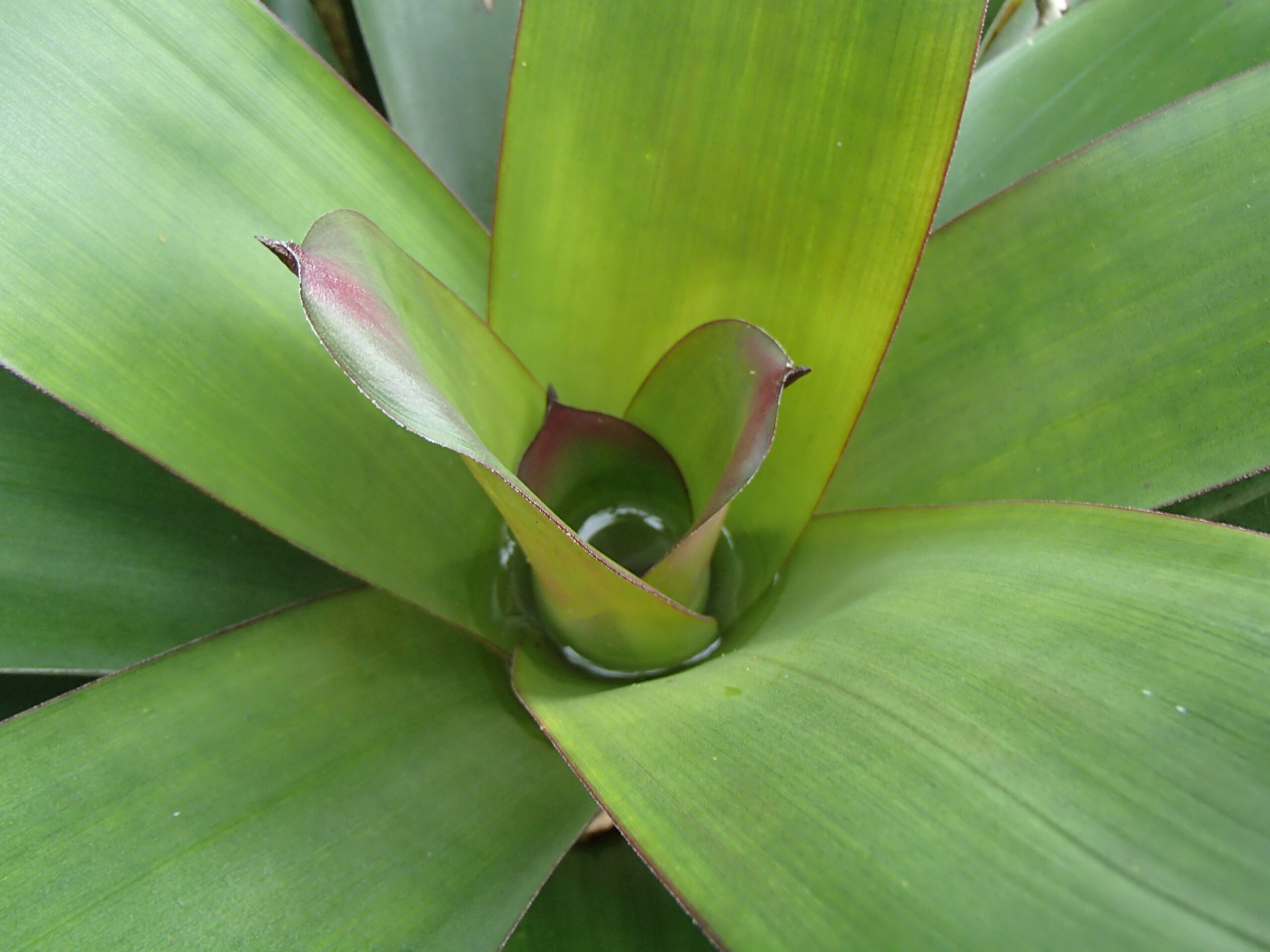
    Werauhia gladioliflora rosette, showing its overlapping leaves.
    Werauhia gladioliflora rosette, showing its overlapping leaves.

    Many of the so-called “tank bromeliads” are epiphytes, meaning that they grow non-parasitically on other plants. These bromeliads have ample rosettes of overlapping leaves, capable of holding considerable amounts of water. These water tanks keep them hydrated, and plant detritus that accumulates in these structures also provides bromeliads with nutrients. Arthropods take refuge in bromeliad rosettes, and consequently these plants attract mammals and birds seeking prey. Mutualistic ants build their nests in bromeliad rhizospheres, or root zones, and frogs lay eggs in the tanks. When sufficiently numerous in tree canopies, bromeliads can stabilize local temperature and humidity.

    Water stored inside a W. gladioliflora tank.
    Water stored inside a W. gladioliflora tank. (Photo courtesy of Dave Janas)

    Despite these important ecological roles, vascular epiphytes like bromeliads are often scarce in regenerating tropical forests. Their recovery could be slowed by limited seed dispersal or by a lack of suitable recruitment sites. One way to overcome dispersal limitation is to transplant individuals. In our study area in southern Costa Rica, transplanting bromeliads is relatively simple because they are easily found on fallen tree branches in the old growth forest reserve at Las Cruces Biological Station. We hypothesized that transplanting bromeliads from the old growth forest into 10-year old forest restoration sites would buffer local temperatures and increase arthropod abundance and diversity compared to bare, control branches.

    Measuring local temperature in a transplanted Aechmea dactylina.
    Measuring local temperature in a transplanted Aechmea dactylina.

    To test our hypothesis, we transplanted 120 bromeliads into three restoration sites in southern Costa Rica. The restoration sites are part of the Islas Project, an NSF-funded restoration experiment led by Drs. Karen Holl and Rakan Zahawi. Bromeliads were sterilized and attached to tree branches in the restoration sites with twine. Each day, we measured the microsite temperature on branches with and without transplanted bromeliads, as well as ambient temperature in the nearby air. To characterize arthropod colonization, we extracted and identified arthropods (to order) from transplanted bromeliads after two and three weeks.

    We found that transplanted bromeliads decreased local temperatures on tree branches, creating a less stressful microclimate for other organisms. Bromeliads also facilitated arthropods; transplanted bromeliads were quickly colonized, especially by ants. We also observed small frogs inside of some bromeliad tanks, but none on the bare branches where we did not transplant bromeliads.

    We found this frog (Craugastor stejnegerianus) in a small  Catopsis sessiliflora tank. (Photo courtesy of Dave Janas)
    We found this frog (Craugastor stejnegerianus) in a small Catopsis sessiliflora tank. (Photo courtesy of Dave Janas)

    Our observations suggest that bromeliad transplantation can buffer microclimates and create useful structures for invertebrates. If so, this method could improve restoration outcomes for canopy flora and fauna. Given that this experiment was conducted over a single field season, it is still an open question whether transplanted bromeliads will survive over longer time periods. It will also be important to learn whether transplanted bromeliads will facilitate colonization by other epiphytic plants. We did find some evidence of this as ferns were already growing in several bromeliads’ rhizospheres after two months.