This post was co-written by Leighton Reid and Chris Birkinshaw after a three-day field trip in the tampoketsa with Cyprien Mandriamanana and Jeannie Raharimampionona.
A narrow, paved road winds north from Antananarivo through a high, windswept plain. It is the wet season, and the hills are green and close-cropped, but in the long dry season the landscape burns black. Orange rivers wind through the valleys, muddied by massive erosion. Here and there are thin strips of riparian forest, chock full of endemic species.
The biggest chunk of remaining forest is Ambohitantely, Malagasy for “hill of honey”. Ambohitantely encompasses 1,800 ha of humid forest (about three times the size of Saint Louis’s Forest Park). We visited the reserve to observe natural forest recovery in one of the few places it can still be seen on Madagascar’s Central Highlands.


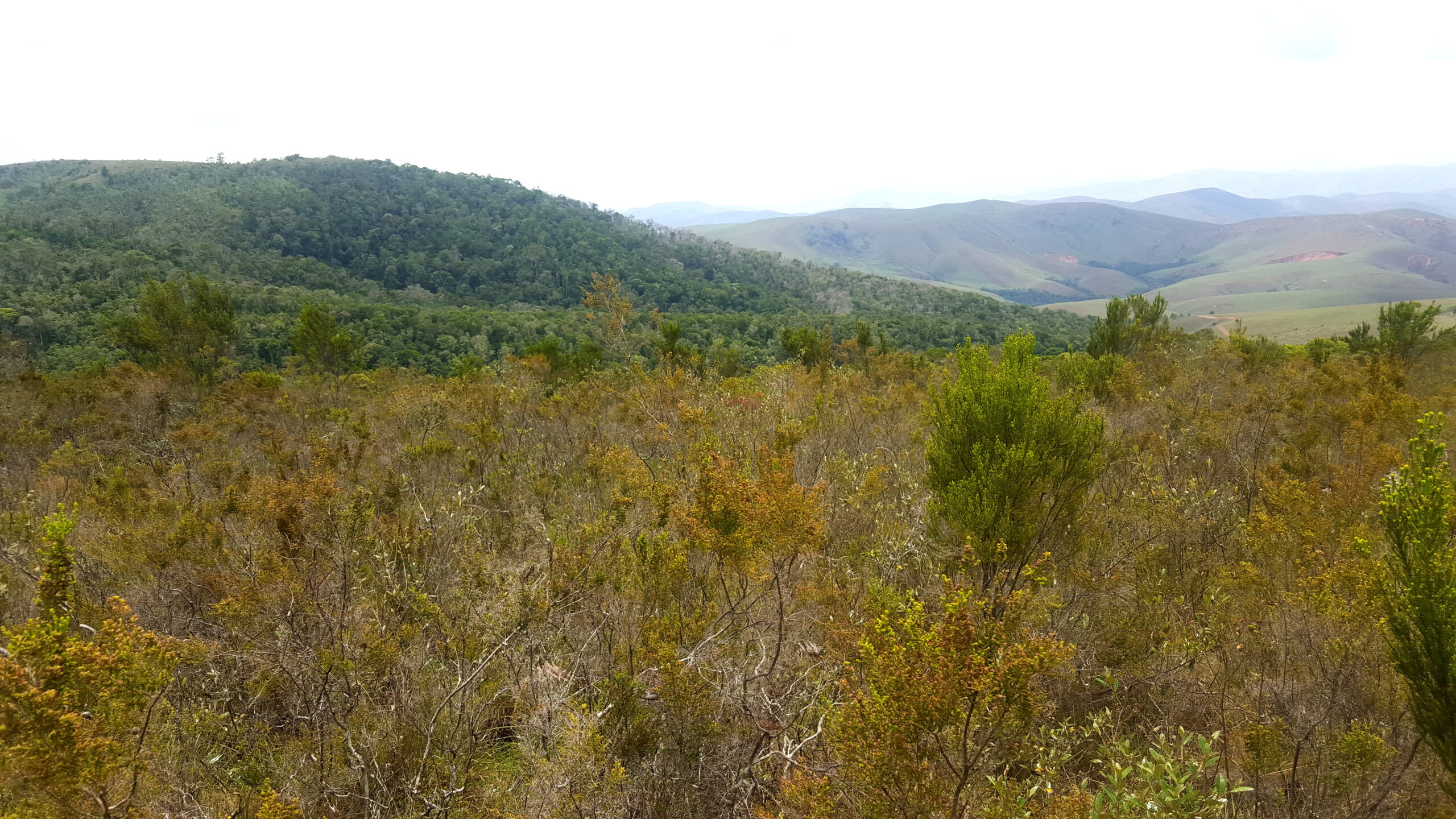
Our guide at Ambohitantely took us on a hike through several areas where forest had once been cleared and burned but where fire had been excluded for 15 or 25 years, allowing the forest to begin to recover. Frankly, the vegetation was uninspiring. Low shrubs and forbs were scattered through a matrix of C4 grass (mostly Aristida), but trees and tree seedlings were nowhere to be seen outside of the forest (where they were abundant). By tropical forest standards, this looked slow. But for natural forest recovery on the Central Highlands, it’s hard to imagine a better situation than being protected from fire and immediately adjacent to the largest remaining tract of forest.

Our main interest in Ambohitantely was to compare natural forest recovery there to our observations at another forest fragment, Ankafobe, 10 km northwest. For the last decade, MBG has partnered with a local community to preserve a thin, riparian forest containing several critically endangered plant species. Community members constructed a fire break and have begun to restore the surrounding hillsides by turning over the orange clay and planting fast-growing legumes to develop the soil.

Some of our comparative observations were promising. We were happy to find examples at Ambohitantely where recovering land dominated by heather and blueberry seemed to have continued developing into a more diverse thicket, including Nuxia capitata, Psiadia altissima, and Razafimandimbisonia minor. At Ankafobe, we had worried that the heather growing in some areas signified poor soil conditions and possibly arrested development.
Overall our visit left us with more questions than answers. We hope to answer at least a couple of them over the coming years.
- Why is natural forest recovery so slow on the Central Highlands?
- Has it always been this slow?
- Are Malagasy tree species poor pioneers because of their long, relatively stable evolutionary ecological history?
- Is there any way to make Malagasy trees grow any faster on the degraded grasslands?1
- Are the fire-stoking C4 grasses introduced from east Africa rather than being native species?
- If so, when?
- Is the soil too far gone to ever recover?
- How important were now-extinct seed dispersers and grazers, like 200-kg lemurs and elephant birds?

References
Goodman, S.M. & Jungers, W.L. 2014. Extinct Madagascar: Picturing the Island’s Past. University of Chicago Press, Chicago, IL.
Pareliussen, I., Olsson, E.G.A. & Armbruster, W.S. 2006. Factors Limiting the Survival of Native Tree Seedlings Used in Conservation Efforts at the Edges of Forest Fragments in Upland Madagascar. Restoration Ecology 14: 196-203.
1Two datasets (one from our team and one from Pareliussen et al’s [2006]) suggest that NPK fertilizer, even in relatively small doses, reduces native tree seedling performance. It is unclear whether this is because of toxicity (a direct effect) or because other plants, like shrubs, are better able to utilize the nutrient pulse and then compete more strongly against the native tree seedlings (an indirect effect).