Tag: Colombia

  • The cost-effectiveness of fertilizing and irrigating tropical dry forest seedlings in an applied nucleation project

    The cost-effectiveness of fertilizing and irrigating tropical dry forest seedlings in an applied nucleation project

    By Dr. Laura Toro

    Laura is a Restoration Scientist at the Missouri Botanical Garden’s Center for Conservation and Sustainable Development, where her research focuses on dry tropical forest restoration (ltoro@mobot.org).

    Tropical dry forests are among the most threatened ecosystems in the world. Commercial agriculture, livestock farming, and mining have damaged and reduced the extent of this ecosystem type globally. Now less than 10% of the original extension of this ecosystem persists. The conservation and restoration of tropical dry forests are often overlooked because they are not as lush and well-studied as rainforests. However, restoring tropical dry forests can ensure the survival of thousands of unique plant and animal species that only exist in this ecosystem, and the protection of food, medicine, and livelihoods for millions of people. 

    Colombia has been one of the few countries that has invested resources to study the diversity and function of tropical dry forests across the country to ensure the conservation and restoration of the existing remnants of tropical dry forests. Since 2013 the von Humboldt Institute has been leading most of the research initiatives, and all the knowledge compiled about tropical dry forests has motivated the creation of a biodiversity offsetting policy. This policy establishes that for every hectare of tropical dry forest that is impacted by any kind of development project, 10 hectares (25 acres) of land need to be restored and conserved.

    Although our understanding of the ecology, function, and diversity of tropical dry forests has increased in the last decade, the unique characteristics of this ecosystem type including the lack of precipitation for up to 8 months, makes it challenging for seeds and seedlings to naturally establish in these forests. Therefore, restoring tropical dry forests requires extra investment, like seed purchasing, in situ seedling production, tree planting, irrigation, fertilization, and weed control. These extra steps translate into a large financial investment at the beginning of a restoration project. According to published estimates, the establishment phase (year 1) of a restoration project in a tropical dry forest can range from $105 – $25,830 ha-1 (Bodin et al. 2022).

    Irrigation and fertilization are among the most expensive management practices often implemented. When seedlings are planted in previously tropical dry forest areas, they are often irrigated to extend seedling access to water, and fertilized because most tropical dry forest soils are expected to be highly degraded from previous land uses. However, it is still unknown how much irrigation and fertilization seedlings need to be able to survive and grow. To answer this question, Fundación Natura, a Colombian nonprofit organization, Enel-Emgesa, an Italian electrical company, and researchers from the University of Minnesota established an applied nucleation project (where trees are planted in small patches to serve as focal areas of recovery) in a grassland area dominated by non-native species in southwestern-central Colombia that used to be a tropical dry forest. In this area, Enel-Emgesa built a dam, and as part of their biodiversity offsetting strategy the company committed to restore ~12,000 ha of degraded tropical dry forests in the next 10 years. 

    Ten-year-old grassland where tropical dry forests seedlings are not naturally establishing (photo: Laura Toro).

    The grassland, where the research project we report on here was established, covered 7 hectares (17 acres) and had little evidence of spontaneous natural regeneration, so we implemented an applied nucleation intervention. To do that, we cleared the existing vegetation of the area with machetes and scythes, tilled with a tractor to reduce soil compaction, and set up 42 hexagonal plots that had an area of 1000 m2 (0.25 acres) each. In each plot, we planted 271 seedlings belonging to 11 different plant species native to dry tropical forests of this region. Four of these species had the ability to associate with bacteria that can fix atmospheric nitrogen. The seedlings planted all received 1 kilogram of ant farm soil, 10 grams of hydrogel to extend the period of favorable soil moisture, and 50 grams of nitrogen – phosphorus – potassium (NPK) fertilizer, 25 grams of NPK, 43 grams of phosphoric rock, or no fertilizer, depending on the plot where the seedlings were planted. All seedlings were irrigated once they were planted to activate the hydrogel. The seedlings that received the irrigation treatments were watered two more times during the first month of the experiment. The control and the 50 grams of NPK without additional irrigation treatments did not receive any additional water. Once the seedlings were 6 months old, we started monitoring their survival and growth. In each plot,we recorded the height of every seedling that was still alive. Thereafter, we measured seedling height approximately every six months for two years.

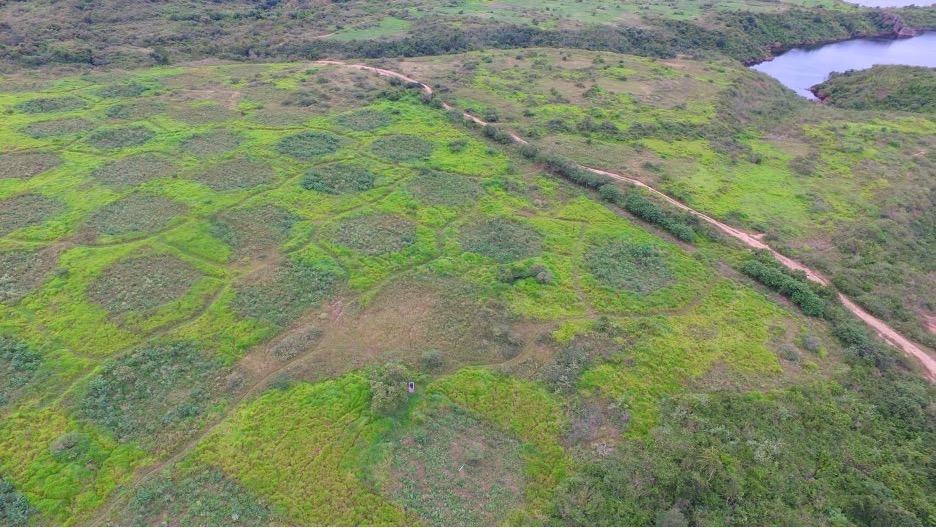
    Aerial image of the 42 nucleation plots established in 2019 in El Quimbo, Colombia. The extension of the restoration intervention was 7 hectares (17 acres) (photo: Fundación Natura). 
    A close-up view of the experimental restoration plot. The orange lines represent the limits of the plot (1000 m2 = 0.25 acres), and each small dot represents a seedling planted (Photo: Fundación Natura). 

    Additionally, we decided to compare the costs among the different management strategies implemented. We documented the cost of seedling production, planting, fertilizers, irrigation, and monitoring. Finally, we estimated the cost-effectiveness of each treatment for any of the eleven species planted. We did that by first estimating the total cost of planting a hectare of grassland with a single tree species (a hectare is equivalent to six nuclei = 1,626 individuals) under a specific treatment, and then dividing that cost by the % survival of that species under that specific treatment after two years. The most cost-effective method was the one that yielded the lowest cost and had the highest % survival.

    An employee from Fundación Natura fertilizing a seedling of Vachellia farnesiana a shade-avoiding plant species common in tropical dry forests in Colombia (photo: Laura Toro). 

    We found that during the first two years of the project seedling survival was on average 73% across treatments. The seedlings that received 25 grams of NPK plus irrigation treatment had the highest survival (76%), while the seedlings that were fertilized with 50 grams of NPK and did not receive additional irrigation had the lowest survival (69%). However, when we looked at the survival across species, we found that survival varied across species and treatments. The plant species with the highest survival was Ceiba pentandra (99%), while Handroanthus coralibe had the lowest survival rates (5%). In terms of costs of planting seedlings, we found that the cheapest strategy was to not fertilize or irrigate the seedlings ($7,313 per hectare, $2,961 per acre), while the most expensive strategy was 50 grams of NPK plus irrigation ($11,689 per hectare, $4,732 per acre). Finally, when we compared the cost-effectiveness of the six fertilization and irrigation strategies implemented, we found that the control treatment was the most cost-effective management practice across the eleven species planted ($19,522 per hectare, $7,903 per acre) in part due to the low costs of no additional management beyond planting and monitoring, and the modest benefits to survival of costly irrigation and fertilization practices.

    Aerial image of nucleation plots in El Quimbo, Colombia in 2022. (photo: Fundación Natura).

    Even though restoration practitioners deal with a lot of uncertainty and restoration studies still lack information about how fertilizers affect the growth of native tree species and non-native grasses, there are multiple ways to improve restoration outcomes in tropical dry forests. We encourage partnerships between scientists and restoration practitioners to test how fertilizers impact different plant species growth and survival, and to estimate the costs of this practice across different tropical dry forests. Additionally, paying close attention to the soil fertility of the area, planting species that are found locally, actively weeding during the first year of the project, and fencing the restored area to ensure herbivores do not browse the seedlings will increase seedling survival and the success of the restoration efforts. Based on our results, we suggest that restoration projects should spend less resources on irrigation and fertilization, and more on plant species selection and weed removal.

    If you want to learn more about how fertilization and irrigation impacted the growth and survival of tropical dry forest seedlings, we invite you to read our recent paper in Restoration Ecology or contact Dr. Laura Toro.
  • Bunkered ex situ plant conservation and páramo biodiversity farms

    Bunkered ex situ plant conservation and páramo biodiversity farms

    By Iván Jiménez (Center for Conservation and Sustainable Development, Missouri Botanical Garden), Carlos A. Vargas (Herbario, Jardín Botánico de Bogotá José Celestino Mutis), Carlos I. Suárez (Colecciones Vivas, Jardín Botánico de Bogotá José Celestino Mutis), and Erika Benavides (Finca Milmesetas, Pasca, Sumapaz, Cundinamarca, Colombia)

    As anthropogenic pressures on biodiversity mount, plant species conservation increasingly requires the integration of a variety approaches, including ex situ conservation: the maintenance of populations in intensively managed living collections. Conventional seed banking is commonly regarded as a particularly effective and efficient method of ex situ conservation, because a large number of seeds representing many species can be stored for long periods in relatively small spaces at seemingly low cost. It entails drying seeds to 15% relative humidity and storing them at −20 °C. For some “exceptional” species that cannot be easily represented in conventional seed banks, cryopreservation and associated methods are seen as good choices. In contrast, living collections of whole growing plants are often seen as relatively inefficient, requiring more space and care.

    A particular problem with seed banks and cryopreservation projects, however, is that they may suffer from a “bunkered” conception of biodiversity conservation. By example, the Millenium Seed Bank is a “flood, bomb and radiation proof” underground facility designed as a “global insurance policy” to conserve seed diversity. Although focused on crops rather than wild plants, the Svalbard Global Seed Vault has a similar bunker ethos, aiming to guard against the loss of plant diversity due “not only to natural catastrophes and war, but also to avoidable disasters, such as lack of funding or poor management”. These bunker-like seed banks invite obvious questions: what protects them from lack of funding, miscalculation, poor management or extreme political ideology?

    Both bunker-like seed banks are remarkable spatial concentrations of resources for ex situ conservation, seemingly at odds with the key biological insight according to which a large spatial spread decreases the probability of extinction. At the same time, these seed banks correspond to what Bruno Latour called “centers of calculation”, institutions where observations and specimens from faraway locations are amassed, organized and combined to produce scientific knowledge. Centers of calculation were foundational to the expansion of European colonialism. The Millenium Seed Bank and the Svalbard Global Seed Vault may be seen as contemporary extensions of the same colonial mindset, repurposed in the context of biodiversity conservation.

    While other seed banks might not seem as obviously colonial, many do dislocate plant propagules from their original wild plant populations and human milieu. Most plant diversity in ex situ collections is held in the Global North, largely away from sources at the main centers of plant diversity. Even seed banks focused on nearby regional floras remove propagules from their immediate human and non-human environments.

    And while not all seed banks boast about their bunker-like properties, many do sit well within the “ark paradigm”, whereby representative samples of species must be secured away (perhaps even in the back side of the moon, as suggested by a foundational paper) in preparation for a likely apocalyptic future of widespread extinction. The ark paradigm is clearly articulated in a chapter about the role of botanical gardens in ex situ plant conservation: “The primary goal of ex situ collections is to maintain a representation of the species as a source of material for restoration, should the species be lost in the wild, and this should be done as effectively and efficiently as possible”. This salvific post-extinction role for seed banks (let alone cryopreservation projects) seems to have little support in practice.

    An alternative to the ark paradigm suggests that ex situ conservation can play a primary role before the extinction of wild populations. Ex situ collections may be used for research, training, education, awareness-raising and incentive programs that directly target the causes of primary threats to wild populations. In terms of this pre-extinction role, the conservation value of ex situ collections may be determined by their geographic location. The primary threats to many plant species are local. To address the causes of such threats, the most valuable living collections may be those able to engage the human communities coexisting with threatened plants. Bunkered living collections, removed from the human and non-human environment of the source plant populations, would likely be ineffective and inefficient at this task.

    The alternative to the ark paradigm also suggests that ex situ conservation can play a central role in offsetting the effects of threats to wild populations, through the restoration of wild populations via reinforcement. Ex situ collections may provide plant stock for population management aimed at mitigating the effects of threats. Here, again, the geographic location of ex situ collections may determine their effectiveness and efficiency. Ex situ collections in the vicinity of threatened species would seem best for reinforcement programs. Moreover, issues related to propagation of whole growing plants would seem far more germane in this context than the worries about long-term storage prioritized by the ark paradigm and pursued in seed banks and cryopreservation projects.

    An initiative adopting this alternative view of ex situ conservation is taking place in the páramo de Sumapaz, perched on the Eastern Colombian Andes. Páramos are high elevation ecosystems that are central for provisioning water to human populations in the tropical Andes. They are perilously affected by global change. The páramo de Sumapaz occupies about 315,000 hectares and, based on analysis of a recently compiled and edited database, hosts more than 3,000 plant species. Although the conservation status of 76% of these species has yet to be evaluated, currently 64 species are known to be threatened.

    In this context, a group of researchers including local campesinos as well as staff and students from the Jardín Botánico de Bogotá, Parque Nacional Natural Sumapaz, Universidad Nacional de Colombia, Washington University in St. Louis, and the Missouri Botanical Garden, are engaged in participatory action research, with partial support from the Living Earth Collaborative. The aim is to develop the concept of “páramo biodiversity farms”, provisionally defined as properties in or near the páramo that derive economic benefits from at least one of four activities: i) biodiversity research, ii) education about biodiversity, iii) ex situ conservation of threatened plant species in living collections, and iv) plant stock production for population or ecosystem restoration.

    A pilot páramo biodiversity farm began in 2019 at “El Carmen”, a 40-hectare property in the Sumapaz region. This pilot is focused on an ex situ collection of plants in the genus Espeletia (Asteraceae). Although páramo biodiversity farms would include work on many other plants, the focus on Espeletia at El Carmen is strategic. First, Espeletia are dominant “nurse-plants” in páramos and largely determine the physical structure of these ecosystems. Second, despite being locally dominant, several taxonomic species of Espeletia are threatened. Third, obtaining meaningful monitoring data for conservation is often difficult because the species boundaries in Espeletia are poorly understood and field identification is problematic.

    Espeletia plants are dominant in páramos, as shown in the picture of the páramo de Sumapaz on the left. Orlando Romero, a campesino working for the Parque Nacional Natural Sumapaz, collects Espeletia seeds for the living collection at El Carmen. Photos by Iván Jiménez.

    The living collection at El Carmen serves multiple purposes. First, it is a “common garden” experiment, designed to understand species boundaries and phenotypic characteristics of Espeletia species from Sumapaz. The experiment entails propagating plants from seeds sourced from +500 mother plants occurring across the páramo de Sumapaz, initially in a nursery and subsequently in an outdoor landscape. Second, the living collection serves as a facility to train local students in plant biology and conservation. Third, the collection conserves ex situ threatened Espeletia species that are endemic to the Sumapaz region. Finally, the living collection may serve as a seed-increase field providing Espeletia plant stock for future population or ecological restoration projects.

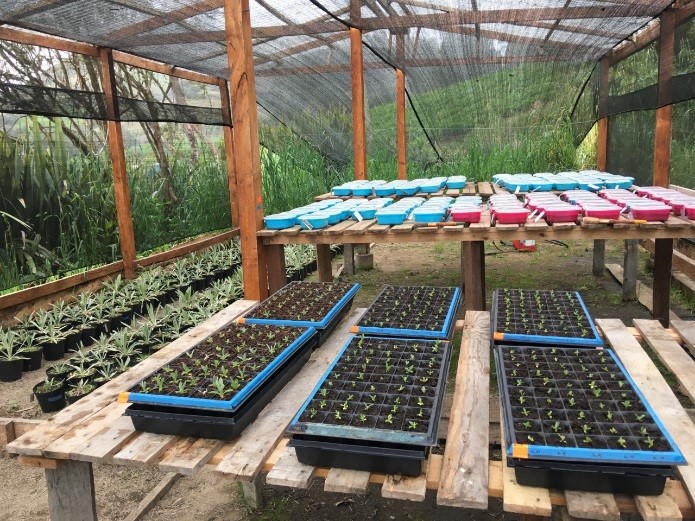
    The picture on the left shows part of the living collection at El Carmen, including seedling trays (forefront), germination containers (right and back), and 3-year old plants in pots on the ground (back left). On the right Rudy Ortiz (left) and Natalia Beltrán, both biology students at the Universidad Nacional de Colombia, measure Espeletia seedlings at El Carmen. Photos by Erika Benavides.

    A central theme of the project is the participation of local campesinos as co-investigators and managers, alongside researchers and officials from academic and environmental institutions. Achieving true participatory research and exchange of knowledge across these actors is far from trivial. Nonetheless, a concrete result of the project is that co-investigators, including campesinos, developed a sophisticated understanding of the phenotypic groups of Espeletia and their geographic distributions across Sumapaz, facilitating conservation monitoring programs. This increase in plant awareness among people coexisting with Espeletia plants is a key step towards addressing the causes of threats to páramo plant diversity. Campesino management of the ex situ collection at El Carmen (and the associated information) provides modest but direct economic benefits to a local family. We hope it also builds local capacity for the governance of biodiversity and collaborative relationships between campesinos and institutions focused on studying and managing biodiversity.

    Jorge Penagos (left) and Erika Benavides, both campesinos from Sumapaz, record survival of Espeletia seedlings in the living collection at El Carmen. Photo by Rudy Ortiz.

    The pilot biodiversity farm at El Carmen hints at how ex situ collections of whole growing plants may help prevent extinction of wild populations. This kind of collection is often thought to be inefficient because requirements of space and resources may be higher than for seed banks and cryopreservation. Collections of whole growing plants for ex situ conservation can indeed be costly when bunkered inside botanical gardens. But they can be more efficient when spread across lands owned by human communities coexisting with threatened plants. We suspect that páramo biodiversity farms may not be more costly than comparable seed banks in the Global North. And the benefits from páramo biodiversity farms would include ex situ collections that act not only as safeguards (the ark paradigm) but also as tools to prevent extinction in the wild and promote local (rather than colonial) biodiversity governance. Studies comparing costs and benefits, beyond back-of-the-envelope calculations, are needed to determine which approaches to ex situ conservation are more effective and efficient in different regions of the world.

  • Virtual field trip to the Guajira desert and the Serranía de Macuira in northern Colombia

    Virtual field trip to the Guajira desert and the Serranía de Macuira in northern Colombia

    James and Thibaud Aronson describe the natural and cultural context of a little-known area of northern Colombia, home to the Wayuu people and a microcosm of arid lands worldwide.

    Colombia is one of the world’s seventeen megadiverse countries.  In a few hours of travel, one can go from the sweltering Amazonian lowlands to the snow-capped peaks of the Andes. It even has a true desert, a small peninsula called la Guajira, shared with Venezuela, which constitutes the northernmost point of South America.

    For most of the last 50 years, the Guajira was notoriously dangerous, principally because of drug trafficking, but things have improved in recent years. We traveled there last month, shortly after the first big rains the region had received in several years. ​ And we found that it’s a poignant example of the plight of drylands globally and their peoples.

    Guajira02_26_2019_map
    The Guajira peninsula, in northern Colombia, including the authors’ itinerary.

    Our trip actually began in Panama, which was part of Colombia until 1903. While much smaller, Panama is also a country of contrasts. Much of the Pacific coast used to be covered in seasonally dry tropical forest, and some fragments persist today in and around Panama City itself, while the forests of the Caribbean slope, a mere 50 km away, are much wetter. A curious switch occurs near the Colombian border, where the wet forests then extend down the Pacific coast of Colombia and Ecuador – the famous Chocó-Darien rainforest, one of the wettest and most diverse tropical forests on Earth.

    Meanwhile, the seasonally dry forests continue along the 1,000 km long Caribbean coast of Colombia and give way to semi-desert and then true desert (annual rainfall < 250 mm), lined by a coast with mangrove forests, and a series of lagoons and bays where flamingos and ibises add a shock of color.

    IMGP2432
    Mangroves in Bahia Hundita, Alta Guajira, showing desert woodland with tree cacti (Stenocereus griseus) and various legume trees growing on the sandstone bluffs in the background.

    6Z1A5797
    Roseate spoonbills, great egrets, and a white ibis sharing a coastal wetland near Uribia.

    As if this wasn’t enough contrast, halfway along the Caribbean coast rises the Sierra Nevada de Santa Marta, Colombia’s tallest mountain range, reaching 5,700 meters (18,700 feet) above sea level at the highest peak. It takes only about two hours to drive from its foothills, where toucans and monkeys chatter in the majestic trees, to Riohacha, the gateway to the desert.

    6Z1A3879
    A brown-throated three-toed sloth (Bradypus variegatus) hanging by one arm in a Cecropia tree in Tayrona National Park, at the base of the Santa Marta mountains.

    Alta Guajira’s desert trees and woodlands

    The Alta Guajira is arid indeed, but it hosts trees, remarkable both in their exuberant diversity and their abundance, considering the high temperatures and meager rainfall. We saw what we consider true desert canopies, such as we have described in other posts. However, no desert flora exists in isolation, and indeed the kinship to the ecosystem type known as Seasonal Dry Tropical Forest (SDTF; see map above) seems to be strong.

    The dominant trees of the Guajira are species of Prosopis, Caesalpinia, Vachellia (formerly part of Acacia s.l.), Parkinsonia and other legume genera, accompanied by Bursera, Capparis relatives, Bignoniaceae, and other species common in the dry forests of Central and South America, and 3 kinds of tree cacti (Stenocereus, Pilocereus, and Pereskia), growing close together, often covered in climbing vines. In particular, it was interesting to see bona fide desert woodlands dominated by two well-known legume trees, Prosopis juliflora and Vachellia farnesiana, which are widespread and often strongly invasive in other parts of the world, but not here! Fascinating biogeographical and ecological questions abound in this poorly explored region, many of which are relevant to conservation and restoration.

    Regarding  landscape ecology in the region, the vegetation is curiously like a patchwork, alternating between dense desert woodlands, nearly pure tree cacti stands, sometimes with a dense grass cover, and sometimes not, and frequent saline flats where nothing grows. In our opinion, the human element, namely land and resource use history, is paramount to understanding what one sees when travelling here and trying to ‘read’ the landscapes.

    IMGP1364
    Mixed patch of tree cacti and spiny legume trees with a surprising amount of grass understory. Elsewhere under similar stands, for no clear reason, there is no grass cover at all.

    IMGP2305
    A track of the Alta Guajira, near Nazareth, at the base of the Macuira hills where the notorious Prosopis juliflora, known in Colombia as Trupillo, is so exuberant and long-lived it forms a natural tunnel above this track.

    IMGP1037
    Prosopis juliflora colonizes newly exposed beach dunes, in areas where the shoreline is receding. Here, at Camarones, it occurs alongside Calotropis procera, a woody weed of the Apocynaceae known in English as giant milkweed, and familiar throughout the Caribbean islands, the Middle East and drylands of Africa. It survives because of its toxic milky latex where most other plants get eaten out by livestock.

    Other standouts are the beautiful Palo de Brasil, Haematoxylum brasiletto, with its unusual fluted trunks and Pereskia guamacho, an enigmatic ‘primitive’ tree cactus with true leaves and one of the most exquisite tasting fruits we know. This is one of the least well-known but most intriguing of all desert trees to our minds.

    IMGP1656
    Typical landscape of the northern Guajira desert woodlands, with an even-aged stand of one of the several neotropical legume trees known as Brazilwood: Haematoxylum brasiletto, or Palo de Brasil in Spanish.

    Despite those common names, this species is in fact only found wild along Caribbean coastlines from Colombia and Venezeula, all the way north to both coasts of Mexico. The scientific name is thus a misnomer. The most famous Brazilwood tree is another legume, Paubrasilia echinata (= Caesalpinia echinata) that once grew abundantly along the Atlantic coast of Brazil, as a large tree with a massive trunk, reaching up to 15 meters tall. Today, it’s almost entirely gone in the wild, and mostly planted in gardens and along roadsides. It was prized for the bright red dye obtained from the resin that oozes from cut branches or trunks. The dye was widely used by textile weavers in the Americas and Europe in the 17th-19th centuries. The tree also provided the wood of choice for high quality bows for stringed instruments and was widely used for furniture making as well. So important was its economic value that the country was named after it, originally Terra do Brasil (Land of the Brazilwood), later shortened to Brazil. Recently it was designated as sole member of a new genus, as part of a comprehensive revision of the entire genus Caesalpinia, carried out by an international team of experts.

    It’s curious that H. brasiletto bears the same common name as P. echinata, since the two trees are nothing alike, apart from their red sap and heartwood. Little literature exists for H. brasiletto, and we are embarking on some detective work to shed some light on this puzzle. We go into detail as these are both relatively fast-growing trees with great economic as well as ecological value. They would both be excellent candidates for inclusion in ecological restoration work and are both in dire need of conservation efforts.

    Wayuu: Alta Guajira’s Indigenous People

    This desert also hosts a fairly large human population. The Guajira is the home of the Wayuu, Colombia’s largest surviving Indigenous group and, along with the Navajo, one of the last desert-dwelling peoples in the New World. These fiercely independent people, organized in 17 matrilineal clans, were never subjugated by the Spanish, and even today the Guajira region functions mostly in isolation from the rest of the country. As we were heading well off the beaten track, we needed a guide, a 4 x 4 jeep in good condition, and a skilled driver to navigate the meandering and unmarked desert paths.

    Despite an ancient history of human presence, and some periods of intensive exploitation and intervention (such as a pearl harvesting boom that took place soon after European explorers arrived), the ecological condition of the region at the landscape scale is remarkably good. Indeed, apart from the salt works in the small town of Manaure, which produce two thirds of Colombia’s salt, and El Cerrejón, South America’s largest open-pit coal mine, in the south of the Guajira, there is no major industry.

    IMGP2473
    Typical traditional salt works at Manaure worked by hand by local men and women just as they have for generations.

    And the isolated people who dwell here – fishermen, shepherds, and weavers – are right out of a Gabriel García Márquez story. Indeed the author, most famous for One Hundred Years of Solitude, grew up on Colombia’s northern coast, speaking both Spanish and the Wayuu language, Wayuunaiki. As we traveled deeper into the desert, we traversed small settlements with simple houses made of wood and yards surrounded by tree cacti hedges.

    IMGP0996
    The Wayuu village of Boca de Camarones, in the south of the Guajira peninsula, showing the living hedgerows of columnar cacti produced from tall stanchions. In the background, surrounding the homes, are Trupillos, and good specimens of Dividivi Libidibia coriaria (formerly called Caesalpinia coriaria).

    This third caesalpinoid legume tree, closely related to the two Brazilwoods mentioned above, is the source of another lovely red dye, derived in this case from its pods. Until recently, there was an annual festival in Camarones, in honor of this formerly major economic plant product. The tree was also used as an important source of tannins. Like Paubrasilia echinata, it deserves more ethnobotanical and biogeographical studies.

    Here, as in many other arid lands, goats and sheep are important for the Wayuu people, as a source of food and social currency. For example bride price during arranged weddings, and gifts for guests attending vigils of important elders and healers, are paid to this day in heads of live goats or sheep. Historically, mules and donkeys were very common as well, but now they are increasingly replaced by motorcycles.

    IMGP0993
    Small children following a flock of desert-hardy sheep in Boca de Camarones. The peaks of the Sierra Nevada de Santa Marta are visible in the background.

    Crown jewel of the Alta Guajira

    The crown jewel of this desert, its best kept secret, is the Serranía de la Macuira, a small mountain range (serranía meaning “small sierra” in Spanish) in the northeast of the peninsula. This miniature sky island is almost impossibly lush, thanks to moisture-bearing clouds that shroud its upper reaches. They feed streams that flow year-round, and sustain many kinds of trees that grow to well over 10 meters tall.

    As one climbs the slopes of the Macuira, the humidity dramatically increases and the parched lowlands, with their desert woodlands, blend perceptibly into a seasonally dry tropical forest reminiscent of those we had seen in Panama. A little-known fact: seasonally dry tropical forests are the most endangered of all tropical forest types, and those in La Guajira are worthy of much greater research, conservation, and restoration.

    Climbing higher still, the mid- and upper ranges of the Macuira seem like another world. Most astonishing of all, there is apparently an abrupt transition above 550 meters, and the higher reaches are covered in true cloud forest, with mosses, epiphytic orchids, tree ferns, and dozens of tree species that otherwise occur hundreds of kilometers away! This is probably the only place in the world where cloud forest is found less than 5 km from true desert. Fortunately – from a conservation point of view, but unfortunately for us – the upper peaks of all three peaks of the Macuira are sacred to the Wayuu, and completely off-limits, to native people and visitors alike. Try as we might, we were unable to get permission to hike up there.

    IMGP1967

    IMGP2002
    Seasonally dry tropical forest on the northeastern facing slope of the Macuira, where precipitation is much higher than in the surrounding lowlands occupied by desert woodlands.

    Even though the whole Macuira is officially protected as a national park, the reality is more complicated. While walking inside the park, we encountered recently cut trees, the ubiquitous goats, and even a Wayuu man hunting birds with a slingshot in broad daylight. The beautiful continuous tree canopy covering most of the slopes stands in stark contrast to the severely eroded, nearly bare hilltops, on which stand small Wayuu homesteads. Still, the presence of clear ecotones speaks to mostly healthy landscapes.

    IMGP1898
    The severe erosion around a small Wayuu farm inside the Macuira National Park.

    Alta Guajira’s ecological future

    The pressures on the Guajira’s ecosystem health include a large mine (El Cerrejón, mentioned above), overgrazing by domestic livestock, and stark poverty facing the native people and more recent immigrants. But there are positive factors as well. There are progressive laws in Colombia related to ecological restoration. Moreover, since 2012, Colombia has a National Restoration and Rehabilitation Plan (pdf), as well as a Law of Remediation, which imposes large environmental offset payments from large-scale development projects (like hydroelectric dams) to underwrite conservation and restoration work. Moreover, the national park system, within its network of 56 protected areas, harbors populations of almost half of the 102 Indigenous peoples in the country, and in the case of Macuira, this is clearly not just a paper park idea.

    Still, the national park (25,000 ha in size; officially designated in 1977), operates with a skeleton staff attempting to carry out an ambitious management plan (pdf) despite an insufficient budget. Staff and volunteers provide short tours to day-visitors, and maintain some fenced-off livestock exclosure plots, where they are studying natural regeneration. Daily interaction with the Wayuu living in the park appear to be harmonious, and indeed there is a clear sense that part of the Park’s mission is to restore and protect the Wayuu people’s natural and cultural heritage. Recently, the Instituto Humboldt, Colombia’s stellar national research institute, has established permanent plots in the Macuira range as part of a series of 17 plots including all the tropical dry forest types in Colombia. In the Macuira, this work is done in collaboration with botanists from the Universidad de Antioquia, in Medellin. Furthermore, researchers at Kew, the Smithsonian Institute, and many conservation NGOs are all developing collaborations with the Colombian government to explore and help the country move forward with green development.  The Missouri Botanical Garden also has long-standing MoUs for joint research with 3 different institutions in Colombia, with bright prospects for deepening cooperation in the future.

    Like many Indigenous peoples around the world, the Wayuu are at a crossroads. Their language and some of their traditions are still alive and well, but others have already faded. There are few legal sources of income in the harsh desert, the ancestral Wayuu land. How will they manage in the future? What can they do to adapt?  Some, like our guide, José Luis, are trying to change mentalities, but they clearly need more help.  As throughout Colombia, there is clear and urgent need to build on the alpha-level studies already underway, and move onto applied ecology, agroforestry and land management programs, including community-based restoration programs and ecotourism in conjunction with the national parks.

    IMGP2197
    Our Wayuu guide José Luis Pushaina Epiayu (on the right) and Macuira park ranger Ricardo Brito Baez-Uriana (on the left), talking about birds with a local Wayuu family.