Tag: Ecological Health Network

  • Ecological restoration of sandy grassland ecosystems in Kiskunság, central Hungary and combating the allergenic Common ragweed (Ambrosia artemisiifolia)

    Ecological restoration of sandy grassland ecosystems in Kiskunság, central Hungary and combating the allergenic Common ragweed (Ambrosia artemisiifolia)

    By: Katalin Török and Melinda Halassy

    Katalin Török and Melinda Halassy are restoration ecologists specializing in sandy grasslands in Central Hungary. Katalin focuses on botany, ecology, and biodiversity monitoring. Melinda, formerly Katalin’s student, took part in their first restoration experiment and is likely Hungary’s first PhD in restoration ecology. Their research aims to identify barriers to spontaneous restoration and analyze long-term ecological processes triggered by various restoration methods to find the most effective approaches. Both contribute to international ecological research (eLTER) and restoration policy (SERE), working to link scientific knowledge with public policy in ecological restoration.

    HUN-REN Centre for Ecological ResearchInstitute of Ecology and BotanyRestoration Ecology Research Group, halassy.melinda@ecolres.hu

    KIskun LTER Restoration Experiments site is located in a unique sandy landscape of central Europe. Situated at the center of a vast sandy region, the core area of Kiskunság National Park represents one of the largest of its kind in Central Europe, spanning approximately 7,400 square kilometers. This unique environment is especially accessible near the village of Fülöpháza, where visitors can experience an impressive range of sand dunes. The landscape features both open sand steppes and  wind-blown dunes, offering a rare glimpse into one of the continent’s most distinctive and unusual natural habitats. Credit: Melinda Halassy, CER2021

    The ecosystem

    One of Hungary’s most distinctive geological regions is the Danube–Tisza Interfluve (Kiskunság), which is an important reservoir of biological diversity within the Pannonian Biogeographical Region of Europe. Situated at the westernmost edge of the vast Eurasian forest-steppe biome, this region is part of a bioregion that extends approximately 9,000 km from Central Europe to Eastern Asia, covering more than 4.7 million km² (Erdős et al. 2022). The Eurasian forest-steppe represents Hungary’s dominant vegetation type, covering more than half of the country. Although the grasslands in this zone are sometimes misinterpreted as being heavily deforested in historic times, ecological models that integrate climate variability, topography, soil conditions, herbivory, and natural fire regimes reveal that forests and grasslands naturally coexist in a dynamic mosaic within the forest-steppe zone (Erdős et al. 2022). 

    The largest and most ecologically diverse areas of the region preserve the characteristic ”puszta“, which includes both sandy and alkaline grasslands, sand dune forests, and remnants of former sodic pans, marshes, fens, fen meadows, and wet grasslands. The inland sand dunes, shaped by wind action, consist of coarse-textured, lime-rich soils that are low in water and nutrients, supporting unique vegetation, including specialist plant and insect species. The sandy forest-steppe of the “puszta” consists of poplar-juniper sand dune forests and thickets, as well as open oak-dominated woodlands forming complex mosaics with both open and closed sand grasslands, all of which are considered habitats of high conservation concern by the European Commission. The driest grasslands in the region, known as ”Festucetum vaginatae danubiale“ community, are found on the crests and southern slopes of sand dunes. These grasslands are characterized by tussock-forming grasses such as the endemic grass Festuca vaginata and the protected Stipa borysthenica, interspersed with cryptogam cover of mosses, ferns, lichens, etc. and frequent patches of bare ground.

    Sandy Forest-Steppe Mosaic of the Puszta: Poplar-Juniper Stands and Open Sand Grasslands. Dominated by White Poplar (Populus alba), this landscape reflects the natural vegetation adapted to arid, sandy conditions.  Credit: Evgeni Dimitrov, eLTER 2023

    Throughout the 19th and 20th centuries, the landscape underwent significant human modifications, beginning with river regulation and drainage, followed by agricultural intensification and plantation forestry. As a result, the region is now predominantly covered by agricultural lands, forest plantations, and fragmented remnants of semi-natural grasslands.  During the post-socialist transition (1987–1999), large-scale agricultural land abandonment occurred, particularly in low-productivity areas such as the Kiskunság (Valkó et al. 2016). While some native vegetation regenerated spontaneously, abandoned lands also became increasingly susceptible to invasion by non-native species. One of the most problematic invaders is Black locust (Robinia pseudoacacia), a fast-growing, nitrogen-fixing hardwood tree from eastern North America, which has spread extensively. Another notorious example is Common ragweed (Ambrosia artemisiifolia) that we will discuss below.  The expansion of invasive species not only threatens native biodiversity and ecosystem health but can also have negative impacts on human health.

    Land abandonment presents a valuable opportunity for the spontaneous regeneration of native sandy grasslands, it also introduces significant ecological challenges. One of the most pressing threats to natural recovery is the aggressive spread of invasive alien plant species, particularly Common milkweed (Asclepias serica, formerly A. syriaca). Credit: Melinda Halassy, CER 2021

    Restoration experiments

    For the past 27 years, we have been conducting restoration experiments at the Kiskunság Long-term Ecological Research site to facilitate the recovery of sandy grasslands on lands degraded by Black locust plantations and arable cultivation. Our research focuses on the long-term effects of various treatments aimed at overcoming barriers to spontaneous grassland regeneration, assessing the positive and negative influences of the surrounding landscape, and enhancing invasion resistance through seed-based restoration.  

    Our findings indicate that active restoration interventions can significantly accelerate recovery. Specifically, sowing a mixture of locally sourced grass and forb species has proven to be the most effective method for initiating restoration in dry grasslands and controlling invasive species (Reis et al. 2023). Additionally, carbon amendments and mowing can serve as valuable complementary measures; however, they should be applied cautiously in invaded landscapes to avoid unintended ecological consequences (Reis et al. 2022).

    Seeding Native Species: A Key Strategy for Restoring Sandy Grasslands. In the restoration of dry sandy grasslands, sowing a carefully selected mixture of locally sourced grasses and forbs has emerged as the most effective strategy for initiating vegetation recovery and suppressing invasive species. Although remnants of native sand grasslands remain in the landscape, their specialist species show limited natural dispersal capacity. As a result, abandoned agricultural fields are often colonized by weeds and invasive alien plants, which significantly hinder the process of secondary succession. Research has shown that even the low-rate seeding of as few as five native species can have a catalytic effect, facilitating the establishment of characteristic grassland communities and accelerating the recovery of degraded former croplands. Credit: Melinda Halassy, CER2021

    The success of restoration efforts is further challenged by the presence of other aggressively invasive species beyond Black locust, including the tree of heaven (Ailanthus altissimus) and the herbaceous Common milkweed (Asclepias serica (formerly A. syriaca), which are particularly widespread in forest plantations (Csecserits et al. 2016). Even after the removal of dominant invasive species, new invasions may occur, likely due to legacy effects and the high dispersal capacity of these non-native species (Reis et al. 2023). To mitigate these negative impacts, restoration efforts should prioritize areas with lower invasion pressure or integrate early seeding of native species as a complementary strategy for invasion control (Csákvári et al. 2023Halassy et al. 2023).

    Managing Invasive Species: The Limitations of Mowing in Invasive Species Control. Mowing is widely used as a method to control the spread of invasive alien species. However, experience indicates that mowing alone often fails to deliver satisfactory results. This is largely due to the persistent legacy effects of previous invasions and the limited natural dispersal capacity of native grassland specialist species. While mowing can effectively suppress certain targeted invasives, it does not prevent secondary invasions—the establishment of other non-native species that quickly occupy the disturbed space. To ensure successful and lasting restoration, mowing must be combined with the active introduction of native species, which can stabilize the ecosystem and reduce vulnerability to further invasions. Credit: Márton Kállai 2023

    Restoration – human health links; research in progress  

    Enhancing public health through ecological restoration efforts can be of significant importance. Ecosystem services and direct contact with nature may contribute to this improvement (Millennium Ecosystem Assessment 2005Marselle et al. 2021), but robust evidence is needed to establish clear links between biodiversity, ecological restoration, and human health at landscape, regional, and national scales.  

    In Hungary, a national project has recently been launched to investigate these nature–health connections using ecosystem condition maps and health data (https://termeszetem.hu/en). This initiative aims to identify correlations between environmental factors and various health indicators, such as the prevalence of allergies, depression, autoimmune and inflammatory diseases, and self-reported well-being. The research focuses on detecting these relationships at the sub-regional scale and in urban areas, as well as assessing the economic impacts of health conditions. A key initial focus of the project is the highly allergenic Common ragweed (Ambrosia artemisiifolia), which poses significant public health challenges throughout Europe and elsewhere.

    Restoration as a Tool to Combat Common Ragweed and Its Public Health Impact. Abandoned croplands provide favorable conditions for the establishment and spread of Common ragweed (Ambrosia artemisiifolia), a highly invasive species known for its allergenic pollen. This plant poses a growing public health threat across Europe and beyond. In 2015 alone, ragweed allergy adversely affected the health of an estimated 13.5 million people in Europe, resulting in public health costs exceeding €7.4 billion (US$8.1 billion). Common ragweed thrives in open, disturbed soils, making abandoned agricultural lands particularly vulnerable to colonization. However, as natural vegetation succession progresses and plant cover becomes denser, ragweed populations tend to decline. This succession process can be significantly accelerated through active ecological restoration, which helps close vegetation gaps more quickly, thereby limiting the window during which ragweed can release its pollen and spread. Credit: Anikó Csecserits, CER 2020

    Battling Common ragweed – for ecosystem and human health

    Successes so far with reducing invasion of Common ragweed (Ambrosia artemisiifolia) are noteworthy.   For starters, note that the disservices of Common ragweed are already serious and likely to get worse throughout Europe since its allergenic pollen affects one in ten people throughout the European continentSchaffner et al. (2022) estimate that the health of 13.5 million people was adversely affected in 2015 by Common ragweed allergy in Europe alone, generating 7.4 billion euros (8.1 billion US$) in public health costs. Happily, our ecological restoration interventions have already demonstrated their effectiveness in battling this noxious annual weed (Fig. 1).

    Figure 1. The decrease of cover of the highly invasive, and allergenic, common ragweed (Ambrosia artemisiifolia), under three different restorative treatments and control. The figure shows the pooled data of three experiments that included mowing (Reis et al. 2021), carbon amendment (Halassy et al. 2021) and seeding (Reis et al. 2023) between 1995 and 2019. Carbon amendment through addition of sucrose and sawdust reduced available N-levels in the soil. Mowing was carried out twice a year, and was followed by removal of dry plant biomass.

    The successful reduction of Common ragweed invasion serves as a promising example of how ecological restoration can yield measurable benefits for human health. The new national-scale study aims to provide evidence-based insights into the potential interconnections between ecosystem health and human well-being. These findings could help inform policy decisions related to land management and restoration efforts not only in Hungary but also in other regions.  

    A potential next step is to investigate links between ecosystem conditions and asthmatic diseases. By analyzing data on general practitioner and specialist visits for asthma-related complaints, as well as the purchase of asthma-specific medications, we can correlate health trends with different ecosystem states across temporal and spatial scales (Nitschke et al. 2022). This approach will allow us to assess the broader health impacts of ecological restoration.  

    Moving forward, we plan to deepen our research on the relationship between ecological restoration and human health by collaborating with the Ecological Health Network and its member sites and hubs working on similar challenges. We believe that participation in an international social impact network will not only advance our research but also enhance its value and real-world impact.
  • “We planted a forest!” – The mental health benefits of ecological restoration: a pilot study

    “We planted a forest!” – The mental health benefits of ecological restoration: a pilot study

    By Suzanne Hicks, Ecological Health Network, Gondwana Link. Suzanne Hicks is a clinical psychologist from Margaret River, Western Australia, with an interest in how nature influences our mental health. Here, she describes the evolution of an innovative pilot project involving disengaged young people in ecological restoration work with the intention of improving their mental health. The novel experimental design allowed her and her colleagues to test the hypothesis that there is a causal link between the observed improvements in social anxiety of the participants and the ecological restoration work undertaken by them.

    An intriguing discussion in 2020 with James Aronson, of the global organisation Ecological Health Network (EHN), about the links between ecological restoration, soil health, and human health, whetted my curiosity to attend the second workshop in Hobart, Tasmania in February the following year. Although a clinical psychologist, rather than a scientist or ecologist, I have long been aware of the ways that being out and about in nature has a positive impact on mental wellbeing, both mine and that of my patients. But I wanted to learn more about the mechanisms by which this might occur, and also to be part of the growing movement involved in the regeneration of degraded landscapes and restoration of habitat.

    In the days prior to the conference, we visited a site in the North East Bioregion of Tasmania where a group of unemployed people, brought together by Todd Dudley, president of the North East Bioregional Network, had undertaken ecological restoration at the site of a former pine plantation. Over 700 hectares of harvested, burned plantation land had been restored to the trajectory of a thriving native forest recovering from several cycles of clearing and pine plantations.

    Landscape immediately following clearing of pine plantation in the North East Bioregion of Tasmania, Australia (left), and the same landscape four years after initiation of restoration of the endemic forest ecosystem.

    The scale and success of the Tasmanian ecological restoration project was impressive, but equally intriguing from my point of view was the reported improvement in the physical and mental health of the participants. Accounts of changes from apathetic, disengaged and unhealthy unemployed people to enthusiastic and fit workers, some of whom went on to do further study in forest management and ecological restoration and regeneration, piqued my interest. However, what also stuck in my mind was a comment made by James Aronson. While applauding the success of the project, he also remarked that “It may as well not have happened”. Puzzled, I asked him why. His answer – because there was no empirical research data to support its outcomes. The intuitively obvious link between being involved ecological restoration and improvements in human health was purely anecdotal. I held that thought…

    I felt somewhat out of my comfort zone at the start of the Hobart workshop, sitting among a high-powered group of public health researchers and environmental scientists from Australasia and the United States. While passionate about nature and very committed, through my work, to helping people improve their mental well-being, I certainly didn’t have deep scientific understanding of the nexus between the two. However, I was welcomed by the group and soon found myself intrigued and stimulated by what I was learning about ecological regeneration efforts being undertaken around Australia and Aotearoa New Zealand, and the ways that human health is impacted by natural environments and healthy biomes. The take-home message was clear: being in nature is good for people. In particular, the restoration of riverbanks may have the biggest bang for buck, improving water quality and the downstream health of the people who use the water. Yet, again and again, the need for empirical evidence was emphasized.

    There is an abundance of data attesting to improvements in human health from being in nature, and also for the positive impacts on the environment of improving biodiversity. However, when it comes to support for the hypothesis that being actively involved in ecological regeneration, in and of itself, improves human health and wellbeing, EHN’s Adam Cross informed me there appears to be only a handful of published papers worldwide. Of these, almost all are correlational, and rely on subjective measures of well-being. There is, therefore, an urgent need for empirical data to guide ecological restoration endeavors, and further, in these times of escalating health budgets, to attract funding for ecological restoration as an important public health intervention.

    On the plane back to my home in rural Margaret River, Western Australia, I mulled over what I had learned and wondered how I might bring it to bear in my community. My academic training as a clinical psychologist prompted me to speculate on the ways one might empirically research the hypothesized link between healing activities for impaired ecosystems and psychological health.

    The Margaret River Program

    I am a member of a recently-formed group of volunteers, who call ourselves Mindful Margaret River (MMR). We are working to improve the mental health and well-being of people in our town, which has had its fair share of recent natural disasters and tragedies: serious bushfires in 2011 and 2021 that burned numerous homes as well as large areas of national parks, and a multi-generational murder/suicide that took seven members of a single family. In addition, I belong to our local Nature Conservation group (NCMR). I wondered if, under the umbrella of MMR, I might develop a program, drawing on the resources of NCMR, whereby disengaged students from our local high school were invited to be part of a 20-week ecological restoration program aiming to improve both nature and the participants’ mental health. The novel part of the program would be to allocate students to one of two groups, the first involved in ecological restoration and the other to be in actively working in nature but not specifically participating in restoration activities. Researchers from the Psychology Department of University of Western Australia (UWA) would be invited to empirically evaluate the outcomes of the program.

    In collaboration with my colleague Sandra Robertson, a community nurse at the local high school, a twenty-week program was developed taking students from school one day per week under the supervision of two teachers. The program would be assisted by NCMR staff in the practical aspects of restoration work. Volunteers from the Cape to Cape Walking Track  would guide the second group in maintenance of this long-distance coastal hiking track. The program would be under the formal custodianship of the local Indigenous Peoples, the Wandandi Peoples, who welcomed the students onto their Country (an Australian term referring to the ancestral Traditional lands of an Indigenous group) and accompanied them for a number of days throughout the program to teach them about Indigenous lore and culture, and about caring for Country. Additionally, a number of people working in environmental science and management such as rangers, scientists, and artists, were approached to talk to the students about nature-based career options, and on other occasions the students heard from experts in various components and aspects of local biodiversity.

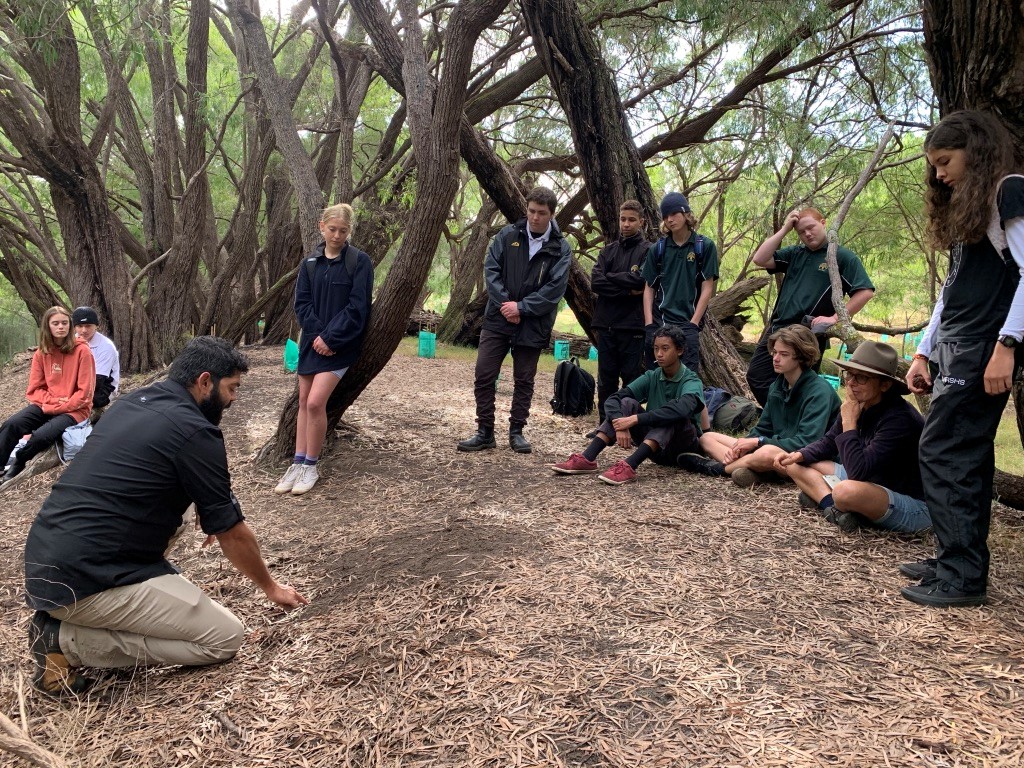
    Wandandi cultural custodian Zac Webb drawing a map of Country for the participants of the high school program.
    Students of the program learning simple survey skills prior to beginning restoration work.

    Over the course of 2020 we secured seed funding for the project from EHN Hub Gondwana Link, and subsequently full project funding from the Western Australian state-based grants body, Lotterywest, to operate the program for a further two years. Following this success, our pilot program was launched in 2021. Twenty-four year 10 and 11 students were selected, semi-randomly, for the two groups. There were 17 boys and seven girls, and four of the students were Indigenous. Their average age was sixteen. Sadly, due to behavioral issues, after 12 weeks the group involved in track maintenance was disbanded.

    Students were excited to record different species of fungi during biological surveys.

    The regeneration group completed the 20-week program and three questionnaire measures of their psychological wellbeing, taken at three points in the program, were obtained and analyzed by the UWA researchers. Taken together with focus group information, the researchers determined that there had been a statistically significant reduction in the students’ social anxiety over the course of the program, and that they had developed a greater sense of connection with nature and more appreciation of the actions they could take as individuals to help preserve their local environment.

    The Boodja (“Country”) Regeneration crew, on Country during their 20-week program.
    The Biddi (“Coastal path”) crew, on Country during the program.

    After the challenges of the pilot stage, more work is now being undertaken to modify the research model of the program to fit more smoothly within the framework and timetabling of the school curriculum. However, even at this early stage we are pleased to be able to begin demonstrating empirically the benefits for mental health of being involved in ecological restoration activities. We hope that the next stage of the program will build our evidence base further, developing strong empirical support for the health benefits of engaging with nature and participating in ecological restoration—towards a vision where such activities might even become a central aspect of learning and education. In the meantime, it was a delight to have the enthusiastic endorsement of our young participants, captured in the comment from one of them – “We planted a forest!”