By: Tate Bushell
Tate Bushell is the Director of Natural Lands with the Mount Desert Land & Garden Preserve on Mount Desert Island, Maine, where he cares for ~1,400 acres of beautiful spruce-fir forest. tbushell@gardenpreserve.org
The Mount Desert Land & Garden Preserve’s mission is to conserve and share the beauty of our historic lands and gardens, which it does by managing three historic gardens and approximately 1,400 acres (567 ha) of natural land on Mount Desert Island, Maine for ecosystem health. Also, as needed, we undertake restoration interventions, particularly in our post-agricultural meadows.
Mount Desert Island (‘MDI’, ~60,000 acres, 24,280 ha) is well known for its breathtaking, rugged coastal scenery and for holding the largest unit of Acadia National Park (~30,500 acres, 12,343 ha), one of America’s earliest (1916) and most visited (~4 million visitors/year) national parks. The two other units of Acadia National Park include part of Schoodic Peninsula (2,366 acres, 957 ha) and part of Isle au Haut (2,900 acres, 1,200 ha). The Garden Preserve’s natural lands are directly adjacent to Acadia National Park and mirror it ecologically; both are covered by spruce-dominated hills (primarily red spruce, Picea rubens), streams and wetlands.

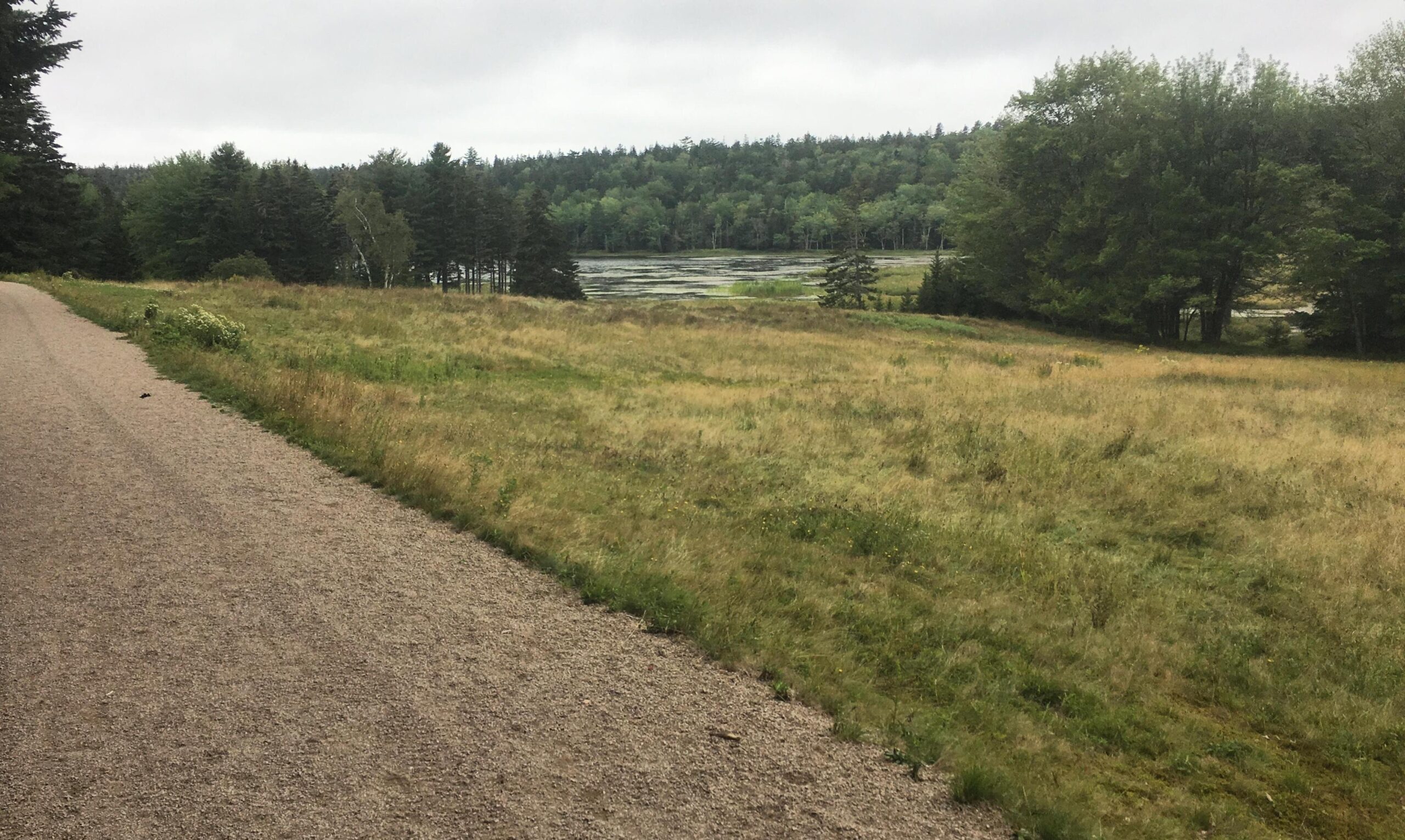
As the Land & Garden Preserve’s Director of Natural Lands, I am charged with conserving the ecological integrity of the natural lands while ensuring safe public access. Our ten miles of trails and ten miles of carriage roads see over 75,000 visitors per year. A twenty-acre, post-agricultural meadow sits at the heart of the natural lands, and from the nearby carriage road the meadow provides picturesque views of the surroundings, making this a popular destination for walkers, dog walkers, horseback riders, and bird watchers.

I have focused management on Garden Preserve’s meadow because early successional habitats are uncommon on Mount Desert Island (Acadia National Park manages less than 100 acres of upland meadows on MDI) and because of the presence of invasive glossy buckthorn (Frangula alnus), invasive reed canary grass (Phalaris arundinacea), and some other weedy, nonnative plants. To establish a firm understanding of the plant community I commissioned a wonderful field botanist to conduct a survey of the meadow’s vascular plants (completed in 2020). From 2019-2021 we eradicated the canary grass from three monoculture patches (totaling 2,500 ft², 232 m²) and began restoring the area left behind. We have used a 130-year-old dataset – Flora of Mount Desert Island, Maine, published in 1894 – to better understand changes in the meadow’s plant community, and help us select a plant species list for our ecological restoration work. I also visited approximately 15 different meadows – ranging from 2-60 miles (3.2 km – 97 km) away – to develop a loose reference system. The goal of this restoration work was to 1) ensure long term eradication of reed canary grass and, 2) establish an enduring native plant assemblage that could provide habitat and other ecosystem benefits to the meadow’s fauna. I began with a conservative approach to ‘native’ and selected species according to this hierarchy:
MDI>Hancock County>Maine>New England. Most species we use in this restoration naturally occur in Maine.

The 1894 Flora of Mount Desert Island, Maine by Rand and Redfield
The Champlain Society was a group of scientifically minded Harvard students who, starting in the early 1880’s, dedicated their summers to learning and documenting MDI’s natural history. Student Edward L. Rand headed up the society’s botanical studies and, along with John C. Redfield, published the Flora of Mount Desert Island, Maine in 1894. The flora is incredibly comprehensive, including nearly 1,500 species of vascular plants, marine algae, bryophytes, and lichen. Remarkably, MDI represents less than 1% of the state of Maine’s land area but supports more than half of its known plant species (Greene et al. 2005).

The 1894 Flora has proven to be a reliably accurate reference for late 19th century plant life on MDI. For example, by reviewing the herbarium vouchers, Greene et al. (2005) concluded that less than 45 taxa were misidentified. As a natural resource professional, this 285-page book serves me as a priceless reference. I even found an original copy signed by the authors in the Garden Preserve’s library!
Old datasets of this breadth, accuracy and credibility are rare, and therefore extremely valuable to understanding how plant communities change over time. When you compare the ‘Flora of Mount Desert Island, Maine’ (1894) to the contemporary ‘Vascular flora of Acadia National Park region, Maine’, (2005) as MacKenzie et al. (2019) did, you can see just how much has changed in approximately 120 years. They report that between 1894 and 2005, 15.8% of the original species are no longer found on MDI, 34.4% declined in abundance, 30.4% experienced no apparent change in abundance, 19.4% increased in abundance, and there were 205 new plant species in 2005.
In their 1894 Flora, Rand and Redfield left us wonderful notes about each taxa’s abundance, special occurrences and locations, which I’ve used to reconstruct something of an 1894 Flora for the Garden Preserve’s meadow (albeit incomplete). For example, many entries include location names where large populations of that taxa could be found, and location names such as ‘long pond meadows’ (the old name of our meadow), ‘Seal Harbor’ (the village where the meadow is found), ‘road to Jordan Pond’ (approximately ½ mile from meadow) provide a direct link to the Garden Preserve’s meadow of the 1880’s. To show how prevalent this anecdotal data is, ‘Long Pond meadows’ is included in 30 taxa entries and ‘Seal Harbor’ is included in over 100 taxa entries.
Where Rand and Redfield did not provide location names, I use their notes on habitat (e.g., ‘fields’, ‘meadows’, ‘open areas’) and abundance (e.g., ‘common’, ‘frequent’, ‘rare’), and what I personally know about these species’ habitats to infer which taxa were found in 1894 at or around the Garden Preserve’s meadow. For example, the entry for New York aster (Symphyotrichum novi-belgii) includes ‘Abundant everywhere in both wet and dry ground’ (pg. 115). Therefore, although Rand and Redfield did not tell us that New York American aster was found at the Long Pond meadows, I can assume that it was.
When I compared my 2020 meadow survey (340 taxa) to the list I recreated from Rand and Redfield’s 1894 Flora, I found that at least nine native forbs were likely present in the late 19th century but are no longer found on or around the Garden Preserve’s meadow. I call these ‘historic’ species. There are more than nine historic species, but for the purposes of this article, I only discuss the taxa considered for meadow restoration. The nine historic forbs I have identified are:
Anaphalis margaritacea (pearly everlasting), Clematis virginiana (Virginia virgin’s bower), Eupatorium perfoliatum (boneset), Eutrochium maculatum (spotted Joe-Pye weed), Lobelia spicata (pale-spiked lobelia), Symphyotrichum ciliolatum (Lindley’s American-aster), Symphyotrichum lanceolatum (Lance-leaved American-aster), Symphyotrichum pilosum (awl American-aster), Symphyotrichum undulatum (wavy-leaved American-aster).
Although I conclude that these species are no longer found in our meadow, they have not been extirpated from Maine. For example, I see Anaphalis margaritacea growing on roadsides on MDI, and I infrequently see Eupatorium perfoliatum in Acadia National Park. Likewise, I see large swaths of Symphyotrichum lanceolatum on the mainland, just three miles from MDI. Other Symphyotrichum species were more difficult to find, but they still turned up when I searched similar meadows approximately 30-60 miles from MDI.
Natural resource professionals can be apprehensive by nature because we fear the slow creep of local species extinction. We understandably get nervous when our data reveal that we lost at least nine forbs in a 130-year span. The reasonable question becomes: ‘With viable populations of these historic species nearby, should we include these in our ecological restoration efforts’?
Using ‘historic’ species in meadow restoration efforts
Starting in 2021 we decided to incorporate eight of the nine ‘historic species’ into our meadow restoration efforts (Virginia virgin’s bower requires different habitat characteristics and was used elsewhere), via two different methods: 1) planting pint and quart-size live plants, and 2) seeding (with associated seed bed preparation). These eight historic species were among a larger group of approximately 25 species, all of which are native to Maine and/or New England and found in similar early successional habitats.


The Mount Desert Land & Garden Preserve operates a propagation facility to support the needs of our three gardens, and the propagation staff enthusiastically grows native plants from seed for our restoration projects on the natural lands.

While obtaining the seed for the historic species, I employed a ‘local is better’ mindset regarding provenance. I collected seed from populations on MDI where possible, then as near as possible thereafter. Where I couldn’t collect the seed for a given species myself or obtain wild-collected seed from a trusted colleague in Maine, I purchased seed from the Wild Seed Project (Portland, Maine). Some of the asters were only available through larger, Midwestern nurseries such as Prairie Moon Nursery (Minnesota).

The only consistent impediment to historic plant reintroduction and establishment that we have observed has been deer browse, which impacted six of the eight species.

An all too familiar story – too many deer
White tailed deer foraging has been shown to impact a great variety of North America’s ecosystems including forest ecosystems, tallgrass prairie, boreal forests through selective browsing. It is generally accepted that at high enough densities selective deer browse can drive floristic changes in plant communities, decrease native plant biodiversity, impact wildlife populations and hinder forest regeneration.
The National Park Service’s ecologists conducted forest health assessments in Acadia National Park, 2006-2013, and found that forest health is relatively good, and that deer abundance is within the carrying capacity of the park (i.e. tree regeneration is sufficient). In fact, for both of those metrics, the forests of Acadia National Park scored better than the seven other National Park forests in their ‘Northeast Temperate Network’ study. Acadia National Park’s forests may not be experiencing the detrimental effects of deer browse that many other forests in eastern USA are (yet), but my work in the Garden Preserve’s meadow suggests that forb diversity in early successional habitats is – at least in part – influenced by deer. Ask any gardener or farmer in the northeast USA, and they will agree that deer are an issue.
In New England, white tailed deer abundance has risen and fallen in response to landscape-scale land use changes since European colonization. The 1890’s saw the lowest historic deer population in the United States (only 350,000 animals). It is very likely that the flora documented by Rand and Redfield in the late 1800’s thrived in a period of low deer abundance, which allowed some of these more deer palatable historic species to survive.

It’s not currently realistic to manage the deer herd on the Garden Preserve’s natural lands so I have experimented with planting some of the deer-palatable historic species in areas that deer are less likely to access, such as behind pre-existing fences and near buildings and other structures. I have had good success with this.


At the Garden Preserve, we are not attempting to recreate past ecological conditions. Incorporating some historic species into our meadow restoration would be nice if it were possible, but I am keeping an open mind going forward regarding which plants we promote versus which plants we try to remove. We have experimented with some (native to Maine) species not currently found on MDI or in the county. So long as deer browse remains an issue, we may need to use plant species that are not native in the strictest sense, and I personally feel comfortable with that. Our restoration work is benefitted by partnering with others in the Northern Appalachian/Atlantic Maritime hub of the Northeast Seed Network.