Tag: Grassland

  • Native Plant Seeding Solutions for High Disturbance Highway Roadsides

    Native Plant Seeding Solutions for High Disturbance Highway Roadsides

    By Wes Bollinger

    Wes Bollinger completed his master’s in 2025 with Jeffrey Matthews lab in the Department of Natural Resources and Environmental Sciences at the University of Illinois. Wes is now a restoration ecologist in Chicago and runs his own restoration consulting business – Wildshape Ecological Design.

    The modern American landscape is crosscut by millions of miles of roadways. This land that was previously part of intact ecosystems has been converted into impermeable pavement and ditches, reducing the quantity and quality of habitat. Roadways also lead to habitat fragments, which can impede the movement of animals around the landscape. Highways in the Midwest (Illinois, Indiana, Iowa, Michigan, Minnesota, Missouri, Ohio, and Wisconsin) amount to more than 100,000 centerline miles (160,934 km) of roadway, and their unpaved right-of-way (roadside margins, medians, interchanges, etc.) total over 1,010,000 acres (445,000 ha) of unpaved land and soil. Highway roadsides typically experience high rates of disturbance due to wind, vehicle traffic and pollution from oil, microplastics from tires and litter, and often agricultural additives like herbicides, insecticides, and fertilizers. These lands and similar areas adjacent to roadways may be either burden or boon to the local ecosystem depending on management regimes and use of disturbance tolerant plant species. Here I recommend an approach to identifying appropriate native species for roadside vegetation, but this perspective may also apply to a variety of marginal greenspaces, such as residential sidewalk strips.

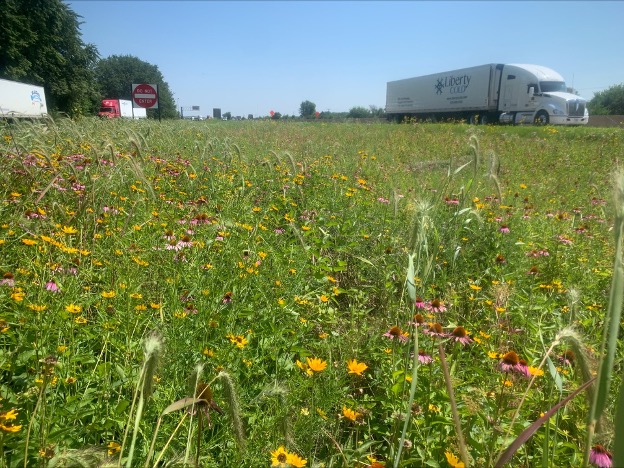
    Native species dominated restoration project on a highway roadside in Northern Illinois. Visible flowerheads are pale purple coneflower (Echinacea pallida), lanceleaf coreopsis (Coreopsis lanceolata), black-eyed Susan (Rudbeckia hirta), and Canada wildrye (Elymus canadensis). Photo by Wes Bollinger.

    If poorly managed, rights-of-way can become heavily invaded by nonnative plants like common reed (Phragmites australis), teasel (Dipsacus fullonumDipsacus laciniatus), and Johnsongrass (Sorghum halepense) among many others. These invasive species inhibit the native grasses and forbs and reduce ecosystem functioning. When heavily invaded, roadsides also cause economic impacts, functioning as source populations of weeds that can impact adjacent agroecosystems. Typically, roadsides are seeded with a mixture of Eurasian turfgrasses like Kentucky bluegrass (Poa pratensis) and red fescue (Festuca rubra). These nonnative grasses are comparatively short both in their above- and below-ground growth. Their short roots do not inhibit the growth of undesirable nonnative species, resulting in more mowing and maintenance than a native plant community to keep areas appearing ‘pristine.’ 

    However, roadsides can be restored with native species and managed using best practices to provide economic and environmental benefits to the region. Native-dominated vegetation can inhibit invasion, protect nearby remnant habitats, promote healthy soil, improve stormwater retention, absorb agricultural additives, sequester carbon, and provide forage and migration corridors for native animals. Though establishing native vegetation on roadsides may have these obvious benefits, there are many knowledge gaps pertaining to this practice such as how and what to seed in these areas to maintain the highest ecosystem fidelity and greatest economic benefits.

    We conducted research to determine which native species to seed on highways and the best practices for establishment and maintenance of these areas, with the goals of lowering overall maintenance costs by reducing the frequency of mowing needed to maintain these areas. This work was funded through grants from the Illinois and Indiana Departments of Transportation (DOTs) in conjunction with the Illinois Center for Transportation and the University of Illinois.

    I carried out three projects to gain empirical evidence on how to restore Midwestern roadsides with native species. Project 1) reviewed the native seeding practices of the DOTs of the Midwest to identify commonly seeded species and assessed establishment and management practices. For Project 2) we conducted experimental trials in Illinois comparing existing Illinois DOT mixes (non-native and partially native) with novel mixes that we designed to be more diverse and contain only native species. For Project 3) we conducted a field survey of existing native roadside plantings across Illinois and Indiana. Projects 2 and 3 sought to quantify the performance of individual species to determine which ones have the greatest establishment and persistence in roadside conditions, and what conditions lead to favorable native establishment generally.

    Project 1) Current native seeding and management practices

    My review of Midwestern DOT seeding practices revealed stark differences between DOTs among states, but some commonalities that are noteworthy for establishment and maintenance. Most interestingly was the disparity in native diversity between states. Michigan did not list any native species in their roadside manual, while Minnesota listed 108, the most of any Midwestern DOT. Further, Minnesota listed 11 majority or entirely native seed mixes and had the most comprehensive standard operating procedures for native seeding. Many mixes had average max heights under 3 ft (~1m) to avoid obscuring motorists views on roadsides; however, some states had mixes more than 5 ft (~1.5 m) for tallgrass areas and to increase the invasion resistance of an area by blocking light access with taller plants. Perhaps surprisingly, the states of Ohio and Indiana still list an invasive legume, crownvetch (Securigera varia), in mixes designed for erosion control.

    Number of majority native species mixes listed by Midwestern Department of Transportation in order of most to least native species (n) listed.

    Several establishment methods were common across states. Native seeds should be sown into low-fertility topsoil using a hydroseeding machine (a device that sprays a mixture of seed, water, and an organic adhesive agent directly onto soil) especially on sloped areas. Hydroseeders show remarkable success in soils with a seed bank containing invasive species, by avoiding tillage which can bring these seeds to the surface and increase their germination. Native straw can be applied as a mulch layer and may be harvested from areas scheduled for maintenance with mowing. Seeding should take place in the fall to allow for cold stratification. Local ecotype seeds are preferred to produce individuals with locally adapted phenotypes and avoid genetic contamination with seeds harvested outside the region. Mowing in the first year of growth is critical to reduce invasive species while native seedlings establish. Minnesota recommends three mows in year one, in May, June, and July, and a singular mow between July and August of year two. Controlled burning of these areas is ideal every 3-5 years but mowing at the same rate is also beneficial. 

    Project 2) Comparative performance of standard (mixed origin) and native-only mixes

    As a method of direct comparison between existing DOT seed mixes and a fully native roadside, I established four trials across Illinois to test differences in seeded, native, seeded native, and nonnative unseeded plant cover and richness, thus also providing information on invasion resistance between four popular mixes (DOT lawn, roadside, north IL, south IL) and four corresponding fully native plant mixes I designed to meet the same general criteria (low growing, disturbance, and salt tolerant) while also being higher diversity (from 9 to 38 species depending on mix). These experimental plots were seeded in November 2023 and surveyed in May and August of 2024. I observed that plantings differed in degrees of success, but every trial showed at least one significant positive result for the native planting over the nonnative IDOT mix. Native richness was higher for all sites by August of the first growing year, and native cover was higher for three of the four experiments. My trial of the IDOT Class 3 North Slope mix against a mix of 38 native species yielded significantly higher seeded cover by August 2024, and higher richness and cover of all native species in both May and August, suggesting that this high diversity mix competed very well against an existing DOT mix which was a combination of native forbs and nonnative grasses. Based on preliminary data collected during 2025, the native species are continuing to outpace the nonnatives in these mixes. 

    Of the native species seeded in these trials, those with the greatest record of germination in year one are lanceleaf coreopsis (Coreopsis lanceolata), common milkweed (Asclepias syriaca), partridge pea (Chamaecrista fasciculata), Illinois bundleflower (Desmanthus illinoensis), pale purple coneflower (Echinacea pallida), common evening primrose (Oenothera biennis), golden Alexander (Zizia aurea), blue vervain (Verbena stricta), and plains oval sedge (Carex brevior), which were present in the first year between 50% and100% of plots they were seeded in.

    Example paired plot before site prep and seeding (left) and August of the first growth year after establishment (right). IDOT mix on the left, native mix on the right of each image. Yellow flowers are golden Alexanders (Zizia aurea). Photo by Wes Bollinger.

    Project 3) Identifying the most successful native species from field surveys

    Lastly, I surveyed 34 native plantings on roadways across Illinois and Indiana at various distances from the road edge while collecting data on soil chemistry, surrounding land use, and soil compaction. Sites were more than two years old to avoid plantings early in their establishment. The purpose of this project was to identify which seeded species tend to germinate and persist, and what environmental factors contribute to higher native and invasive success. Of the 153 native species seeded in one or more sites, we found that 28 native species were observed in at least half of the planted sites and 84 species were never observed once despite being seeded in anywhere from one to 12 sites. Five species were found a total of 10 or more times each across all 34 sites: common milkweed (Asclepias syriaca), bee-balm (Monarda fistulosa), black-eyed Susan (Rudbeckia hirta), false sunflower (Heliopsis helianthoides), and switchgrass (Panicum virgatum). These five species along with Virginia wildrye (Elymus virginicus) were also the most observed species at sites where they were seeded. These surveys were not designed to be comprehensive given the size of many of these plantings and it is highly probable some other seeded species were present but unobserved.

    I found that native diversity and cover were generally higher further from the road edge, in areas with less salt, more basic soil, lower nitrogen and phosphorous, and a higher seed mix diversity. The opposite was true for nonnative cover and diversity. Richness of the seeded native mix was one of the strongest determinants of both diversity and cover. 

    In summary, we recommend that seed mixes should be hydroseeded at a rate of 60-70 seeds per square ft. (650-750 seeds per square meter) into low-nutrient, unfertilized soils, and covered in native straw. High-diversity mixes with no more than 10% legumes and an otherwise equal ratio of grasses to forbs should be used. Several species (but no more than 10%) should be early-establishing annual forbs for first year cover. Select species so that there is at least one blooming at all times of the growing season, favoring plants like golden Alexander (Zizia aurea) and native Alliumspecies for early spring blooms. Seed in as large an area as possible to reduce edge effects, consider cloverleaf interchanges as ideal locations for large projects.

    For maintenance in year one post-seeding, mow several times (May, June, July, potentially also August in warmer states) to a height of 6-8 inches. In year two, mow at least once between June and September. Controlled burning or mowing can be conducted as needed for persistent weed issues but generally are only required every three to five years. If mowing is needed, areas with low abundance of non-native plants can be harvested as native straw for future plantings.

    Native species with the best establishment record and widest usage are as follows and should be prioritized in high disturbance roadside plantings: Asclepias syriacaAsclepias verticillataBouteloua curtipendulaCarex breviorCarex cristatellaCarex hystericinaChamaecrista fasciculataCoreopsis lanceolataDalea purpureaDesmanthus illinoensisEchinacea purpureaElymus canadensisElymus virginicusEryngium yuccifoliumEupatorium perfoliatumHelianthus grosseserratusHeliopsis helianthoidesJuncus effususMonarda fistulosaOenothera biennisPanicum virgatumPenstemon digitalisPhysostegia virginianaPycnanthemum tenuifoliumRatibida pinnataRudbeckia hirtaSilphium laciniatumSymphyotrichum novae-angliaeSymphyotrichum puniceumLiatris pycnostachyaVerbena strictaVernonia fasciculataand Zizia aurea.

    Further details and methods can be found in the thesis here or by contacting the author at info@wildshaperestoration.com
  • Ecological restoration of sandy grassland ecosystems in Kiskunság, central Hungary and combating the allergenic Common ragweed (Ambrosia artemisiifolia)

    Ecological restoration of sandy grassland ecosystems in Kiskunság, central Hungary and combating the allergenic Common ragweed (Ambrosia artemisiifolia)

    By: Katalin Török and Melinda Halassy

    Katalin Török and Melinda Halassy are restoration ecologists specializing in sandy grasslands in Central Hungary. Katalin focuses on botany, ecology, and biodiversity monitoring. Melinda, formerly Katalin’s student, took part in their first restoration experiment and is likely Hungary’s first PhD in restoration ecology. Their research aims to identify barriers to spontaneous restoration and analyze long-term ecological processes triggered by various restoration methods to find the most effective approaches. Both contribute to international ecological research (eLTER) and restoration policy (SERE), working to link scientific knowledge with public policy in ecological restoration.

    HUN-REN Centre for Ecological ResearchInstitute of Ecology and BotanyRestoration Ecology Research Group, halassy.melinda@ecolres.hu

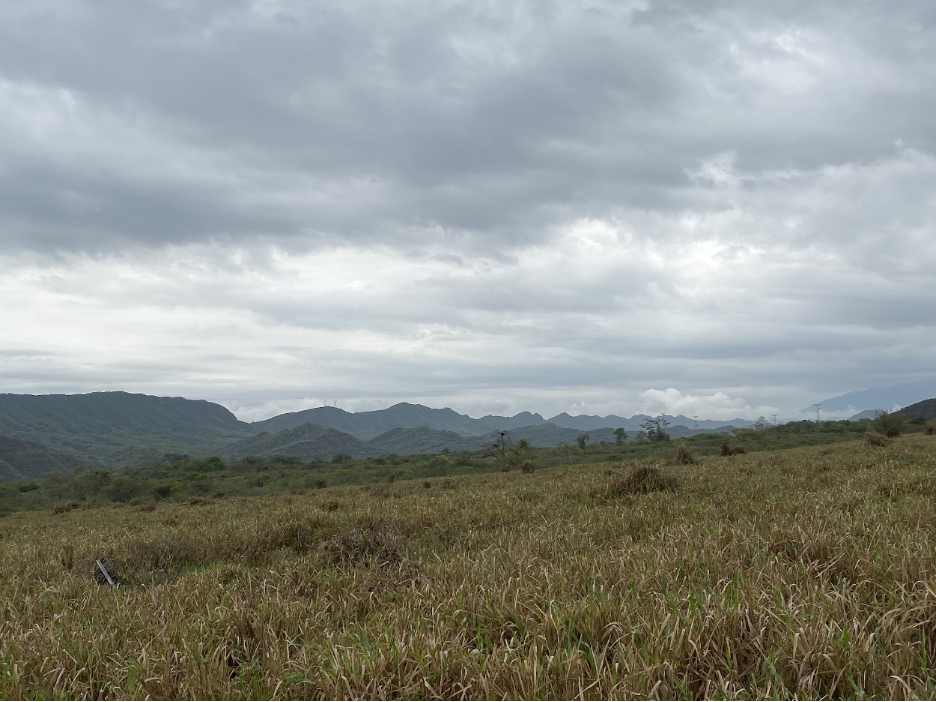
    KIskun LTER Restoration Experiments site is located in a unique sandy landscape of central Europe. Situated at the center of a vast sandy region, the core area of Kiskunság National Park represents one of the largest of its kind in Central Europe, spanning approximately 7,400 square kilometers. This unique environment is especially accessible near the village of Fülöpháza, where visitors can experience an impressive range of sand dunes. The landscape features both open sand steppes and  wind-blown dunes, offering a rare glimpse into one of the continent’s most distinctive and unusual natural habitats. Credit: Melinda Halassy, CER2021

    The ecosystem

    One of Hungary’s most distinctive geological regions is the Danube–Tisza Interfluve (Kiskunság), which is an important reservoir of biological diversity within the Pannonian Biogeographical Region of Europe. Situated at the westernmost edge of the vast Eurasian forest-steppe biome, this region is part of a bioregion that extends approximately 9,000 km from Central Europe to Eastern Asia, covering more than 4.7 million km² (Erdős et al. 2022). The Eurasian forest-steppe represents Hungary’s dominant vegetation type, covering more than half of the country. Although the grasslands in this zone are sometimes misinterpreted as being heavily deforested in historic times, ecological models that integrate climate variability, topography, soil conditions, herbivory, and natural fire regimes reveal that forests and grasslands naturally coexist in a dynamic mosaic within the forest-steppe zone (Erdős et al. 2022). 

    The largest and most ecologically diverse areas of the region preserve the characteristic ”puszta“, which includes both sandy and alkaline grasslands, sand dune forests, and remnants of former sodic pans, marshes, fens, fen meadows, and wet grasslands. The inland sand dunes, shaped by wind action, consist of coarse-textured, lime-rich soils that are low in water and nutrients, supporting unique vegetation, including specialist plant and insect species. The sandy forest-steppe of the “puszta” consists of poplar-juniper sand dune forests and thickets, as well as open oak-dominated woodlands forming complex mosaics with both open and closed sand grasslands, all of which are considered habitats of high conservation concern by the European Commission. The driest grasslands in the region, known as ”Festucetum vaginatae danubiale“ community, are found on the crests and southern slopes of sand dunes. These grasslands are characterized by tussock-forming grasses such as the endemic grass Festuca vaginata and the protected Stipa borysthenica, interspersed with cryptogam cover of mosses, ferns, lichens, etc. and frequent patches of bare ground.

    Sandy Forest-Steppe Mosaic of the Puszta: Poplar-Juniper Stands and Open Sand Grasslands. Dominated by White Poplar (Populus alba), this landscape reflects the natural vegetation adapted to arid, sandy conditions.  Credit: Evgeni Dimitrov, eLTER 2023

    Throughout the 19th and 20th centuries, the landscape underwent significant human modifications, beginning with river regulation and drainage, followed by agricultural intensification and plantation forestry. As a result, the region is now predominantly covered by agricultural lands, forest plantations, and fragmented remnants of semi-natural grasslands.  During the post-socialist transition (1987–1999), large-scale agricultural land abandonment occurred, particularly in low-productivity areas such as the Kiskunság (Valkó et al. 2016). While some native vegetation regenerated spontaneously, abandoned lands also became increasingly susceptible to invasion by non-native species. One of the most problematic invaders is Black locust (Robinia pseudoacacia), a fast-growing, nitrogen-fixing hardwood tree from eastern North America, which has spread extensively. Another notorious example is Common ragweed (Ambrosia artemisiifolia) that we will discuss below.  The expansion of invasive species not only threatens native biodiversity and ecosystem health but can also have negative impacts on human health.

    Land abandonment presents a valuable opportunity for the spontaneous regeneration of native sandy grasslands, it also introduces significant ecological challenges. One of the most pressing threats to natural recovery is the aggressive spread of invasive alien plant species, particularly Common milkweed (Asclepias serica, formerly A. syriaca). Credit: Melinda Halassy, CER 2021

    Restoration experiments

    For the past 27 years, we have been conducting restoration experiments at the Kiskunság Long-term Ecological Research site to facilitate the recovery of sandy grasslands on lands degraded by Black locust plantations and arable cultivation. Our research focuses on the long-term effects of various treatments aimed at overcoming barriers to spontaneous grassland regeneration, assessing the positive and negative influences of the surrounding landscape, and enhancing invasion resistance through seed-based restoration.  

    Our findings indicate that active restoration interventions can significantly accelerate recovery. Specifically, sowing a mixture of locally sourced grass and forb species has proven to be the most effective method for initiating restoration in dry grasslands and controlling invasive species (Reis et al. 2023). Additionally, carbon amendments and mowing can serve as valuable complementary measures; however, they should be applied cautiously in invaded landscapes to avoid unintended ecological consequences (Reis et al. 2022).

    Seeding Native Species: A Key Strategy for Restoring Sandy Grasslands. In the restoration of dry sandy grasslands, sowing a carefully selected mixture of locally sourced grasses and forbs has emerged as the most effective strategy for initiating vegetation recovery and suppressing invasive species. Although remnants of native sand grasslands remain in the landscape, their specialist species show limited natural dispersal capacity. As a result, abandoned agricultural fields are often colonized by weeds and invasive alien plants, which significantly hinder the process of secondary succession. Research has shown that even the low-rate seeding of as few as five native species can have a catalytic effect, facilitating the establishment of characteristic grassland communities and accelerating the recovery of degraded former croplands. Credit: Melinda Halassy, CER2021

    The success of restoration efforts is further challenged by the presence of other aggressively invasive species beyond Black locust, including the tree of heaven (Ailanthus altissimus) and the herbaceous Common milkweed (Asclepias serica (formerly A. syriaca), which are particularly widespread in forest plantations (Csecserits et al. 2016). Even after the removal of dominant invasive species, new invasions may occur, likely due to legacy effects and the high dispersal capacity of these non-native species (Reis et al. 2023). To mitigate these negative impacts, restoration efforts should prioritize areas with lower invasion pressure or integrate early seeding of native species as a complementary strategy for invasion control (Csákvári et al. 2023Halassy et al. 2023).

    Managing Invasive Species: The Limitations of Mowing in Invasive Species Control. Mowing is widely used as a method to control the spread of invasive alien species. However, experience indicates that mowing alone often fails to deliver satisfactory results. This is largely due to the persistent legacy effects of previous invasions and the limited natural dispersal capacity of native grassland specialist species. While mowing can effectively suppress certain targeted invasives, it does not prevent secondary invasions—the establishment of other non-native species that quickly occupy the disturbed space. To ensure successful and lasting restoration, mowing must be combined with the active introduction of native species, which can stabilize the ecosystem and reduce vulnerability to further invasions. Credit: Márton Kállai 2023

    Restoration – human health links; research in progress  

    Enhancing public health through ecological restoration efforts can be of significant importance. Ecosystem services and direct contact with nature may contribute to this improvement (Millennium Ecosystem Assessment 2005Marselle et al. 2021), but robust evidence is needed to establish clear links between biodiversity, ecological restoration, and human health at landscape, regional, and national scales.  

    In Hungary, a national project has recently been launched to investigate these nature–health connections using ecosystem condition maps and health data (https://termeszetem.hu/en). This initiative aims to identify correlations between environmental factors and various health indicators, such as the prevalence of allergies, depression, autoimmune and inflammatory diseases, and self-reported well-being. The research focuses on detecting these relationships at the sub-regional scale and in urban areas, as well as assessing the economic impacts of health conditions. A key initial focus of the project is the highly allergenic Common ragweed (Ambrosia artemisiifolia), which poses significant public health challenges throughout Europe and elsewhere.

    Restoration as a Tool to Combat Common Ragweed and Its Public Health Impact. Abandoned croplands provide favorable conditions for the establishment and spread of Common ragweed (Ambrosia artemisiifolia), a highly invasive species known for its allergenic pollen. This plant poses a growing public health threat across Europe and beyond. In 2015 alone, ragweed allergy adversely affected the health of an estimated 13.5 million people in Europe, resulting in public health costs exceeding €7.4 billion (US$8.1 billion). Common ragweed thrives in open, disturbed soils, making abandoned agricultural lands particularly vulnerable to colonization. However, as natural vegetation succession progresses and plant cover becomes denser, ragweed populations tend to decline. This succession process can be significantly accelerated through active ecological restoration, which helps close vegetation gaps more quickly, thereby limiting the window during which ragweed can release its pollen and spread. Credit: Anikó Csecserits, CER 2020

    Battling Common ragweed – for ecosystem and human health

    Successes so far with reducing invasion of Common ragweed (Ambrosia artemisiifolia) are noteworthy.   For starters, note that the disservices of Common ragweed are already serious and likely to get worse throughout Europe since its allergenic pollen affects one in ten people throughout the European continentSchaffner et al. (2022) estimate that the health of 13.5 million people was adversely affected in 2015 by Common ragweed allergy in Europe alone, generating 7.4 billion euros (8.1 billion US$) in public health costs. Happily, our ecological restoration interventions have already demonstrated their effectiveness in battling this noxious annual weed (Fig. 1).

    Figure 1. The decrease of cover of the highly invasive, and allergenic, common ragweed (Ambrosia artemisiifolia), under three different restorative treatments and control. The figure shows the pooled data of three experiments that included mowing (Reis et al. 2021), carbon amendment (Halassy et al. 2021) and seeding (Reis et al. 2023) between 1995 and 2019. Carbon amendment through addition of sucrose and sawdust reduced available N-levels in the soil. Mowing was carried out twice a year, and was followed by removal of dry plant biomass.

    The successful reduction of Common ragweed invasion serves as a promising example of how ecological restoration can yield measurable benefits for human health. The new national-scale study aims to provide evidence-based insights into the potential interconnections between ecosystem health and human well-being. These findings could help inform policy decisions related to land management and restoration efforts not only in Hungary but also in other regions.  

    A potential next step is to investigate links between ecosystem conditions and asthmatic diseases. By analyzing data on general practitioner and specialist visits for asthma-related complaints, as well as the purchase of asthma-specific medications, we can correlate health trends with different ecosystem states across temporal and spatial scales (Nitschke et al. 2022). This approach will allow us to assess the broader health impacts of ecological restoration.  

    Moving forward, we plan to deepen our research on the relationship between ecological restoration and human health by collaborating with the Ecological Health Network and its member sites and hubs working on similar challenges. We believe that participation in an international social impact network will not only advance our research but also enhance its value and real-world impact.

  • Looking Back to Guide the Future: Evaluating 23 Years of Management History in Big Meadows, Shenandoah National Park

    Looking Back to Guide the Future: Evaluating 23 Years of Management History in Big Meadows, Shenandoah National Park

    By Jordan T. Coscia

    Jordan is a PhD candidate in the Restoration Ecology Lab at Virginia Tech and a Research Fellow with the Smithsonian’s Virginia Working Landscapes program whose research focuses on the characterization and restoration of Virginia’s native grasslands.

    An open landscape of grasses, forbs, and low shrubs meets the edge of a forest in the background. Three trees are in the foreground to the right, and forested mountaintops are visible in the distance.
    The western section of Big Meadows, Shenandoah National Park in June 2022. Photo by Wendy Cass.

    Located at the heart of Shenandoah National Park, the Big Meadows landscape is a site of both natural and cultural history. The 134-acre meadow is the largest open area in the Park, and it is a popular visitor destination boasting numerous walking trails and proximity to campgrounds, picnic grounds, and one of the park’s two visitor centers. Ecologically, the Big Meadows landscape includes two globally critically rare Blue Ridge Mafic Fen plant communities, and hosts plant and animal diversity not found elsewhere in Shenandoah National Park.

    Like other meadows and grasslands across the Southeastern United States, Big Meadows occurs in a climate that can support closed-canopy forests. Therefore, the open landscape and the species that rely on it only persist due to a combination of edaphic characteristics, such as shallow and poorly drained soils, and frequent disturbance, such as fires or the grazing of herbivores, that prevent the growth of woody trees and shrubs. In the post-colonial absence of large herbivores and the suppression of both cultural burning and wildfires, the open landscape of Big Meadows was maintained by livestock grazing before the establishment of Shenandoah National Park in 1935. Continuous efforts have been made to preserve the historic open landscape since the Park’s founding, including routine mowing, prescribed burns, and the targeted cutting and herbicide treatment of encroaching Robinia pseudoacacia (black locust) saplings and Rubus (blackberry) canes. While initially successful, management efforts appear to have become less effective over time, and the spread of woody and invasive species threatens the open landscape of Big Meadows.

    Close-up of a sedge with a terminal, brown, staminate spike and two lower, pistillate spikes of green, oblong perigynia sporting “racing stripes” formed by impressed nerves.
    A rare sedge, Carex conoidea, in Big Meadows. Common names for this species include the prosaic “field sedge” (Flora of Virginia) and the romantic “ancient prairie sedge” (Southeastern Flora). Photo by Leighton Reid.

    Since 1998, botanist Wendy Cass and The Inventory and Monitoring program at Shenandoah National Park have recorded land management actions and collected plant community composition data in Big Meadows. Big Meadows was split into three major management zones, and all three zones were treated with prescribed fire each spring between 2000 and 2003. In 2004, a new management schedule was created with the goal of maintaining a three-year burn-mow-fallow cycle in each zone. To determine how these management changes impacted Big Meadows, Leighton Reid (Virginia Tech), Wendy Cass, and I assessed changes in the plant community composition from 2000 to 2023 using multivariate statistics and the creation of statistical models through regression analysis.

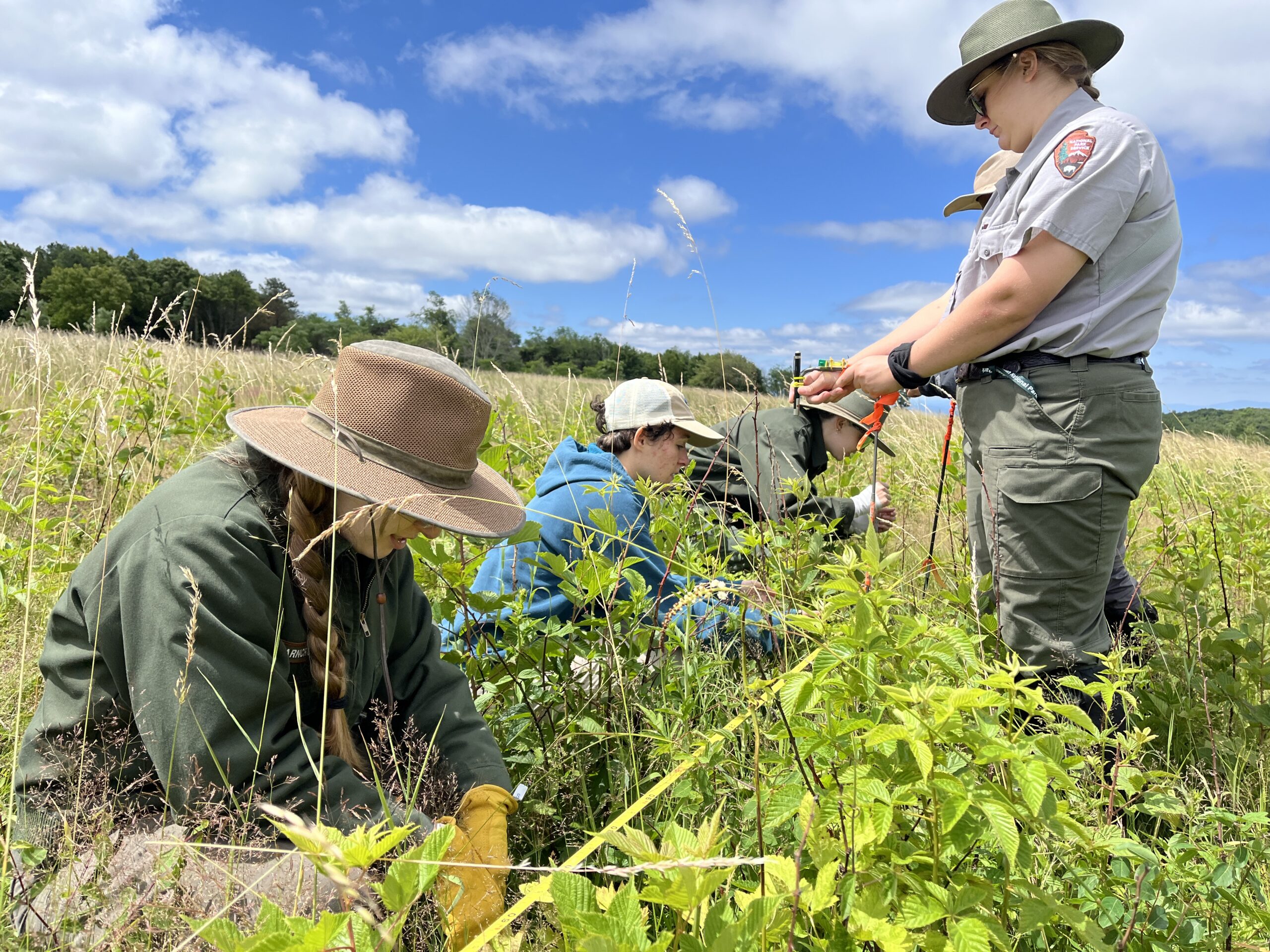
    Five people huddle around a field tape marking a vegetation transect through a grassland with white clouds and blue sky in the background.
    Jordan Coscia (second from left) and Inventory and Monitoring NPS staff measuring plant community composition in Big Meadows in June 2024. Photo by Wendy Cass.

    We found that the plant community composition of Big Meadows shifted over the past 23 years, with the original mosaic of shrubs within a grass and herb-dominated community experiencing marked increases in low shrubs, young trees, and other woody plants. Though the average percentage of graminoids (grasses, rushes, and sedges) encountered along each survey transect experienced little overall change between 2000 and 2023, the average percentage of forbs (non-woody herbs that are not graminoids) encountered decreased by over 50%, while the average percentage of woody plants encountered increased by 200%-400%. This increase in woody plants was partially driven by native Rubus (blackberry) species, which increased from less than 1% of the plants encountered along each transect in 2000 to 15-20% of the plants encountered along each transect by 2023. Multivariate statistics revealed that the trajectory of change in the Big Meadows plant community shifted abruptly after the three-year burn-mow-fallow cycle was adopted in 2004. The direction of this shift was correlated with an increase in the time interval between prescribed burns.

    An open landscape of green vines interspersed with brown, leafless stems. The sky is cloudy and Big Meadows stretches into the distance, terminating in a line of trees.
    Woody encroachment near the northern edge of Big Meadows. Bare stems represent Robinia pseudoacacia (black locust) top-killed by prescribed fire. Emerging beneath them is a green carpet of invasive bittersweet (Celastrus orbiculatus). Photo by Leighton Reid.

    Our statistical models provided evidence that both climate and changes in the timing of land management actions have impacted the plant community in Big Meadows. There was moderate evidence that later springs (as indicated by the date of the last spring freeze) are correlated with desired increases in forbs, however, this positive effect may be lost as climate change brings milder winters with fewer frost days to Shenandoah National Park. There was strong evidence that longer intervals between prescribed fires are correlated with unwanted increases in woody plants and decreases in forbs and moderate evidence that longer intervals between mowings are correlated with unwanted increases in Robinia (black locust) and decreases in forbs. Together, this evidence indicates that these unwanted changes may be mitigated by increasing the frequency of prescribed burns and mowing in the future.

    Overall, our analysis revealed that the changes in land management between 2000 and 2023 have negatively impacted the plant community composition in Big Meadows. Together, the shifts in community trajectory after 2004 and the evidence from our statistical models suggest that the change from annual burning to a three-year burn-mow-fallow cycle in 2004 has contributed to the declining landscape conditions in Big Meadows. Though ad-hoc changes to the three-year management cycle and gaps in the plant data make it difficult to determine an ideal burn or mow interval from the existing data, evidence from the past 23 years suggests that more frequent burning and mowing may aid the preservation of the Big Meadows landscape for future park visitors and wildlife alike.

    An open landscape with patches of dark green trees in the left foreground and the right background, surrounded by a low, shrubby wetland. The sky is pale blue with a few wispy clouds above a forested hill that rises on the right hand side.
    A line of gray dogwoods (Cornus racemosa) accentuates a shorter canopy of narrowleaf meadowsweet (Spiraea alba) shrubs in the wet, central portion of Big Meadows. Photo by Leighton Reid.
  • A Tale of Two Highlands Part II: Ankafobe, Madagascar

    A Tale of Two Highlands Part II: Ankafobe, Madagascar

    Leighton Reid, James Aronson, and Chris Birkinshaw all contributed to this post on restoration in one of Missouri Botanical Garden’s community-based conservation sites in Madagascar. They are currently travelling together discussing opportunities for ecological restoration in MBG’s Madagascar Program and more generally for the country as a whole.

    Madagascar’s central highlands appear as a grassy sea – an undulating terrain with intermittent red gashes where heavy rain has dramatically eroded the landscape. Driving north along the national highway from the capital, Antananarivo, one sees Eucalpytus trees growing near villages, as fuel and firewood plantations, but there is almost no natural forest. The few natural communities that remain represent vestiges of a former world.

    The view across the road from Ankafobe - nearly unbroken grassland.
    The view across the road from Ankafobe – nearly unbroken grassland.

    Our destination today is one such vestige – the Ankafobe reserve. Ankafobe is a tiny (33 hectare) strip of native forest growing near the headwaters of a highland stream. Water-loving Pandanus trees demarcate the stream bed and provide fruits for several lemur species. A Souimanga Sunbird (Cinnyris sovimanga) flitters from tree to tree. Just outside of the forest, highly flammable grassland stretches to every horizon.

    Pandanus spikes stand out in this thin patch of gallery forest at Ankafobe.
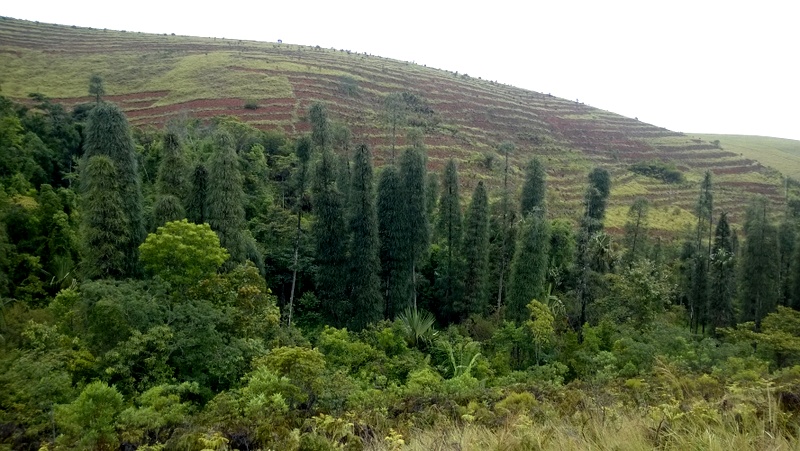
    Fragmented gallery forest at Ankafobe. Spikey Pandanus demarcate the streambed. Red strips in the background are incipient forest restoration plots, where the soil has been turned over prior to planting nitrogen-fixing shrubs and native trees.

    MBG staff and local villagers are working to restore forest on these bare hills, but it is not an easy task. Between clumps of grass is baked, orange laterite – rock hard soil bereft of life and nutrients. Tree seedlings planted in it grow slowly, or not at all. To improve seedling growth, MBG scientists are testing several strategies. One method is to turn over the soil and seed hearty legumes, whose symbiotic bacteria replenish soil nitrogen – a key ingredient in DNA.

    Last October, a wildfire jumped the double fire breaks surrounding Ankafobe and burned a piece of the forest. Two hundred people from the local village (with a population of 600) voluntarily and spontaneously fought the fire for three days. Their impressive response minimized damage to this small forest and raised hopes and excitement about working together on conservation going forward.

    The wildfire highlighted this forest fragment’s vulnerability, but it also provided a unique opportunity to observe the response to fire by a natural biotic community that has almost disappeared from the world. A number of trees were completely burned up that had been growing in the savannah just outside of the forest. Unexpectedly, several of these resprouted from their base and from superficial roots at some distance from the main stem. Nearby, the burned grassland bloomed an interesting  array of geophytic plants – particularly orchids – that were rarely observed in unburned grassland. These observations seem to support the hypothesis that at least part of the highland flora may be adapted to fire – a controversial idea that complicates the already challenging task of managing Ankafobe.

    Ankafobe is a rare gem; a green emerald that stands out from the surrounding countryside and supports at least one species found almost nowhere else. The reserve is also a special opportunity for ecological restoration. Hard-won lessons from this site could eventually be used to restore tens of thousands of square miles of Madagascar’s central highlands.

    Chris Birkinshaw (center) and the Ankafobe restoration team after a rainy afternoon in the field.
    Chris Birkinshaw (center) and the Ankafobe restoration team after a rainy afternoon in the field.