Tag: Karoo

  • Bee-neath the surface: Some bare ground needs no restoration!

    Bee-neath the surface: Some bare ground needs no restoration!

    By: Karin Sternberg with inputs from Sue Milton. All images were taken by the author.

    Karin Sternberg is an amateur naturalist and conservationist focused on the study of solitary bees and wild honeybees in the Great Karoo region. Over the past decade, she has conducted research into the ecologies of these essential pollinators, documenting more than one hundred wild honeybee nests during the course of her fieldwork. Her research is self-funded. Sue Milton is an arid zone restoration ecologist based in the Karoo region of South Africa. She is the owner of Wolwekraal Nature Reserve and Wolwekraal Conservation and Research Organisation (https://www.wcro.co.za) that promotes conservation, education and research in the Karoo.

    Wolwekraal Nature Reserve in the Great Karoo.

    There are 2755 bee species in sub-Saharan Africa, about 1300 of which occur in South Africa. Of these, only the honeybee and 10 species of mopane bees store honey, but all bees are important pollinators of a wide variety of plant species. They pollinate not only fruit and field crops, but most of the annuals, succulents and shrubs that make up the natural grazing lands, particularly in the more arid parts of South Africa. The arid, winter-rainfall region of South Africa known as the Succulent Karoo, is extraordinarily rich in succulent plants—and in the solitary bees that visit their flowers. Bee hotspots with around 700 bee species are found in the arid winter and aseasonal rainfall regions of South Africa.

    Nesting sites of the solitary bees Samba (left) and Colletes (right) on the inner edge of an aardvark burrow.

    In September 2024, I spent several weeks documenting the diversity and behaviour of solitary bees on Wolwekraal Nature Reserve which lies within the arid, aseasonal rainfall bee hotspot in the southern Karoo. This Nature Reserve protects rare succulent plants, most of which are pollinated by bees and flies, but the reserve is also used for conducting restoration trials. Most of these focus on revegetating patches of bare ground where over-grazing or corralling destroyed vegetation centuries ago and led to wind-blown loss of the shallow topsoil. Over millennia the vegetation here has adapted to withstand dramatic temperature fluctuations, from severe winter frosts to scorching summer heat at times exceeding 45°C, often enduring prolonged periods of drought. Extreme droughts, such as the 8-year-long dry period from 2015-2022, can kill 40 to 80% of long-lived plants, and because perennials do not maintain seed banks there is only limited regeneration of these after drought-breaking rain. Annuals, such as Gazania lichtensteinii (Asteraceae), emerge in their masses, saturating the landscape with colour and scent. This is a cue for the emergence of solitary bees which can remain dormant for months or years.

    The barren ground of a deflation hollow which is home to so much insect diversity (left) and the vegetation surrounding the deflation hollow (right).

    Most solitary bees nest in the ground and eroded patches and paths are favoured. During my studies, a seemingly desolate stretch of land caught my attention. This area, characterised by hard sediment, served as a shortcut from the jeep tracks to a wild colony of honeybees nesting in an aardvark (antbear) burrow.

    Dead honeybees and soldier termites in an aardvark burrow following a clash between the two species occupying it as nesting sites.

    The flora surrounding this bare ground is a stark reminder of the Karoo’s remarkable resilience, showcasing a rich tapestry of species that thrive in one of the world’s most harsh climates. Yet, amid this tenacity, certain areas of the landscape remain barren and hardened—perhaps trampled centuries ago by fat-tailed sheep held in corals overnight to protect them from predators, or more recently, during the 19th century when the natural rangeland was stocked way over the capacity of the vegetation to recover.

    Not long ago, I buried a wild hare—a tragic victim of roadkill—in an aardvark dugout: a deep, empty cavity in an area of hard ground I could never have dug myself. My sister, with her characteristic humour, had remarked, “Everyone needs an aardvark.” Indeed they do. For Aardvarks (Orycteropus afer) are extensive burrowers in sub-Saharan ecosystems, actively modifying their environment in the construction of shelters, and in excavating termitaria for food. This, in turn, generates nest sites and unique habitats that support a variety of other species. Burrows of aardvarks are used as shelter by foxes, porcupines, suricates, birds and honeybees. Moreover, when their large burrows collapse they form dams that capture seeds and water and initiate vegetation regeneration. As I reflected on the hare’s untimely death, I was once again captivated by the number of solitary bees nesting in holes on the inner edges of these burrows. Like the wild honeybees in these landscapes, many species are dependent on the aardvark for their nest sites; a reminder of nature’s interconnectedness. All around the dugout vibrant yellow swathes of Gazania lichtensteinii (Asteraceae) were in flower, their annual beauty enhanced by early winter rains.

    Annuals, Gazania lichtensteinii (Asteraceae), in flower on Wolwekraal Nature Reserve.

    The seemingly lifeless stretch of ground, a wind-scoured deflation hollow, was located close to this dugout. Deflation hollows form where vegetation is lost allowing wind to remove sandy topsoil and expose a hard subsoil comprising desert dust cemented with calcium carbonate. They are often associated with stone age human settlements of hunter-gatherers and herders. At this particular deflation hollow, there are various stone tools made from chert including a stone arrowhead. Standing on this hardened ground I was struck by a common misconception: that bare earth signifies death. Often ignored in environmental assessments, this apparently barren, hard ground was, in fact, teeming with life and intrigue. Initially mistaking the sounds I was hearing for a drone congregation area—where honeybee males dart through the sky waiting for a queen—I quickly realised that the sound was emanating from the ground.

    Male Tetraloniella solitary bees congregating around the nest holes, waiting for the females to emerge.

    A closer look revealed a fascinating gathering of male Tetraloniella bees. These short-horned, longhorn solitary bees were eagerly vying for a chance to mate with a female as she emerged from her underground nest. 

    Although solitary by nature—females work alone in building nests and provisioning food—these bees form dense aggregations in favourable environments. The apparent barrenness of the ground belied its role as a prime breeding ground, and I counted an astonishing 114 nests in the vicinity. 

    The evolutionary journey of bees, stretching back around 100 million years, began with solitary, predatory mud-dauber wasps, coinciding with the rise of flowering plants. Today, bees exhibit remarkable diversity. They range in size from a mere 2 mm to 39 mm and come in various forms, from densely hairy to smooth and shiny, often adorned with striking colours and patterns. Most species of solitary bees prefer to nest in the ground, often utilising plant materials or resin to line their nests. On this hard, bare ground, the thriving community of Tetraloniella served as a vivid testament to the vibrant life hidden beneath the surface.

    The deflation hollow measured 24 m by 13 m, with nests concentrated in a mere 12 square metres. The solitary male bees have one primary role: to mate. To prepare for mating in the earlier hours of the day, the males press their bodies against the sun-warmed sand, basking to boost their speed for the frenzied mating rituals to come. Many were covered in bright yellow Gazania lichtensteinii (Asteraceae) pollen, evidence of their flower visits for a source of energy-rich nectar.

    A small section of the Tetraloniella nest aggregation.

    In addition to the Tetraloniella, there were other species thriving in this environment. Among them were various species of leafcutter, dauber and mason bees (Megachilidae) that make their nests in pre-existing burrows. The leafcutters were using both leaves of Lessertia annularis (Fabaceae) as well as petals of Gazania lichtensteinii (Asteraceae) to construct thimble-like cells. One of the females used chewed reddish-pink plant pulp to line her burrow walls. The collected pollens for provision of larvae with food were from plants different from those used for nesting materials, possibly from Melobium candicans (Fabaceae) or Rushia bijliae (Aizoaceae), both in flower and in range of the nest sites and on which Megachilidae were sighted.

    Leafcutter, dauber and mason bees thriving on the deflation hollow.

    Tetraloniella female foraging on Berkheya spinosa (Asteraceae) (left) and leafcutter bees on Rushia bijlae (Aizoaceae) (centre) and Melobium candicans (Fabaceae) (right).

    A closer examination of the ground revealed a Camponotus rufopilosis ant carrying a dead conspecific. With mandibles featuring 5 to 7 teeth, these ants defend themselves by spraying formic acid when threatened. Meanwhile, a brown-and-white striped fly (probably in the genus Parisus) hovered above a bee nest, rapidly depositing 33 eggs. This Bombyliidae fly is known to parasitise a range of insects including bees. This observation might represent a new host record, and underscores the intricate relationships between host and parasite.

    The climax of my observations came when a chaotic scrum formed around a single nest hole, where male bees gathered in a frenzied attempt to mate with the emerging virgin female. As mating commenced, the male, mounted on the female, used his antennae to possibly fan a courtship pheromone believed to induce receptiveness in the female. Clasped tightly to her, other males attempted to dislodge him, displaying a complex mating struggle.

    A mating pair of short-horned longhorn Tetraloniella bees.

    While at the study site, I saw numerous other creatures including lizards (rock agama and Namaqua sand), cryptic Sphingonotis grasshoppers, beetles, robber flies (Asilidae), and a wingless female mutillid wasp, entering the nest of a solitary bee by using her abdomen to push aside stones. I also heard barking geckos and, with much patience, managed to photograph one in its burrow. Overhead many kinds of birds flew by, including two pale chanting goshawks. Beyond this deflation hollow, I discovered an extraordinary nest in the shallow of a stone with a Chalicodoma mason bee sealing it closed with mud.

    Camponotus rufopilosis ant carrying a dead conspecific (top left) Parisus fly laying eggs (top right) Cryptic Sphingonotis grasshopper (centre left) Mutilid wasp (centre right) Barking gecko (bottom left) Pale chanting goshawk (bottom right).

    This study illuminated a critical lesson: even the most unassuming, barren stretches of land may be far from lifeless. They may harbour intricate ecosystems teeming with life that defies initial perceptions. The conservation of these natural ground-nesting habitats is crucial. Therefore, these often-overlooked spaces must be included in environmental impact assessments, as they may support complex and often unnoticed biodiversity, and may be vital for the survival of solitary bees and other species. Though tiny, bees and other insects are the architects of entire ecosystems. Through pollination, they shape which plants thrive or fade, ultimately contributing to the plant composition of particular regions. This, in turn, largely determines the composition of insect communities that maintain overall biome structure. 

    Bare ground is too rich in life to be ignored; recognising such ecosystems is essential for maintaining biodiversity and ecological resilience, while still allowing for erosion control and restoration efforts such as reseeding rehabilitation and replanting on damaged lands to enhance ecosystem health. While much restoration effort in rangelands is concentrated on revegetating bare ground, some hard, bare soil patches should be left as habitat for specialised soil-nesting bees and pollen wasps. Diversity begets diversity. 

    For readers interested in a deeper exploration of wild honeybees and solitary bees, we invite you to refer to our published paper in The Science of Nature and to visit our website for additional resources and information.
  • South Africa 3 | Town and country: aiming for ecological restoration at the landscape scale

    South Africa 3 | Town and country: aiming for ecological restoration at the landscape scale

    James and Thibaud Aronson offer their third photo essay from South Africa, highlighting FOSTER, a dramatically successful community-based restoration program in the Eastern Cape, aimed at eradicating an invasive Australian acacia, and reducing urban wildfire risk, and a private restoration program at Kaboega Farm, situated in a megadiverse landscape of extraordinary conservation and educational value.

    The Republic of South Africa is rightly famous for its 22-year old Working for Water program, WfW, and offshoots such as Working for Wetlands. These government-funded programs aim at restoring both natural and social capital, which are clearly the wave and the way of the future. They are also increasingly working with NGO implementers, private companies, and landowners in the Karoo, as we highlighted in two earlier posts (here and here). Teams, partnerships, and networks are essential here, given the complexity of the landscapes – both biophysical and political.

    To close our trip in South Africa, we traveled to Cape Saint Francis, on the coast of the Eastern Cape, where our friends Richard Cowling and Shirley Pierce, who have lived there for more than 20 years, long ago founded a restoration project they dubbed FOSTER (short for Friends of the St Francis Nature Areas).

    Richard, a top academic, communicator, and world expert on the ecology, biodiversity, and landscapes of South Africa has also worked closely with the WfW government programs elsewhere in the country, not only in the fynbos (the mega-diverse shrublands of the mediterranean-type climate region of the Cape) but also the karoo and subtropical thicket (on which, more below).

    photo-1-r-cowling-and-s-pierce
    Richard Cowling and Shirley Pierce-Cowling in their adopted habitat, St Francis Bay. 2013.  

    In and around Cape St Francis, and St Francis Bay, one of the main issue is Acacia cyclops (known in South Africa as rooikrans), one of many fast-growing acacias intentionally introduced from Australia 150 years ago for sand dune stabilization.

    In 1994, Richard and Shirley took up the challenge of developing a conservation plan and implementation strategy for consolidating 230 ha of municipal land and existing protected areas into a network that would sustain – among other things – faunal movement. More than 50% of this was densely invaded with rooikrans; only 38 ha was officially proclaimed a nature reserve. It was a slow process. Rooikrans grows quicker and taller than the native plants. But they had a very strong motivation. Indeed, “as a result of its greater biomass and more flammable foliage, rooikrans increases fire hazard by several fold relative to uninvaded fynbos” says Richard.

    Over 20 years, they achieved near total success in removal of seed-bearing alien plants through the generous funding from the World Wide Fund (WWF) and residents’ donations, but only on the 132 hectares of public lands where they could work, often with the enthusiastic help of school groups and volunteers who learned much along the way.

    photo-2-apr-16-foster-fire-prevention-work
    FOSTER restoration workers conducting follow-up removal of the alien invasive rooikrans, Acacia cyclops, in the Cape St Francis nature reserve. Photo. R.M. Cowling.

    photo-3-children-1
    A learner from a local school enjoying the leaves of Brunsvigia gregaria (Amaryllidaceae) during an excursion organized by FOSTER. Photo. R.M. Cowling.


    photo-4-brunsvigia
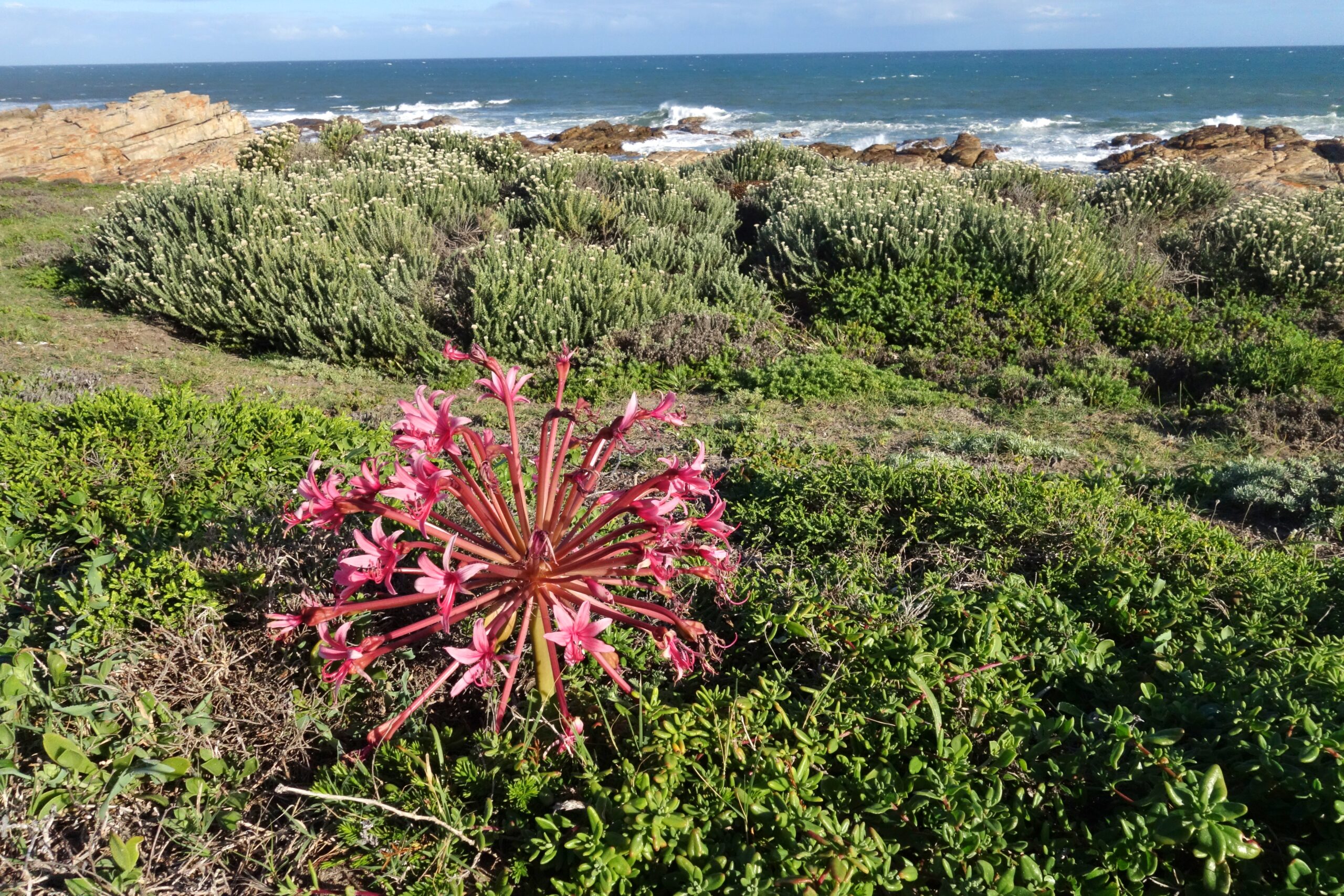
    Brunsvigia gregaria in bloom; this species is popularly known as candelabra flower.  Cape St Francis, Apr 7, 2016.

    But there were hundreds of hectares more to clear, both on public and private lands around the town. Then, in late 2012, a fire swept through, leaving severe damage and a wake-up call.

    By that time, WfW was ready to help with restoration on private lands, provided that landowners contributed to the effort. The help from WfW and others much expanded FOSTER’s reach, and in only four years, some 1000 hectares of rooikrans were cleared from private lands in the area.

    This of course dramatically reduced the township’s vulnerability to wildfire damage. As proof, when another massive wildfire swept through the area in January 2016, only three houses were destroyed. Notably, all three belonged to owners who had refused access to WfW workers seeking to eradicate rooikrans.

    Other communities along the coast have taken notice and hopefully will follow the example of Cape St Francis.

    Second landscape example: Kaboega farm

    Finally, following Richard’s advice we drove two hours inland from Port Elisabeth, not too far from St Francis Bay, to visit a truly remarkable place where four different ecosystem types meet and intermingle in a property of only 6550 hectares: 1) fynbos, 2) the karoo desert, here at its southernmost limit, 3) the northernmost temperate rain forest fragments of the South East, of which the only important remnants are found in the Knysna region, and 4) subtropical thickets.

    photo-5-podocarpus
    Outenieqwa-geelhout, or small-leaved yellowwood, Podocarpus falcatus. Outstanding specimen of the relict population growing near a perennial stream at Kaboega Farm.

    What South Africans call subtropical thickets are in fact a remarkable tapestry of vegetation types, with as many as 116 distinct variants (Cowling et al. 2005). Of particular interest here is the so-called spekboom-dominated thicket, characterized by the spekboom (Portulacaria afra).

    photo-6-old-spekboom
    Fully mature spekboom, one of the largest individuals known

    Spekboom-dominated thicket once flourished on approximately 1.4 million hectares (3.46 million acres), but today it occupies barely one-seventh of its former area. “The remainder has been degraded by over-exploitation, mainly through injudicious farming with angora goats……” (see the report Investing in Sustainability). However, spekboom is an extremely hardy succulent tree, remarkably fast-growing and readily propagated from cuttings, or even large stancheons.

    This makes it attractive for large-scale restoration work. Indeed, it has been the focus of much attention from Working for Woodlands, another member of the Working-for family of government restoration programs. The manager and co-owners of Kaboega Farm, Ian and Sandra Ritchie, stopped all agricultural activity on their land 20 years ago, to allow the land to recover from an estimated 135 years of over-grazing by small livestock. They live instead by hosting visitors, including succulent plant lovers, drawn to this hotspot of Haworthias, and university groups led by Richard Cowling. Among other recent discoveries, Cowling and co-workers have shown that subtle difference in community-level frost tolerance can determine the boundaries between tightly packed biomes at Kaboega, where diversity is sky-high despite an average rainfall of just 300 mm per annum and frequent, extreme droughts.

    photo-7-spekboom-cutting
    Spekboom cuttings struggling to get going

    Furthermore, Ian and Sandra Ritchie are attempting to restore swathes of spekboom thicket at strategic spots on their farm, as a part of an ambitious large-scale program with support of Working for Woodlands.

    They plant spekboom cuttings, which over time create an enhanced micro-environment in an otherwise harsh and difficult environment for young plants, and thus try to kick-start the regeneration of the habitat, biological community, and ecosystem. Furthermore, spekboom traps large amounts of CO2, and the general hope is that carbon credits can help finance large-scale restoration in the future. In the meantime, this is a remarkably attractive destination for nature-lovers.  In addition to the flora and landscapes, giraffe, kudu, and other game are added and allowed to roam free for the pleasure of visitors (and the owners). When numbers grow too high, however, there is a risk of exceeding carrying capacity, and some animals are captured for resale to other land-owners. This provides an additional income flow as game ranching linked to tourism and recreational hunting is increasingly popular in the region.

    photo-8-giraffes
    Portion of a thriving population of 28 South African giraffe or Cape giraffe (Giraffa giraffa giraffa) at Kaboega Farm. While some argue that giraffes are not native to the area, nearby millennial cave paintings indicate the contrary.

    At this remarkable farm, science-based conservation and restoration are making progress in an attempt to enhance biodiversity conservation, tourism revenues, and ecosystem services of all kinds. Clearly, spekboom planting is not an all-in-one solution; for jumpstarting restoration and assisting regeneration in a complex landscape and land tenure situation like this one, where temperate forests, fynbos, thicket, and karoo shrublands all occur and interact, a landscape perspective on the challenges of ecological restoration is essential. We’ll be posting more on this challenge in the future.

  • South Africa 2. Toward a Restoration Culture? Good news from the Karoo

    South Africa 2. Toward a Restoration Culture? Good news from the Karoo

    In this 4th post from southern Africa, James and Thibaud Aronson report on a pioneering, science-based restoration project, the associated private restoration company, and also a nature reserve, all founded by one pair of scientists in Prince Albert, Western Cape province, South Africa.

    Last October, posting from SW Australia, we reported on Gondwana Link and some of the activities of the Australasia chapter of SER. These are just two of the thousands of independent non-governmental groups of people working for joint environmental and social change around the world, as celebrated in Blessed Unrest, Paul Hawken’s 2007 best-selling book dedicated to the “unnamed movement” to reimagine our relationship to the environment and one another. After a year and a half researching our book on arid and semi-arid land trees, and ecological restoration projects and programs in the world’s drylands, we still like our name for that “unnamed movement” Hawken referred to, namely a restoration culture for the 21st century.

    Opportunities for grassroots or combined bottom-up – top-down efforts and synergies abound in South Africa, with its outstanding research, technology, and capacity-building from academics, think tanks, not-for-profit organizations, and small companies offering restoration services and counsel. In our last post, we described a few Working for Wetlands programs and the participation of SAN Parks (the body that governs South African national parks) developing new ways to restore natural capital and social capital at the same time. Here we move to the vast central drylands of southern Africa, known very broadly as the Karoo.

    As compared to other inland arid regions, landscape complexity here is enormous and, remarkably, ecotones, a.k.a. frontier zones are largely visible, if not intact.

    photo 1
    A klipspringer (Oreotragus oreotragus) in the Swartberg, near Prince Albert. This small antelope, which occurs throughout much of sub-Saharan Africa, is unusual in that it walks on the tips of its hooves, an adaptation to its rocky habitat.

    This huge inland semi-desert has at least four sub-regions, and borders to the southeast an archipelago of more than 100 recognized types of subtropical thicket, a plant formation forming a key transition zone, in ecological and evolutionary terms, intermediate between forest and savanna. According to plant ecologist Prof. Sue Milton and ornithologist Dr. Richard Dean,  the archeological and historical evidence indicate that the Karoo has been largely treeless for millennia. Trees are mostly prevented from growing in the Karoo, not only by the aridity (<200 mm precip./year), but also by shallow soils and cold winter temperatures. The Karoo was prehistorically grazed by nomadic ungulates that were hunted by hunter-gathers (San or Bushmen) and by transhumant pastoralists – the Khoe-khoe. Yet, a huge change came about when European colonization in the 18th century brought wire fencing, deep drilling and wind pumps for extracting underground water. As Sue and Richard put it, “combined with a large demand for wool in Europe, this led to a boom in sheep farming and the development of rural villages, mostly dependent on ground-water.”


    Map
    Southern African biomes, highlighting the large extent of the Karoo (yellow & brown), and the two sites we visited: Prince Albert and the Plains of Camdeboo. Modified from: http://www.plantzafrica.com/vegetation/vegimages/biomes800.jpg 

    We traveled to Prince Albert, a small town in the Karoo, where we met up with our old friends and colleagues Sue Milton and Richard Dean, who are the co-owners of Renu-Karoo Veld Restoration and founders of the Wolwekraal Conservation and Research Organization, a unique research site Sue and Richard acquired in 2007, very near the edge of this isolated town. After nearly 40 years of hard work as international researchers and teachers, Sue and Richard decided to focus their considerable energy for the remainder of their careers to their town, and a community-based restoration and revitalization program for the Karoo. Unlike many NGOs in the “restoration movement” theirs is firmly grounded in science. Prior to launching Renu-Karoo, when they first moved to Price Albert, they continued teaching part-time in Cape Town – a full day’s drive away, and ran the Tierberg Karoo Research Station, a long-term ecological research site nearby, for many years. They have also written or edited the major ecological textbooks on the Karoo, both for basic researchers and managers. And indeed, it is a complex area in need of serious restoration work.

    The plant nursery is a key component for all of Renu-Karoo’s activities, producing indigenous Karoo plants and plugs for landscaping and restoration. Availability of indigenous plants in the village has also gradually led to increased popularity of water-wise gardening and to an awareness of local plant diversity.

    photo 2
    Sue Milton and Richard Dean surrounded by native and ornamental plants at the Renu-Karoo nursery.

    photo 3
    One of the nursery’s 10 employees beginning the day with a round of watering.

    As Sue and Richard explain:

    “……the vast plains of the Karoo, the wooded drainage lines, the ancient gnarled trees of the dunes and mountains, and the elusive wildlife have been damaged by poor agricultural practices. The area is also currently threatened by development of solar and wind energy generation facilities, and uranium and gas mines that could convert the quiet Karoo into the ‘power factory’ of South Africa. A combination of conservation, education, and continuous active rehabilitation will be needed to enable future generations of people to benefit economically as well as recreationally and scientifically from this rocky and glorious desert landscape.”

    When Sue and Richard established Renu-Karoo a decade ago, their goal was to grow and supply Karoo shrub and grass seeds and to provide consulting services on how to re-establish or “repair” Karoo vegetation. Through trial and error, research by students and interns, collaboration with other companies and not-for-profit organizations, and follow-up surveys of restoration and rehabilitation projects, they have produced valuable knowledge, made available both informally and in scientific publications. Additional services, such as contract growing of plugs and plants of never-before propagated veld (the South African name for the sparsely vegetated landscapes typical of the Karoo) plants have added to the interest and capabilities of the business. They also provide free environmental classes and natural history talks and walks to school children and adults. They are truly global citizens working locally to build a Restoration culture in their home, the Karoo.

    As part of their work to advance the movement, and raise the bar in restoration and management work, Sue and Richard’s consulting work takes them to businesses and private farms throughout the Karoo. From Prince Albert, we traveled north- east, to visit one such place, the Plains of Camdeboo Nature Reserve, a privately-owned property on the edge of the Karoo.

    photo 4
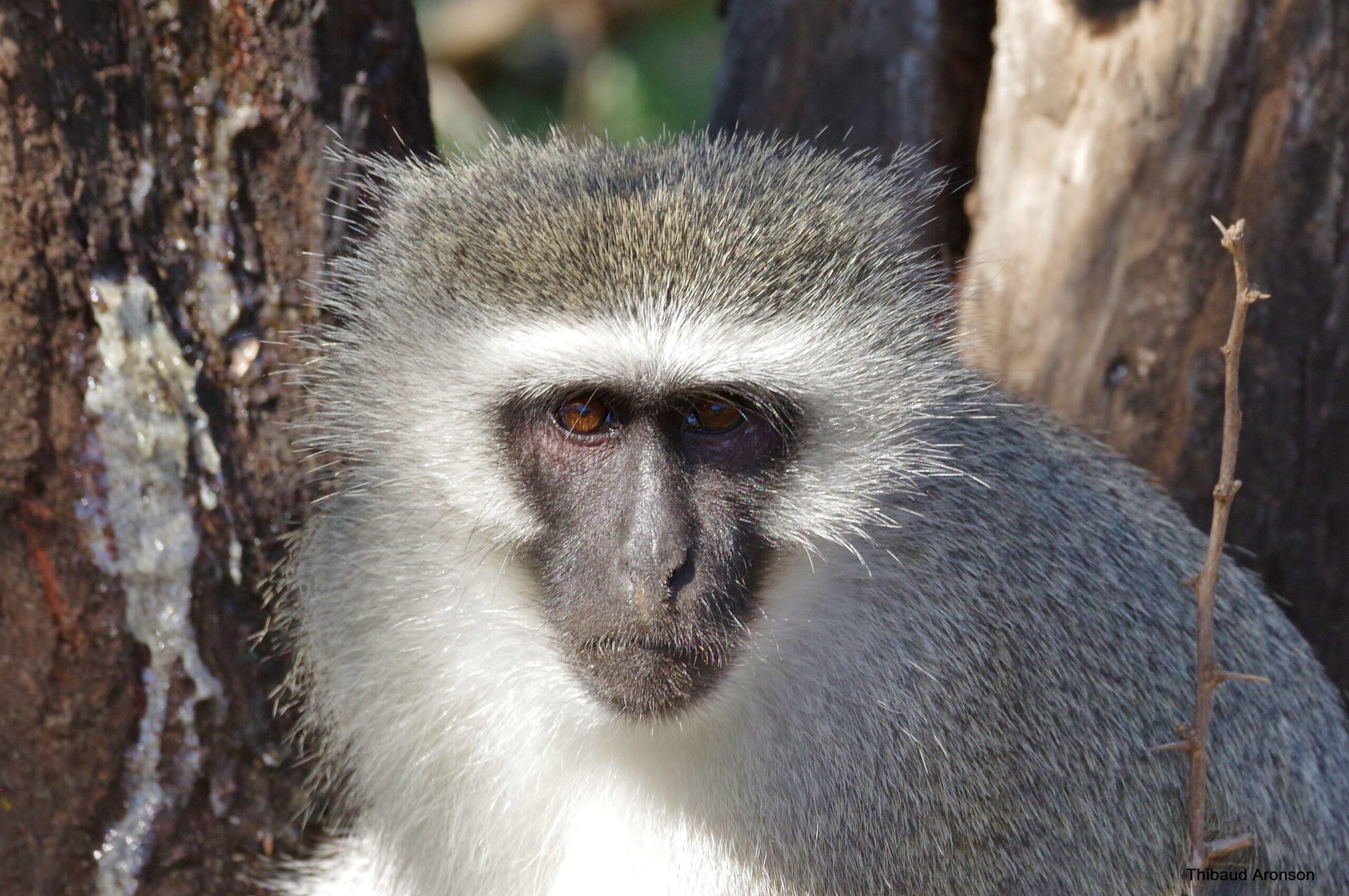
    A male vervet monkey (Chlorocebus pygerythrus) feeding in an Acacia, at Camdeboo National Park.

    This nearly 9000-ha property once encompassed three game farms, which were severely overgrazed for a century, if not more. The properties were acquired by Vincent Mai, a South African who lives and works in New York City, and his wife Anne. They wanted to help preserve a piece of the Karoo where Vincent had grown up.

    As it was clear that overgrazing in the past had seriously damaged the land, a South African conservation organization, the Wilderness Foundation, was invited to help. For the past six years, this foundation has been carrying out restoration work on the reserve. Their main focus is on eroded and impoverished soils, and they have undertaken a range of approaches, from grazing native Zulu cattle, to using agave stems and hay to block erosion gullies. A number of mammal species were also reintroduced. Angus Tanner, the indefatigable manager, showed us the range of their work on the reserve. Money and manpower is limited, and there are still many obstacles, but they are making great strides. They rely on Renu-Karoo for advice and seeds and technical advice. They are also reaching out to cooperate with the nearby township and their neighbors. Stitch by stitch, and farm by farm, the restoration culture is spreading in the Karoo.

    photo 5
    Traditional Zulu cattle in the Plains of Camdeboo Nature Reserve. They both break up compacted soil and fertilize it as the managers move them around the property.

    photo 6
    Two adjacent erosion gullies at the Plains of Camdeboo. The one on the right was plugged with a fence gabion and agave stems, in order to slow water flow and trap sediments. The gully on the left was not treated. A year later the difference between the two speaks for itself.