Tag: native plants

  • From Hayfield to Meadow: An Herbicide-Free Sod Removal Trial to Restore Native Meadows in Virginia’s Northern Piedmont Region, USA.  

    From Hayfield to Meadow: An Herbicide-Free Sod Removal Trial to Restore Native Meadows in Virginia’s Northern Piedmont Region, USA.  

    By Charlotte Lorick

    Charlotte Lorick is the Head of Biodiversity Conservation at the Oak Spring Garden Foundation in Virginia, United States. She also leads the Forgotten Flora Project, an environmental and educational consulting initiative. In addition to this work, she serves as a co-lead of the Restorative Landscape Coalition, a working group of the Northeast Seed Network. In this blog, she shares her hands-on experience organically restoring a meadow in a former horse pasture and hayfield in the eastern United States.

    Transformation of former hay fields (left) to native meadow (right) using sod removal for site prep. Photo by Charlotte Lorick.

    In Virginia’s Northern Piedmont region, where rolling hills extend from the Blue Ridge Mountains toward the Atlantic Coastal Plain, sits the Oak Spring Garden Foundation (OSGF). Its mission is to support and inspire scholarship and public dialogue on the history and future of plants, including the art and culture of plants, gardens, and landscapes, and the importance of plants for human well-being. OSGF advances this mission through fellowship and residency programs, a renowned research library, and by cultivating a biocultural conservation farm and ornamental gardens. The foundation also convenes meetings and collaborations focused on botany, horticulture, and landscape conservation. In this capacity, OSGF hosted the inaugural meeting of the Restorative Landscape Coalition in 2024

    Among the foundation’s primary goals is conserving and promoting native plants and biodiversity across the 280-hectares (700-acres) of land under its care. This goal can often prove challenging because the land at OSGF, like much of the rich soils of the Northern Piedmont, has long been shaped by agricultural land use. The impacts of agriculture on soil and plant communities are long lasting and can be detrimental to native species richness and diversity. Heavy fertilization favors exotic species over natives and the common practice of heavy tillage forever alters the soil and seed bank, further decreasing native species richness. Indeed, the IUCN considers temperate grasslands the least protected, most heavily altered, and most endangered terrestrial biome in the world. In the southeastern United States in particular, an estimated 90% of pre-European grasslands have been lost due to agricultural practices and other factors. And the small amount that do remain are indicators of the incredible species richness that have been lost. A recent study of Virginia’s Piedmont grasslands demonstrates they are far more biodiverse than previously documented, with surveyed sites having over 100 plant species in a single 100 m² plot. 

    This ecological and land use legacy raises a common challenge for conservation landowners across our region: how to restore native meadows to ecosystems degraded by intensive agriculture? As agricultural abandonment has increased across the region, converting old pastures to native meadows by removing existing vegetation and seeding a regionally native seed mix has become a common practice to address that challenge. Meadow restoration as a practice can actually mean different things depending on the situation. In the context of the Society for Ecological Restoration’s (SER) Restorative Continuum of activities, most often these kinds of meadow plantings fall along the restoration continuum but are distinct from efforts to fully restore native biodiversity and ecosystem health based on a reference ecosystem. Instead, in our region and at OSGF these meadow restorations emphasize incorporating designed, site-adapted native plant communities into degraded grasslands. We are aiming to increase native diversity in our grasslands and this is one way to accomplish this. However, for several reasons, including lack of robust data on reference communities or access to hyperlocal native seed, we consider these projects as distinct from but complementary to a full-scale ecological restoration effort. 

    As every practitioner will tell you, restoring a native meadow is a challenging process in this region as the non-native weeds and pasture grasses (that had historically been introduced for cattle and hay production throughout the Eastern US) are tenacious. Removing them effectively to allow establishment from a native seed mix is arguably the most critical yet most challenging part of the meadow restoration process. Conventional methods rely on heavy use of herbicides or tilling, which both have considerable downsides. Yet data are lacking in this region specifically on alternatives. To address this gap and inspire formal research on innovative or alternative techniques to restore native meadows in the Eastern US, in 2023 we trialed a novel method to restore a meadow that could prove a viable alternative for small areas to the conventional herbicide and tillage approaches.  

    This post details our project, outcomes, and lessons learned. We outline the experimental approach, site preparation methods, and early establishment results, and reflect on the practical implications of this technique. This project is a case study rather than a formal experiment, but we believe that what we learned in the field and are sharing here can havevalue for generating hypotheses and informing land managers interested in applying this method on their land and researchers interested in conducting future studies.

    Landscape Context and the Case for Meadow Restoration

    The OSGF landscape includes a rich mosaic of open fields, meadows, forests, streams, and wetlands that have been shaped by a long history of anthropogenic influence. In Pre-settlement times, the commonly held theory is that the Piedmont was characterized by oak-hickory landscapes with patches of forest and savannahs often managed by controlled fire. Post European settlement, the land at OSGF was managed, including by enslaved people, for row crops and apple orchards, grazing cattle and hay production, and, in the last 50 years, horse pasture. 

    Today, through careful inventory of the landscape, we have identified several remnant and globally rare plant communities on the OSGF property that seem to have escaped much of the human impacts. These include a Piedmont upland depression swamp containing cypress-knee sedge (Carex decomposita), a species designated as critically imperiled in Virginia with fewer than five known populations remaining in the state, and false hop sedge (Carex lupuliformis), another exceptionally rare species.

    However, most of the open fields on the property are now products of a two and a half century agricultural legacy and are low in diversity, dominated by non-native cool-season grasses and other exotic species. While these non-native grass dominated pastures are actually choice nesting areas for many declining grassland specialist bird species at OSGF (including Eastern Meadowlarks (Sturnella magna), Grasshopper Sparrows (Ammodramus savannarum) and Bobolinks (Dolichonyx oryzivorus), we are selecting areas carefully to convert to native meadow where these birds are not nesting to support other suites of species that benefit from native meadow conversion. These areas hold strong potential for ecological restoration and conversion to diverse native meadow habitat and have become high priorities for conservation for OSGF.  For example OSGF is also home to several threatened or declining bird species that depend on diverse grasslands and early successional plant communities. These species include Short-eared Owl (Asio flammeus), Northern Bobwhite (Colinus virginianus), American Kestrel (Falco sparverius), Savannah Sparrow (Passerculus sandwichensis), and Henslow’s Sparrow (Centronyx henslowii). Notably, the native meadows that OSGF has established over the years have become winter hotspots for Short-eared Owls and Northern Harriers (Circus hudsonius) and other birds.

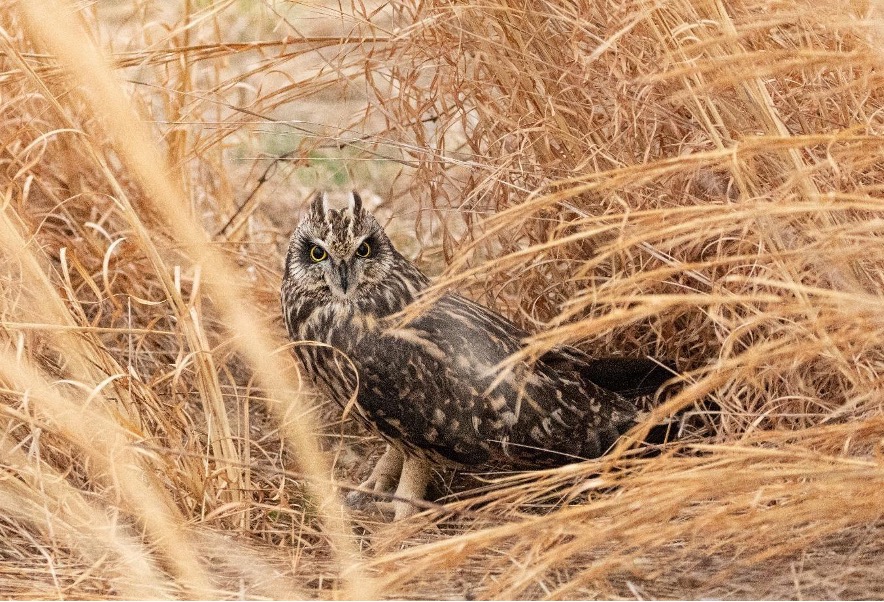
    Short eared Owls overwinter at OSGF every year and prefer roosting in clumps of native bunch grasses and in our restored native meadows. Pictured here in native broomsedge (Anatherum virginicus, syn. Andropogon virginicus) and purpletop (Tridens flavus) clump. Photo by Josh Rector, OSGF.

    Can Sod Removal Replace Herbicides?

    As OSGF transitions away from its historic use of the land for hayfields and pasture, we have initiated several native meadow restoration projects over the past decade, totaling roughly 24 hectares (60 acres). These projects have primarily used conventional installation approaches, including herbicide application or chemical-free methods such as repeated tilling and plowing. The most common conventional method is to apply a broad-spectrum herbicide, such as glyphosate, at least 3 times to create enough bare ground to seed the meadow. But chemical herbicides are not always effective on some of the most aggressive weeds, they are not effective on controlling weed seeds in the seed bank, they can alsonegatively alter the soil, and pose safety concerns for humans and wildlife. Unfortunately the common organic alternative relies on heavy tillage which comes with its own major downsides, including increases in noxious non-native weeds and negative impacts on soil health.

    OSGF is particularly interested in restoration strategies that minimize or avoid the use of chemical herbicides. We are not alone. Across our region, many landowners are exploring herbicide-free approaches to meadow restoration. However, robust data on the efficacy of alternative methods are limited.

    For this project we decided to try sod removal or scraping. Although this method of site preparation is often employed on small scales for garden installation or lawn conversion, we found little data on this method for large scale restoration plantings. However, we were encouraged by the results of some restoration studies from Europe and California involving topsoil removal.

    Sod Removal Project Design: Methods, Site Preparation, Seeding, and Maintenance

    The sod removal trial was designed with two main goals: to test an understudied organic approach to meadow restoration site preparation, and to share our case study to encourage further exploration of the approach, and perhaps formal research comparing this method with more common approaches. 

    The trial took place on a 0.8-hectare (2-acre) parcel of a former horse pasture and hayfield. Baseline vegetation surveys showed it was dominated by introduced cool-season pasture grasses: tall fescue (Lolium arundinaceum), orchard grass (Dactylis glomerata), and Kentucky bluegrass (Poa pratensis).

    To track change over time, we established permanent vegetation monitoring plots across the site. Vegetation surveys were conducted at baseline (Year 0) before disturbance and twice per growing season following seeding (2024 = Year 1, 2025 = Year 2). Soil samples were also collected at baseline and in each subsequent year. In November 2023, we removed the top layer of sod using the bucket of a skid-steer at a depth of approximately two inches. Afterward, the soil surface was lightly raked to improve seed-to-soil contact. We hand-broadcast a native seed mix using pine shavings as a carrier at 13.5 kg per hectare (12 lb per acre) and seeded a temporary cover crop of 50% winter rye and 50% oats at 34 kg per hectare (30 lb per acre). The field was then lightly covered with straw using a straw blower. The seed mix included 28 regionally appropriate species, roughly 60% perennial grasses and 40% forbs. 

    Management during the first two years was intentionally light. In Year 1, the cover crop was flail-mowed once in the spring. Other interventions involved manual cutting or pulling of problem weeds, primarily biennial thistles (Carduusspp.), a single clump of Johnsongrass (Sorghum halepense) likely introduced during site preparation, and spot mowing of creeping thistle (Cirsium arvense). Additional mowing had been planned but proved unnecessary due to relatively low weed pressure. The most common weeds were the annual grass Setaria pumila, which we expected to decline naturally, and white clover (Trifolium repens), which remained low-growing and did not appear to inhibit germination of the native seed mix. In Year 2, the meadow was flail-mowed once in the spring, followed by two days of manual cutting of problem weeds—mainly biennial thistles—to prevent seed set during the growing season.

    Progress photos

    Year 0 baseline (left) dominated by cool-season pasture grasses with intermittent ruderal forbs. Site prep (middle & right) included sod removal with skid-steer, raking soil, hand seeding and covering with straw. Photos by Charlotte Lorick.
    Year 1 from left to right, July, September, October. A lot of bare ground in year 1 (left) and complete removal of non-native grasses with pioneering black-eyed susan and mistflower (middle) already blooming. Slower-growing perennials such as hoary mountain-mint were abundant as well (right). Photos by Charlotte Lorick.
    Year 2 from left to right, July, September, October. Abundant mountain mints and volunteer path rush dominating the wetter section with black-eyed susans in the background (left). Many perennials flowering and fruiting including the gray goldenrod and little bluestem (middle & right). Photos by Charlotte Lorick.

    Preliminary but Encouraging Outcomes 

    Because native meadows take time to establish, we want to emphasize that these observations are preliminary, with only two growing seasons documented so far. We will continue monitoring the site over the coming years and hope to share longer-term results as the meadow develops.

    Nevertheless, at this early stage, several encouraging patterns have emerged. Total native species richness approximately doubled in Year 1 and tripled in Year 2 compared to baseline conditions. Native forb richness increased even more dramatically, more than tripling from baseline to Year 2. At the same time, the three most abundant baseline species—all exotic cool-season grasses—dropped from nearly 100% cover in Year 0 to less than 5% cover by Year 2 when averaged across all survey plots. This is an important indicator that sod removal was extremely effective in removing existing non-native vegetation.

    Figure 6. Total number of species documented across all survey plots and including incidentals encountered outside formal surveys. Plants were designated native or introduced rank based VA Digital Atlas and given invasive rank based off : https://www.dcr.virginia.gov/natural-heritage/invsppdflist
    Figure 7. Total number of native forb species documented across all survey plots and including incidentals encountered outside formal surveys. 

    By the second year, 22 of the 28 species in the seed mix had germinated, with several species already fruiting in the first year. This is a highly successful germination result by year two. For comparison, some of our other meadow restoration projects that used herbicide did not have germination of many of these same species until after year 2.

    Species seeded. P = Present but not seen flowering or fruiting, F = Observed flowering or fruiting, 0 = Not observed. *A small number of Midwestern species were included to provide early visual interest and occupy space in the first few years, but are expected to fade as the native perennial species establish. ** This species was only seeded in a small drift to prevent overabundance.

    In addition to the seeded species, we documented a number of native volunteer species that were not part of the seed mix and were not recorded in baseline surveys. These included secund rush (Juncus secundus), path rush (Juncus tenuis), forked rush (Juncus dichotomus), sweet everlasting (Pseudognaphalium obtusifolium), green milkweed (Asclepias viridiflora), and sedges such as fox sedge (Carex vulpinoidea), straw-colored flatsedge (Cyperus strigosus) and globe flatsedge (Cyperus echinatus). The arrival of native volunteer species was an exciting bonus and good indicator that some of the legacy native seedbank was still intact and uncovered with sod removal.

    Lessons Learned and Key Takeaways 

    While this project was not designed as a formal experiment, the results have been striking and our hypotheses can inform further studies. Compared to other meadow restoration efforts attempted at OSGF, this planting has performed exceptionally well. It has required far less maintenance and weed management, and the native seed mix established with noticeably higher germination, flowering, and overall cover. The method was also particularly effective at suppressing the dominant cool-season grasses that often make meadow establishment so challenging.

    Before seeding, the site supported very little native diversity. And the few native plants that we did find were woody seedlings or ruderal species such as horse-nettle (Solanum carolinense) and pokeweed (Phytolacca americana). Following the restoration work, native forb diversity increased substantially, including the appearance of several volunteer species. Although non-native white clover became the dominant plant by percent cover, its low, spreading growth did not appear to suppress the emerging native seedlings.

    Of course, many factors could have contributed to this success. The seed was broadcast rather than drilled, which may have supported quicker germination. Careful site selection, existing vegetation conditions, and even the drought that followed seeding may also have played a role. Still, after more than a decade spent surveying and working in meadows across Virginia, this site stands out as one of the most rapidly successful restorations I’ve ever observed.

    Our working hypothesis is that scraping away the existing sod removed much of the weed pressure by removing the grassrhizomes in the uppermost soil profile and some of the associated seed bank. It also slightly reduced the organic matter and nutrient layer at the soil surface—conditions that may have favored native species during establishment by reducingweed pressure (which thrive in more fertile soil). Although a decrease in organic matter may not be ideal for overall soil health, the decline is likely temporary. A growing body of research suggests that over time, the increase in native plant diversity may ultimately improve soil health beyond what we observed at baseline. This is something we plan to monitor in the years ahead with continued soil sampling. 

    The primary drawback of this method is cost. Removing and relocating large amounts of topsoil requires significant upfront investment, which may be impractical in some situations and at larger scales. However, this material can be reused elsewhere on a property in areas not prioritized for restoration or offered as a resource to farmers or composting operations. It is possible that these higher initial costs could ultimately be offset by reduced long-term maintenance and weed control, but that would take further study to determine.

    Another challenge we encountered was sourcing local seed. Ideally, we would have used seed with documented provenance sourced from populations occurring in Virginia’s Northern Piedmont ecoregion, but the native seed supply chain still has significant gaps. To help address native seed shortages, OSGF has partnered with the Northeast Seed Network’s Mid-Atlantic Seed Partnership and the Restorative Landscape Coalition, a working group of botanic gardens, arboreta, seed banks, and allied organizations working to expand the availability of diverse, source-identified native seed for ecological restoration across the Mid-Atlantic and Northeastern United States. For this project we purchased seed from Ernst Conservation Seed in Pennsylvania and although not all seeds were sourced from our ecoregion, we were pleased that all their seed was from very nearby ecoregions and states in the Eastern US. 

    We hope this project encourages others to explore sod removal for meadow restoration. There is much practical experience still to be gained and there are many questions worth investigating in controlled experiments to compare this method with other site preparation techniques, test different sod removal depths, or variations in seed mix compositions.

    In the meantime, we plan to explore the further use of this approach in future restoration projects at OSGF. If you’re curious about the project or interested in collaborating, we’d be happy to connect.

    Please feel free to reach out to me at charlotte.lorick@osgf.org, and stay up to date with the outcomes of this project—and more of my work—at https://www.osgf.org/conservation-biodiversity and https://forgottenfloraproject.substack.com/.

    Acknowledgements: Special thank you to OSGF team Clif Brown, Josh Rector, Katharine Perkin, Sarah Krementz, Sam Terry and local contractor Virginica LLC for support of this project.
  • Native Plant Seeding Solutions for High Disturbance Highway Roadsides

    Native Plant Seeding Solutions for High Disturbance Highway Roadsides

    By Wes Bollinger

    Wes Bollinger completed his master’s in 2025 with Jeffrey Matthews lab in the Department of Natural Resources and Environmental Sciences at the University of Illinois. Wes is now a restoration ecologist in Chicago and runs his own restoration consulting business – Wildshape Ecological Design.

    The modern American landscape is crosscut by millions of miles of roadways. This land that was previously part of intact ecosystems has been converted into impermeable pavement and ditches, reducing the quantity and quality of habitat. Roadways also lead to habitat fragments, which can impede the movement of animals around the landscape. Highways in the Midwest (Illinois, Indiana, Iowa, Michigan, Minnesota, Missouri, Ohio, and Wisconsin) amount to more than 100,000 centerline miles (160,934 km) of roadway, and their unpaved right-of-way (roadside margins, medians, interchanges, etc.) total over 1,010,000 acres (445,000 ha) of unpaved land and soil. Highway roadsides typically experience high rates of disturbance due to wind, vehicle traffic and pollution from oil, microplastics from tires and litter, and often agricultural additives like herbicides, insecticides, and fertilizers. These lands and similar areas adjacent to roadways may be either burden or boon to the local ecosystem depending on management regimes and use of disturbance tolerant plant species. Here I recommend an approach to identifying appropriate native species for roadside vegetation, but this perspective may also apply to a variety of marginal greenspaces, such as residential sidewalk strips.

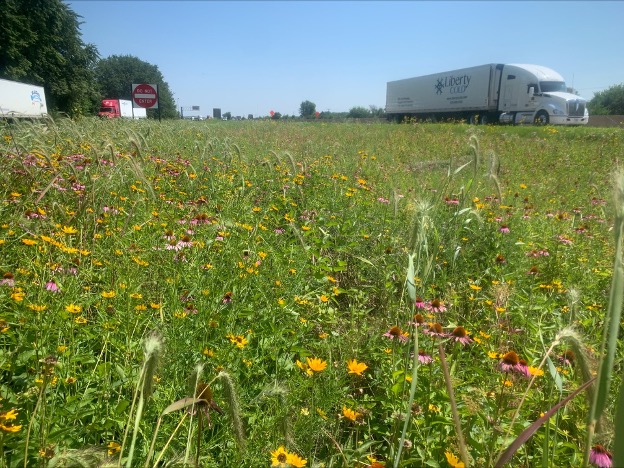
    Native species dominated restoration project on a highway roadside in Northern Illinois. Visible flowerheads are pale purple coneflower (Echinacea pallida), lanceleaf coreopsis (Coreopsis lanceolata), black-eyed Susan (Rudbeckia hirta), and Canada wildrye (Elymus canadensis). Photo by Wes Bollinger.

    If poorly managed, rights-of-way can become heavily invaded by nonnative plants like common reed (Phragmites australis), teasel (Dipsacus fullonumDipsacus laciniatus), and Johnsongrass (Sorghum halepense) among many others. These invasive species inhibit the native grasses and forbs and reduce ecosystem functioning. When heavily invaded, roadsides also cause economic impacts, functioning as source populations of weeds that can impact adjacent agroecosystems. Typically, roadsides are seeded with a mixture of Eurasian turfgrasses like Kentucky bluegrass (Poa pratensis) and red fescue (Festuca rubra). These nonnative grasses are comparatively short both in their above- and below-ground growth. Their short roots do not inhibit the growth of undesirable nonnative species, resulting in more mowing and maintenance than a native plant community to keep areas appearing ‘pristine.’ 

    However, roadsides can be restored with native species and managed using best practices to provide economic and environmental benefits to the region. Native-dominated vegetation can inhibit invasion, protect nearby remnant habitats, promote healthy soil, improve stormwater retention, absorb agricultural additives, sequester carbon, and provide forage and migration corridors for native animals. Though establishing native vegetation on roadsides may have these obvious benefits, there are many knowledge gaps pertaining to this practice such as how and what to seed in these areas to maintain the highest ecosystem fidelity and greatest economic benefits.

    We conducted research to determine which native species to seed on highways and the best practices for establishment and maintenance of these areas, with the goals of lowering overall maintenance costs by reducing the frequency of mowing needed to maintain these areas. This work was funded through grants from the Illinois and Indiana Departments of Transportation (DOTs) in conjunction with the Illinois Center for Transportation and the University of Illinois.

    I carried out three projects to gain empirical evidence on how to restore Midwestern roadsides with native species. Project 1) reviewed the native seeding practices of the DOTs of the Midwest to identify commonly seeded species and assessed establishment and management practices. For Project 2) we conducted experimental trials in Illinois comparing existing Illinois DOT mixes (non-native and partially native) with novel mixes that we designed to be more diverse and contain only native species. For Project 3) we conducted a field survey of existing native roadside plantings across Illinois and Indiana. Projects 2 and 3 sought to quantify the performance of individual species to determine which ones have the greatest establishment and persistence in roadside conditions, and what conditions lead to favorable native establishment generally.

    Project 1) Current native seeding and management practices

    My review of Midwestern DOT seeding practices revealed stark differences between DOTs among states, but some commonalities that are noteworthy for establishment and maintenance. Most interestingly was the disparity in native diversity between states. Michigan did not list any native species in their roadside manual, while Minnesota listed 108, the most of any Midwestern DOT. Further, Minnesota listed 11 majority or entirely native seed mixes and had the most comprehensive standard operating procedures for native seeding. Many mixes had average max heights under 3 ft (~1m) to avoid obscuring motorists views on roadsides; however, some states had mixes more than 5 ft (~1.5 m) for tallgrass areas and to increase the invasion resistance of an area by blocking light access with taller plants. Perhaps surprisingly, the states of Ohio and Indiana still list an invasive legume, crownvetch (Securigera varia), in mixes designed for erosion control.

    Number of majority native species mixes listed by Midwestern Department of Transportation in order of most to least native species (n) listed.

    Several establishment methods were common across states. Native seeds should be sown into low-fertility topsoil using a hydroseeding machine (a device that sprays a mixture of seed, water, and an organic adhesive agent directly onto soil) especially on sloped areas. Hydroseeders show remarkable success in soils with a seed bank containing invasive species, by avoiding tillage which can bring these seeds to the surface and increase their germination. Native straw can be applied as a mulch layer and may be harvested from areas scheduled for maintenance with mowing. Seeding should take place in the fall to allow for cold stratification. Local ecotype seeds are preferred to produce individuals with locally adapted phenotypes and avoid genetic contamination with seeds harvested outside the region. Mowing in the first year of growth is critical to reduce invasive species while native seedlings establish. Minnesota recommends three mows in year one, in May, June, and July, and a singular mow between July and August of year two. Controlled burning of these areas is ideal every 3-5 years but mowing at the same rate is also beneficial. 

    Project 2) Comparative performance of standard (mixed origin) and native-only mixes

    As a method of direct comparison between existing DOT seed mixes and a fully native roadside, I established four trials across Illinois to test differences in seeded, native, seeded native, and nonnative unseeded plant cover and richness, thus also providing information on invasion resistance between four popular mixes (DOT lawn, roadside, north IL, south IL) and four corresponding fully native plant mixes I designed to meet the same general criteria (low growing, disturbance, and salt tolerant) while also being higher diversity (from 9 to 38 species depending on mix). These experimental plots were seeded in November 2023 and surveyed in May and August of 2024. I observed that plantings differed in degrees of success, but every trial showed at least one significant positive result for the native planting over the nonnative IDOT mix. Native richness was higher for all sites by August of the first growing year, and native cover was higher for three of the four experiments. My trial of the IDOT Class 3 North Slope mix against a mix of 38 native species yielded significantly higher seeded cover by August 2024, and higher richness and cover of all native species in both May and August, suggesting that this high diversity mix competed very well against an existing DOT mix which was a combination of native forbs and nonnative grasses. Based on preliminary data collected during 2025, the native species are continuing to outpace the nonnatives in these mixes. 

    Of the native species seeded in these trials, those with the greatest record of germination in year one are lanceleaf coreopsis (Coreopsis lanceolata), common milkweed (Asclepias syriaca), partridge pea (Chamaecrista fasciculata), Illinois bundleflower (Desmanthus illinoensis), pale purple coneflower (Echinacea pallida), common evening primrose (Oenothera biennis), golden Alexander (Zizia aurea), blue vervain (Verbena stricta), and plains oval sedge (Carex brevior), which were present in the first year between 50% and100% of plots they were seeded in.

    Example paired plot before site prep and seeding (left) and August of the first growth year after establishment (right). IDOT mix on the left, native mix on the right of each image. Yellow flowers are golden Alexanders (Zizia aurea). Photo by Wes Bollinger.

    Project 3) Identifying the most successful native species from field surveys

    Lastly, I surveyed 34 native plantings on roadways across Illinois and Indiana at various distances from the road edge while collecting data on soil chemistry, surrounding land use, and soil compaction. Sites were more than two years old to avoid plantings early in their establishment. The purpose of this project was to identify which seeded species tend to germinate and persist, and what environmental factors contribute to higher native and invasive success. Of the 153 native species seeded in one or more sites, we found that 28 native species were observed in at least half of the planted sites and 84 species were never observed once despite being seeded in anywhere from one to 12 sites. Five species were found a total of 10 or more times each across all 34 sites: common milkweed (Asclepias syriaca), bee-balm (Monarda fistulosa), black-eyed Susan (Rudbeckia hirta), false sunflower (Heliopsis helianthoides), and switchgrass (Panicum virgatum). These five species along with Virginia wildrye (Elymus virginicus) were also the most observed species at sites where they were seeded. These surveys were not designed to be comprehensive given the size of many of these plantings and it is highly probable some other seeded species were present but unobserved.

    I found that native diversity and cover were generally higher further from the road edge, in areas with less salt, more basic soil, lower nitrogen and phosphorous, and a higher seed mix diversity. The opposite was true for nonnative cover and diversity. Richness of the seeded native mix was one of the strongest determinants of both diversity and cover. 

    In summary, we recommend that seed mixes should be hydroseeded at a rate of 60-70 seeds per square ft. (650-750 seeds per square meter) into low-nutrient, unfertilized soils, and covered in native straw. High-diversity mixes with no more than 10% legumes and an otherwise equal ratio of grasses to forbs should be used. Several species (but no more than 10%) should be early-establishing annual forbs for first year cover. Select species so that there is at least one blooming at all times of the growing season, favoring plants like golden Alexander (Zizia aurea) and native Alliumspecies for early spring blooms. Seed in as large an area as possible to reduce edge effects, consider cloverleaf interchanges as ideal locations for large projects.

    For maintenance in year one post-seeding, mow several times (May, June, July, potentially also August in warmer states) to a height of 6-8 inches. In year two, mow at least once between June and September. Controlled burning or mowing can be conducted as needed for persistent weed issues but generally are only required every three to five years. If mowing is needed, areas with low abundance of non-native plants can be harvested as native straw for future plantings.

    Native species with the best establishment record and widest usage are as follows and should be prioritized in high disturbance roadside plantings: Asclepias syriacaAsclepias verticillataBouteloua curtipendulaCarex breviorCarex cristatellaCarex hystericinaChamaecrista fasciculataCoreopsis lanceolataDalea purpureaDesmanthus illinoensisEchinacea purpureaElymus canadensisElymus virginicusEryngium yuccifoliumEupatorium perfoliatumHelianthus grosseserratusHeliopsis helianthoidesJuncus effususMonarda fistulosaOenothera biennisPanicum virgatumPenstemon digitalisPhysostegia virginianaPycnanthemum tenuifoliumRatibida pinnataRudbeckia hirtaSilphium laciniatumSymphyotrichum novae-angliaeSymphyotrichum puniceumLiatris pycnostachyaVerbena strictaVernonia fasciculataand Zizia aurea.

    Further details and methods can be found in the thesis here or by contacting the author at info@wildshaperestoration.com

  • Using a 130-year-old dataset to inform ecological restoration decisions on Mount Desert Island, Maine, USA

    Using a 130-year-old dataset to inform ecological restoration decisions on Mount Desert Island, Maine, USA

    By: Tate Bushell

    Tate Bushell is the Director of Natural Lands with the Mount Desert Land & Garden Preserve on Mount Desert Island, Maine, where he cares for ~1,400 acres of beautiful spruce-fir forest.  tbushell@gardenpreserve.org

    The Mount Desert Land & Garden Preserve’s mission is to conserve and share the beauty of our historic lands and gardens, which it does by managing three historic gardens and approximately 1,400 acres (567 ha) of natural land on Mount Desert Island, Maine for ecosystem health. Also, as needed, we undertake restoration interventions, particularly in our post-agricultural meadows. 

    Mount Desert Island (‘MDI’, ~60,000 acres, 24,280 ha) is well known for its breathtaking, rugged coastal scenery and for holding the largest unit of Acadia National Park (~30,500 acres, 12,343 ha), one of America’s earliest (1916) and most visited (~4 million visitors/year) national parks. The two other units of Acadia National Park include part of Schoodic Peninsula (2,366 acres, 957 ha) and part of Isle au Haut (2,900 acres, 1,200 ha).  The Garden Preserve’s natural lands are directly adjacent to Acadia National Park and mirror it ecologically; both are covered by spruce-dominated hills (primarily red spruce, Picea rubens), streams and wetlands.

    Acadia National Park (shown in green on map) comprises three primary units. Mount Desert Island is home to the park’s largest unit. The yellow star shows the location of the Land & Garden Preserve’s natural lands (1,400 acres, 567 ha).  Map courtesy of US National Park Service.

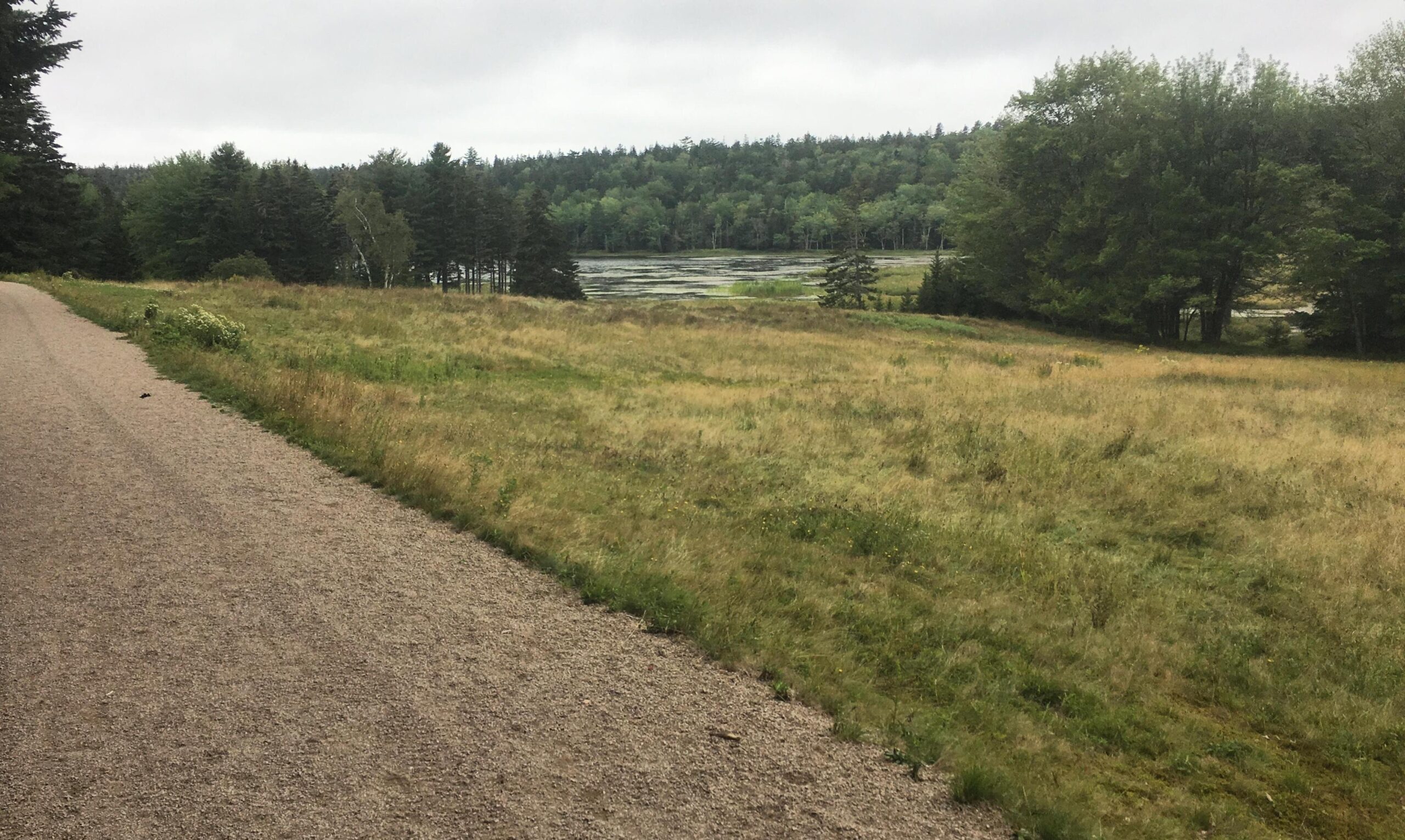
    As the Land & Garden Preserve’s Director of Natural Lands, I am charged with conserving the ecological integrity of the natural lands while ensuring safe public access. Our ten miles of trails and ten miles of carriage roads see over 75,000 visitors per year. A twenty-acre, post-agricultural meadow sits at the heart of the natural lands, and from the nearby carriage road the meadow provides picturesque views of the surroundings, making this a popular destination for walkers, dog walkers, horseback riders, and bird watchers.

    A ‘carriage road’ sits next to the 20-acre meadow. Because of its views, this road is a draw to thousands of walkers and nature enthusiasts. (This and all other photos are by the author unless otherwise indicated.)

    I have focused management on Garden Preserve’s meadow because early successional habitats are uncommon on Mount Desert Island (Acadia National Park manages less than 100 acres of upland meadows on MDI) and because of the presence of invasive glossy buckthorn (Frangula alnus), invasive reed canary grass (Phalaris arundinacea), and some other weedy, nonnative plants. To establish a firm understanding of the plant community I commissioned a wonderful field botanist to conduct a survey of the meadow’s vascular plants (completed in 2020). From 2019-2021 we eradicated the canary grass from three monoculture patches (totaling 2,500 ft², 232 m²) and began restoring the area left behind.  We have used a 130-year-old dataset – Flora of Mount Desert Island, Maine, published in 1894 – to better understand changes in the meadow’s plant community, and help us select a plant species list for our ecological restoration work. I also visited approximately 15 different meadows – ranging from 2-60 miles (3.2 km – 97 km) away – to develop a loose reference system. The goal of this restoration work was to 1) ensure long term eradication of reed canary grass and, 2) establish an enduring native plant assemblage that could provide habitat and other ecosystem benefits to the meadow’s fauna. I began with a conservative approach to ‘native’ and selected species according to this hierarchy:

    MDI>Hancock County>Maine>New England. Most species we use in this restoration naturally occur in Maine.

    Aerial photo of a portion of the Land & Garden Preserve’s meadow. Two patches of invasive reed canary grass are visible: center left (with hole in middle of patch), and center (some soil is exposed). Once the grass was eradicated, we restored the areas with native plants. Photo credit: Allison Bourke. 

    The 1894 Flora of Mount Desert Island, Maine by Rand and Redfield        

    The Champlain Society was a group of scientifically minded Harvard students who, starting in the early 1880’s, dedicated their summers to learning and documenting MDI’s natural history. Student Edward L. Rand headed up the society’s botanical studies and, along with John C. Redfield, published the Flora of Mount Desert Island, Maine in 1894. The flora is incredibly comprehensive, including nearly 1,500 species of vascular plants, marine algae, bryophytes, and lichen. Remarkably, MDI represents less than 1% of the state of Maine’s land area but supports more than half of its known plant species (Greene et al. 2005).  

    Members of the Champlain Society at their summer campsite on Mount Desert Island, 1880. These students from Harvard University summered on MDI starting in 1880 and documented the island’s natural history. Photo credit: Mount Desert Island Historical Society.

    The 1894 Flora has proven to be a reliably accurate reference for late 19th century plant life on MDI. For example, by reviewing the herbarium vouchers, Greene et al. (2005) concluded that less than 45 taxa were misidentified. As a natural resource professional, this 285-page book serves me as a priceless reference. I even found an original copy signed by the authors in the Garden Preserve’s library! 

    Old datasets of this breadth, accuracy and credibility are rare, and therefore extremely valuable to understanding how plant communities change over time. When you compare the ‘Flora of Mount Desert Island, Maine’ (1894) to the contemporary ‘Vascular flora of Acadia National Park region, Maine’, (2005) as MacKenzie et al. (2019) did, you can see just how much has changed in approximately 120 years. They report that between 1894 and 2005, 15.8% of the original species are no longer found on MDI, 34.4% declined in abundance, 30.4% experienced no apparent change in abundance, 19.4% increased in abundance, and there were 205 new plant species in 2005.  

    In their 1894 Flora, Rand and Redfield left us wonderful notes about each taxa’s abundance, special occurrences and locations, which I’ve used to reconstruct something of an 1894 Flora for the Garden Preserve’s meadow (albeit incomplete). For example, many entries include location names where large populations of that taxa could be found, and location names such as ‘long pond meadows’ (the old name of our meadow), ‘Seal Harbor’ (the village where the meadow is found), ‘road to Jordan Pond’ (approximately ½ mile from meadow) provide a direct link to the Garden Preserve’s meadow of the 1880’s. To show how prevalent this anecdotal data is, ‘Long Pond meadows’ is included in 30 taxa entries and ‘Seal Harbor’ is included in over 100 taxa entries. 

    Where Rand and Redfield did not provide location names, I use their notes on habitat (e.g., ‘fields’, ‘meadows’, ‘open areas’) and abundance (e.g., ‘common’, ‘frequent’, ‘rare’), and what I personally know about these species’ habitats to infer which taxa were found in 1894 at or around the Garden Preserve’s meadow. For example, the entry for New York aster (Symphyotrichum novi-belgii) includes ‘Abundant everywhere in both wet and dry ground’ (pg. 115). Therefore, although Rand and Redfield did not tell us that New York American aster was found at the Long Pond meadows, I can assume that it was. 

    When I compared my 2020 meadow survey (340 taxa) to the list I recreated from Rand and Redfield’s 1894 Flora, I found that at least nine native forbs were likely present in the late 19th century but are no longer found on or around the Garden Preserve’s meadow. I call these ‘historic’ species. There are more than nine historic species, but for the purposes of this article, I only discuss the taxa considered for meadow restoration. The nine historic forbs I have identified are: 

    Anaphalis margaritacea (pearly everlasting), Clematis virginiana (Virginia virgin’s bower), Eupatorium perfoliatum (boneset), Eutrochium maculatum (spotted Joe-Pye weed), Lobelia spicata (pale-spiked lobelia), Symphyotrichum ciliolatum (Lindley’s American-aster), Symphyotrichum lanceolatum (Lance-leaved American-aster), Symphyotrichum pilosum (awl American-aster), Symphyotrichum undulatum (wavy-leaved American-aster)

    Although I conclude that these species are no longer found in our meadow, they have not been extirpated from Maine. For example, I see Anaphalis margaritacea growing on roadsides on MDI, and I infrequently see Eupatorium perfoliatum in Acadia National Park. Likewise, I see large swaths of Symphyotrichum lanceolatum on the mainland, just three miles from MDI. Other Symphyotrichum species were more difficult to find, but they still turned up when I searched similar meadows approximately 30-60 miles from MDI. 

    Natural resource professionals can be apprehensive by nature because we fear the slow creep of local species extinction. We understandably get nervous when our data reveal that we lost at least nine forbs in a 130-year span. The reasonable question becomes: ‘With viable populations of these historic species nearby, should we include these in our ecological restoration efforts’? 

    Using ‘historic’ species in meadow restoration efforts

    Starting in 2021 we decided to incorporate eight of the nine ‘historic species’ into our meadow restoration efforts (Virginia virgin’s bower requires different habitat characteristics and was used elsewhere), via two different methods: 1) planting pint and quart-size live plants, and 2) seeding (with associated seed bed preparation). These eight historic species were among a larger group of approximately 25 species, all of which are native to Maine and/or New England and found in similar early successional habitats.  

    The author monitors the germination of native plants at a restoration site, August, three months after seeding. The site was formerly dominated by invasive reed canary grass. Photo credit: Christa Little-Siebold
    Restoration site, June, in its second growing season. We used a seed mix of twenty native species (13 forbs, 7 graminoids).
    Restoration site, August, in its second growing season.

    The Mount Desert Land & Garden Preserve operates a propagation facility to support the needs of our three gardens, and the propagation staff enthusiastically grows native plants from seed for our restoration projects on the natural lands.

    Staff propagator waters her plants in the Land & Garden Preserve’s propagation facility. Photo credit: Cassie Banning.

    While obtaining the seed for the historic species, I employed a ‘local is better’ mindset regarding provenance. I collected seed from populations on MDI where possible, then as near as possible thereafter. Where I couldn’t collect the seed for a given species myself or obtain wild-collected seed from a trusted colleague in Maine, I purchased seed from the Wild Seed Project (Portland, Maine). Some of the asters were only available through larger, Midwestern nurseries such as Prairie Moon Nursery (Minnesota).

    A pint sized wavy-leaved aster ready for planting in a meadow restoration site that was formerly dominated by invasive reed canary grass.

    The only consistent impediment to historic plant reintroduction and establishment that we have observed has been deer browse, which impacted six of the eight species.

    Staff planting native plants in a restoration site.

    An all too familiar story – too many deer

    White tailed deer foraging has been shown to impact a great variety of North America’s ecosystems including forest ecosystems, tallgrass prairie, boreal forests  through selective browsing. It is generally accepted that at high enough densities selective deer browse can drive floristic changes in plant communities, decrease native plant biodiversity, impact wildlife populations and hinder forest regeneration.    

    The National Park Service’s ecologists conducted forest health assessments in Acadia National Park, 2006-2013, and found that forest health is relatively good, and that deer abundance is within the carrying capacity of the park (i.e. tree regeneration is sufficient). In fact, for both of those metrics, the forests of Acadia National Park scored better than the seven other National Park forests in their ‘Northeast Temperate Network’ study. Acadia National Park’s forests may not be experiencing the detrimental effects of deer browse that many other forests in eastern USA are (yet), but my work in the Garden Preserve’s meadow suggests that forb diversity in early successional habitats is – at least in part – influenced by deer. Ask any gardener or farmer in the northeast USA, and they will agree that deer are an issue.  

    In New England, white tailed deer abundance has risen and fallen in response to landscape-scale land use changes since European colonization. The 1890’s saw the lowest historic deer population in the United States (only 350,000 animals). It is very likely that the flora documented by Rand and Redfield in the late 1800’s thrived in a period of low deer abundance, which allowed some of these more deer palatable historic species to survive.

    White tailed deer browse on New England aster in a meadow restoration site. Notice that the terminal shoot has been chewed off.

    It’s not currently realistic to manage the deer herd on the Garden Preserve’s natural lands so I have experimented with planting some of the deer-palatable historic species in areas that deer are less likely to access, such as behind pre-existing fences and near buildings and other structures. I have had good success with this.

    This fence was erected to manage human and dog traffic entering a pond, but we have since used it to deter white tailed deer from browsing historic species.
    Here we are using historic species joe-pye weed (pink flowers) and boneset (white flowers) behind a fence where deer cannot reach it. In the absence of deer browse, both species have flourished.
    Virginia’s virgin bower, an historic species no longer found on Land & Garden Preserve’s natural lands. Here, we use the vine on a fence where it has space and support to grow and spread.

    At the Garden Preserve, we are not attempting to recreate past ecological conditions. Incorporating some historic species into our meadow restoration would be nice if it were possible, but I am keeping an open mind going forward regarding which plants we promote versus which plants we try to remove. We have experimented with some (native to Maine) species not currently found on MDI or in the county. So long as deer browse remains an issue, we may need to use plant species that are not native in the strictest sense, and I personally feel comfortable with that. Our restoration work is benefitted by partnering with others in the Northern Appalachian/Atlantic Maritime hub of the Northeast Seed Network.