Tag: northeast seed network

  • News from the Northeast Seed Network: Launching Wild Seed Collection Protocols

    News from the Northeast Seed Network: Launching Wild Seed Collection Protocols

    By Eve Allen, Geordie Elkins, Heather Liljengren, and Sefra Alexandra

    Eve Allen is the US Northeast Regional Director at the Ecological Health Network. In this role, she co-coordinates the Northeast Seed Network. She is joined by Geordie Elkins, the Executive Director of the Highstead Foundation, Heather Liljengren, the owner and president of Local Land Consulting, and Sefra Alexandra- The Seed Huntress- co-founder of the Ecotype Project. Together, they share about the process of the Northeast Seed Network’s Standards and Protocols Committee coming together to develop wild seed collecting protocols for the US Northeastern and Mid-Atlantic States.

    The collection of seeds and cuttings from wild plant populations is a critical first step in increasing the availability of cultivated seed and propagated plant materials for ecological restoration. Across nearly all regions of the world, the limited supply of native seeds and plant materials remains a persistent bottleneck, constraining the scale, effectiveness, and long-term durability of restoration efforts.

    Seeds and nursery-grown plants are often a key part of carrying out restoration activities, typically through the reestablishment of native species to sites where they have been lost or depleted. This reintroduction is important for supporting recovery on heavily degraded sites and contributes to maintaining genetic diversity, providing wildlife habitat, improving resilience to climate change impacts and disturbance, and reducing the spread of invasive species. As restoration efforts scale up, so does the demand for native seeds and plant materials. Projects spanning hundreds to thousands of hectares can require vast quantities of seed and planting stock. For example, in Minnesota, more than 500,000 kg (1.1 million lb) of seed was used to restore 9,000 hectares (~22,000 acres) of northern tallgrass prairie. Similarly, restoration practitioners at the Massachusetts Division of Ecological Restoration report that individual projects restoring wetlands, streams, and sandplain grasslands may require between 5,000 and 50,000 native plant plugs per project depending on the size and the extent of degradation.

    Meeting both current and future demand is challenging because wild populations are often the primary source of seeds and cuttings—a reliance that can place additional pressure on already fragmented and degraded ecosystems. A more sustainable and scalable approach involves bringing native species into horticultural and agricultural production systems to multiply seed and develop reliable sources of propagated plant materials. This step is paramount to building regional seed supply chains that can provide diverse, source-identified seed and plant materials for the range of activities across the Society of Ecological Restoration’s Restorative Continuum.

    In this post, we share the story behind the Northeast Seed Network’s Wild Seed Collecting Protocols—why they were developed, how they came together, and what they aim to achieve. These protocols provide a practical framework to help land managers, land trusts, and seed collectors make thoughtful, ethical decisions that protect wild plant populations, maintain genetic diversity, and ensure that seed remains available for future restoration work. Developed with support from a Land Trust Alliance grant, they are designed both for our regional partners and as a model for others looking to build or strengthen seed collection programs.

    While the guidance focuses on common plant species (and does not address the additional considerations required for threatened or endangered plants), the core idea applies broadly: when done responsibly, seed collection can be an important conservation action. This is especially relevant for land trusts, which steward and care for large areas of conserved land and are increasingly engaged in restoration and habitat management to promote conservation goals and objectives. At the same time, our experience across the seed supply chain has shown that collecting from the wild is not always the right first step. Throughout this post, we explore the “why, when, and how” of seed collection, emphasizing a key principle—wild seed collecting should be approached with care, intention, and restraint, and in many cases, considered a strategy of last resort rather than a default approach.

    Geordie Elkins, Highstead Foundation, collecting seed of round-headed bush-clover (Lespedeza capitata) at the Wilton Land Trust, Slaughter Fields Preserve, Wilton, Connecticut. Credit: Highstead Foundation. 

    The Northeast Seed Network: A Regional Alliance of Seed Hubs and Partnerships

    At the 2023 National Native Seed Conference, stakeholders came together to formally launch the Northeast Seed Network (NSN) and build a more resilient, region-wide supply chain. It was recognized that strengthening the region’s supply chain to meet the growing demand for ecological restoration activities is too big a job for any entity to tackle on its own. See our shared timeline of key efforts and activities that have helped spark a groundswell of support and enthusiasm for this collective work. The Ecological Health Network currently coordinates the NSN. 

    Our multi-hub and spoke network currently brings together more than 150 partners—from Virginia to Maine and into Atlantic Canada—including seed farmers, nursery professionals, land managers, Tribal Nations, restoration practitioners, home gardeners, seed bank curators, botanic gardens, land trusts, and regional academic institutions. Learn more about our partners on our Network Directory Map.

    Our mission is to foster connection and knowledge sharing among those working to improve access to diverse, source-identified native seeds and plants for ecological restoration, as well as related efforts such as ecological landscaping and regenerative agriculture—activities that increasingly rely on native species to support biodiversity and ecosystem health, and strengthen connections to place and a culture of belonging and stewardship. Learn more about the NSN’s core activities and governance model in our Network Charter.

    The Growing Need for Seed

    In the eastern United States (US), research has shown that restoration practitioners often source seed from suppliers located an average of 584 km (363 miles) away. One of the clearest needs identified by NSN’s members has been a growing demand for locally sourced seed that can serve as a starting point for the production of bulk seed and native plant nursery stock. Without this initial material collected from wild populations, there is no pathway to scale up supply.

    In response, network partners across the region have been working to coordinate wild seed collection and establish seed production fields, often sourcing from multiple populations within the US Environmental Protection Agency’s Ecoregional Level III boundaries to maintain genetic diversity and better reflect local conditions. Once established, these production plots, also referred to as “seed increase plots,” can remain viable for up to five years before farmers begin to see a significant decline in seed production or genetic variation for most species.

    Seed collection of Butterfly Milkweed (Asclepias tuberosa) (left image) and Joe-Pye weed (Eutrochium dubium). Credit: Sefra Alexandra- The Seed Huntress. 

    The Need for Shared Standards Across the Network

    As the Northeast Seed Network (NSN) has grown, so has the recognition that coordination alone is not enough—shared standards are essential for building a functional and trustworthy seed supply system. With partners working across all stages of the supply chain, from wild seed collection to production and use, there is a clear need for consistency in how seed is collected, amplified, documented, and managed. However, developing and agreeing on a set of standards is not enough; we are also providing resources and guidance for those new to working with diverse, source-identified native seeds and plants.

    In response to these needs, in December 2023, the NSN established a Standards and Protocols Committee. The goal of the committee is to bring partners together to develop guidance that supports consistency, transparency, and ecological integrity across the network, while still allowing for flexibility across our regional alliance of partnerships and hubs.

    One of the committee’s first actions was to apply for and secure funding through a Land Trust Alliance grant. This support enabled the convening of a focused working group to develop wild seed collection protocols for land trusts and create landowner permission templates for organizations and individuals interested in seed collection. Wild seed collection was identified as an immediate and shared priority across NSN hubs and partnerships, given its foundational role in building initial seed supply.

    Through this effort, partners from across the region contributed their experience and expertise to co-develop a set of protocols grounded in real-world practice. The process itself was as important as the outcome, helping to align approaches, identify regional challenges, and build a shared understanding of what responsible and effective seed collection would mean for our bioregion. This work represents an early but important step toward broader standardization through shared practices across the network, beginning with one of the most critical entry points in the supply chain. 

    Populations of northern blue flag iris (Iris versicolor) and cardinal flower (Lobelia cardinalis) at the Highstead Foundation in Redding, Connecticut, are being stewarded as potential seed collection sources for future restoration efforts. Credit: Geordie Elkins.

    Wild Seed Collecting Protocols

    A working group with private, public, nonprofit, and Tribal partners met monthly from March 2024 to May 2026. Their process involved reviewing existing international literature and established standards, then adapting those approaches to the ecological, logistical, and cultural context of the U.S. Northeast and Mid-Atlantic. This was a critical step, as many existing protocols have been developed for different regions, species, or production systems, and yet none of them was entirely appropriate to the conditions and needs of our bioregion. For example, the Seeds of Success Protocols (SOS), which are widely used across the US and are derived from Royal Botanic Gardens, Kew Millennium Seed Bank protocols, were designed to support the broader goals of the SOS program, including long-term conservation and storage, and largely assume collection from extensive federal land holdings with large plant populations. However, landscapes are much more fragmented across the Northeastern and Mid-Atlantic states, which do not support the same continuous large populations of species as in the US West. Adapting the protocols to reflect smaller population sizes was necessary to reduce the risk of overharvesting. For example, the SOS protocols broadly recommend a 20% “safe seed fraction” for collection. However, we recommend evaluating collection limits on a species-by-species basis to determine whether a 20% threshold is truly sustainable or whether lower collection levels may be more appropriate for certain species or populations. Collections in our region may not need to have an ideal target of 10,000 seeds, especially when collections are intended to provide starter material for seed increase plots. Our collections are also not slated to have a portion sent to a National Seed Extractory, in Bend, Oregon.

    From this work, we drew two products:

    1) Northeast Seed Network’s Wild Seed Collecting Protocols — a comprehensive guidance document designed to support land managers, seed collectors, and restoration practitioners engaged in ethical and sustainable wild seed collection. The document is intentionally adaptable, recognizing that approaches may need to be tailored to specific species, sites, and organizational goals. It is also intended to be a living resource that will continue to evolve as knowledge grows and the community of practice expands.

    2) Wild Seed Collecting Best Practices: Key Messages and Protocols for Land Trusts — an adapted guidance document developed specifically to support land trusts in creating thoughtful policies, partnerships, and practices for ethical wild seed collection. Drawing from the Northeast Seed Network’s broader protocols, this publication provides practical language, decision-making frameworks, and field guidance to help land trusts protect the ecological integrity of their preserves while contributing to the development of a resilient regional supply of locally adapted native seed.

    A central principle that we want to emphasize is that wild collection should be justified. Collectors are encouraged to first determine whether seed is already available from existing sources and to proceed only when wild collection is necessary to support restoration, seed increase, or conservation goals. Seed collecting should not be done to commodify a wild product or exploit our natural resources but rather as part of larger programs to strengthen ecosystem health and landscape interconnectedness, for public benefit and for future generations.

    Coevolution of plants and pollinators. From left to right: Spicebush swallowtail butterfly (Papilio troilus) on Swamp milkweed (Asclepias incarnata); Fruit fly (Drosophila) on common yarrow (Achillea millefolium); Silver Spotted Skipper (Epargyreus clarus) on Wild bergamot (Monarda fistulosa). Credit: Abbye Carsten at The Hickories seed increase plots, Ridgefield, Connecticut. 

    Supporting Land Trusts Through Wild Seed Collection

    Land trusts are uniquely positioned to play a key role in building a sustainable and ethically sound regional native seed supply. Across the United States,  most landscapes are fragmented, and land trusts represent a significant portion of conserved and protected lands. This is especially true in the eastern US, where there is less federally owned and managed land than west of the Mississippi. As a result, land trusts provide some of the best opportunities to collect, safeguard, and regrow native plant populations. These trusts exist to conserve and steward land for ecological, agricultural, and community benefit, with efforts focused on habitat protection, invasive species management, and ecosystem restoration. This places them in a strong position to support the responsible collection and use of diverse, source-identified seed.

    Through collaborative seed networks and partnerships, land trusts have become important partners in advancing sustainable wild seed collection as part of broader conservation, restoration, and landscape connectivity strategies. There is growing recognition that seed collecting is not separate from land and landscape stewardship, but rather an extension of it. When done well, and especially where there is planning, protocols, and cooperation, wild seed collecting is a conservation and restoration action supporting conservation, restoration, and reintegration of fragmented landscapes at bioregional levels. 

    Our work with land trusts to date has demonstrated how seed collection can be incorporated into day-to-day stewardship. This includes collecting seed from healthy populations and, in some cases, growing and planting that seed back into the same landscape to bolster existing populations. It also helps to support restoration both on and off conserved lands.

    Wild seed collection also creates meaningful opportunities for engagement. Many land trusts already rely on volunteers, and seed collection can bring people more directly into the work of restoration. It can become part of a full-cycle approach, where seeds are collected, cleaned, grown, and ultimately returned to sites and ecosystems where they are needed. In practice, this work often involves close collaboration among land managers, botanists, seed collectors, and seed bank curators, along with careful monitoring of plant populations to track their health, size, and changes over time. This sustained attention not only improves understanding of how plant populations respond to environmental change and disturbance but also supports more informed conservation, restoration, and land management strategies. At the same time, seed collection must be approached carefully. It should not be haphazard or extractive, but guided by clear policies, ethical frameworks, and strong relationships between land managers and collectors.  

    Direct seeding of wrinkleleaf goldenrod (Solidago rugosa), little bluestem (Schizachyrium scoparium), and purpletop (Tridens flavus) from wild-collected seed within the Kent Land Trust preserve system in Kent, Connecticut. Credit: Melissa Cherniske, Program Manager.

    Conclusions and Looking Ahead

    Protecting the long-term health of wild populations must remain the top priority, even as demand for native seed continues to grow. We hope that our new Wild Seed Collection Protocols will provide clear guidance for responsible collection, support ethical decision-making in the field, and help ensure that seed collection practices contribute to long-term ecosystem health rather than placing additional pressure on already vulnerable plant populations.

    A next step for NSN partners across all hubs and partnerships is to establish a shared system for documenting wild seed collections and tracking what is currently in production. Improving visibility into existing wild seed collections, regional seed bank holdings, and species currently being increased in production fields can help reduce the need for additional collections from wild populations, thereby minimizing unnecessary and unhealthy pressure on ecosystems and plant communities. Better information sharing can also support more strategic planning across the network, enabling partners to coordinate efforts more effectively and avoid unnecessary duplication.

    Meeting the scale and diversity of restoration needs across the Northeast and Mid-Atlantic requires a coordinated yet largely decentralized approach. The region’s wide range of species, habitat types, and restoration priorities depends on many individuals and organizations contributing at different scales and across different geographies. The volatility of native seed markets further underscores the need for flexible, locally driven production and stewardship efforts. At the same time, this distributed model makes strong communication and shared planning even more essential. By using diverse, source-identified seed from local populations, working within appropriate ecological boundaries, and adopting a network-based approach, we can help ensure that restoration efforts place the right seeds and plants, in the right places, at the right time.

    At its core, this work relies on building relational capital among a diverse constellation of partners and practitioners. These connections are the foundation needed to sustain wild plant populations over the long term and build the infrastructure for durable, ecologically sound restoration—supporting healthier, more resilient ecosystems and, in turn, healthier human communities. 

    Acknowledgements

    We extend our sincere thanks to the Land Trust Alliance for their generous support in making this work possible. We are also deeply grateful to the Northeast Seed Network’s Standards and Protocol Committee members, as well as the many contributors and reviewers who helped shape and strengthen this work.

    Contributors:
    Geordie Elkins — Executive Director, Highstead Foundation
    Heather Liljengren — Owner and President, LocalLand Consulting
    Sefra Alexandra — The Seed Huntress – Co-founder, The Ecotype Project
    Eve Allen — US Northeast Program Director, Ecological Health Network
    Dina Brewster — Founder, The Hickories; Northeast Seed Collective; Co-founder, Ecotype Project
    Lauren Shew — Director of Operations, Ecological Health Network
    Matthew Garrambone — Principal Consultant at Beechwood Environmental LLC, contracted by Native Plant Trust 
    Seth August — Manager of the Seed Programs, NYC Parks Plant Ecology Center and Nursery
    Lindsey Feinberg — Native Plants Manager, Hilltop Hanover Farms 
    Emily Baisden —Seed Stewardship Director, Wild Seed project
    Brooke Fleischman — Conservation Nursery Seed Coordinator, Intervale Center
    Linda Rohleder, , President, Wild Woods Restoration Project
    Erin Camire — Ecological Landscape Consultant, Association to Preserve Cape Cod
    Brigitte Wierzbicki — Plant Materials Program Coordinator, New York State Parks
    Kate Rakosky — Volunteer / Rhode Island Wild Plant Society; Co-owner of Sagewood Botanical Sanctuary 
    Jay Richardson Grebe — Co-founder and Executive Director of Just Harvest
    Ashley Senegal — Co-founder, Traditional Eastern Foodways Alliance
    Jessica Raspitha — Land Resources Program Manager, Saint Regis Mohawk Tribe 
    Dan Brubaker — Director of Conservation and Outreach at Greenwich Land Trust 
    Mary Ellen Lemay — Director of Landowner Engagement, Aspetuck Land Trust
    Lizzie Hunt — Trustee, Rhode Island Wild Plant Society, and a member of the ReSeeding RI Steering Committee  
    Alliy Gundlach-Massimino — Heritage Nursery Seed Program Manager, Tree Pittsburgh Heritage Nursery 
    Sue Theriault — Vice President, Rhode Island Wild Plant Society, chair of the ReSeeding RI Steering Committee 
    John Price — Native Seed Collection Coordinator, Mid-Atlantic Regional Seed Bank
    Melissa Cullina — Vice President of Plants and Science, Coastal Maine Botanical Gardens
  • From Hayfield to Meadow: An Herbicide-Free Sod Removal Trial to Restore Native Meadows in Virginia’s Northern Piedmont Region, USA.  

    From Hayfield to Meadow: An Herbicide-Free Sod Removal Trial to Restore Native Meadows in Virginia’s Northern Piedmont Region, USA.  

    By Charlotte Lorick

    Charlotte Lorick is the Head of Biodiversity Conservation at the Oak Spring Garden Foundation in Virginia, United States. She also leads the Forgotten Flora Project, an environmental and educational consulting initiative. In addition to this work, she serves as a co-lead of the Restorative Landscape Coalition, a working group of the Northeast Seed Network. In this blog, she shares her hands-on experience organically restoring a meadow in a former horse pasture and hayfield in the eastern United States.

    Transformation of former hay fields (left) to native meadow (right) using sod removal for site prep. Photo by Charlotte Lorick.

    In Virginia’s Northern Piedmont region, where rolling hills extend from the Blue Ridge Mountains toward the Atlantic Coastal Plain, sits the Oak Spring Garden Foundation (OSGF). Its mission is to support and inspire scholarship and public dialogue on the history and future of plants, including the art and culture of plants, gardens, and landscapes, and the importance of plants for human well-being. OSGF advances this mission through fellowship and residency programs, a renowned research library, and by cultivating a biocultural conservation farm and ornamental gardens. The foundation also convenes meetings and collaborations focused on botany, horticulture, and landscape conservation. In this capacity, OSGF hosted the inaugural meeting of the Restorative Landscape Coalition in 2024

    Among the foundation’s primary goals is conserving and promoting native plants and biodiversity across the 280-hectares (700-acres) of land under its care. This goal can often prove challenging because the land at OSGF, like much of the rich soils of the Northern Piedmont, has long been shaped by agricultural land use. The impacts of agriculture on soil and plant communities are long lasting and can be detrimental to native species richness and diversity. Heavy fertilization favors exotic species over natives and the common practice of heavy tillage forever alters the soil and seed bank, further decreasing native species richness. Indeed, the IUCN considers temperate grasslands the least protected, most heavily altered, and most endangered terrestrial biome in the world. In the southeastern United States in particular, an estimated 90% of pre-European grasslands have been lost due to agricultural practices and other factors. And the small amount that do remain are indicators of the incredible species richness that have been lost. A recent study of Virginia’s Piedmont grasslands demonstrates they are far more biodiverse than previously documented, with surveyed sites having over 100 plant species in a single 100 m² plot. 

    This ecological and land use legacy raises a common challenge for conservation landowners across our region: how to restore native meadows to ecosystems degraded by intensive agriculture? As agricultural abandonment has increased across the region, converting old pastures to native meadows by removing existing vegetation and seeding a regionally native seed mix has become a common practice to address that challenge. Meadow restoration as a practice can actually mean different things depending on the situation. In the context of the Society for Ecological Restoration’s (SER) Restorative Continuum of activities, most often these kinds of meadow plantings fall along the restoration continuum but are distinct from efforts to fully restore native biodiversity and ecosystem health based on a reference ecosystem. Instead, in our region and at OSGF these meadow restorations emphasize incorporating designed, site-adapted native plant communities into degraded grasslands. We are aiming to increase native diversity in our grasslands and this is one way to accomplish this. However, for several reasons, including lack of robust data on reference communities or access to hyperlocal native seed, we consider these projects as distinct from but complementary to a full-scale ecological restoration effort. 

    As every practitioner will tell you, restoring a native meadow is a challenging process in this region as the non-native weeds and pasture grasses (that had historically been introduced for cattle and hay production throughout the Eastern US) are tenacious. Removing them effectively to allow establishment from a native seed mix is arguably the most critical yet most challenging part of the meadow restoration process. Conventional methods rely on heavy use of herbicides or tilling, which both have considerable downsides. Yet data are lacking in this region specifically on alternatives. To address this gap and inspire formal research on innovative or alternative techniques to restore native meadows in the Eastern US, in 2023 we trialed a novel method to restore a meadow that could prove a viable alternative for small areas to the conventional herbicide and tillage approaches.  

    This post details our project, outcomes, and lessons learned. We outline the experimental approach, site preparation methods, and early establishment results, and reflect on the practical implications of this technique. This project is a case study rather than a formal experiment, but we believe that what we learned in the field and are sharing here can havevalue for generating hypotheses and informing land managers interested in applying this method on their land and researchers interested in conducting future studies.

    Landscape Context and the Case for Meadow Restoration

    The OSGF landscape includes a rich mosaic of open fields, meadows, forests, streams, and wetlands that have been shaped by a long history of anthropogenic influence. In Pre-settlement times, the commonly held theory is that the Piedmont was characterized by oak-hickory landscapes with patches of forest and savannahs often managed by controlled fire. Post European settlement, the land at OSGF was managed, including by enslaved people, for row crops and apple orchards, grazing cattle and hay production, and, in the last 50 years, horse pasture. 

    Today, through careful inventory of the landscape, we have identified several remnant and globally rare plant communities on the OSGF property that seem to have escaped much of the human impacts. These include a Piedmont upland depression swamp containing cypress-knee sedge (Carex decomposita), a species designated as critically imperiled in Virginia with fewer than five known populations remaining in the state, and false hop sedge (Carex lupuliformis), another exceptionally rare species.

    However, most of the open fields on the property are now products of a two and a half century agricultural legacy and are low in diversity, dominated by non-native cool-season grasses and other exotic species. While these non-native grass dominated pastures are actually choice nesting areas for many declining grassland specialist bird species at OSGF (including Eastern Meadowlarks (Sturnella magna), Grasshopper Sparrows (Ammodramus savannarum) and Bobolinks (Dolichonyx oryzivorus), we are selecting areas carefully to convert to native meadow where these birds are not nesting to support other suites of species that benefit from native meadow conversion. These areas hold strong potential for ecological restoration and conversion to diverse native meadow habitat and have become high priorities for conservation for OSGF.  For example OSGF is also home to several threatened or declining bird species that depend on diverse grasslands and early successional plant communities. These species include Short-eared Owl (Asio flammeus), Northern Bobwhite (Colinus virginianus), American Kestrel (Falco sparverius), Savannah Sparrow (Passerculus sandwichensis), and Henslow’s Sparrow (Centronyx henslowii). Notably, the native meadows that OSGF has established over the years have become winter hotspots for Short-eared Owls and Northern Harriers (Circus hudsonius) and other birds.

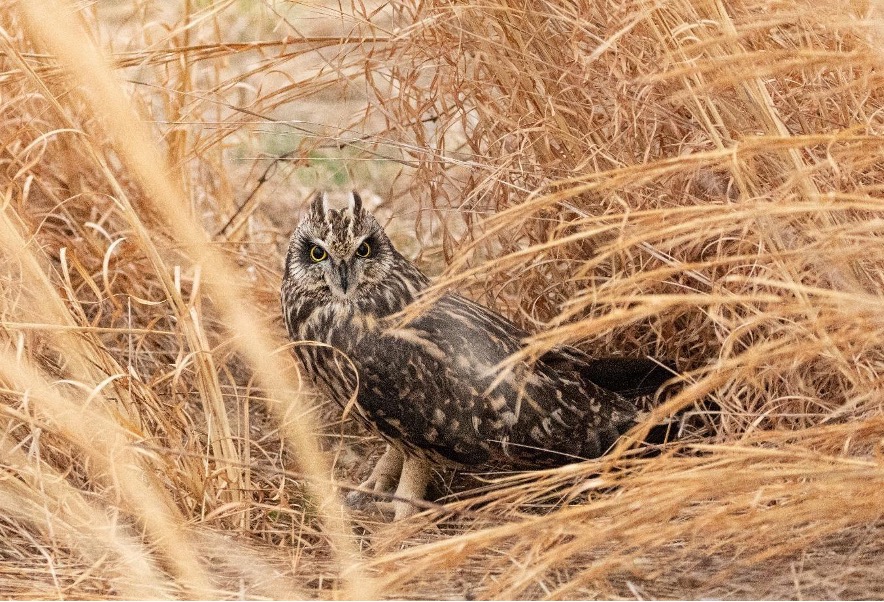
    Short eared Owls overwinter at OSGF every year and prefer roosting in clumps of native bunch grasses and in our restored native meadows. Pictured here in native broomsedge (Anatherum virginicus, syn. Andropogon virginicus) and purpletop (Tridens flavus) clump. Photo by Josh Rector, OSGF.

    Can Sod Removal Replace Herbicides?

    As OSGF transitions away from its historic use of the land for hayfields and pasture, we have initiated several native meadow restoration projects over the past decade, totaling roughly 24 hectares (60 acres). These projects have primarily used conventional installation approaches, including herbicide application or chemical-free methods such as repeated tilling and plowing. The most common conventional method is to apply a broad-spectrum herbicide, such as glyphosate, at least 3 times to create enough bare ground to seed the meadow. But chemical herbicides are not always effective on some of the most aggressive weeds, they are not effective on controlling weed seeds in the seed bank, they can alsonegatively alter the soil, and pose safety concerns for humans and wildlife. Unfortunately the common organic alternative relies on heavy tillage which comes with its own major downsides, including increases in noxious non-native weeds and negative impacts on soil health.

    OSGF is particularly interested in restoration strategies that minimize or avoid the use of chemical herbicides. We are not alone. Across our region, many landowners are exploring herbicide-free approaches to meadow restoration. However, robust data on the efficacy of alternative methods are limited.

    For this project we decided to try sod removal or scraping. Although this method of site preparation is often employed on small scales for garden installation or lawn conversion, we found little data on this method for large scale restoration plantings. However, we were encouraged by the results of some restoration studies from Europe and California involving topsoil removal.

    Sod Removal Project Design: Methods, Site Preparation, Seeding, and Maintenance

    The sod removal trial was designed with two main goals: to test an understudied organic approach to meadow restoration site preparation, and to share our case study to encourage further exploration of the approach, and perhaps formal research comparing this method with more common approaches. 

    The trial took place on a 0.8-hectare (2-acre) parcel of a former horse pasture and hayfield. Baseline vegetation surveys showed it was dominated by introduced cool-season pasture grasses: tall fescue (Lolium arundinaceum), orchard grass (Dactylis glomerata), and Kentucky bluegrass (Poa pratensis).

    To track change over time, we established permanent vegetation monitoring plots across the site. Vegetation surveys were conducted at baseline (Year 0) before disturbance and twice per growing season following seeding (2024 = Year 1, 2025 = Year 2). Soil samples were also collected at baseline and in each subsequent year. In November 2023, we removed the top layer of sod using the bucket of a skid-steer at a depth of approximately two inches. Afterward, the soil surface was lightly raked to improve seed-to-soil contact. We hand-broadcast a native seed mix using pine shavings as a carrier at 13.5 kg per hectare (12 lb per acre) and seeded a temporary cover crop of 50% winter rye and 50% oats at 34 kg per hectare (30 lb per acre). The field was then lightly covered with straw using a straw blower. The seed mix included 28 regionally appropriate species, roughly 60% perennial grasses and 40% forbs. 

    Management during the first two years was intentionally light. In Year 1, the cover crop was flail-mowed once in the spring. Other interventions involved manual cutting or pulling of problem weeds, primarily biennial thistles (Carduusspp.), a single clump of Johnsongrass (Sorghum halepense) likely introduced during site preparation, and spot mowing of creeping thistle (Cirsium arvense). Additional mowing had been planned but proved unnecessary due to relatively low weed pressure. The most common weeds were the annual grass Setaria pumila, which we expected to decline naturally, and white clover (Trifolium repens), which remained low-growing and did not appear to inhibit germination of the native seed mix. In Year 2, the meadow was flail-mowed once in the spring, followed by two days of manual cutting of problem weeds—mainly biennial thistles—to prevent seed set during the growing season.

    Progress photos

    Year 0 baseline (left) dominated by cool-season pasture grasses with intermittent ruderal forbs. Site prep (middle & right) included sod removal with skid-steer, raking soil, hand seeding and covering with straw. Photos by Charlotte Lorick.
    Year 1 from left to right, July, September, October. A lot of bare ground in year 1 (left) and complete removal of non-native grasses with pioneering black-eyed susan and mistflower (middle) already blooming. Slower-growing perennials such as hoary mountain-mint were abundant as well (right). Photos by Charlotte Lorick.
    Year 2 from left to right, July, September, October. Abundant mountain mints and volunteer path rush dominating the wetter section with black-eyed susans in the background (left). Many perennials flowering and fruiting including the gray goldenrod and little bluestem (middle & right). Photos by Charlotte Lorick.

    Preliminary but Encouraging Outcomes 

    Because native meadows take time to establish, we want to emphasize that these observations are preliminary, with only two growing seasons documented so far. We will continue monitoring the site over the coming years and hope to share longer-term results as the meadow develops.

    Nevertheless, at this early stage, several encouraging patterns have emerged. Total native species richness approximately doubled in Year 1 and tripled in Year 2 compared to baseline conditions. Native forb richness increased even more dramatically, more than tripling from baseline to Year 2. At the same time, the three most abundant baseline species—all exotic cool-season grasses—dropped from nearly 100% cover in Year 0 to less than 5% cover by Year 2 when averaged across all survey plots. This is an important indicator that sod removal was extremely effective in removing existing non-native vegetation.

    Figure 6. Total number of species documented across all survey plots and including incidentals encountered outside formal surveys. Plants were designated native or introduced rank based VA Digital Atlas and given invasive rank based off : https://www.dcr.virginia.gov/natural-heritage/invsppdflist
    Figure 7. Total number of native forb species documented across all survey plots and including incidentals encountered outside formal surveys. 

    By the second year, 22 of the 28 species in the seed mix had germinated, with several species already fruiting in the first year. This is a highly successful germination result by year two. For comparison, some of our other meadow restoration projects that used herbicide did not have germination of many of these same species until after year 2.

    Species seeded. P = Present but not seen flowering or fruiting, F = Observed flowering or fruiting, 0 = Not observed. *A small number of Midwestern species were included to provide early visual interest and occupy space in the first few years, but are expected to fade as the native perennial species establish. ** This species was only seeded in a small drift to prevent overabundance.

    In addition to the seeded species, we documented a number of native volunteer species that were not part of the seed mix and were not recorded in baseline surveys. These included secund rush (Juncus secundus), path rush (Juncus tenuis), forked rush (Juncus dichotomus), sweet everlasting (Pseudognaphalium obtusifolium), green milkweed (Asclepias viridiflora), and sedges such as fox sedge (Carex vulpinoidea), straw-colored flatsedge (Cyperus strigosus) and globe flatsedge (Cyperus echinatus). The arrival of native volunteer species was an exciting bonus and good indicator that some of the legacy native seedbank was still intact and uncovered with sod removal.

    Lessons Learned and Key Takeaways 

    While this project was not designed as a formal experiment, the results have been striking and our hypotheses can inform further studies. Compared to other meadow restoration efforts attempted at OSGF, this planting has performed exceptionally well. It has required far less maintenance and weed management, and the native seed mix established with noticeably higher germination, flowering, and overall cover. The method was also particularly effective at suppressing the dominant cool-season grasses that often make meadow establishment so challenging.

    Before seeding, the site supported very little native diversity. And the few native plants that we did find were woody seedlings or ruderal species such as horse-nettle (Solanum carolinense) and pokeweed (Phytolacca americana). Following the restoration work, native forb diversity increased substantially, including the appearance of several volunteer species. Although non-native white clover became the dominant plant by percent cover, its low, spreading growth did not appear to suppress the emerging native seedlings.

    Of course, many factors could have contributed to this success. The seed was broadcast rather than drilled, which may have supported quicker germination. Careful site selection, existing vegetation conditions, and even the drought that followed seeding may also have played a role. Still, after more than a decade spent surveying and working in meadows across Virginia, this site stands out as one of the most rapidly successful restorations I’ve ever observed.

    Our working hypothesis is that scraping away the existing sod removed much of the weed pressure by removing the grassrhizomes in the uppermost soil profile and some of the associated seed bank. It also slightly reduced the organic matter and nutrient layer at the soil surface—conditions that may have favored native species during establishment by reducingweed pressure (which thrive in more fertile soil). Although a decrease in organic matter may not be ideal for overall soil health, the decline is likely temporary. A growing body of research suggests that over time, the increase in native plant diversity may ultimately improve soil health beyond what we observed at baseline. This is something we plan to monitor in the years ahead with continued soil sampling. 

    The primary drawback of this method is cost. Removing and relocating large amounts of topsoil requires significant upfront investment, which may be impractical in some situations and at larger scales. However, this material can be reused elsewhere on a property in areas not prioritized for restoration or offered as a resource to farmers or composting operations. It is possible that these higher initial costs could ultimately be offset by reduced long-term maintenance and weed control, but that would take further study to determine.

    Another challenge we encountered was sourcing local seed. Ideally, we would have used seed with documented provenance sourced from populations occurring in Virginia’s Northern Piedmont ecoregion, but the native seed supply chain still has significant gaps. To help address native seed shortages, OSGF has partnered with the Northeast Seed Network’s Mid-Atlantic Seed Partnership and the Restorative Landscape Coalition, a working group of botanic gardens, arboreta, seed banks, and allied organizations working to expand the availability of diverse, source-identified native seed for ecological restoration across the Mid-Atlantic and Northeastern United States. For this project we purchased seed from Ernst Conservation Seed in Pennsylvania and although not all seeds were sourced from our ecoregion, we were pleased that all their seed was from very nearby ecoregions and states in the Eastern US. 

    We hope this project encourages others to explore sod removal for meadow restoration. There is much practical experience still to be gained and there are many questions worth investigating in controlled experiments to compare this method with other site preparation techniques, test different sod removal depths, or variations in seed mix compositions.

    In the meantime, we plan to explore the further use of this approach in future restoration projects at OSGF. If you’re curious about the project or interested in collaborating, we’d be happy to connect.

    Please feel free to reach out to me at charlotte.lorick@osgf.org, and stay up to date with the outcomes of this project—and more of my work—at https://www.osgf.org/conservation-biodiversity and https://forgottenfloraproject.substack.com/.

    Acknowledgements: Special thank you to OSGF team Clif Brown, Josh Rector, Katharine Perkin, Sarah Krementz, Sam Terry and local contractor Virginica LLC for support of this project.