Tag: Peru

  • Birdwatching and organic cacao at Hacienda Herrera: exploring alternative pathways for a sustainable future in the Peruvian Amazon

    Birdwatching and organic cacao at Hacienda Herrera: exploring alternative pathways for a sustainable future in the Peruvian Amazon

    By: Thibaud Aronson

    Thibaud Aronson is a field ornithologist based in Peru, carrying out conservation work in the Amazonas region.

    Sunset at Hacienda Herrera with Puerto Maldonado in the background. © Thibaud Aronson

    Tambopata. For anyone who knows about the Peruvian Amazon, there are few names that are more evocative. All it takes is an hour and a half flight from Lima, quickly leaving behind the parched desert of the coast, flying above snow-capped glaciers, and finally down over the rainforest that surrounds Puerto Maldonado, one of Peru’s three main Amazonian cities. 

    Established in the year 2000 and covering 270,000 hectares (1,000 square miles), Tambopata is one of Peru’s 17 National Reserves. This is a category within the country’s protected area systems that allows a certain degree of human activities within its borders by the local communities. These include scattered Ese Ejja Indigenous people and more recently established colonists from other parts of Peru. The reserve borders the much larger Bahuaja-Sonene National Park, which itself connects to Madidi National Park in Bolivia, where MoBot researchers have been working for many years.

    Blue-and-yellow macaws (Ara ararauna) in a tree along the Madre de Dios River near Puerto Maldonado. © Thibaud Aronson

    Considering it’s a city of nearly a hundred thousand souls, the surroundings of Puerto Maldonado are still surprisingly wild. Macaws and poison dart frogs, some of the most common victims of human encroachment in the lowlands due to the never-ending demands of the illegal wildlife trade, can still be found only a couple minutes outside the city. Likewise, howlers and tamarin monkeys, elsewhere either hunted for food or trapped as pets, still dwell in forest patches on the city’s outskirts.

    Bolivian red howler monkey (Alouatta sera). © Thibaud Aronson

    There are a few reasons for this. First of all, there is more of an ecological conscience here than in many other parts of Peru. Visions of giant river otters or flocks of parrots coming in at clay licks, both easily seen in Tambopata, are some of the most ubiquitous marketing features of Peru’s tourism board, right after Machu Picchu, of course. Indeed, there are daily flights between Cuzco and Puerto Maldonado, one of the only flight routes in the country that connects two provincial cities, instead of having to transit through Lima’s hub. As a result, ecotourism represents a substantial share of the region’s income. 

    Furthermore, one of the main agricultural products of Madre de Dios is the Brazil nut (Bertholletia excelsa, locally called castaña. This is a massive canopy tree, one of the largest in the Amazon Basin, whose fruits are still harvested in a traditional way, within concessions that preserve the existing forest where the castaña trees grow. And of course, much of the region is covered in large protected areas, which are reasonably easy to access, and therefore easier to actually monitor and protect. The Amazonian tracts in central Peru, for example, where ecotourism is essentially inexistent, have been facing much more trouble.

    The dock leading to an ecolodge on Lago Sandoval. © Thibaud Aronson

    However, Madre de Dios is not a perfect Eden either, far from it. The city proper has only existed for a few decades, and reaching it from Cuzco used to be a journey that could take a week, navigating dubious muddy tracks that were regularly blocked by landslides. But since 2011, the city is reachable by an asphalt road, in only 10 hours from Cuzco. This is the infamous Interoceanic Highway, the only road that connects the Pacific and Atlantic shores of South America, and cuts through an immense swath of Amazonia. Years later, the Odebrecht scandal revealed that over 20 million dollars in bribes had been paid out to ensure its building, and economic studies have since demonstrated its very underwhelming contribution to the economy of either Peru or Brazil. But the damage is done.  

    There has since been a massive influx of migrants from the Andes, with a very different culture. They practice slash-and-burn agriculture, which regularly results in out-of-control wildfires. But the main environmental plague has been the gold rush that has been gripping the region for the past two decades. There are some 30 to 50 thousand gold miners in Madre de Dios, many of them working in illegal, small-scale operations on remote river tracts. What is left after these illegal operators move away has been described as moonscapes. And they have impacts far beyond the mining sites themselves. The mercury that is used to extract the gold seeps into the water and soils, to the tune of 50 tons per year, resulting in widespread environmental contamination and serious health issues. Furthermore, the region suffers more and more from increased crime and all the other societal ills that characterize resource-rich frontier regions undergoing rapid and poorly planned development.

    Fortunately, there are people working to propose alternatives for the future of the region. For example, various NGOs, including WWF, are carrying out restoration projects on abandoned mining sites, in some cases working with the miners themselves. Limiting heavy metal contamination, which plants can help with, is in everybody’s interest, after all.

    Hacienda Herrra, an ecolodge on the Rio Madre de Dios near Puerto Maldonado. © Thibaud Aronson

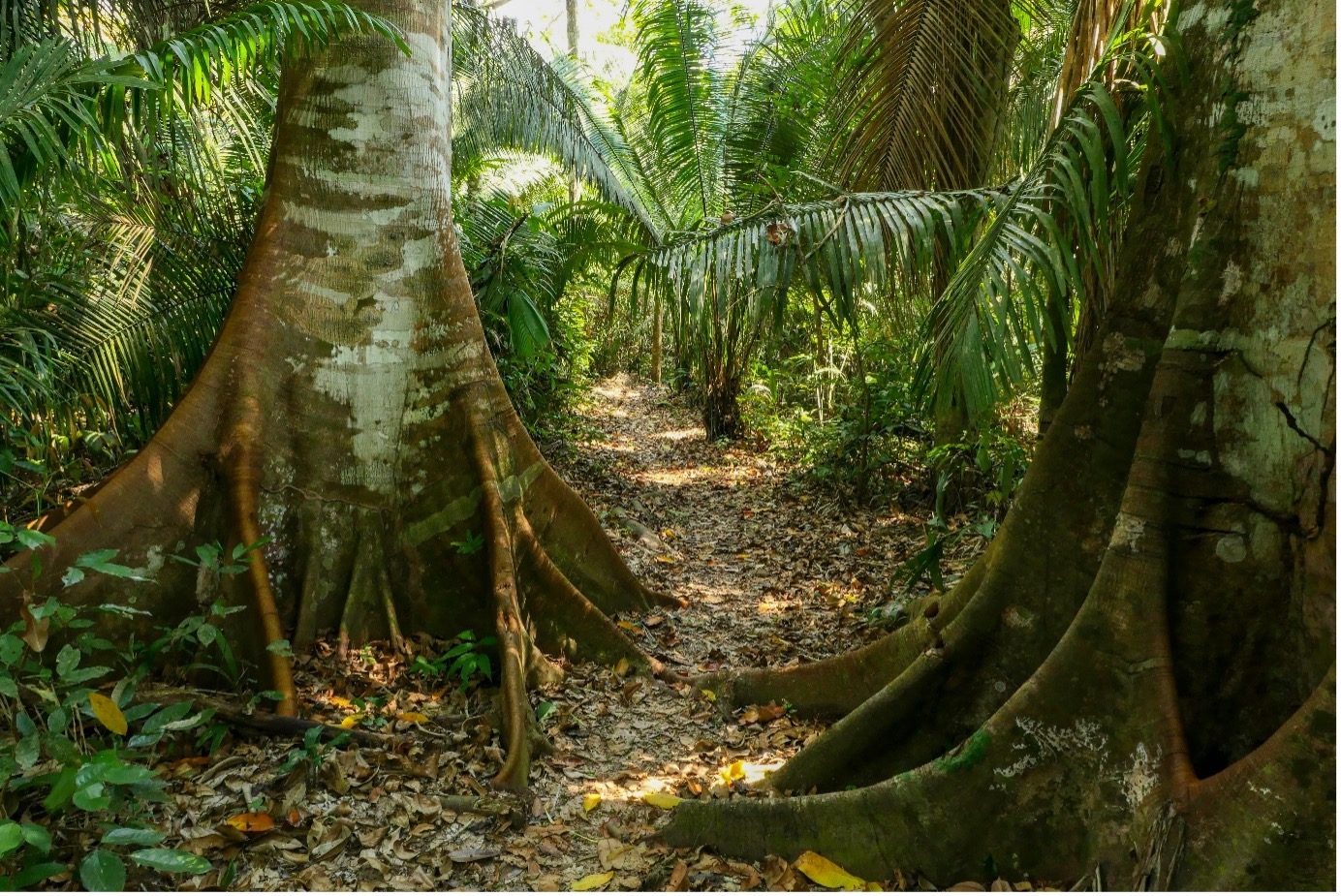
    Another notable initiative is the Hacienda Herrera. This 32-hectare (79-acre) property is located 15 minutes from the city, and reachable only by peque-peque, the narrow, motorized canoes that are the most common means of transportation on the Amazonian waterways. From the small wooden jetty, a path makes its way under massive-buttressed trees towards the buildings of the Hacienda. This land has belonged to the Herrera Segara family for 4 decades, where they used to plant various crops and raise cattle, as the regional government itself gave away cows to local people in order to “settle” the land. However, showing remarkable vision, the family realized the value of the forest they had, and decided to focus on agroforestry systems, growing avocado, orange, cocoa, banana and more, while helping the native forest recover around their crops. Ten hectares of the property (about 25 acres) are occupied by the various organic orchards, while the other 22 hectares (54 acres) are covered in tall forest, which is part of the buffer zone for the Tambopata National Reserve. Then, over 10 years ago, they partnered with CECCOT, the Tambopata Education, Science and Conservation Center, led by Dr. Ursula Valdez, a Peruvian ecologist who now teaches at the University of Washington. Together, they have developed their “forest school” philosophy. 

    Visiting Lago Sandoval with students from CECCOT. © Thibaud Aronson

    Each year, the CECCOT organizes courses and workshops that bring people from all over the world to learn and train at the Hacienda, on topics as diverse as nature photography, bird banding, tree scaling (a highly valuable skill in research projects involving arboreal camera traps or the collection of botanical specimens, for example), and much more. In addition to foreigners, CECCOT always integrates people from local communities to give them new opportunities for training or simply to learn more about the natural heritage of their land. Many local students, but also children from orphanages and disadvantaged communities have been able to come and learn at Hacienda Herrera.

    One of the main goals of the Hacienda is to offer a learning space about biodiversity conservation, but always working hand in hand with sustainable development. Dr. Valdez and her students have been carrying out a long-term study of the birds that use the Hacienda’s organic cacao orchards, and which subset they represent of the avifauna of the surrounding forest matrix. The finding that some of these “cacao birds” include antbirds, understory insectivores that notoriously are some of the first to disappear from fragmented forests, is very encouraging. Camera traps placed along the trails have registered most of Peru’s lowland mammals, including the full suite of felines and even the Short-eared dog (Atelocynus microtis), one of the most elusive mammals on the continent! Sure enough, during my visit, I was lucky enough to photograph a jaguarundi crossing an orange orchard between two forest patches!

    Jaguarundi (Puma yagouaroundi) crossing an orchard at Hacienda Herrera. © Thibaud Aronson

    At the same time, it has also become a gorgeous space to receive visitors and tourists, with a very strong focus on sustainability. This can be seen through the solar panels that are now the main source of electricity for all buildings, the collection of rainwater and the vegetarian cuisine, using products from the Hacienda’s garden and local producers. These have been implemented over time, with the family and the CECCOT sharing costs for the improvements. Ruth and Kenny, the husband-and-wife team, run everyday business at the Hacienda and they have created a travel company that takes visitors to see other natural attractions in the area, such as the famous Sandoval Lake or the Inkaterra canopy bridges.

    Black caiman (Melanosuchus niger). © Thibaud Aronson

    The grounds and trails of the Hacienda are a wonderful showcase for Amazonian biodiversity, from the bats that roost under the thatched roofs of the cabins to the massive caiman lizard that hunts water snails around the seasonal pond near the main building, to the multicolored butterflies that can be seen on flowers along the paths or on the muddy riverbanks. Meanwhile, with some 350 bird species, the Hacienda is becoming a hotspot in the booming world of birdwatching, with Peru finally starting to catch up to Ecuador and Colombia, where birds have been a powerful enginefor conservation and sustainable development.

    Sac-winged bat (Saccopteryx sp.) roosting under the eaves of a cabin at Hacienda Herrera. © Thibaud Aronson

    Besides the visitors, the Herrera family is also generating positive change outside its own borders. Some of the first mammals captured on the CECCOT camera traps were neighbors carrying out timber that they’d illegally harvested from the Hacienda itself. But they slowly made inroads with them, inviting them and their children to show them what they had managed to do. The idea was to have the Hacienda be a model for sustainable living. Things such as renewable energy or clean sanitation for their homes, achieved with relatively low investments. Now some of these same neighbors are implementing agroforestry systems on their orchards and planting native trees around them, while others are opening ecolodges of their own.

    Banana orchard growing in the shade of native trees at Hacienda Herrera. © Thibaud Aronson

    Just across the river is a stark reminder of how things could have gone, with the regular wildfires, illegal land grabs and health problems. On Hacienda Herrera’s side, people seem to finally have agreed that they want to try something else. Not long ago, when there was a problem with a roaming jaguar snatching dogs from people’s backyards, the neighbors got together. With help from experts at the San Diego Zoo, they agreed to a monitoring program, instead of sending a hunting party. After all, the jaguar, or otorongo, is the most emblematic species of the Amazon, even for Peruvians who aren’t of Indigenous descent. They summed it up in one sentence: “Do we want to be the community that kills our jaguar, or the community that protects him?”

    Black-capped squirrel monkey (Saimiri boliviensis) © Thibaud Aronson
  • The Huarango and Algarrobo forests of coastal Peru: rays of  hope

    The Huarango and Algarrobo forests of coastal Peru: rays of hope

    James and Thibaud Aronson report from coastal Peru, where they travelled in December, with Oliver Whaley, of RBG Kew.

    Yesterday, at our local market here in France, we saw Peruvian avocados. We’d seen them there before, and we don’t buy them. But we’d never really given them more than a passing thought. Now, having come back from coastal Peru, where they are grown, we have a very different outlook.

    Passing through much of Peru’s southern coast is perhaps more interesting to geologists than ecologists. The tenuous ecological balance, and its rather checkered history since humans arrived, needs time to reveal its secrets. But the earth’s surface here is simply naked and laid out as for a desert geomorphology text book. An extension of the famous Atacama desert of northern Chile, it is one of the driest places on Earth, with an average annual rainfall of 0.3 mm, or barely more than one tenth of an inch.

    Here more than in nearly any other desert, life is almost entirely confined to areas with some amount of moisture. As a result, the few river valleys that come down from the Andes form spectacular green ribbons among the dunes. They carry some water down from the rainstorms high in the mountains but the critical driver here is El Niño. It brings down tremendous amounts of water and sediment once every 6 to 15 years, thereby rejuvenating the whole system, and generating extremely fertile alluvial soils.

    IMGP3119 mtn
    The last remaining stretch of Prosopis limensis riparian forest near Copara, Ica region, southern Peru.

    500 years ago, the river valleys were occupied by dense woodlands or veritable forests of Prosopis limensis (local name – Huarango), which is often misidentified as Prosopis pallida, teeming with wildlife in the canopy and understories. Today, most of the Prosopis are gone, the excellent charcoal produced from their wood having been used up to fuel the stream engines of the now defunct coastal railway and, more recently, for fast food chicken restaurants ‘pollo a la brasa’ and millions of barbecue fires in cities and roadside restaurants. Instead, one now sees vast monocultures of asparagus, avocadoes, and table grapes, producing cash crops for the North American and European export markets.

    This story of deforestation is in fact almost complete, with nearly 99% of the original vegetation having been removed.

    DSC06261
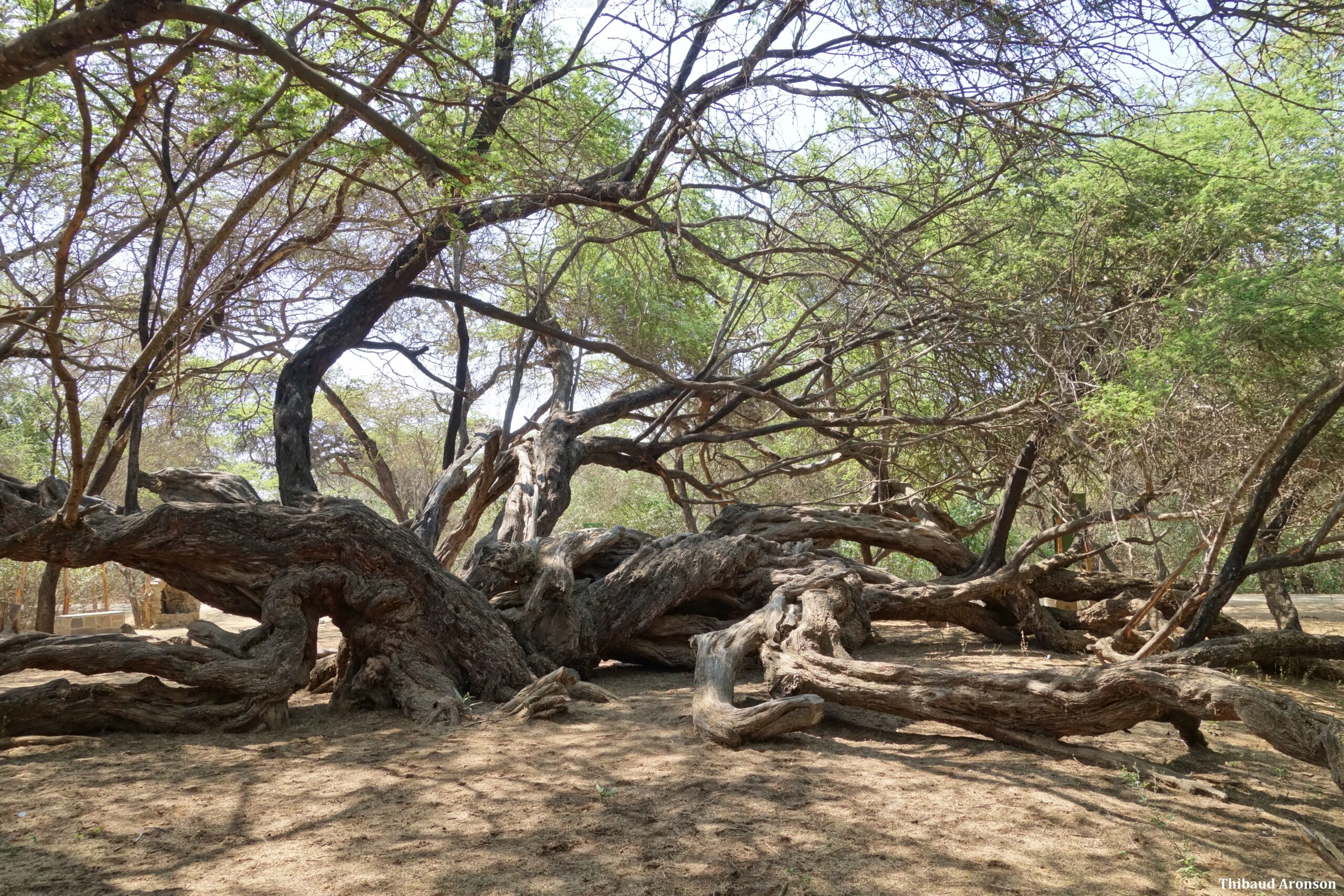
    There once were countless Prosopis trees such as this one, which has probably lived for a thousand years on this sand dune, near Copara.

    DSC06280
    Most of them fell to the charcoal burners’ axes, and even though it is now forbidden to harvest firewood from live trees, illegal cutting continues, as seen here, 20 meters from the tree pictured above.

    Depressing? Yes, but as engaged ecologists, we were also encouraged that change is happening; there is cause for hope. There are program in community-based restoration led by Ecoan underway in the high Andes, near Cuzco and environs, and science and conservation efforts underway at the Missouri Botanical Garden’s station at Oxapampa.

    We were lucky to spend 10 days with Oliver Whaley, from RBG Kew, who has been instrumental in many of the first initiatives attempting to reverse some of the damage done on this arid coast and to find a new path that explicitly includes restoration. Particularly noteworthy is a partnership he’s brokered with the large agroindustry supply chain, including a giant supermarket chain where almost half of the UK buys its vegetables, and which is the destination of a high percentage of the region’s produce.

    The agro-industries overcome the lack of reliable rainwater by installing intensive irrigation systems, which although highly efficient, are driving unsustainable expansion even as they produce spectacular crop harvests.

    However, the coast also experiences strong winds coming from the coast year-round, which require that rows of trees be planted as windbreaks to shield the valuable crops. Furthermore security hedging today is almost entirely composed of introduced water-guzzling African or Asian exotics. Under Whaley’s in-farm reforestation  program, some producers have begun planting native Prosopis, Parkinsonia, and Acacia trees yielding a mixed forest instead, which provides habitat for wildlife and also improves the neighboring soils through their capacity to fix atmospheric nitrogen in symbiosis with rhizobacteria. They require far less water than introduced trees, and will never become weeds. Agroindustry management has also donated land for restoration corridors, a vitally important undertaking at the landscape scale that has not yet been well-explored in coastal Peru or other drylands.

    The Kew Peru team planted 7,000 trees and shrubs of 15 native species derived from the degraded tiny relicts. The results have been nothing short of astounding, with over 70 new native plant species, 45 bird species, various lizards, desert fox and wild guinea pigs recolonizing areas that were nothing but barren soil 9 years ago. (The full results of this work will be published in the spring). Whaley takes a practical and patient view – whereby to nurture back woodland and a cultural re engagement with what nature provides takes time and needs to show results.

    DSC05268_stitch
    A patch of restored land on the edge of an asparagus field, showing the difference 10 years make. Santiago de Ica, southern Peru.

    Whaley and the local NGO, Conservamos por Naturaleza that he helped found and works closely with, is also committed to education and communication, working in Ica, Nasca, and elsewhere, to change people’s perception of the key desert plants such as Prosopis and Capparis, and their ecosystems, and of native biodiversity in general. Cultural reengagement, he argues, is about changing perception from symbols of a rural, backwards environment to be left behind in the wake of progress, to highly useful and valuable trees and woodlands that are part of the local heritage. These ecosystems clearly are worthy of pride, not only for their inherent value, but also because they offer the prospects of  sustainable, profitable agriculture that is also conservation-friendly.

    The Huarango Festival in Ica, which focuses on the numerous products that can be extracted from the tree, such as algarrobina, a sweet spread, a sweet drink, high quality honey, ink, and more has been a large success, and is now in its eleventh year. Whaley also works with schools, working to restore small patches of native vegetation inside the school compounds and promoting ecological consciousness through small nurseries and gardening projects.

    DSC05126
    Seedlings in a native species nursery funded by the Royal Botanic Gardens, Kew, at the Faculty of Agronomy at the University of Ica.

    DSC05153
    Middle school students in their school’s nursery, in a town near Ica, where they grow native species and food crops and have a great time doing it.

    The other unique feature of the southern coast is an inland archipelago of sorts, made up of coastal fog oases, or lomas, in Spanish. Fed by the moisture provided by coastal fogs, they rise from the surrounding desert and harbor herbaceous vegetation and in some cases various kinds of trees, all of which show high rates of endemism. Most of the lomas are sadly threatened by mining and other uses today, but Whaley has already succeeded in helping protect the new national reserve of Lomas San Fernando. This and other efforts , such as drone surveys and modelling, are conducted with help from Kew GIS staff, and Whaley’s team in Peru that includes Alfonso Orellana, Consuelo Borda, Ana Juarez and other dedicated workers. They are currently doing the baseline research in two other lomas reserves to help strengthen the case for protected area status.

    DSC05589
    The amazing vegetation supported almost entirely by coastal fogs in the Lomas de Atiquipa, home to an endemic very endangered Myrtaceae:  Myrcianthes ferreyrae.


    IMGP2576
    A female Andean condor (Vultur gryphus), in the Lomas de San Fernando reserve, the only place in Peru where this raptor roosts near sea level.

    Whaley and his co-workers are also engaged in restoration efforts the tropical northern coast of Peru, where the circumstances are rather different. The north coast receives significantly more rainfall than the south, i.e., about 100 mm per year (!), that is 4 inches. This permits the vegetation to climb out of the river valleys, and in fact, the local Algarrobo (Prosopis pallida and in the extreme North only P. juliflora along with hybrids between the two), and Capparis species, among others, still form true woodlands. Traditionally, the trees were preserved by the local people as their leaves and in particular their pods are remarkably nutritive, and provide prime forage for free-ranging cattle, the peoples’ primary source of income.

    DSC04473
    The remarkable woodlands dominated by Prosopis pallida (Algarrobo), in the Pomac Forest Sanctuary, Lambayeque Region, northern Peru.

    1. DSC04599

    The Algarrobo trees have been preserved in large part because they provide excellent forage for the local people’s cattle.

    However, a still poorly understood plague, apparently resulting from the combination of a small fly and a fungus, are decimating the woodlands; in some areas over 80% of the Algarrobo have apparently died. Just like in the South, El Niño is paramount in keeping the system healthy and, in particular, no Prosopis seedlings have been seen germinating in the last 50 years, except during El Niño years. What’s more, the next El Niño event is overdue: the last one came in 1997/1998, and now the system appears exhausted. Clearly the system is waiting for the next El Niño, and the long wait appears to have increased the Algarrobo’s vulnerability to the plague.

    DSC04139
    Severe Prosopis pallida dieback, near Talara, Piura region.

    However, El Niño is coming this year, and according to the climate experts, it’s going to be a big one. As a result, Whaley and his team are scrambling to prepare as many Prosopis seeds as possible, to be sown during or right after the heavy rains. As the trees slowly dying from the plague usually fail to set seed, Whaley and his collaborators fear that much of the soil seed bank is exhausted and this could truly be the last chance for this species in its wild state.

    DSC04579
    A seed-ball with 4 native species, including Algarrobo, being prepared at a community nursery, near Salas, Lambayeque region.

    Now there is an additional layer to the issue, which asks of would-be restorationists exactly what it is that they are trying to do. There hasn’t been nearly as much deforestation in Peru’s North coast as in the South, so there are still reasonably large tracts of native vegetation left intact. Further, apart from Algarrobo, none of the other five dominant native tree species, including two species of Capparis,  appear to be affected in any way by the plague.  Domestic cattle will also eat the leaves of these other trees and shrubs, though they aren’t quite as good as the Prosopis.

    Therefore, some might say that this is just a natural transition occurring within an ecosystem, and it would be foolish, or even a case of trying to play God, to attempt to save the Prosopis at all costs. However, Whaley thinks differently, and we agree with him. The Algarrobo, like the Huarango, is a remarkable tree, fantastically well adapted to its environment, capable of living 1000 years of more, and clearly the keystone species of the riparian and related ecosystems where it occurs.

    It forms remarkable canopies, and in areas where it is absent, we did not see the other tree species present produce anything like it, rather forming a much more open low savanna. Further, it has been a pillar of the various civilizations that have existed in the area for the last 4000 years. Therefore, Whaley is not yet ready to just let it go…

    DSC04392
    A thousand-year old Prosopis pallida in the Pomac Forest Sanctuary, possibly the oldest of its kind still alive in northern Peru…


  • Road to Santa Barbara

    Road to Santa Barbara

    A road was recently built to connect the village of Santa Barbara, in central Peru, to the outside world. Previously Santa Barbara was accessible only by a two-day walk on a winding mule path. The new road is broader, loose and muddy. It cuts through what had been an intact, montane forest. The road builders cut large sections from hillside and dumped them into adjacent river valleys, leaving bare, rutted slopes, which will rapidly erode and cut trenches back through the new road. Much of the surrounding forest was burned.

    Section of a new road connecting Lanturachi and Santa Barbara, in Pasco Province, Peru.
    Section of a new road connecting Lanturachi and Santa Barbara, in Pasco Province, Peru.

    We drove up the road as far as we could before we were blocked by a landslide, and then we slowly walked and drove back down. My companions searched for, and found, interesting plants among the piles of broken limbs.

    The only people that we saw on the road were two men with four mules, carrying buckets of honey from their farm in Santa Barbara to market in Lanturachi. They used the new road only along sections where the old mule path was buried from the new road’s construction.

    The new road to Santa Barbara is emblematic of Peru’s struggle for sustainable development. The area is within the buffer zone for a hyper-diverse national park, and it is part of a larger UNESCO biosphere reserve. Both designations mean that activities here should be more focused on conservation and sustainability than elsewhere. These words fit nicely with Peru’s recent commitment to make its forestry and agriculture carbon neutral by 2021, and its hosting of the COP20 climate change conference next month in Lima. But lofty national priorities frequently clash with other activities – such as governments approving resource extraction projects without the consent of local inhabitants, police killing environmental activists, or municipalities supporting new roads of dubious utility.

    The end of the road.
    The end of the road.

  • Restoring Peruvian Forests for Bees

    Restoring Peruvian Forests for Bees

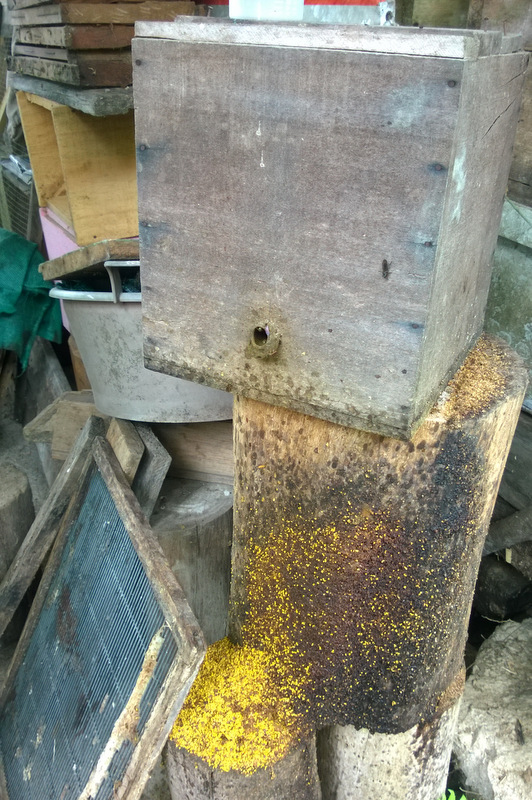
    A box of little angels (angelitos). Freddy sells their honey, as well as the nutritious, yellow pollen that accumulates near the opening.
    A box of little angels (angelitos). Freddy sells their honey, as well as the nutritious, yellow pollen that accumulates near the opening.

    There are bee hives all over Freddy’s farm in Oxapampa, Peru. An old tree stump houses a colony of curco negro, a stingless bee native to the eastern Andes. Another species, commonly called niño de monte real, has nearly been extirpated from the area. These bees are Freddy’s livelihood, and the basis for a collaborative reforestation project with one of the world’s most diverse national parks.

    Freddy is one of a handful of farmers cultivating land within the buffer zone of Yanachaga-Chemillén National Park. His family has been here since 1978 and has seen the area transform from forests full of Wattled Guans and Andean bears to eroded cow pastures and pesticide-laced rows of passion fruit.

    Now some of these degraded areas are being replanted with native trees. Peru’s national park service is using sticks and carrots to create a buffer around Yanachaga-Chemillén. Law mandates that farmers working in special use areas must only do agriculture that is nature-friendly – things with trees, like shade coffee. But the park service also offers funding to farming associations to help them make the transition. In Freddy’s case, the park service provided tree seedlings, fertilizer, and transport of these to his farm, at the end of a very rough road.

    Tree seedlings and an edible fruit, Solanum quitoensis, are sprouting up in this native tree plantation.
    Tree seedlings and an edible fruit, Solanum quitoensis, are sprouting up in this native tree plantation.

    Honey from the flowers of native trees. I tried some, and it was delicious.
    Honey from the flowers of native trees. I tried some, and it was delicious.

    Freddy and the national park managers see this arrangement as mutually beneficial. As we walked through his seven-year old plantation, Freddy pointed out native trees, like cedro (Cedrela sp.), and told me about the flowers they produce for his bees. At different times of the year, Freddy’s bees collect nectar and pollen from different trees. The artisanal honey he sells is well-known in Lima. These plantations also help protect the core of Yanachaga-Chemillén National Park by reducing outside influences, like domestic animals that wander into the forest.

    It’s not all gravy though. Programs like the one in Alto Navarro have not been as successful everywhere. Of seven farming associations that are currently receiving funds from Yanachaga-Chemillén, three are stalled with infighting. In one case, thousands of native tree seedlings were transported to a community six hours’ drive from Oxapampa; a year later most of the seedlings still sat unplanted by the side of the road.

    Within individual projects there are also compromises. One project area in Alto Navarro was planted in exotic pines – trees that are little more than wood factories. But these pines can be harvested and sold after just ten years, and in the meantime cows can graze in the understory. This short tree rotation makes it more economically attractive to plant other areas with native trees, which will not be available to harvest for much longer.

    Cow grazing lush grass in an exotic pine plantation at Alto Navarro.
    Cow grazing lush grass in an exotic pine plantation at Alto Navarro.

    Is this ecological restoration? In one sense, no. When Freddy plants native trees, he plans to use them to make honey, and then to cut them down and sell them for timber. The area will not turn into a mature forest. But these same trees are likely reducing edge effects, like elevated wind and light, in the adjacent national park forest. Trees planted just outside the old-growth forest could increase habitat area for plants and animals that live in the forest interior. At a broader scale, the collaborations between the national park and local farming associations are also likely restoring natural capital, stocks of natural assets like soil, water, and biodiversity.

    Freddy and me in a cow pasture at the edge of Yanachaga-Chemillén National Park. Freddy plans to plant native trees here in May 2015.
    Freddy and me in a cow pasture at the edge of Yanachaga-Chemillén National Park. Freddy plans to plant native trees here in May 2015.