Tag: Polylepis

  • ACCIÓN SERRANA Network: Conserving and restoring cloud forests in the mountains of Córdoba  province, central Argentina.

    ACCIÓN SERRANA Network: Conserving and restoring cloud forests in the mountains of Córdoba  province, central Argentina.

    By: Pablo Friedlander and Romina Torre

    Dr. Pablo Friedlander, Director of Acción Serrana has initiated and led pioneering restoration and intercultural education projects in Argentina, Brazil and Spain for more than two decades. He also organizes ethnobotanical research and expeditions to the Amazon and the Andes. pablofriedlander@gmail.com

    Biologist Romina Torre is the executive coordinator of Acción Serrana, with ten years of  experience in mountain restoration, research and educational activities involving rural communities, health practitioners and scientific institutions at bioregional and international levels. torre.romina@gmail.com

    Introduction to the Polylepis forests

    In the highest mountains of South America, remnants of vast stands of so-called cloud forests dominated by members of the beautiful Rose-family genus Polylepis are found throughout the Andes Cordillera, from Colombia and Venezuela to northern Chile and northwestern Argentina. In addition, in the much older Sierras Grandes de Córdoba, in central Argentina, the endemic Polylepis australis (locally known as Tabaquillo), occurs in scattered fragments of once extensive mid-altitude forests. At the continental scale, the canopies of these open, moist formations,  or what remains of them today, comprise 45 recognized species and constitute the highest altitude forests on Earth (Boza Espinoza & Kessler 2022). Sadly, their range and integrity has been drastically reduced by logging, burning, and overgrazing since the 16th century, especially with the introduction of European cattle.Their moss- and lichen-covered branches collect fog, while their roots prevent erosion and regulate water runoff. These forests also contribute to climate change mitigation,  by favoring carbon sequestration, and they support diverse endangered species dependent on these habitats. In all seven of the Andean countries where they occur, the restoration and conservation of these cloud forests is of vital importance to local communities and to protect. the headwaters of the main rivers and creeks (del Campo & Friedländer 2023).

    This locally famous ‘Grandfather’ Tabaquillo (Polylepis australis) tree grows in the heart of one of the last remaining cloud forest fragments in Córdoba  province.
    The Argentina anole, Pristidactylus achalensis, is an endemic lizard of the Pampa de Achala.

    The hand-shaped Polylepis leaves and the soft, multi-layered bark of the trees, draped with epiphytes, mosses and lichens, collect fog and give rise to the compelling and accurate image of the forest “milking” the omnipresent mist and clouds. At a continental scale, these cloud forests when they are healthy and thriving contribute to the ‘biotic pump’ connecting the Andes- the Amazon-and the Atlantic Forest biomes (Beveridge et al. 2024) and regulating water and climate cycles and  reducing the risk and severitry of wildfires. The savannas and cloud forests The recent increase of forest fires in all biomes of South – and Meso- and North America – demands more strategic and intercultural, public-private coalitions to increase restoration areas and protection of basins at multiple spatial scales for present and future generations (Argañaraz et al. 2015; Argibay & Renison 2018). Additionally, Polylepis roots and their mutualistic microorganisms retain and enrich soils. They also provide a ‘framework’ for regenerating forest communities undergoing active or assisted restoration. Indeed, when mature, these emblematic forests harbour very high biodiversity, including many endemic species of epiphytic orchids, insects, birds and reptiles, and also provide a wide range of ecosystem services to people at multiple spatial scales. Finally, they have huge cultural significance, and by working in synergy with local communities we aim to introduce and sustain biocultural as well as ecological restoration.

    Conserving and Restoring the cloud forests with Acción Serrana and Acción Andina

    In 2002, the project “Milking the Clouds” (Ordeñando Nubes, in Spanish) was launched, along with other local grassroots initiatives. Then, after a long learning curve in restoration methods and typical pioneering struggles, the five interrelated projects gradually scaled up their ‘footprint’ and their impact to a bioregional level over the next decade and a half. A big step was taken in 2018 when, together with the ECOAN (Asociación Ecosistemas Andinos) and Global Forest Generation, Acción Serrana was set up as a hub including 5 different local organizations to help in the launching of  “Acción Andina” as a a new international ecocultural restoration consortium. In that context, Acción Serrana is now managed by the Fundación de Actividades Biosféricas as part of Acción Andina

    Currently working in Peru, Ecuador, Colombia, Bolivia, Chile and Argentina, with 23 member institutions, Acción Andina partners have planted more than 7 million Polylepis trees, of many different species, and this number is rising each year, as is the success rate of the plantings. In 2023, Accion Andina received the prestigious Earthshot Prize, and in 2024 we were named one of the 7 UN World Restoration Flagships for the UN Decade on Ecosystem Restoration 2021-2030

    Map of the 12 Acción Serrana restoration sites in the Sierras Grandes de Córdoba.

    The 12 biocultural restoration areas in the Sierras Grandes of Córdoba under Acción Serrana management add up, at the time of writing, to a total of 3,170 fenced hectares. 

    The reforestation and restoration campaigns are made possible by 65 permanent staff members and over 1,500 volunteers per year on average. To date, we have produced and planted more than 860, 000 Polylepis australis nursery-grown saplings in consecutive seasons (see https://ecohealthglobal.org/network-sites/accion-serrana-argentina/). All of these trees were grown from seeds collected locally in each of the planting areas managed by the five different partnering organizations or local implementing groups  For the 2024-2025 October 2024 to March 2025 planting season, 250,000 trees were propagated in the 29 plant nurseries we maintain, and at the time of writing most of the plantings have been very successful. Since 2023, Accion Serrana has been helping to replicate the same initiative in Northwestern Argentina, with the Project Arbol y Vida in Jujuy Province (in cooperation with various high-Andean communities) and the Germinar Project in Tucuman Province (working with Diaguita communities of the Tafi del Valle bioregion), advising on and synergizing actions and application of  techniques and strategies. In addition to this biocultural restoration, another critical line of work is our environmental education program being run in local schools and municipalities for more than a decade already.

    The ecosystems of Acción Serrana are Sub-Andean and Chaco serrano forests and grasslands (sensu Cabrera 1976), composed of seasonally dry forests or open woodlands with 4 different altitudinal belts in the central Argentina mountain ranges, Sierras Grandes de Córdoba (Giorgis et al. 2011). The land tenure of the areas under restoration inside the Provincial Watershed Reserve of Pampa de Achala, which consists of private landholdings subject to Provincial Management & Conservation plans, or  public protected áreas within the National Park Quebrada del Condorito. The numerous activities we carry out include: maintenance and fencing of new areas, native forest tree and shrub seed collection, construction and improvements of nurseries, germination of seedlings, transplanting of seedlings to reusable plastic forest tubes, high mountain transfer of seedlings to the planting areas and their planting in the intervention areas during the rainy season. We establish permanent plots for scientific monitoring and we support research carried out in the intervention areas. Workshops, public talks and training programs are also organized yearly to train and recruit more enthusiastic and qualified citizen restorationists for the work in the mountains.

    Acción Serrana team planting the native Polylepis australis of Córdoba province.

    Implementation of Acción Serrana with local partners in reciprocity

    We work to  generate ecological, economic, social and cultural sustainability by reaching agreements with landowners, communities, networks and institutions (municipalities of Mina Clavero and Villa de Las Rosas, the Ministry of Education of the Province of Córdoba, and others). 

    To help with the local matching needed to be part of the Acción Andina  initiative, Acción Serrana had set up the Ayni Plan (“ayni” meaning “reciprocity” in the quechua language of the Andes). Basically this implies the commitment to generate 30% of operating costs through specific fundraising campaigns and by other quantified means. For example the constant one of inviting the public to participate by donations of the costs required for producing a forest (25 trees under monitoring), a tree or a volunteering activity. Then we promote the reception of donations of funds, lands, tools, materials, vehicles, etc.. In addition, we encourage ecotourism with a schedule for each area: summer plantations and seeds, winter transplanting of seedlings and fencing of restoration areas. Acción Serrana aims to increase reciprocity and abundance also throughout the different courses and events both virtual and in-person, and some special community parties, with raffles, concerts, talks, video screenings, and promotion of crowdfunding campaigns. Currently we are running our international matching crowdfunder campaign with the help of the Treeangle Foundation from the United Kingdom, as we have done each year from 2012, to complete the mission of this season January 2024 – March 2025. (See video here.)

    In the years ahead, Acción Serrana will propagate and plant a wider variety of native trees and shrubs in pursuit of a Framework species approach to restoration such as that being tested by EHN partner Daniel Perez and his team in Caviahue, Patagonia (Perez et al. 2019; see also here and (here). As a new initiative, we aim to  deploy 30% of funds raised to reintroduction of multipurpose Neltuma (formerly Prosopis) species and other framework species in lower altitudes of the mountain system, and 70% to ongoing Polylepis restoration in the high mountains. This year, we have begun studying how to propagate the obvious additional choices of “framework species” namely Maiten (Maytenus boaria), Escalonia (Escallonia cordobensis) and Molle (Lithraea molleoides)

    Escallonia cordobensis a formerly common shrub now considered key to restoration.
    Co-dominant Maytenus boaria and Polylepis australis ‘giants’.

    Next steps

    Following decades of reforestation and cloud forest restoration, we are working with Indigenous inhabitants in these mountains, including the Comechingones (Henia and Camiare tribes) and Sanavirones peoples, who have been historically marginalized. We are cultivating intercultural bridges (Rojas et al. 2025) in áreas like nursery propagation, environmental education, and llama and alpaca reintroduction and ancestral practices of weaving with camelid wool. This collaborative framework aims to integrate and restore  key zones around the Ansenuza Sea, Traslasierra Valley, Pampa Achala, and Pampa de Pocho. 

    In January 2025, Acción Serrana became a new member hub of the Ecological Health Network, following two fruitful visits from James Aronson. These visits facilitated knowledge sharing and collaboration, furthering our core purpose of scaling up watershed restoration, enhancing environmental education, and deepening intercultural collaboration for research projects. By integrating ecological, social, and economic perspectives and approaches, we aim to share our regenerative experiences across mountains, jungles, deserts and oceans within a quickly growing international network of networks. We are delighted to be part of this movement and consortium with a strong, clear set of values and shared purpose  – something we all need to cultivate in these critical times. As a meaningful next step of Acción Serrana, we look forward to participating in multi-site research projects based on the simultaneous monitoring and evaluation of a series of ecological and human health indicators in areas undergoing biocultural restoration protocols. Through these efforts, we are committed to enhancing ecosystem health and strengthening our relationship with nature, ensuring the longevity and health of Andean cloud forests and lower buffer zones of Chaco serrano forests -as well as the local communities living there for generations to come. 

    Learn more by watching these videos on Acción Serrana and the Biodiversity in Sierras Grandes de Córdoba.

    All images are from the archives of Acción Serrana.
  • Desert Trees of the World – A new database for ecological restoration

    Desert Trees of the World – A new database for ecological restoration

    For the past five years, James and Thibaud Aronson have been traveling to the driest parts of the world to collect data about the distribution, ecology, uses by humans, and up-to-date systematic botany of  the soul-satisfying and mind-boggling trees that grow in Earth’s beleaguered, beloved, and mega-diverse drylands. Here they describe the content and purpose of their new Tropicos database. This work builds on more 3 decades of collaboration between James and Edouard Le Floc’h, who is also a co-author of the database and a book-in-progress on desert trees and their role in ecological restoration and allied activities.

    Desert Trees of the World represents a multi-purpose, participatory database in which we have gathered a vast array of information about dryland trees, where and how they live, the communities they are part of, the many ways in which they are used by people, and some elements about their successful cultivation.

    Our database brings together the most up-to-date botanical, biogeographical, ecological, and ethnobotanical information on 1576 species of trees from the arid and semi-arid regions of five continents and many islands. And because it is hosted on Tropicos, the Missouri Botanical Garden’s vast botanical database, a user can seamlessly access any supplementary information that may be available for a given species thanks to research carried out in other MoBot projects. Further, maps of collection sites, as well as full nomenclatural, bibliographic, and voucher specimen data accumulated digitally at MBG these past 30 years are available.

    The data base is intended for students of natural history, practitioners, policy-makers, and scientists working in ecological and biocultural restoration, conservation, and sustainable and restorative environmental management.

    Trees in the desert?

    Most people think that deserts are – by definition – devoid of trees. Not true! Indeed, some of the strangest, oldest, and most remarkable tree species on the planet are found in drylands, a term often used to refer to deserts and semi-deserts, also known as arid and semi-arid lands.

    For our purposes, drylands are all the lands of the globe that receive less than 400 mm (ca. 16 inches) of rain in an average year. In total, this concerns over 42% of all lands on Earth, so listing all the tree species that occur in them was no small task! But, we were drawing on decades of travel, research and residence in quite a spectrum of the world’s deserts and semi-deserts. We also pored over specimens housed in three dozen major herbaria, and read thousands of technical scientific articles and floras in several languages. And, as this is the 21st century, we used information already online in another Tropicos project, the Catalogue of the Flora of Madagascar as well as many other online sources.

    Saguaro and boojum
    A cardón (Pachycereus pringlei) and a boojum (Fouquieria columnaris) in the Central Desert of Baja California, Mexico. In the harsh conditions of deserts, evolution has favored some of the strangest-looking trees on the planet.

    Boswellia Oman
    In southern Oman, we explored the remote Wadi Aful, where wild frankincense trees (Boswellia sacra) grow between sheer rock walls.

    Astrotricha hamptonii
    The irontree (Astrotricha hamptonii) is not among the most impressive-looking desert trees in our database. And yet, because it only grows on ironstone formations, clever prospectors used its distribution to discover some of the largest iron ore deposits in Western Australia.

    Since there had been no previous attempts at documenting the trees of all the deserts in the world, we weren’t sure how many species we would end up with. And the end result was truly remarkable: a sum of 1576 species of trees native to deserts around the world, occurring in  422 genera and 100 families of flowering plants. Of course, new tree species are still occasionally being discovered, mainly coming out of Namibia, Somalia, and southern Arabia, but we are confident that we have captured the great majority of all extant dryland trees in this database.

    jordan woods
    Then again, some desert trees are not so unfamiliar to visitors from Europe or North America, such as these junipers (Juniperus phoenicea) and oaks (Quercus calliprinos), growing in the central mountains of Jordan.

    What does a desert tree look like?

    If asked about what a desert tree looks like, you might think of spiny or resinous, sticky trees. And you would be right. Fabaceae, the legume family, make up just over a quarter (403) of all species, and of those, 217 are Acacia sensu lato. The next ‘big’ family is the Myrtaceae (the Eucalyptus family), with 133 species, all but one found in Australia, the exception, Myrcianthes ferreyrae, being restricted to the fog oases of Peru’s hyper-arid coast. And in third place are the Burseraceae, with 111 species. This is the family of myrrh and frankincense, two desert trees whose importance for humans dates back millennia, tied as they are to the great cultures of the Old World. For reference, people’s most common images of desert trees are palms (think – oasis) and tree cacti. But there are only 28 desert palm species, and 49 tree cactus species.

    We also have some remarkable oddities, such as one arborescent member of the cucumber family (Dendrosicyos socotrana), and several rose relatives (Polylepis spp.) that grow above 4000 meters in the most parched areas of the Andean cordillera!

    Where do desert trees grow?

    Interestingly, the different desert areas of the world are not equal in terms of their contributions to our database (see the table below, the full version of which is posted on the homepage for our database).

    Region Number of Species Endemic species* Number of Genera Number of Families
    Australia 389 373 62 34
    Madagascar 355 311 160 55
    North America 272 222 126 55
    Northeast Africa 233 80 87 42
    West Asia 224 86 97 46

    *Endemic to the country or region indicated.

    Five regions alone account for two thirds of all the species in our database, with the deserts of Australia and Madagascar being almost preposterously rich in tree species. But of course the area of arid Australia is vastly greater than that of Madagascar, so that in fact the numbers of families, genera and species in the latter country are really the most impressive of all.


    baobabs Mada - pete
    Highly degraded spiny thicket vegetation at the edge of the Ranobe PK32 Protected Area near the town of Ifaty, in western Madagascar, with few trees other than the emergent baobabs, Adansonia rubrostipa (Malvaceae) remaining. Young plants of the spiny tree, Didierea madagascariensis (Didiereaceae) developing in the bare sandy soil around the baobab in the foreground. 11 September 2006. © Peter Phillipson, Missouri Botanical Garden. http://www.tropicos.org/Image/100624586.

    spiny thicket - pete
    Secondary growth spiny thicket near the Ranobe PK32 Protected Area north of Toliara, in Madagascar, with occasional individuals of the locally endemic spiny tree Pachypodium mikea (Apocynaceae) – center image, but dominated by mature Didierea madagascariensis (Didiereaceae). 03 December 2018. © Peter Phillipson, Missouri Botanical Garden.

    A zoom on the astonishing dryland tree species richness and diversity of Madagascar can already be found in an article we published last year, covering the remarkable assemblages of 355 tree species found in the driest part of Madagascar, of which no less than 311 are endemic to the country. This is all the more remarkable considering that they are all crowded into a narrow coastal strip in the Southwest, which is a mere 14,480 square kilometers (5591 square miles), or the same size as Connecticut.

    For us, a key feature when discussing desert trees is the fact that even in the harsh areas where they found, trees can grow densely enough to form true woodlands, sometimes even with dense canopies, which has enormous importance for desert ecosystems and people. In previous blog posts we have reported on striking examples – in northeastern Jordan, and coastal Peru, among others, where evidence of former woodlands provide rays of hope and guidance for people attempting ecological restoration in desert lands.

    Back in 2013, James and Edouard published a first book in French (Les Arbres des Déserts: Enjeux et Promesses) profiling desert trees and developing the subject of desert woodlands. We now have a more comprehensive book in preparation, called Desert Canopies: Reimagining our Drylands. Three chapters on animal-tree relations, and photos and drawings by Thibaud will help make this of interest for a wider audience, not just specialists. We also develop the theme of ecological restoration and provide profiles and virtual field trips from many restoration programs in drylands around the world.

     Where can one see living Desert Canopies today?

    Unfortunately, most drylands are found in poverty-stricken regions of developing countries, where trees are an extremely valuable resource. In recent decades, desert canopies have been hammered by rising populations of people and livestock. As a result, today these canopies are so degraded and fragmented that it’s hard to imagine what they once looked like. Western Australia is one of the few places where reasonably intact desert woodlands still cover large areas.

    Great western woodlands

    A typical landscape of the Great Western Woodlands, in the semi-arid southwest of Australia (mean annual rainfall 250 – 400 mm), with gimlet eucalypts (E. salubris) growing over a beautiful understory of blue bush daisy (Cratystylis conocephala).

    In our last blogpost, we reported on some notable trees, tree canopies, and indigenous peoples of the Guajira peninsula in northern Colombia.

    macuira stream
    From looking at the tree cover, it is hard to believe that this area of Colombia is technically a desert!

    wayuu family
    Young Wayuu and their donkeys, standing in the shade of a tree, on their family farm in the Serranía de Macuira, a mountain oasis in the middle of the Colombian desert. The Guajira, as the region is called, is a microcosm of the problems and drivers of arid lands everywhere, as well as a good example of the diversity and life and beauty that can be found in deserts.

    Other striking tree canopies can still be found in diverse places today, including some of the driest places on Earth.

    Prosopis cineraria
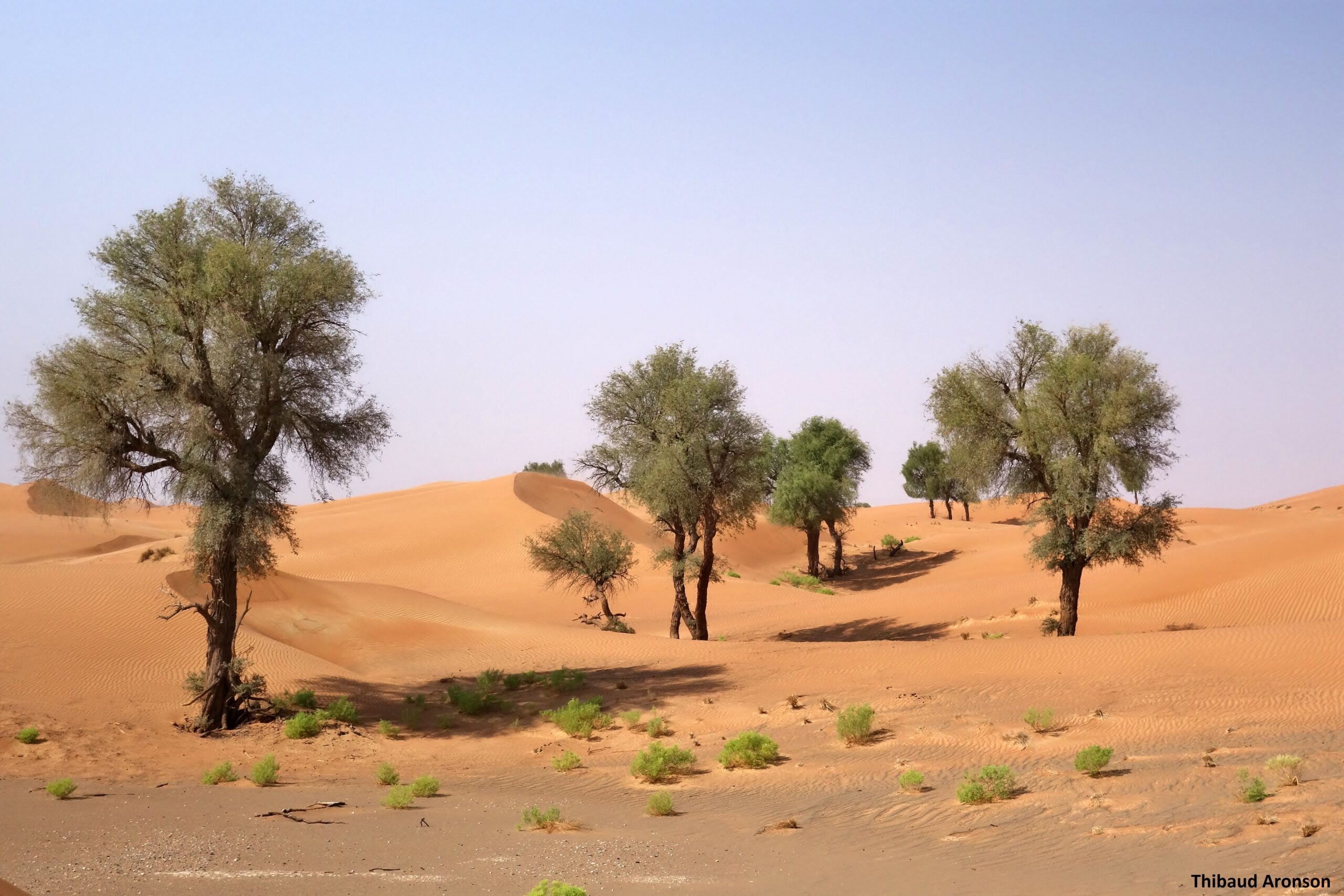
    The Rub al Khali, the famous Empty Quarter of Arabia. Even there, trees can thrive amid the sand dunes (in this case, the venerable khejri, Prosopis cineraria), that we were lucky enough to observe in northern Oman.

    Prosopis pallida Peru
    On the arid coast of northern Peru, Prosopis pallida and other trees can grow in the ever-so-slightly richer soils at the bottom of gullies amid the plains.

    As noted earlier, drylands make up more than two-fifths of all lands on Earth, at present. Furthermore, despite their harsh conditions, drylands are presently home to well over 2 billion people, and indeed many of these are among the poorest and most vulnerable populations on Earth. The United Nations, and many other organizations are working hard on the problems of drylands and their peoples, but it is very much an uphill battle… As we passed Earth Overshoot Day on July 29th this year– the earliest date ever – it is timely to stress once again that the restoration and rehabilitation of degraded ecosystems will be key if we are to hope for a sustainable future. Restoration is undeniably harder in arid lands than in many other places, but that only means that it is more necessary. We are happy to relate that the Society for Ecological Restoration’s scientific journal, Restoration Ecology, is launching a new initiative devoted to dissemination of scientific advances on ecological restoration and rehabilitation in arid lands. Our database is offered in that spirit.

    isla guadalupe
    The small, arid Isla Guadalupe, off the coast of northwestern Mexico, is home to several endemic tree species, which were almost extirpated by introduced goats. But now that the goats have been removed from the island, the trees are making a comeback. Pictured here is the endemic cypress Cupressus guadalupensis, and some of the people who’ve made this recovery possible.

    A large number of the trees included – 932 out of 1576 to be exact – are endemic to a single country – and most are in urgent need of committed conservation, restoration, and better management. We hope that our database can act as a reminder of the wealth of life forms that can thrive in arid lands, and an exhortation to not give up on their desert homes, scarred and battered as they may be, but rather to try and help them flourish once again.