Tag: Resilience

  • Accurately estimating restoration efficacy across large landscapes and timeframes

    Accurately estimating restoration efficacy across large landscapes and timeframes

    By: Dr. Allison Simler-Williamson

    Note from the editors: This month marks ten years since we started Natural History of Ecological Restoration! During the last decade, we’ve posted 127 times on a wide variety of ecological restoration stories from around the world. At the same time, our global readership has grown from 4,000 viewers in our first full year to more than 14,000 viewers in each of the last five years, with readers coming from 150 countries. At their best, NHER stories illuminate ecological restoration’s natural history, taken in the most inclusive sense to mean stories about the people, places, organisms, institutions, and interactions involved in ecological restoration projects.

    This month’s post by Allison Simler-Williamson (Boise State University) exemplifies this standard. In her post, Dr. Simler-Williamson describes how environmental conditions, land manager decisions, and restoration outcomes interact in complex and confusing ways – and she charts a path forward for better understanding the real-world impacts generated by restoration projects.

    A “randomized” experiment can be a beautiful and powerful tool in restoration ecology. Randomization ensures that an experimental treatment (such as a restoration action) is unrelated to any other environmental factors that might influence the outcome we are measuring (such as plant establishment). When we confidently compare plots that received an herbicide or planting treatment to adjacent “reference” sites, our estimation of restoration effectiveness hinges on this assumption of randomization.

    But, despite their elegance, randomized experiments are labor-intensive and often spatially or temporally constrained, limiting how applicable they may be to new areas or in atypical years. Thus, randomized experiments are increasingly mismatched with widespread ecological degradation and growing needs for restoration. Emerging “big data”, such as the US Geological Survey’s Land Treatment Digital Library, which contains information about more than 65,000 restoration treatments that have occurred on Bureau of Land Management land in the western United States, could help tackle the problem of understanding restoration efficacy across wide spatial and temporal scales.

    When we pivot to using these “observational” datasets, which are opportunistically collected, we incur an important tradeoff. We gain generalizability but lose the power of randomization because (and this likely is not a surprise to anyone working in restoration!) real-world management treatments are almost never applied randomly across large landscapes. Restoration occurs in certain parts of landscapes more than others, due to a mix of ecological need, bureaucratic constraints, and stakeholder decision-making processes.

    Why is this lack of randomization a problem when we want to leverage these kinds of large datasets? In statistics courses, I like to use some of my son’s favorite bathtime toys as an analogy for what can occur. When you pour water into these colorful pipes, the wheels spin, and my son loves to create networks between them. If the pipes are arranged as below (Figure 1A) with water flowing through them, it would be immediately obvious that there is no direct relationship between the wheels “X” and “Y” – they are simply both being spun by the water flowing out of “Z”. However, if I were to obscure the connections between the pipes (Figure 1B) and instead ask you, “Based on your observations, is there a relationship between X and Y?”, you could detect a correlation. Depending on your understanding of the system, you might assume that this link is a direct cause of X on Y, or vice versa.

    Figure 1. Confounding variables (Z) jointly impact a predictor variable (X) and our response (Y), biasing our understanding of the relationship between X and Y.

    This phenomenon is an example of statistical “confounding,” in which a background driver can bias our understanding of the relationship between two other variables. This potential for confounding is a big concern if we would like to estimate the efficacy of restoration treatments that were applied in non-random places or times because it can falsely inflate or shrink apparent effects in our analyses. For instance, if restoration actions (X) are disproportionately applied in dry areas (Figure 2a), and drought stress simultaneously reduces plant establishment (Y) (Figure 2b), the correlations between variables can cause a treatment effect to shrink (even if the treatment works!), if we ignore this lack of randomization in treatment applications.

    Figure 2. Non-random application of restoration treatments in real-world settings, due to ecological, social, and institutional processes, can bias estimation of treatment effectiveness.

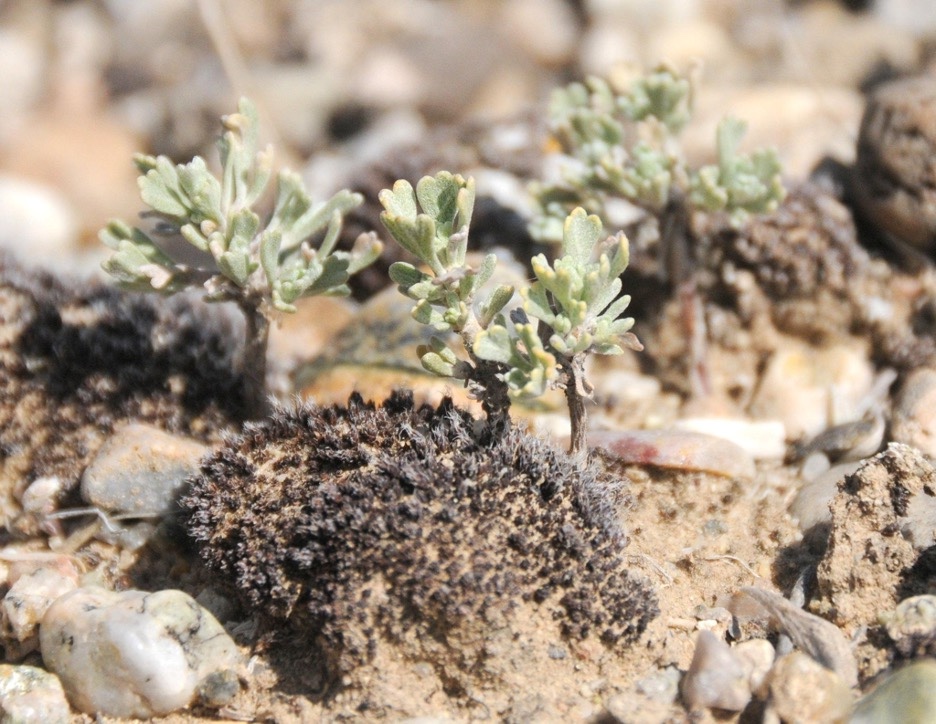
    In a 2022 study (Simler-Williamson and Germino 2022), we explored how the ‘non-random’ application of restoration seedings of big sagebrush (Artemisia tridentata) influenced our estimation of treatment effectiveness, using observations of post-fire seedings across the western U.S. in the Land Treatment Digital Library.

    When we used statistical models that assumed these restoration treatments were applied randomly, we found a somewhat counterintuitive result: a negative relationship between sagebrush seeding and sagebrush recovery. However, this statistical illusion emerged because of background relationships in our dataset: restoration seedings (Figure 2; X) tended to occur in hotter, drier, and more degraded places (Z), where plant establishment was already more difficult (Y). In short, restoration actions were disproportionately applied in more “dire” ecological settings, creating the illusion of failure.

    Next, we compared this approach to two sets of statistical methods designed to minimize the effects of confounders (“Z”) on our treatment effect. The first set of approaches required that we include pre-existing data about the hypothesized confounding variables directly into our model. When we accounted for some of these measured drivers of “non-random” seeding application using existing data about soil types, climate conditions, and fire impacts, restoration efficacy shifted from a negative number toward a neutral effect.

    Finally, the last set of approaches instead used repeated observations of sagebrush stands to ‘control for’ confounding variables, by accounting for pre-existing differences between treated and untreated stands before they had been seeded, rather than requiring the direct inclusion of measured variables. Only when measured and many unmeasured differences between treated and untreated sites were accounted for in our analysis, we revealed a positive impact (of ~4-6% in sagebrush cover by 10 years post-fire) of restoration seedings in degraded sagebrush ecosystems.

    The pattern we described in that paper underscores two key needs in restoration science: one social and one statistical. These results suggest that we urgently need better information about the socio-economic drivers determining where and when we apply restoration treatments, which are poorly described. The analyses that incorporated some common ecological drivers of restoration need (e.g., fire impacts, climate variables) only accounted for some of the bias in the effects of restoration seeding. The strong shift to positive impacts of restoration after “unmeasured” sources of bias were considered suggests that there are significant additional unmeasured processes that simultaneously shape where we attempt to restore and where plant populations recover. In the focal sagebrush steppe ecosystems, these may include diverse drivers such as seed availability, bureaucratic constraints, aesthetic considerations, cultural values, land use, and grazing management. Collecting and understanding these variables seems essential to advancing our understanding of restoration effectiveness broadly.

    But no matter how elegant randomized experiments are as a concept, they may not be able to generate estimates of restoration effectiveness at the broad spatial and temporal scales we require to manage rapidly changing ecosystems. As a community, I think we need to be integrating big, opportunistically collected datasets with statistical approaches that recognize the “messiness” of these data and aim to minimize the risk of confounding in treatment effects. Well-estimated treatment effects can improve how we connect restoration resources (such as seeds, time, and funding) with the locations where the ecological benefits may be greatest, both in space and time.

    For more information about Dr. Simler-Williamson’s work, see her lab website or her 2022 paper in Nature Communications.
  • Reforesting with Figs

    Reforesting with Figs

     Benjamin E. Smith is a Ph.D. student at George Washington University. He recently completed a field ecology course with the Organization for Tropical Studies in Costa Rica, where he worked with CCSD scientist Leighton Reid. When he’s not coring fig trees in Costa Rica, Benjamin studies plant-herbivore interactions in American chestnut.

    It was my recent privilege to spend a week at Las Cruces Biological Station in Costa Rica where I learned about some amazing properties of fig trees.

    The genus Ficus contains over 800 species, which can be found in the tropical to warm temperate regions throughout the world. Where they occur, figs are vital components of their local ecosystems because they provide high quality fruits for many animals. Animals attracted by the delicious figs often carry other plants’ seeds in their digestive tracks and subsequently deposit them below the fruiting fig tree. This can lead to patches of forest with especially high plant diversity.

    FICOBT
    Two individuals of Ficus obtusifolia demonstrating the strangler lifestyle (left) and the free-standing lifestyle (right). The individual on the left has overtaken one host tree and is reaching out to claim another. The individual on the right was planted (either by humans or birds) in a fence row.

    Some fig species have the ability to resprout roots, branches, and leaves from broken limbs – an adaptation that would be useful in an ecosystem with frequent disturbances, like hurricanes or landslides. Rural people have been utilizing this incredible feat of nature to create living fences for hundreds of years; they simply cut branches from a tree and plant them. Plant a large enough branch, and you’ve got an instant tree.

    Instant fruiting trees could be a practical tool for ecological restoration, and there is currently an experiment underway to test this idea. But not all fig species can resprout from cuttings, so in order for this tool to be useful outside of southern Costa Rica, it would be helpful to know which species will resprout and which will not.

    FICCOL Stake
    A healthy cutting of Ficus colubrinae. This instant tree was planted in May 2015.

    Does wood density predict resprouting in figs?

    We sought a way to determine whether a particular fig species would be able to resprout from a limb cutting before actually cutting apart large trees. This would mean only trees whose cuttings will survive would be used and trees that can’t resprout could be left undamaged.

    We believed that wood density would be a good measure to figure this out. Wood density can tell you a lot about a tree’s life history strategy. Is it a hard tree that will resist snapping in a stiff breeze? Or is it a softer tree that might break, but then resprout?

    To test this, we took core samples from seven fig species and headed to the lab. After a couple days of measurements, we had our data.

    Methods
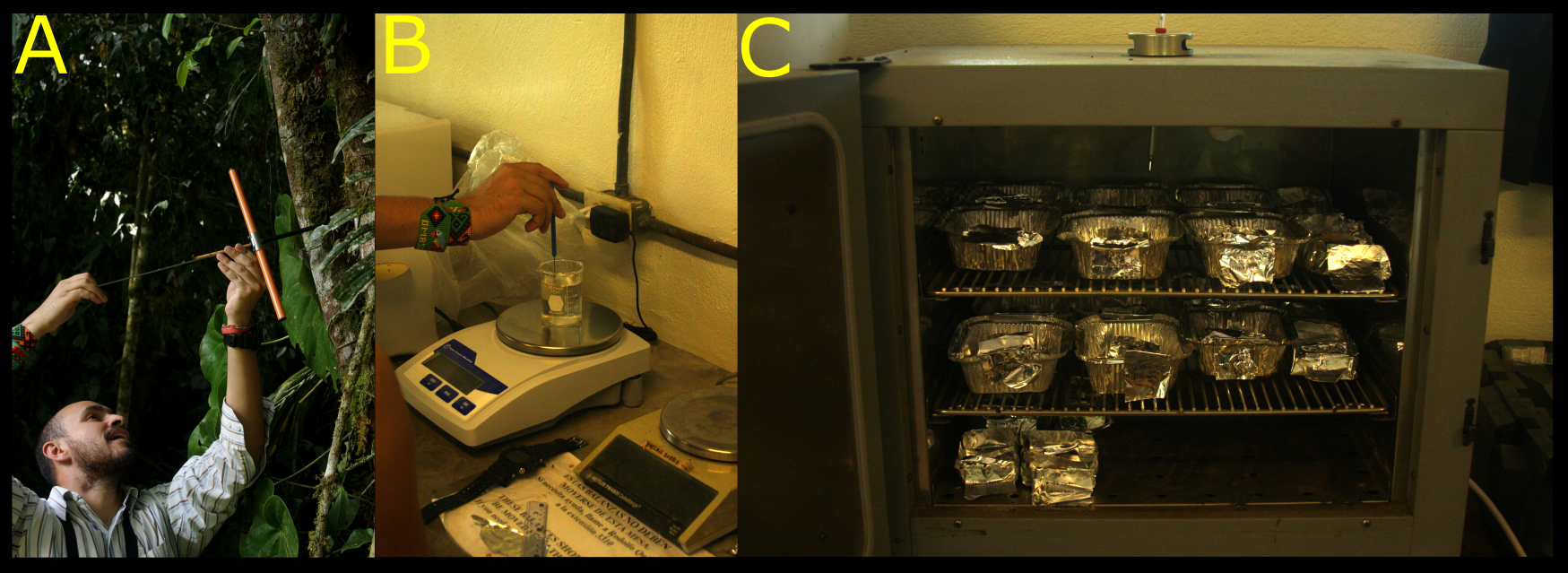
    (A) OTS student Orlando Acevedo Charry extracts a core from a Ficus colubrinae. (B) Cores were cut into small pieces. We measured the mass of the water that each segment displaced to determine the wood’s green volume. (C) Next, samples were placed in a drying oven at 106° C for 24 hours. Finally, we measured the mass of the dried samples and divided by the green volume to determine wood density.

    The fig species we tested turned out to have pretty similar wood densities. Also, the slight variations in wood density did not correlate with trees’ resprouting abilities. This initially came as a big disappointment, but after taking a second look at our data we started to see a trend that may actually be much cooler.

    Results
    Wood density was a poor predictor of resprouting capacity (measured by tallying fig cuttings that were planted in April-May 2015; Left), but strangler figs in the subgenus Urostigma performed much better than two free-standing species in subgenus Pharmacosycea.

    Fig species come in a variety of forms. Some are rather conventional free-standing trees that grow from the ground up, but others start as seedlings high in the canopy of another tree and send roots down to the ground, gradually strangling their host. Still others are shrubs, climbers, and epiphytes. We found that stakes cut from strangling figs, the ones that initially rely on a host tree, were much more likely to resprout than stakes cut from free-standing fig species. If this holds true, no measurements will be needed in the future. People around the world may be able to tell if a tree will likely sprout from a cutting just by the way it grows.

  • Galápagos: A Restoration Reference for Arid Archipelagos?

    Galápagos: A Restoration Reference for Arid Archipelagos?

    Leighton Reid, a postdoctoral fellow in the Center for Conservation and Sustainable Development, reflects on tortoises, tree cacti, and ecological isolation.

    The Galápagos is the world’s most pristine tropical archipelago, and it is utterly unique. Nearly the entire island group is a national park, and 200,000 visitors per year come to witness its ecological singularities ‒ things like penguins and iguanas swimming side-by-side through a mangrove lagoon. The archipelago consists of fourteen large, volcanic islands and over a hundred smaller rocks and islets. Most of the land surface is low and dry. The easternmost island is about 900 km from mainland Ecuador, which is a probable source for the organisms that first began to colonize Galápagos when its volcanic peaks surfaced above the Pacific five million years ago. Indeed, the islands’ ecology is characterized by their isolation. Each island contains a relatively low diversity of organisms, many of which are unafraid of large primates. The biotas’ ecological simplicity and naiveté have facilitated major scientific discoveries, such as that small, heritable variations can have life or death consequences for individuals and ultimately change populations.

    One of the more bizarre life forms on Galápagos is the tree cactus. Prickly pear cacti (Opuntia species) are not particularly rare in the western hemisphere. In the United States, for instance, they occur in every state except Alaska. But over millions of years in Galápagos they have become quite varied. Some grow low to the ground, like the familiar continental forms, whereas others grow as trees, towering up to 15 m above the ground. The first botanist to speculate on this phenomenon was Alban Stewart (1911), a scientist-sailor with the California Academy of Science. He noted that erect, tree cacti tended to grow on islands that also housed another over-sized organism – the Galápagos tortoise (Chelonoidis nigra). Galápagos tortoises eat the fleshy cactus pads, which contain water – a limiting resource in arid environments. Stewart posited that the pressure from tortoises craning their long necks upward to munch cactus pads may have favored taller cacti.

    Opuntia echios var. barringtonensis is one of the taller tree cacti, presumably made that way by pad depredation by giant tortoises over many generations.
    Opuntia echios var. barringtonensis is one of the taller tree cacti, presumably made that way by pad depredation by giant tortoises over many generations.

    A low-growing cactus (Opuntia echios var. zacona) growing on Seymour Norte, an island that historically had no tortoises or iguanas. Herbivore pressure is visible here; an introduced land iguana (Conolophus subcristatus) has been taking bites from the lowest pads.
    A low-growing cactus (Opuntia echios var. zacona) growing on Seymour Norte, an island that historically had no tortoises or iguanas. Herbivore pressure is visible here; an introduced land iguana (Conolophus subcristatus) has been taking bites from the lowest pads.

    The relationship between tortoises and cacti was thrown into disarray after the Galápagos were discovered (accidentally) by Panamanian Bishop Tomás de Berlanga in 1535. By the late 19th Century, pirates and whalers removed thousands of tortoises from the islands, stowing the living animals in their holds as fresh meat for their long Pacific voyages. Eventually, overharvesting extirpated tortoises from several of the islands, with rippling effects on the rest of the ecosystem. Even where tortoises survived, they were often unable to reproduce because their offspring were eaten by introduced, European rats. Tree cacti were among the hardest hit; tortoise decimation stripped these plants of their main seed disperser.

    Reintroduced giant tortoise in the littoral zone on Isabela Island.
    Reintroduced giant tortoise in the littoral zone on Isabela Island.

    In response to tortoise declines, the Charles Darwin Foundation and the Galápagos National Park Service began a captive breeding program on Santa Cruz Island. Since 1965 they have raised and repatriated thousands of tortoises to several islands, waiting to release them until the tortoises have gotten big enough to be “rat proof”. By and large the reintroductions have been successful. On Española Island, for example, tortoise populations had crashed to fifteen individuals in 1960, but by 2007 more than 1500 individuals had been repatriated, and the population appeared stable. Moreover, these reintroduced tortoises reinitiated seed dispersal for an endangered tree cactus (Opuntia megasperma var. megasperma), increasing the number of juvenile plants.

    In addition to species reintroductions, ecological restoration in Galápagos has often entailed species eradications. Isolation historically shaped Galápagos ecology; nine hundred miles is a long way for a snake or a lizard to float on a vegetation raft. But Galápagos’s isolation was compromised by seafaring humans, who facilitated island colonization by domesticated animals and hundreds of plant species. Goats have been among the worst invaders. Until recently, goats overgrazed the islands’ vegetation, converting it into habitat unsuitable for native species. One of the most ambitious restoration projects in Galápagos has been eradicating goats from the archipelago. On the largest island, Isabela, more than 140,000 goats were killed in 2004-2005 using unconventional restoration tools, including helicopters, AR15 rifles, and Mata Hari goats – sterilized female goats induced into long-term estrus and fitted with radio telemetry collars to root out the last hold-outs. Goat eradication has resulted in spontaneous vegetation recovery. In addition to goats, the Charles Darwin Foundation and the Galápagos National Park Service have also eradicated eight exotic plant species. Other species will be harder to get rid of, like rats, guava, blackberry, and domestic cats.

    Despite its one-of-a-kind nature, can the world’s most pristine tropical archipelago serve as a reference for other arid, tropical islands? That is, can we evaluate the success of other island restorations by comparing them to the relatively intact Galápagos’s ecosystem structure, function, and composition? Perhaps to some extent we can. Historical contingency leads to unique island assemblages (for example: giant tortoises in Galápagos, giant skinks in Cabo Verde, giant lizards in Komodo), but many islands may be characterized by their lack of functional redundancy. In other words, if you remove a species from an island, the ecosystem consequences may be greater than if you had removed a species from a more diverse mainland ecosystem. Additionally, plant restoration in the arid Galápagos suggests that when disturbances are removed, vegetation can recover rapidly. This may also be true of other oceanic archipelagos, whose plants and animals have already colonized difficult terrain from a long way away.

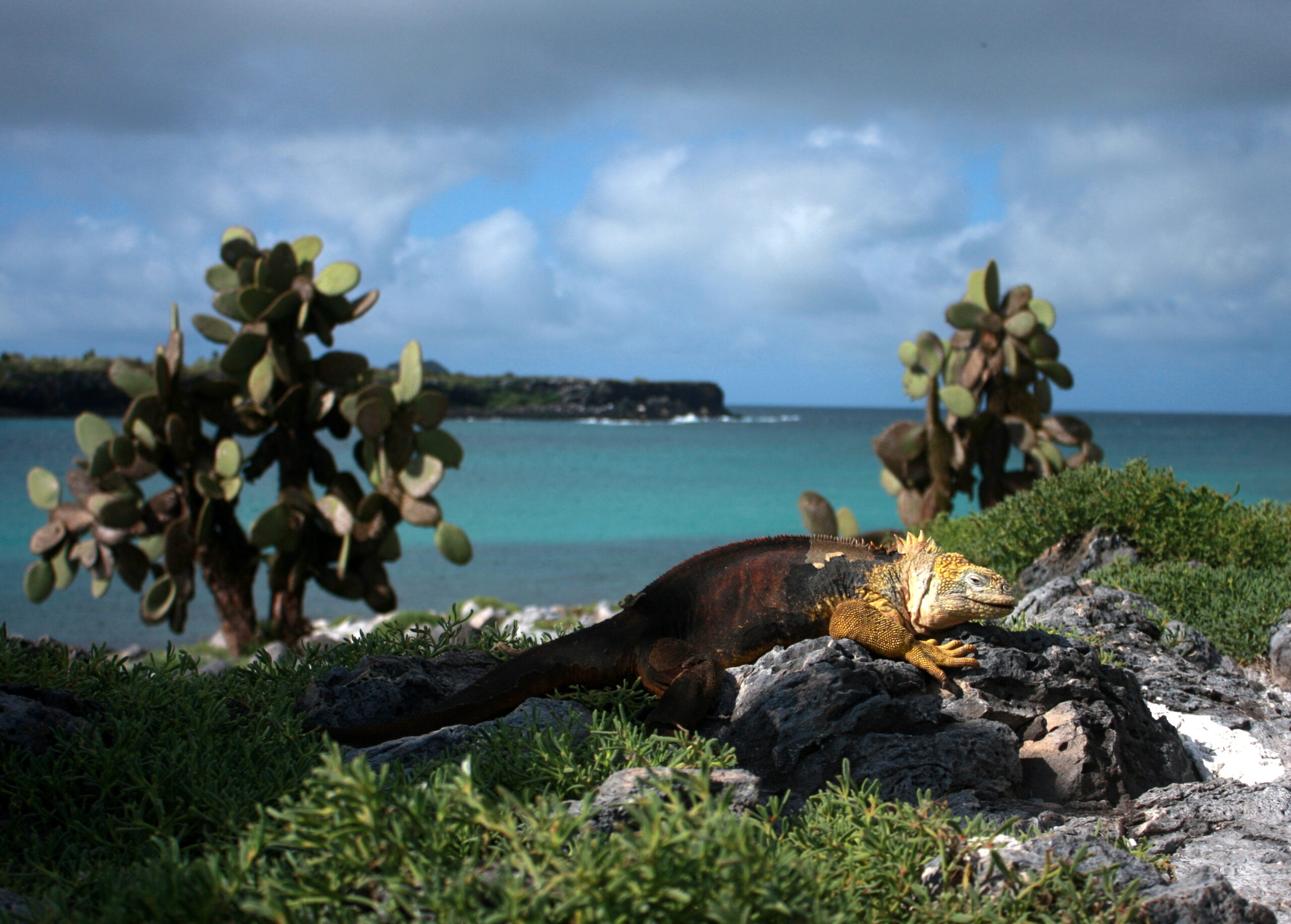
    Land iguana and tree cacti (Opuntia echios var. echios) on Plaza Sur Island.
    Land iguana and tree cacti (Opuntia echios var. echios) on Plaza Sur Island.