Tag: revegetation

  • Invasive plants, restoration, and the soundscapes of urban streams

    Invasive plants, restoration, and the soundscapes of urban streams

    By Gabrielle Ripa

    Dr. Gabrielle Ripa is a postdoctoral researcher at North Carolina State University. 

    Imagine: it’s a nice warm and breezy evening and you decide to enjoy your dinner outside. You hear the burbling of a nearby stream mingling with the nightly chorus of frogs and insects. Maybe a Barred Owl is asking “who cooks for you?” in the distance. The species making noise at dusk are supported by the stream ecosystem: from the side channels and ephemeral pools that support breeding frogs and aquatic macroinvertebrates to the streamside vegetation that provides food and cover for many other species of wildlife.

    Now imagine it’s quiet – or even human-made noise like traffic takes centerstage in the streamside symphony. That would make for a less enjoyable outdoor dining experience.

    To support the biodiversity of the ecosystem, the different components of the stream system must work in tandem. However, in urban environments, streams are under threat from many fronts including climate change, pollution, and invasive species. Stream restoration is increasingly used to address the symptoms of these stressors such as streambank erosion or poor water quality, or to mitigate harm to riparian systems from human development.

    Restoration goals differ among projects. In the Chesapeake Bay watershed in the eastern United States, emphasis is largely placed on improving water quality by reducing certain pollutants and fixing stream incision and erosion. Unfortunately, these projects have often focused on stream engineering with little attention paid to the biota.

    An eroded streambank with exposed roots. Photo: Gabrielle Ripa.

    The Chesapeake Bay watershed connects six U.S. states and Washington D.C. and encompasses over 64,000 square miles of land. The Chesapeake Bay Trust brings together researchers, state and federal agencies, and restoration practitioners to improve watershed restoration practices within the Chesapeake Bay watershed. Many of the projects they fund through their Pooled Monitoring Initiative are in response to questions raised by those doing the on-the-ground work. Restoration managers recognized the growing encroachment of invasive plant species on restored streams and sought solutions to the problem. Invasive plants threaten biodiversity globally and have been at least partially responsible for 60% of extinctions, therefore preventing and limiting their establishment where possible is consequential for many native species of flora and fauna. 

    Thus, the focus of my dissertation research was to give recommendations to restoration practitioners on how to limit invasive plant establishment on urban stream restoration projects. Additionally, I was interested in how invasive plants and stream restoration could impact stream soundscapes, or the sum of all sounds in an environment.

    Stream restoration has the perverse impact of worsening plant invasion

    To understand how restoration impacts the vegetation community, I compared 46 stream reach pairs: each pair consisted of a restored stream reach and an unrestored stream reach. I found that half of all of the restored stream reaches had greater invasive plant richness and cover and lower native plant richness and cover than their paired unrestored stream reach. Many restoration projects improved the stream geomorphology, but didn’t improve, or even worsened, the riparian plant community. Largely, invasion of both restored and unrestored stream reaches was driven by light and soil nutrient availabilities. However, restored streams were not more likely to be resource-rich compared to their unrestored counterparts.

    The projects spanned between 8 and 30 years since project initiation. Some might wonder whether invasive plants are ephemeral features of newly restored streams, taking advantage of the pulse of light and open soil that accompany stream reconstruction (e.g., revegetation after streambanks vegetation was cleared to stabilize the banks). But I didn’t find any evidence for invasive plants phasing out of the vegetation communities as they matured. More often than not, stream restoration in the Chesapeake Bay watershed was facilitating rather than limiting invasion.

    A restored stream heavily invaded by Japanese stiltgrass (Microstegium vimineum). Photo: Gabrielle Ripa.

    Stream restoration design and implementation have limited power to prevent invasion

    Given restored reaches were more invaded than unrestored reaches, I focused on determining how different aspects of restoration influence invasion, including: planting design, project monitoring, project attributes, resource availability, and surrounding land use. Planting design variables included metrics such as the number of species planted, the stem density that was planted, and the number of species that I detected in my surveys that were originally planted during restoration. I examined project monitoring variables such as the number of years a project was monitored and whether invasive plants were monitored. Project attributes focused on the specifications of the restoration project, like the length of stream that was restored and whether the stream was restored as mitigation or for bank stabilization/erosion control/water quality. Because of previously established relationships between increased resource availability, as well as human land use/disturbance, and invasive plants, I also included several of these variables (e.g., measures of soil nutrients and light availability, human development) to determine whether the design and implementation of stream restoration could overcome these limitations.

    Of all the five categories of variables, resource availability and surrounding land use were the most important for predicting invasive plant cover on stream restoration projects. Heavily engineered stream restorations remove trees and expose bare soil – generating light and nutrient resource pulses exploited by invasive species. Therefore, recommendations to limit invasive plant establishment on stream restoration projects include overstory tree retention and actions to accelerate canopy closure.

    Sites with more urban and suburban land nearby had greater invasive plant cover. Potential invasive plant pressure due to surrounding urban and suburban land use is important to incorporate into project monitoring, management, and budgeting (e.g., having an invasive species management plan and setting aside money to treat invasions).

    Projects that used a reference site either for project design or to compare restoration outcomes had significantly lower invasive plant cover than those that did not. Reference sites are important components of restoration design to ensure appropriate ecological targets and to know when project outcomes may have gotten off track.

    While resource availability and surrounding land use play outsized roles in facilitating invasive plant cover on stream restoration projects, restoration practitioners can still address invasion by leaving overstory trees, adding fertilizer only as necessary, and incorporating reference sites into design and monitoring of projects.

    Plant invasion and stream restoration drive seasonal soundscapes

    The urban streams I studied are all invaded to some extent, and many are either in need of, or have undergone, restoration. Why does it matter if restored streams become more invaded? Impairment of stream function or increase in invasive plant prevalence in an ecosystem can have rippling effects on the rest of the system. Invasive plants have been shown to negatively affect both bird and insect speciesespecially in urban areas, and to limit frog survival and foraging success. When the species affected are ones that make sound, we might be able to hear the impacts of invasive plants and stream restoration.

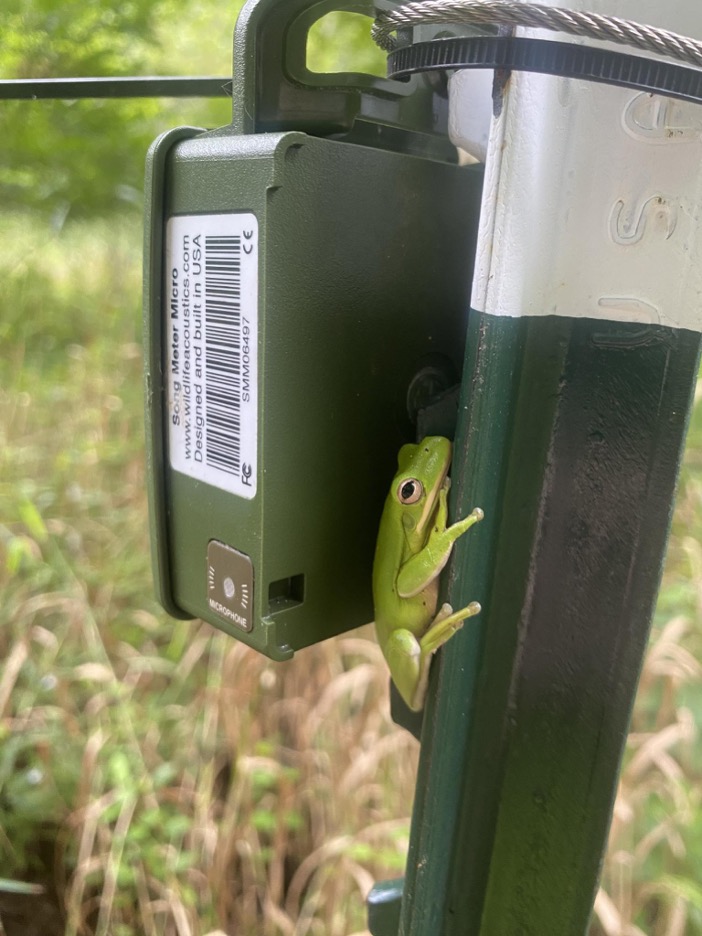
    A green treefrog (Hyla cinerea) on a streamside acoustic recorder. Photo: Gabrielle Ripa.

    To determine how invasive plants and stream restoration impact urban stream soundscapes, I deployed acoustic recorders at 20 of my paired streams for one year. Restored streams had greater bioacoustic activity in the spring, from late February to mid-April, potentially due to more frog activity as restoration reconnected floodplains resulting in more ephemeral pools.

    As expected, there was greater bioacoustic activity in the early summer on streams that were less invaded. This coincides with the typical phenology of Maryland’s temperate system as birds are mating and there is more insect activity alongside peak native vegetation biomass. However, in the winter, bioacoustic activity was greater on more invaded streams from October to mid-February. It’s possible that the different phenology of invasive plants, such as later leafing and fruiting than native plants, provides more food and cover resources in the winter compared to less invaded streams.

    As we’re midway through the UN Decade on Ecosystem Restoration, the use of restoration is increasing to remedy human impacts to natural systems. However, current practices are often understudied in their impacts on native plant and, especially, wildlife communities. My work highlights that improvements to restoration practices are needed to achieve ecological uplift, and additional research can aid in promoting recovery of native biodiversity.
  • Managing invasive common buckthorn (Rhamnus cathartica) in the Midwest US

    Managing invasive common buckthorn (Rhamnus cathartica) in the Midwest US

    Andrew Kaul is a Restoration Ecologist in the Center for Conservation and Sustainable Development at the Missouri Botanical Garden. Mike Schuster is a Researcher in the Department of Forest Resources at the University of Minnesota. 

    Removing invasive shrubs is a critical step in ecological restoration projects in many degraded forests and woodlands across the Eastern US. Invasive shrubs quickly spread and outcompete native plants, which leads to declines in plant species diversity and ecosystem functioning. By suppressing these aggressive non-native species, restoration efforts can promote the regeneration of native vegetation that provides habitat and food sources for local wildlife. Removing invasive shrubs also allows more sunlight to reach the forest floor, enabling the regeneration of native tree seedlings and understory plants. Establishing an understory community is necessary to conduct effective management with prescribed burns in fire-adapted systems.

    Rhamnus cathartica, also known as “common buckthorn” or “European buckthorn”, is one of the most aggressive invasive species in Eastern North American forests. This buckthorn species is a shrub/small tree originally native to Europe and Western parts of Asia, brought to North America in the 1800s, and planted as a hedge-forming species. Buckthorn biology and control have been studied extensively in recent years due to its significant ecological and economic impacts, particularly in the Midwest US.

    R. cathartica native range in Eastern Hemisphere (map from Kurylo et al. 2007).

    ​Many aspects of its growth and reproduction make buckthorn a successful invader.Buckthorn is dioecious (male and female flowers occur on separate individuals) and femalesproduce copious quantities of small berry-like fruits called drupes (like a cherry) that are widely dispersed by birds. Buckthorn can thrive in many soil and light conditions, being especially tolerant to low-light environments caused by shading from other trees and shrubs. It also has unique phenology, holding its leaves late into fall. Like many invasive shrubs, its dense branching physiognomy leads buckthorn to form thickets that shade out native vegetation, decreasing diversity of plant species in invaded forests. In addition to effects on plants, buckthorn invasion has also been linked to changes in soil chemistry and may increase soil erosion through reducing the cover of understory plants.

    R. cathartica non-native range as depicted by the Biota of North America Program (BONAP). Light blue denotes counties where buckthorn has been reported, and pink indicates where it is present and state-listed as a noxious weed. This map likely represents a conservative estimate of common buckthorn’s range, which has been expanding in recent years.

    Many of the same traits that make buckthorn a good invader also make it very difficult to remove and control when restoring natural areas. It produces extensive root systems that store nutrients, so it can re-sprout vigorously when cut. This means removal requires repeated control efforts over multiple years. The most common control methods used to manage buckthorn include mechanical and chemical treatments. Mechanically, young seedlings can be hand-pulled and saplings can be removed with a weed wrench. More mature plants are often girdled, cut, or mowed to remove most of the biomass, and then application of herbicide is necessary, otherwise, stems will survive and quickly re-sprout within only a few weeks. Herbicide can also be applied to basal bark without cutting, but this method is less effective on large individuals.

    Even with persistent effort, complete buckthorn control is rarely successful because it can quickly recolonize areas if not thoroughly removed. Fortunately, there is some good news about the feasibility of buckthorn management. It was previously believed that buckthorn seeds could form persistent “banks” in the soil, with seeds surviving for up to 6 or 7 years, waiting for the right set of conditions to trigger germination. However, our recent study showed that buckthorn seeds actually germinate in one to two years, with 97% germinating in the first year. This is a critical discovery for the management of buckthorn, as it indicates that after removing large individuals, management methods to suppress seedling establishment are key to preventing reinvasion. Moreover, if seedlings are suppressed for the first couple of years, then buckthorn control is possible. Because these fleshy-fruited invaders are so readily dispersed by birds, complete eradication is unlikely, but continued management can keep densities low enough to not impact native plant communities.

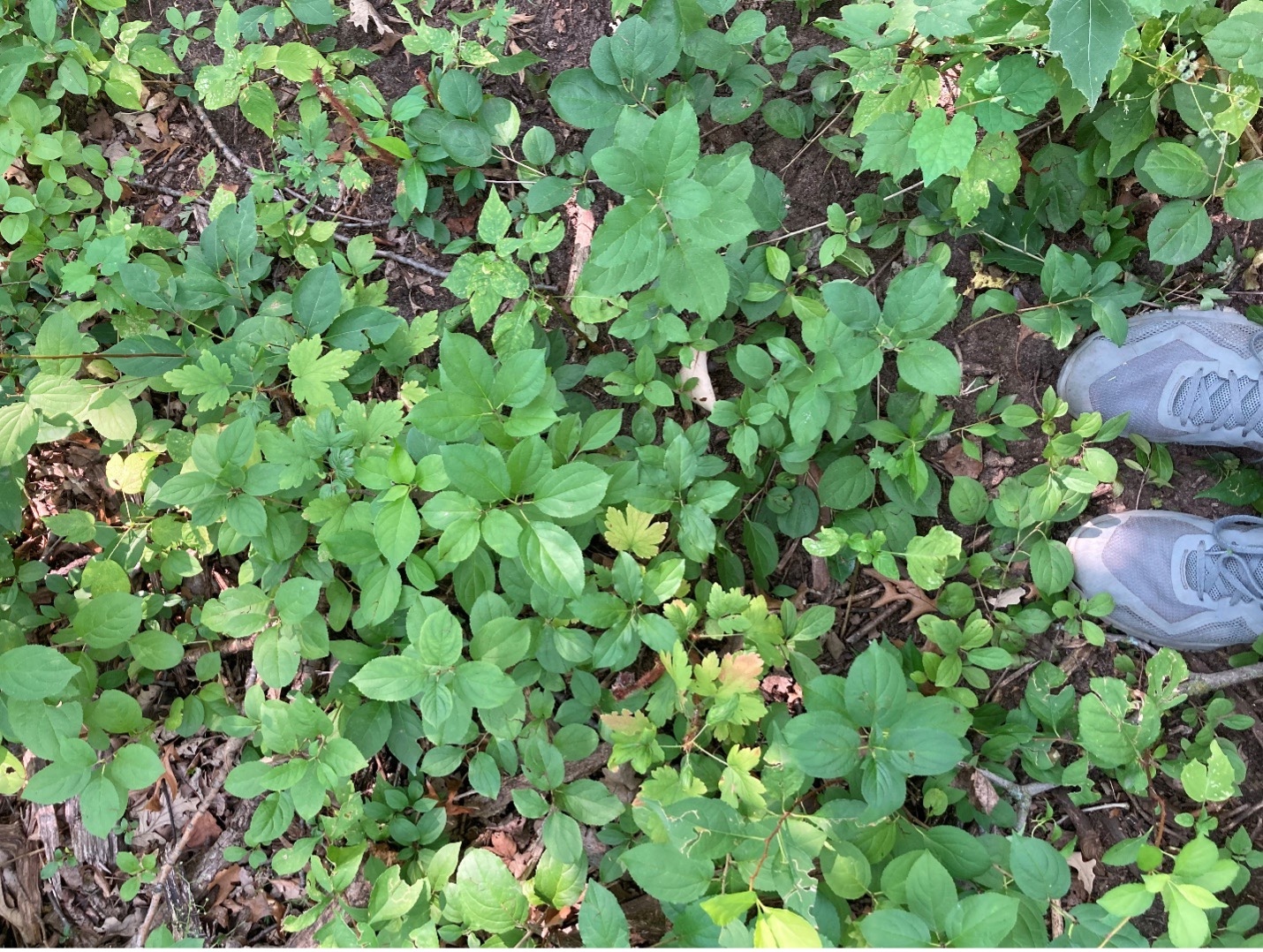
    R. cathartica seedlings forming a dense layer near the ground in a temperate deciduous forest in Eastern Minnesota USA (Photo by Andrew Kaul).

    ​Our research group at the University of Minnesota led by Peter Reich has been studying buckthorn for several years, funded by multiple grants from the Minnesota Invasive Terrestrial Plants and Pests Center (MITPPC). Recent work in our group has focused on how to suppress buckthorn regeneration after initial removal of large individuals. The Cover it up! project investigates which methods of revegetation are most effective for restoring the ground-layer with native species that can prevent buckthorn recruitment and growth. Various experimental introductions of native plants have included direct seeding shrubs, direct seeding trees, adding herbaceous seed mixes with variable ratios of grasses to forbs, and treatments with combinations of functional groups. For example, we combined sowing the Standard Cover It Up seed mix of 34 native grasses, and forbs with planting bare-root plants from other functional groups – trees, shrubs, ferns, or sedges.

    Across several experiments, one of the most important results has been that the extent to which revegetation treatments are effective in suppressing buckthorn, is mostly explained by their ability to rapidly establish vegetation, preempt space, and shade out buckthorn seedlings. Two of the most successful strategies include 1) planting native tree species and 2) seeding a mix of native Elymus spp. grasses (wild ryes) and wildflowers to establish an herbaceous understory. The native trees used in this experiment included species like Sambucus canadensis (elderberry), Abies balsamea (balsam fir), and Acer saccharum (sugar maple), planted immediately after clearing-out buckthorn. Planting woody native species can reduce buckthorn regrowth by up to 80%, and establishing a grassy herbaceous community can reduce regrowth by 77%.

    We recently published A Guide to Forest Understory Revegetation, which makes several science-based recommendations for invasive shrub management based on our research. Revegetation should occur as soon as possible after initial removal of large individuals. Additionally, restoring sites via revegetation will be most effective in areas with at least 10% open canopy so that sufficient light is present for native seedlings to establish. If opening the canopy is feasible by selectively removing some trees, this will facilitate a greater cover and diversity of herbaceous plants in the understory. When conducting revegetation with herbaceous species, planting a native seed mix with a high proportion of cool season (C3) grasses is ideal. These species grow well in shadier environments, establish rapidly, are inexpensive, and produce dense vegetation that can carry a fire to facilitate management with prescribed burns. Shade-adapted wildflowers such as Ageratina altissima (white snakeroot) or Hydrophyllum virginianum (Virginia waterleaf) should be included in the seed mix in order to add value to pollinators and other insects. When conducting revegetation with woody species, planting native tree species can be highly effective in excluding buckthorn, but revegetation through bare-root plantings has its drawbacks, being more expensive and labor intensive. This method would work well if implemented in smaller areas, especially where there are few deer. In general, revegetation plansshould prioritize reducing light reaching the ground where buckthorn seedling are growing.Counterintuitively, this can be achieved by opening the tree canopy to facilitate establishment of herbaceous cover in the understory. 

    In addition to studying methods of revegetation to suppress buckthorn seedlings, our research group is also investigating novel methods for removal of mature buckthorn plants. In June 2024, we initiated an experiment testing the efficacy of critical period cutting to kill large buckthorn without the use of chemicals. This method was pioneered by Friends of the Mississippi River (FMR) as a strategy for removing buckthorn without using herbicide, which is prohibited in Minneapolis parks. This method involves using a saw or loppers to cut off the top of a buckthorn plant about 1.5 m from the ground early in the growing season. Subsequently, a couple times throughout the growing season, each buckthorn is revisited and stripped (picked off easily by hand) of all re-growth. This process is then repeated the following year, if necessary. Cutting the stem at chest height rather than near the ground has multiple benefits of 1) reducing risk of stumps as a tripping hazard, 2) relocating previously cut stems, and 3) stripping re-sproutsthat usually occur at the end of the stem, which is near chest height.

    Given FMR’s success implementing the critical period cutting method, our experiment is examining when this method is most effective in killing buckthorn depending on the size of the individual or its light environment. We are also quantifying the minimal effort required to ensure buckthorn mortality by examining survival of buckthorn over two years of stripping re-sprouts, with 4, 6, or 10 total removals. To test how effective this method is for controlling other invasive shrub species, we are working with collaborators in Wisconsin, Maine, and Missouri, who are also conducing this experiment on the invasive shrubs Frangula alnus (glossy buckthorn) and Lonicera maackii (bush honeysuckle). These are also serious woody invaders of forests throughout the Midwest and our research aims to improve forest restoration outcomes at smaller scales when herbicide or other larger-scale methods are not possible.

    Stems of common buckthorn in a study area examining the efficacy of critical period cutting in Minnesota (Photo credit Alex Roth).
    Experimental stems of bush honeysuckle at the Missouri Botanical Garden’s Shaw Nature Reserve (Photos by Andrew Kaul). 

    If you are interested in learning about these projects in greater depth, you can read the guide to forest understory revegetation here or learn more about ongoing research in the Cover It Up! project here. If you have any questions, feel free to contact Mike (schuster@umn.edu) or Andrew (akaul@mobot.org).