By Wes Bollinger
Wes Bollinger completed his master’s in 2025 with Jeffrey Matthews lab in the Department of Natural Resources and Environmental Sciences at the University of Illinois. Wes is now a restoration ecologist in Chicago and runs his own restoration consulting business – Wildshape Ecological Design.
The modern American landscape is crosscut by millions of miles of roadways. This land that was previously part of intact ecosystems has been converted into impermeable pavement and ditches, reducing the quantity and quality of habitat. Roadways also lead to habitat fragments, which can impede the movement of animals around the landscape. Highways in the Midwest (Illinois, Indiana, Iowa, Michigan, Minnesota, Missouri, Ohio, and Wisconsin) amount to more than 100,000 centerline miles (160,934 km) of roadway, and their unpaved right-of-way (roadside margins, medians, interchanges, etc.) total over 1,010,000 acres (445,000 ha) of unpaved land and soil. Highway roadsides typically experience high rates of disturbance due to wind, vehicle traffic and pollution from oil, microplastics from tires and litter, and often agricultural additives like herbicides, insecticides, and fertilizers. These lands and similar areas adjacent to roadways may be either burden or boon to the local ecosystem depending on management regimes and use of disturbance tolerant plant species. Here I recommend an approach to identifying appropriate native species for roadside vegetation, but this perspective may also apply to a variety of marginal greenspaces, such as residential sidewalk strips.

If poorly managed, rights-of-way can become heavily invaded by nonnative plants like common reed (Phragmites australis), teasel (Dipsacus fullonum, Dipsacus laciniatus), and Johnsongrass (Sorghum halepense) among many others. These invasive species inhibit the native grasses and forbs and reduce ecosystem functioning. When heavily invaded, roadsides also cause economic impacts, functioning as source populations of weeds that can impact adjacent agroecosystems. Typically, roadsides are seeded with a mixture of Eurasian turfgrasses like Kentucky bluegrass (Poa pratensis) and red fescue (Festuca rubra). These nonnative grasses are comparatively short both in their above- and below-ground growth. Their short roots do not inhibit the growth of undesirable nonnative species, resulting in more mowing and maintenance than a native plant community to keep areas appearing ‘pristine.’
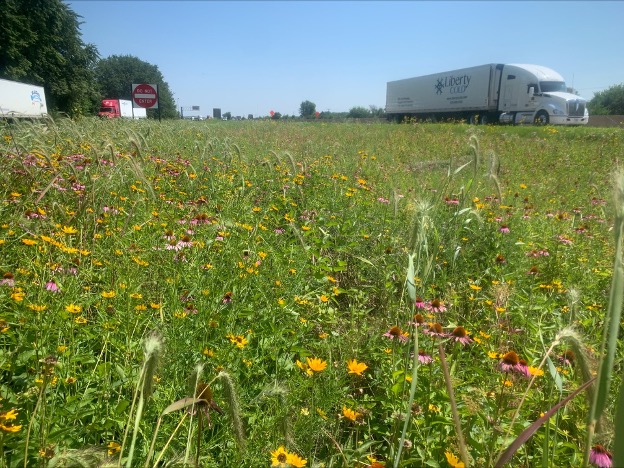
However, roadsides can be restored with native species and managed using best practices to provide economic and environmental benefits to the region. Native-dominated vegetation can inhibit invasion, protect nearby remnant habitats, promote healthy soil, improve stormwater retention, absorb agricultural additives, sequester carbon, and provide forage and migration corridors for native animals. Though establishing native vegetation on roadsides may have these obvious benefits, there are many knowledge gaps pertaining to this practice such as how and what to seed in these areas to maintain the highest ecosystem fidelity and greatest economic benefits.
We conducted research to determine which native species to seed on highways and the best practices for establishment and maintenance of these areas, with the goals of lowering overall maintenance costs by reducing the frequency of mowing needed to maintain these areas. This work was funded through grants from the Illinois and Indiana Departments of Transportation (DOTs) in conjunction with the Illinois Center for Transportation and the University of Illinois.
I carried out three projects to gain empirical evidence on how to restore Midwestern roadsides with native species. Project 1) reviewed the native seeding practices of the DOTs of the Midwest to identify commonly seeded species and assessed establishment and management practices. For Project 2) we conducted experimental trials in Illinois comparing existing Illinois DOT mixes (non-native and partially native) with novel mixes that we designed to be more diverse and contain only native species. For Project 3) we conducted a field survey of existing native roadside plantings across Illinois and Indiana. Projects 2 and 3 sought to quantify the performance of individual species to determine which ones have the greatest establishment and persistence in roadside conditions, and what conditions lead to favorable native establishment generally.
Project 1) Current native seeding and management practices
My review of Midwestern DOT seeding practices revealed stark differences between DOTs among states, but some commonalities that are noteworthy for establishment and maintenance. Most interestingly was the disparity in native diversity between states. Michigan did not list any native species in their roadside manual, while Minnesota listed 108, the most of any Midwestern DOT. Further, Minnesota listed 11 majority or entirely native seed mixes and had the most comprehensive standard operating procedures for native seeding. Many mixes had average max heights under 3 ft (~1m) to avoid obscuring motorists views on roadsides; however, some states had mixes more than 5 ft (~1.5 m) for tallgrass areas and to increase the invasion resistance of an area by blocking light access with taller plants. Perhaps surprisingly, the states of Ohio and Indiana still list an invasive legume, crownvetch (Securigera varia), in mixes designed for erosion control.

Several establishment methods were common across states. Native seeds should be sown into low-fertility topsoil using a hydroseeding machine (a device that sprays a mixture of seed, water, and an organic adhesive agent directly onto soil) especially on sloped areas. Hydroseeders show remarkable success in soils with a seed bank containing invasive species, by avoiding tillage which can bring these seeds to the surface and increase their germination. Native straw can be applied as a mulch layer and may be harvested from areas scheduled for maintenance with mowing. Seeding should take place in the fall to allow for cold stratification. Local ecotype seeds are preferred to produce individuals with locally adapted phenotypes and avoid genetic contamination with seeds harvested outside the region. Mowing in the first year of growth is critical to reduce invasive species while native seedlings establish. Minnesota recommends three mows in year one, in May, June, and July, and a singular mow between July and August of year two. Controlled burning of these areas is ideal every 3-5 years but mowing at the same rate is also beneficial.
Project 2) Comparative performance of standard (mixed origin) and native-only mixes
As a method of direct comparison between existing DOT seed mixes and a fully native roadside, I established four trials across Illinois to test differences in seeded, native, seeded native, and nonnative unseeded plant cover and richness, thus also providing information on invasion resistance between four popular mixes (DOT lawn, roadside, north IL, south IL) and four corresponding fully native plant mixes I designed to meet the same general criteria (low growing, disturbance, and salt tolerant) while also being higher diversity (from 9 to 38 species depending on mix). These experimental plots were seeded in November 2023 and surveyed in May and August of 2024. I observed that plantings differed in degrees of success, but every trial showed at least one significant positive result for the native planting over the nonnative IDOT mix. Native richness was higher for all sites by August of the first growing year, and native cover was higher for three of the four experiments. My trial of the IDOT Class 3 North Slope mix against a mix of 38 native species yielded significantly higher seeded cover by August 2024, and higher richness and cover of all native species in both May and August, suggesting that this high diversity mix competed very well against an existing DOT mix which was a combination of native forbs and nonnative grasses. Based on preliminary data collected during 2025, the native species are continuing to outpace the nonnatives in these mixes.
Of the native species seeded in these trials, those with the greatest record of germination in year one are lanceleaf coreopsis (Coreopsis lanceolata), common milkweed (Asclepias syriaca), partridge pea (Chamaecrista fasciculata), Illinois bundleflower (Desmanthus illinoensis), pale purple coneflower (Echinacea pallida), common evening primrose (Oenothera biennis), golden Alexander (Zizia aurea), blue vervain (Verbena stricta), and plains oval sedge (Carex brevior), which were present in the first year between 50% and100% of plots they were seeded in.

Project 3) Identifying the most successful native species from field surveys
Lastly, I surveyed 34 native plantings on roadways across Illinois and Indiana at various distances from the road edge while collecting data on soil chemistry, surrounding land use, and soil compaction. Sites were more than two years old to avoid plantings early in their establishment. The purpose of this project was to identify which seeded species tend to germinate and persist, and what environmental factors contribute to higher native and invasive success. Of the 153 native species seeded in one or more sites, we found that 28 native species were observed in at least half of the planted sites and 84 species were never observed once despite being seeded in anywhere from one to 12 sites. Five species were found a total of 10 or more times each across all 34 sites: common milkweed (Asclepias syriaca), bee-balm (Monarda fistulosa), black-eyed Susan (Rudbeckia hirta), false sunflower (Heliopsis helianthoides), and switchgrass (Panicum virgatum). These five species along with Virginia wildrye (Elymus virginicus) were also the most observed species at sites where they were seeded. These surveys were not designed to be comprehensive given the size of many of these plantings and it is highly probable some other seeded species were present but unobserved.
I found that native diversity and cover were generally higher further from the road edge, in areas with less salt, more basic soil, lower nitrogen and phosphorous, and a higher seed mix diversity. The opposite was true for nonnative cover and diversity. Richness of the seeded native mix was one of the strongest determinants of both diversity and cover.
In summary, we recommend that seed mixes should be hydroseeded at a rate of 60-70 seeds per square ft. (650-750 seeds per square meter) into low-nutrient, unfertilized soils, and covered in native straw. High-diversity mixes with no more than 10% legumes and an otherwise equal ratio of grasses to forbs should be used. Several species (but no more than 10%) should be early-establishing annual forbs for first year cover. Select species so that there is at least one blooming at all times of the growing season, favoring plants like golden Alexander (Zizia aurea) and native Alliumspecies for early spring blooms. Seed in as large an area as possible to reduce edge effects, consider cloverleaf interchanges as ideal locations for large projects.
For maintenance in year one post-seeding, mow several times (May, June, July, potentially also August in warmer states) to a height of 6-8 inches. In year two, mow at least once between June and September. Controlled burning or mowing can be conducted as needed for persistent weed issues but generally are only required every three to five years. If mowing is needed, areas with low abundance of non-native plants can be harvested as native straw for future plantings.
Native species with the best establishment record and widest usage are as follows and should be prioritized in high disturbance roadside plantings: Asclepias syriaca, Asclepias verticillata, Bouteloua curtipendula, Carex brevior, Carex cristatella, Carex hystericina, Chamaecrista fasciculata, Coreopsis lanceolata, Dalea purpurea, Desmanthus illinoensis, Echinacea purpurea, Elymus canadensis, Elymus virginicus, Eryngium yuccifolium, Eupatorium perfoliatum, Helianthus grosseserratus, Heliopsis helianthoides, Juncus effusus, Monarda fistulosa, Oenothera biennis, Panicum virgatum, Penstemon digitalis, Physostegia virginiana, Pycnanthemum tenuifolium, Ratibida pinnata, Rudbeckia hirta, Silphium laciniatum, Symphyotrichum novae-angliae, Symphyotrichum puniceum, Liatris pycnostachya, Verbena stricta, Vernonia fasciculata, and Zizia aurea.
Further details and methods can be found in the thesis here or by contacting the author at info@wildshaperestoration.com