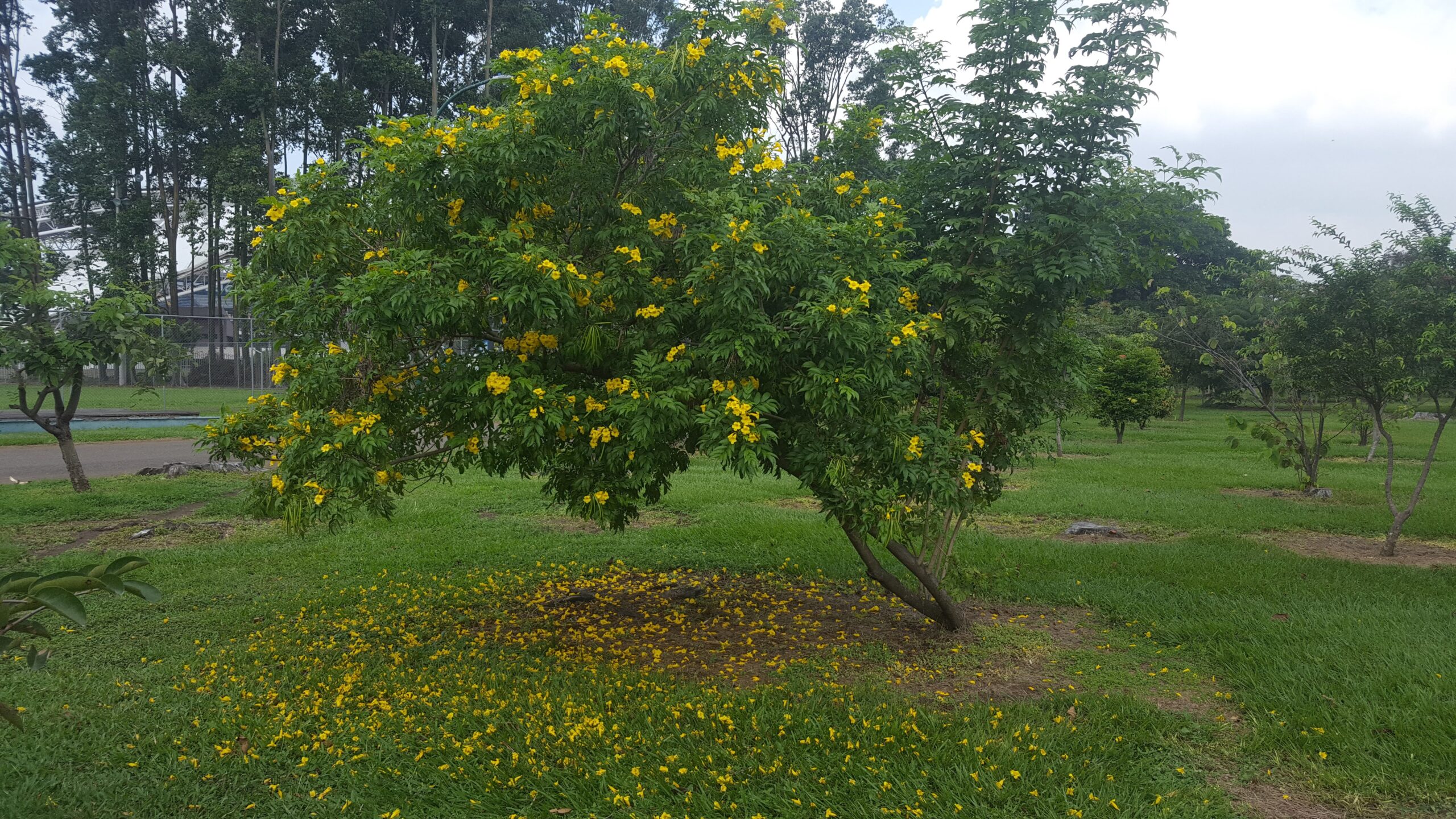
During a recent trip to Costa Rica, CCSD scientist Leighton Reid toured La Sabana, Costa Rica’s largest urban park, with Wilmar Ovares, an instructor at the Universidad Estadal a Distancia who has been studying the recovery of bird diversity following large-scale replacement of exotic trees with native ones.
The first time I visited La Sabana Metropolitan Park in downtown San Jose was in 2005. At that time it was essentially a eucalyptus woodland; the tall trees with peeling bark stretched upwards above the soccer fields and hiking trails. No longer. La Sabana has gotten a makeover in the last few years – and for the better.

The project was initiated as a collaboration between three institutions: the National Biodiversity Institute (INBio), the National Sports and Recreation Institute (ICODER), and Scotiabank. Beginning in 2010, this collaborative removed most of the exotic trees in La Sabana and replaced them with more than 5000 native trees, representing 234 species. Not all of the species are native to the central valley, but all are native to the country.
Although the planted trees are still quite small, one short-term indicator of project success is the recovery of bird diversity in the park. On my first visits to La Sabana prior to 2010, the birding was slow, with occasional excitement when I would stumble on a eucalypt in flower – abuzz with warblers, orioles, and hummingbirds. Now, Wilmar Ovares finds that the number of bird species has increased by more than a third. Many of the new species are migrants, which breed in North America and winter in Central America. Others have drifted in from nearby riparian forests along the Rio Torres and the Rio Maria Aguilar. In some cases, birds and other animals have carried in and deposited native tree seeds, complementing the plantings.


To be clear, this project is not strictly ecological restoration; below the new trees is a manicured lawn, and it is likely to remain that way for some time. The work is better classified as rehabilitation – a return of some elements of the local biodiversity, but by no means all of it. This approach is sensible given that the park is a resource for human recreation – not just a habitat for plants and animals. Still, if the park administration wished to go further, they could consider introducing some native, understory shrubs, ground-layer plants, and epiphytes, all of which would enhance bird diversity and enrich the experience of visitors.


