Tag: Seedling

  • The cost-effectiveness of fertilizing and irrigating tropical dry forest seedlings in an applied nucleation project

    The cost-effectiveness of fertilizing and irrigating tropical dry forest seedlings in an applied nucleation project

    By Dr. Laura Toro

    Laura is a Restoration Scientist at the Missouri Botanical Garden’s Center for Conservation and Sustainable Development, where her research focuses on dry tropical forest restoration (ltoro@mobot.org).

    Tropical dry forests are among the most threatened ecosystems in the world. Commercial agriculture, livestock farming, and mining have damaged and reduced the extent of this ecosystem type globally. Now less than 10% of the original extension of this ecosystem persists. The conservation and restoration of tropical dry forests are often overlooked because they are not as lush and well-studied as rainforests. However, restoring tropical dry forests can ensure the survival of thousands of unique plant and animal species that only exist in this ecosystem, and the protection of food, medicine, and livelihoods for millions of people. 

    Colombia has been one of the few countries that has invested resources to study the diversity and function of tropical dry forests across the country to ensure the conservation and restoration of the existing remnants of tropical dry forests. Since 2013 the von Humboldt Institute has been leading most of the research initiatives, and all the knowledge compiled about tropical dry forests has motivated the creation of a biodiversity offsetting policy. This policy establishes that for every hectare of tropical dry forest that is impacted by any kind of development project, 10 hectares (25 acres) of land need to be restored and conserved.

    Although our understanding of the ecology, function, and diversity of tropical dry forests has increased in the last decade, the unique characteristics of this ecosystem type including the lack of precipitation for up to 8 months, makes it challenging for seeds and seedlings to naturally establish in these forests. Therefore, restoring tropical dry forests requires extra investment, like seed purchasing, in situ seedling production, tree planting, irrigation, fertilization, and weed control. These extra steps translate into a large financial investment at the beginning of a restoration project. According to published estimates, the establishment phase (year 1) of a restoration project in a tropical dry forest can range from $105 – $25,830 ha-1 (Bodin et al. 2022).

    Irrigation and fertilization are among the most expensive management practices often implemented. When seedlings are planted in previously tropical dry forest areas, they are often irrigated to extend seedling access to water, and fertilized because most tropical dry forest soils are expected to be highly degraded from previous land uses. However, it is still unknown how much irrigation and fertilization seedlings need to be able to survive and grow. To answer this question, Fundación Natura, a Colombian nonprofit organization, Enel-Emgesa, an Italian electrical company, and researchers from the University of Minnesota established an applied nucleation project (where trees are planted in small patches to serve as focal areas of recovery) in a grassland area dominated by non-native species in southwestern-central Colombia that used to be a tropical dry forest. In this area, Enel-Emgesa built a dam, and as part of their biodiversity offsetting strategy the company committed to restore ~12,000 ha of degraded tropical dry forests in the next 10 years. 

    Ten-year-old grassland where tropical dry forests seedlings are not naturally establishing (photo: Laura Toro).

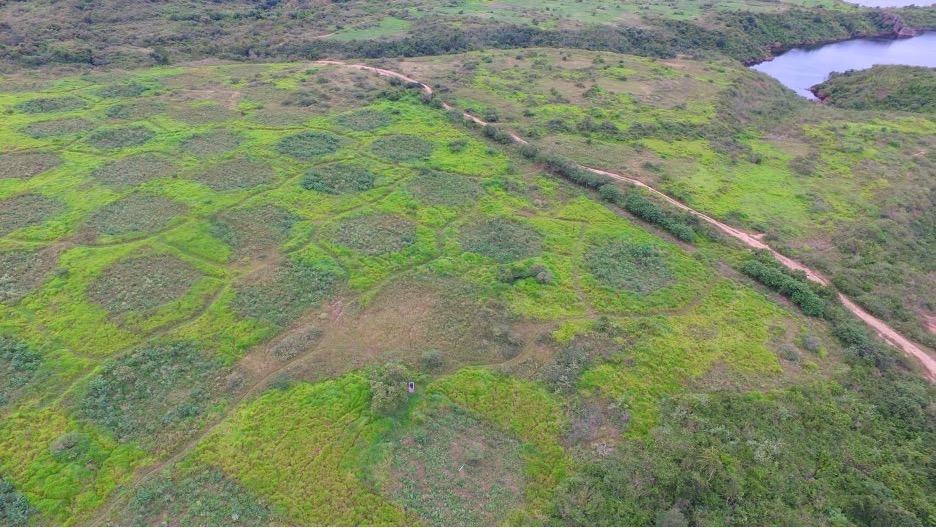
    The grassland, where the research project we report on here was established, covered 7 hectares (17 acres) and had little evidence of spontaneous natural regeneration, so we implemented an applied nucleation intervention. To do that, we cleared the existing vegetation of the area with machetes and scythes, tilled with a tractor to reduce soil compaction, and set up 42 hexagonal plots that had an area of 1000 m2 (0.25 acres) each. In each plot, we planted 271 seedlings belonging to 11 different plant species native to dry tropical forests of this region. Four of these species had the ability to associate with bacteria that can fix atmospheric nitrogen. The seedlings planted all received 1 kilogram of ant farm soil, 10 grams of hydrogel to extend the period of favorable soil moisture, and 50 grams of nitrogen – phosphorus – potassium (NPK) fertilizer, 25 grams of NPK, 43 grams of phosphoric rock, or no fertilizer, depending on the plot where the seedlings were planted. All seedlings were irrigated once they were planted to activate the hydrogel. The seedlings that received the irrigation treatments were watered two more times during the first month of the experiment. The control and the 50 grams of NPK without additional irrigation treatments did not receive any additional water. Once the seedlings were 6 months old, we started monitoring their survival and growth. In each plot,we recorded the height of every seedling that was still alive. Thereafter, we measured seedling height approximately every six months for two years.

    Aerial image of the 42 nucleation plots established in 2019 in El Quimbo, Colombia. The extension of the restoration intervention was 7 hectares (17 acres) (photo: Fundación Natura). 
    A close-up view of the experimental restoration plot. The orange lines represent the limits of the plot (1000 m2 = 0.25 acres), and each small dot represents a seedling planted (Photo: Fundación Natura). 

    Additionally, we decided to compare the costs among the different management strategies implemented. We documented the cost of seedling production, planting, fertilizers, irrigation, and monitoring. Finally, we estimated the cost-effectiveness of each treatment for any of the eleven species planted. We did that by first estimating the total cost of planting a hectare of grassland with a single tree species (a hectare is equivalent to six nuclei = 1,626 individuals) under a specific treatment, and then dividing that cost by the % survival of that species under that specific treatment after two years. The most cost-effective method was the one that yielded the lowest cost and had the highest % survival.

    An employee from Fundación Natura fertilizing a seedling of Vachellia farnesiana a shade-avoiding plant species common in tropical dry forests in Colombia (photo: Laura Toro). 

    We found that during the first two years of the project seedling survival was on average 73% across treatments. The seedlings that received 25 grams of NPK plus irrigation treatment had the highest survival (76%), while the seedlings that were fertilized with 50 grams of NPK and did not receive additional irrigation had the lowest survival (69%). However, when we looked at the survival across species, we found that survival varied across species and treatments. The plant species with the highest survival was Ceiba pentandra (99%), while Handroanthus coralibe had the lowest survival rates (5%). In terms of costs of planting seedlings, we found that the cheapest strategy was to not fertilize or irrigate the seedlings ($7,313 per hectare, $2,961 per acre), while the most expensive strategy was 50 grams of NPK plus irrigation ($11,689 per hectare, $4,732 per acre). Finally, when we compared the cost-effectiveness of the six fertilization and irrigation strategies implemented, we found that the control treatment was the most cost-effective management practice across the eleven species planted ($19,522 per hectare, $7,903 per acre) in part due to the low costs of no additional management beyond planting and monitoring, and the modest benefits to survival of costly irrigation and fertilization practices.

    Aerial image of nucleation plots in El Quimbo, Colombia in 2022. (photo: Fundación Natura).

    Even though restoration practitioners deal with a lot of uncertainty and restoration studies still lack information about how fertilizers affect the growth of native tree species and non-native grasses, there are multiple ways to improve restoration outcomes in tropical dry forests. We encourage partnerships between scientists and restoration practitioners to test how fertilizers impact different plant species growth and survival, and to estimate the costs of this practice across different tropical dry forests. Additionally, paying close attention to the soil fertility of the area, planting species that are found locally, actively weeding during the first year of the project, and fencing the restored area to ensure herbivores do not browse the seedlings will increase seedling survival and the success of the restoration efforts. Based on our results, we suggest that restoration projects should spend less resources on irrigation and fertilization, and more on plant species selection and weed removal.

    If you want to learn more about how fertilization and irrigation impacted the growth and survival of tropical dry forest seedlings, we invite you to read our recent paper in Restoration Ecology or contact Dr. Laura Toro.
  • Things are not always better on the sunny side!

    Things are not always better on the sunny side!

    Chris Birkinshaw is an assistant curator in the Missouri Botanical Garden’s Madagascar Program, based in Antananarivo. He describes his observations on forest succession at Ankafobe, a site in the central highlands.

    Anyone flying over Madagascar’s highly dissected central highlands will be struck at first by the vast grasslands that dominate this landscape.  But, those looking more carefully will also detect pockets of forest within the rich network of valleys.  These forests have a distinct fauna and flora but, perhaps because of their small size, they have attracted little interest from conservationists.  Consequently, in the last few decades, the majority have been degraded or entirely destroyed as their trees were cut for timber or charcoal and the relicts burnt by wild fires that rage over this landscape in the dry season.

    The Ankafobe Forest, located some 135 km NW of Antananarivo, is currently being designated as new protected area by Missouri Botanical Garden’s Madagascar Research and Conservation Program.  It is one of the larger remaining areas of highland forest but, here too, the forest has been impacted by exploitation for timber and charcoal and burning by wild fires.

    Efforts are underway to restore this forest to its former extent in the recent past.  This is no easy task because away from the current forest edge tree seedlings are subjected to harsh conditions: soils impoverished and compacted by annual burning, grasses that compete greedily for water and nutrients, an extended 7-month long dry season, and exposure to hot sunshine and strong desiccating winds.  Even when firebreaks are used to prevent wildfires from penetrating the grassland surrounding the forest, few tree seedlings naturally colonize outside of nurturing limits to the forest.

    Few but not none.  A closer inspection of the landscape reveals some woody plants in the grassland on the less sunny south-facing slopes surrounding the forest (south is less sunny because Madagascar is in the southern hemisphere). Perhaps then the forest could be helped to expand by planting young trees preferentially on these slopes?

    Ankafobe Forest South-facing on left.JPG
    Vegetation is lusher on south-facing slopes (left) compared to north-facing slopes (right) at Ankafobe, a proposed conservation area in highland Madagascar.

    To test this idea in 2017 we planted 25 nine-month old seedlings of each of four native tree species in grassland 20 m from the forest edge on both a south-facing slope and a north-facing slope.  The species were selected for this test are native to the Ankafobe Forest and were available at the local tree nursery when the experiment was installed.  After 12 months the survival and growth of these young plants were measured.

    All four species survived well on the south-facing slope but only one species, Nuxia capitata, had good survival on the north-facing slope.  Mortality of Uapaca densifolia was total on the north-facing slopes.  Growth was sluggish on both the south-facing and north-facing slopes with the exception of Nuxia capitata on the south-facing slope that had a mean 12-month growth exceeding 20 cm.  These results suggest that south-facing slopes may provide the best results, at least at Ankafobe, for forest restoration endeavors.

    South- facing North-facing
    Species % Survival Average growth (cm) % Survival Average growth (cm)
    Eugenia pluricymosa 72% 4.1 8% 3.0
    Baronia taratana 88% 9.1 28% 12.4
    Nuxia capitata 96% 21.5 100% 8.7
    Uapaca densifolia 72% 10.5 0%

    Aspect – the direction that a slope faces – makes a big difference for vegetation in the temperate zone, especially in dry places. But it is not often considered in tropical ecology. Directly or indirectly, the difference in sun exposure between the slopes at Ankafobe can make the difference between life and death for young trees growing in this hostile, water-stressed environment.

    To read more blog posts about the restoration efforts at Ankafobe, please click here. You may also read a 2019 open access paper about seedling trials at this site here.

  • Homemade mycorrhizal inoculum improves seedling growth for some native Malagasy trees

    Homemade mycorrhizal inoculum improves seedling growth for some native Malagasy trees

    MBG Madagascar’s Chris Birkinshaw and Dinasoa Tahirinirainy describe exciting, preliminary results from a forest restoration experiment in highland Madagascar.


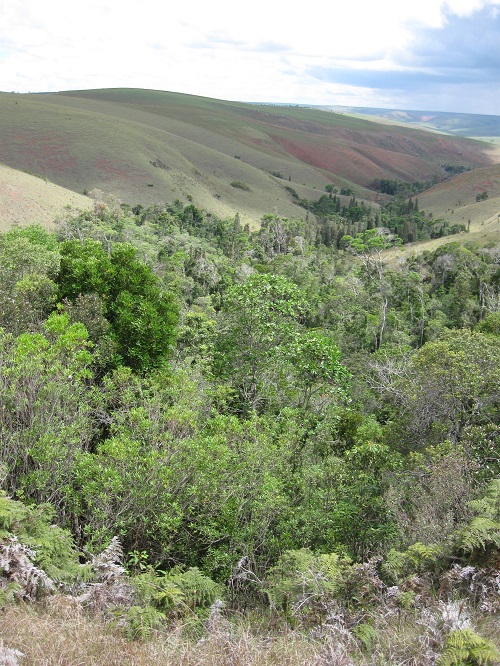
    Ankafobe Forest on Malagasy highlands - experiment located on grassy ridges
    This sliver of riparian forest is one of the last vestiges of Madagascar’s highland forests. Decades of Missouri Botanical Garden research in Madagascar have shown that more than 80% of all plant species on the island exist nowhere else. Many are threatened with extinction due to habitat loss. Several previous posts have described forest restoration efforts at this site, home to the largest population of the endemic sohisika tree (Schizolaena tampoketsana) – a species that belongs to a family (Sarcolanaceae) that only exists on Madagascar.

    A small number of forest restoration projects in Madagascar routinely inoculate the tree seedlings in their nurseries with a homemade mycorrhizal inoculum. While the nurserymen are convinced that this technique promotes growth and survival of tree seedlings, there seems to be no published data objectively demonstrating these positive outcomes. In an effort to provide the evidence to justify investment in this technique, we designed a simple experiment that will compare the survival and growth under four treatments of young plants of six native trees planted in grassland adjacent to the Ankafobe Forest on the central Malagasy highlands.

    Table – Four experimental treatments to test the effects of mulch and mycorrhizal inoculum on native tree seedling growth in highland Madagascar

      Inoculated Not inoculated
    Mulched Treatment 1 Treatment 2
    Not mulched Treatment 3 Treatment 4 (control)

    In our experiment, fifteen seedlings of each of six native tree species will be grown under each of the four treatments listed above. The mycorrhizal inoculum was made by filling a pit (150 cm long × 50 cm wide × 30 cm deep) lined with sacks with topsoil collected from around the roots of three native tree species, then growing maize and beans in this soil for three months before cutting these plants down and letting the substrate dry out for two weeks. The substrate remaining in the pit is the inoculum and was used by adding one tablespoon to each seedling container.

    Making the inoculum
    Beans and maize are grown in topsoil collected from a remnant forest to amplify local mycorrhizae populations. This enriched soil (i.e., inoculum) is then added to seedling containers.

    The tree seedlings that received mycorrhizal enrichment were inoculated in November 2017, and all of the seedlings were otherwise grown under the same conditions in the nursery until January 2018 when they were planted out into an experimental plot at Ankafobe. Half of the tree seedlings were surrounded by a thick layer of grass-based mulch (~30-cm deep). The comparison of seedling performance with and without the addition of mulch is interesting because of the possibility that mulch helps to maintain a relatively cool and moist environment in which the mycorrhizae can flourish.

    Table – Mean difference in tree seedling height (cm) between seedlings inoculated versus not inoculated with homemade mycorrhizae, after two months in the nursery (N = 30 seedlings per species).

    Species Inoculated seedling height Non-inoculated seedling height t p1
    Aphloia theiformis 29.5 ± 10.2 33.4 ± 6.5 -1.75 1.0000
    Baronia tarantana 18.1 ± 6.1 11.4 ± 3.5 5.21 <0.0001
    Brachylaena ramiflora 27.2 ± 6.0 31.8 ± 6.5 -2.87 1.0000
    Craspidospermum verticillatum 43.0 ± 5.9 42.6 ± 3.7 0.37 1.0000
    Macaranga alnifolia 34.8 ± 8.6 39.2 ± 5.2 -2.43 1.0000
    Uapaca densifolia 23.0 ± 7.9 11.5 ± 2.6 7.58 <0.0001

    1 t and p values are from a one-tailed student’s t-test asking whether inoculated seedling height was greater than non-inoculated seedling height. P values are adjusted for multiple comparisons with Bonferroni correction.

    Although we plan to measure seedling survival and growth 12 months from the time when they were planted (i.e., in January 2019), we were interested to see that for two of the species the height of inoculated seedlings was significantly greater than the height of non-inoculated seedlings after a mere two months in the nursery. On average, inoculated seedlings of Baronia tarantana are 1.6× taller than non-inoculated seedlings; while the seedlings of Uapaca densifolia are a full 2× taller. For the other species there was no significant difference between the height of the inoculated and non-inoculated plants.

    Experiment showing line of seedlings some with and some without mulch (1)
    Tree seedlings are planted out in a field experiment at Ankafobe in January 2018. These seedlings are planted adjacent to a line of “green manure” (i.e., nitrogen-fixing Tephrosia shrubs planted to improve the degraded highland soil prior to planting native tree seedlings).


  • Can fungus help grow trees in Madagascar?

    Can fungus help grow trees in Madagascar?

    Thomas Timberlake and Cyprien Miandrimanana write from Madagascar about a field experiment using fungus to help tree seedlings survive.

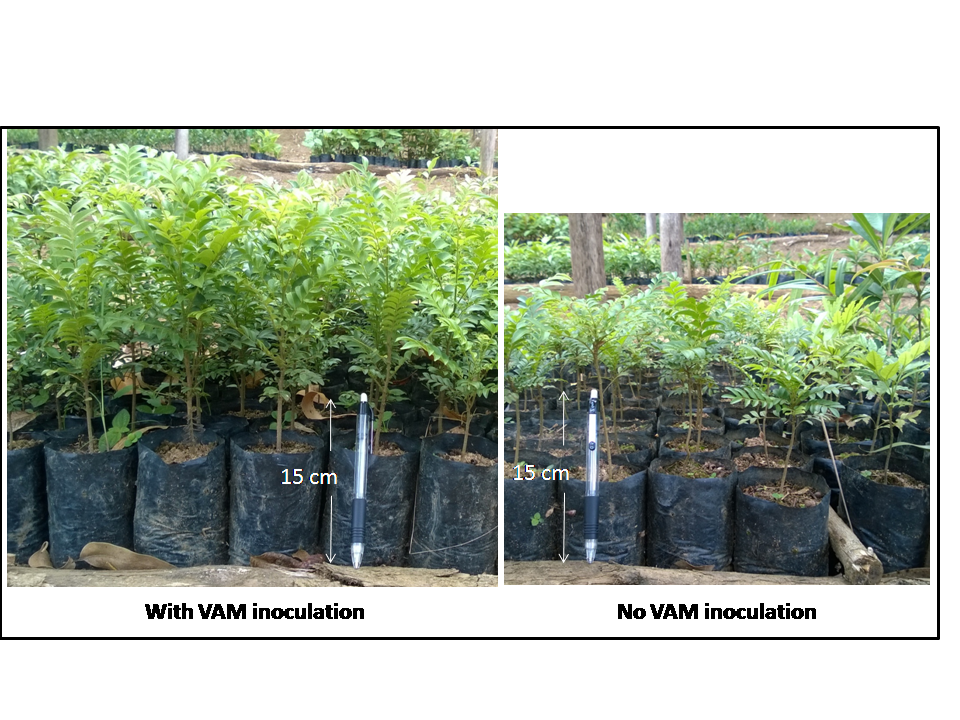
    One of the problems that has long bedeviled ecological restoration efforts in Madagascar is persuading young seedlings to grow at a pace of more than just a few centimetres per year. The site of Ankafobe in the central highlands is a prime example, with many five year old individuals, planted in the anthropogenic grassland surrounding the remaining forest fragments, still no taller than waist height. Clearly, the environment into which the seedlings are planted is in some way inhospitable.  One hypothesis to explain seedling underperformance  is that they are not managing to establish their normal symbiotic relationships with vesicular arbuscular mycorrhizae (VAM) fungi on which most higher plants depend.

    Scaled visual comparison of VAM and VAM-less seedlings at Mitsinjo in Andasibe, Madagascar.
    Scaled visual comparison of VAM and VAM-less seedlings at Mitsinjo in Andasibe, Madagascar.

    In a VAM symbiosis, plants exchange a significant carbohydrate donation to the fungus in return for important nutrients, particularly phosphorus, and often increased drought tolerance. So if mycorrhizae propagules are absent in the savanna soil, this could well explain the slow growth rates and high mortality observed among planted tree seedlings at sites like Ankafobe.

    In response to concern about poor seedling performance, various restoration projects in Madagascar have begun inoculating their nursery seedlings with VAM using a simple protocol pioneered by Mitsinjo, a restoration project in the eastern rain forest of Andasibe. Soil (presumed to contain mycorrhizal fungus) is gathered from underneath forest trees, mixed with sand in a sack-lined pit and then sown with rice and beans to act as hosts for the developing VAM. After three months of maturation, you have a sack-full of VAM inoculum, ready to be applied to the young germinating seedlings – one teaspoon per plant.

    Many groups in Madagascar swear by the VAM protocol and the visual results can be compelling, but as yet there have been no experiments in the country to rigorously test whether this method is actually effective. This lack of clear evidence is what prompted us to work on a series of experiments testing and perhaps refining the VAM protocol.

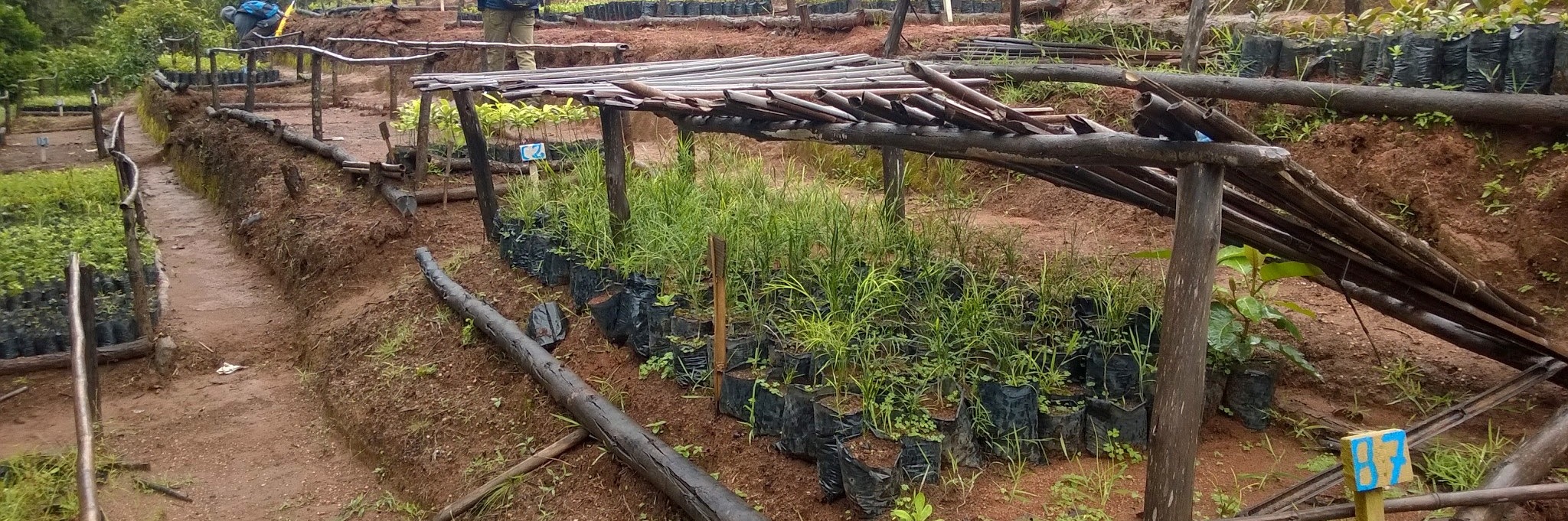
    We planted 480 native tree seedlings with and without VAM inoculation to test whether this method increases seedling survival and growth in the degraded savanna around Ankafobe. Digging into the solid laterite and planting the experimental seedlings was hard work but our efforts were rewarded one day with the sighting of a family of 10 young Tenrecs (Tenrec ecaudatus) who ventured bravely out of the security of the forest to observe the progress.

    Planting complete, we took our “Time Zero” measurements and then a small sample of roots from both VAM and control seedlings to return to Antananarivo and check for the presence of mycorrhizae vesicles. The process of staining involved cooking up some rather nasty chemicals in our improvised laboratory – the kitchen – back in Tana.

    Our next project will be to replicate our VAM study in Ananalava, a humid site on the east coast that contrasts with the drier climate of the Malagasy Highlands. Repeating our study in different environments will help generalize our results and recommendations for people working across this heterogeneous island.

    Cyprien in our kitchen laboratory preparing an improvised stain to look for VAM vesicles.
    Cyprien in our kitchen laboratory preparing an improvised stain to look for VAM vesicles.