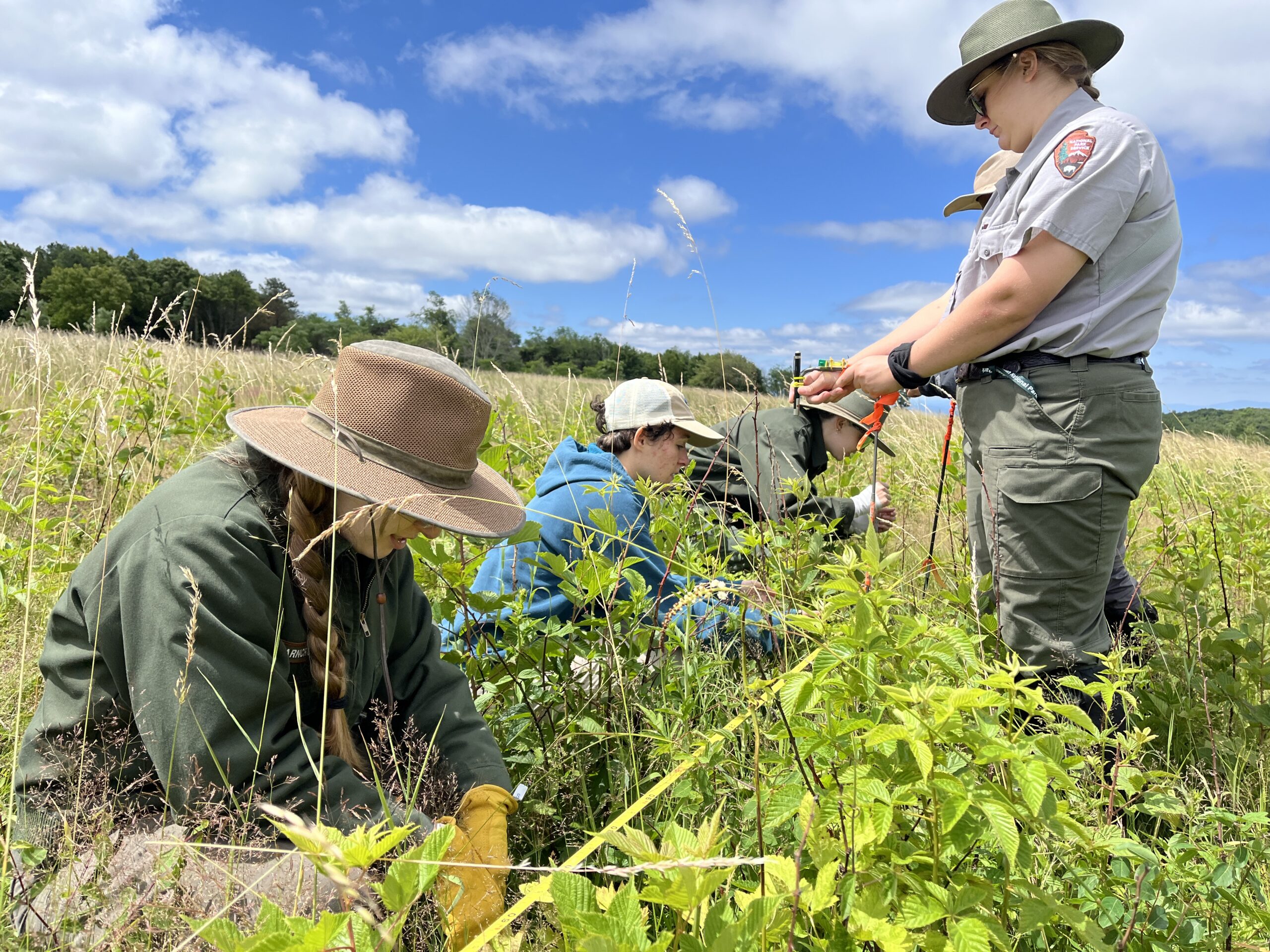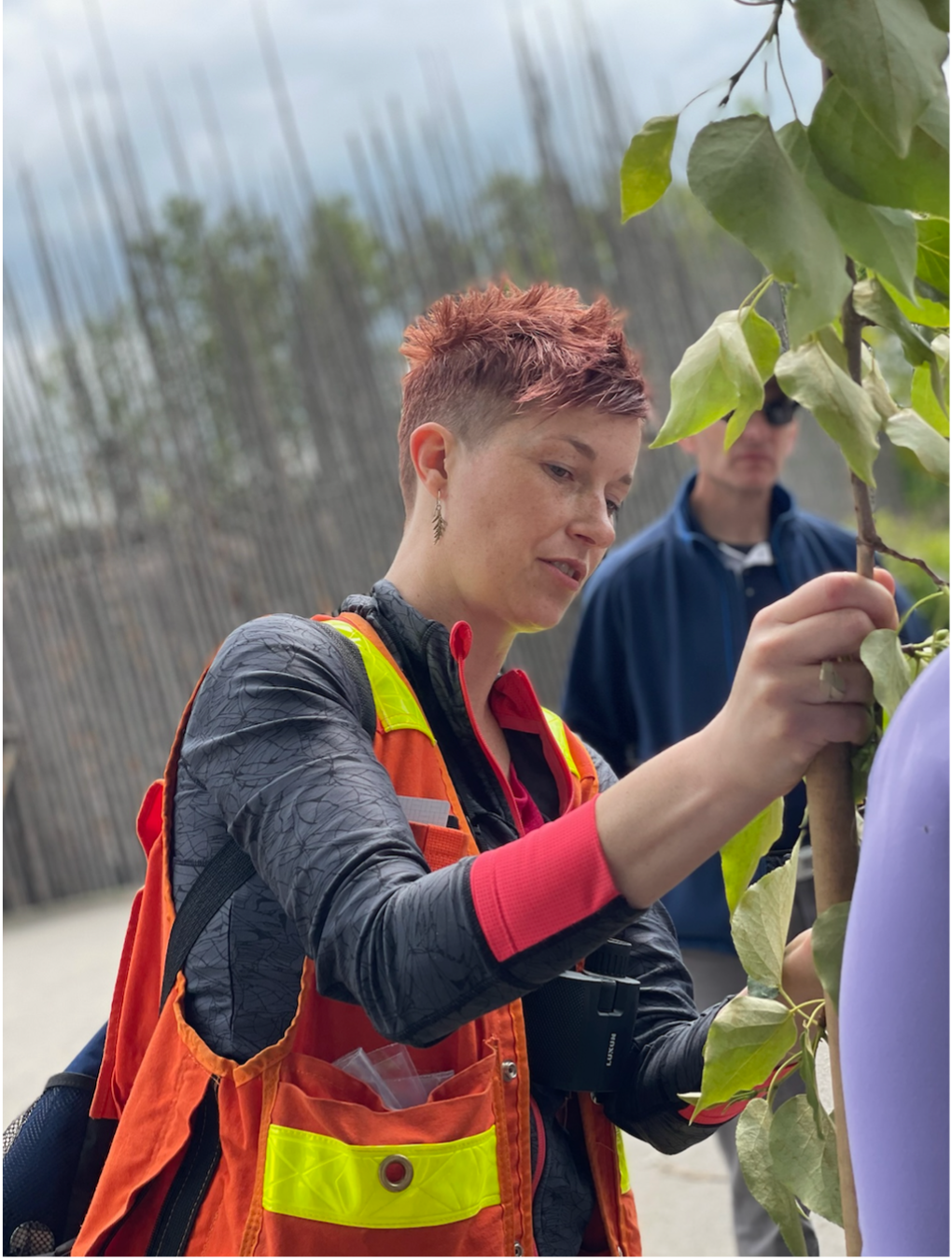
Eve Allen, Program Director for the Northeast Bioregion, James Aronson, President, and Sefra Alexandra, Educational Coordinator of the Ecological Health Network, share their trip report from a recent visit to Canada’s National Tree Seed Center (NTSC) in June 2024. (In collaboration with Melissa Spearing, Seed biologist, Mary Knockwood, Indigenous Seed Program Coordinator, and Lucie Lavoie, Coordinator and Senior Forester of the NTSC).
In Memory of Melissa Spearing
We dedicate this post to the loving memory of Melissa Spearing, our friend and devoted Seed Biologist at the National Tree Seed Centre, who graciously hosted our visit and played a key role in organizing it.
Melissa’s career was marked by a profound commitment to tree seed conservation. Her work in the collection, storage, and study of seeds from across Canada ensured the preservation of the country’s diverse tree species for future generations. Her contributions to the Centre’s research were invaluable, and her passion for advancing conservation and climate research was unwavering. Her sudden passing on August 19, 2024, has deeply affected all who knew her, both professionally and personally.
As many have shared, Melissa was not just a colleague or mentor but a dear friend to many in the seed conservation community. She was a proactive networker, working to build bridges between the Centre’s work in Atlantic Canada and our efforts in the Northeastern U.S. We are deeply saddened by her passing, yet profoundly grateful for the time we shared with her—experiencing her warmth, enthusiasm, generosity, and the passion she brought to her work. Like all who knew her, we have been significantly touched by her life and the enduring impact she leaves behind.

Purpose of the Trip
In June 2023, at the Society for Ecological Restoration’s RE3 Conference in Quebec City, we connected with leaders from Canada’s National Tree Seed Centre (NTSC) during a Two-Eyed Seeing Seed Collection workshop they hosted. We shared a mutual interest in staying connected, as the Northeastern U.S. and Atlantic Canada together form a crucial ecological and cultural transition zone.
We made the trip one year later to visit our friends at the NTSC, Mellisa Spearing, Seed biologist, and Mary Knockwood, Indigenous Seed Program Coordinator, with the goal of testing the waters and appetite in this region to develop a regional hub of the Northeast Seed Network to serve and promote synergy in southern Québec, New Brunswick, Nova Scotia, and Prince Edward Island, as well as Maine, Vermont, New Hampshire, and upstate New York. A possible name for the hub is the Northern Appalachian/Atlantic Maritime Hub.
This region bridges temperate woodlands and boreal forests and is part of the smaller yet globally significant “Northern Appalachian-Acadian Wabanaki Ecoregion,” which holds high ecological and cultural value from a social-ecological perspective. A binational, biocultural consortium called Two Countries One Forest exists already, and EHN and the NTSC would like to work together. Fortunately, there are no significant legal or political challenges when it comes to sourcing or shipping seeds for research or use. A phytosanitary certification can be obtained through the Canadian Food Inspection Agency or the USDA’s Phytosanitary Certification Issuance and Tracking System (PCIT).
Overview of Canada’s National Tree Seed Centre
Canada’s National Tree Seed Centre (NTSC) is the principal national resource for forest seed science and conservation in the country. Located in the Atlantic Forestry Centre in Fredericton, New Brunswick, the center was established in 1967 by the Canadian Forest Service. Initially, the NTSC focused on collecting, storing, and providing native tree seeds of known origin primarily to support the timber industry in Canada. Over the past five decades, this mandate has broadened to include the conservation of genetic resources threatened by invasive pests, pathogens, and climate change.
In 2020, the NTSC underwent a significant renewal to enhance efforts to grow and maintain healthy forests in Canada as a viable economic sector and an effective strategy to address climate change. For example, in 2021, the Government of Canada committed CAD $3.2 billion to establish partnerships to plant two billion trees over ten years, aiming to ‘tackle the dual crisis of climate change and biodiversity loss.’ A 2023 press release reported that the project had exceeded its planting goals and now was intending to plant 56 million more. This project is just one among many ambitious undertakings for which the NTSC is at the helm.
The NTSC’s core function is seed collection management, encompassing the collection, processing, testing, documentation, and storage of seeds from tree and shrub species across Canada. Melissa Spearing organized a phenomenal tour of the facilities, which included a visit to the central laboratory with attached processing rooms, freezers that house seed collections, and cryopreservation storage, as well as greenhouses and on-site nursery installations. The NTSC also maintains an extensive digitized and readily accessible seed collection database.
The Atlantic Forestry Centre is a campus of innovation. Behind each door is an impressive array of machinery for seed cleaning, assessment, preservation, and research operated by enthusiastic teams of scientists and technicians. This centre is tackling the major issues that threaten the tree and shrub diversity of the varied landscapes of the ten provinces and three territories of Canada. Upon our arrival, the halls were bustling with a young, excited seed collection team, assembling their gear to head out on a week-long expedition for plant materials gathering to be safeguarded in the growing ex situ collections. The state-of-the-art greenhouses are propagating germplasm for utilization in restoration projects, and the surrounding grounds are teeming with pollinators dancing through the willows (Salix spp.) trials designed to determine which willow species thrive best for application in improving degraded soils. The dynamic atmosphere is fast-paced, and professional and instills an air of optimism in the face of the massive climate challenges facing the fields and forests of this country.
Overview of Canada’s National Tree Seed CentreStrengthening Indigenous Leadership in Seed Conservation
As mentioned above, while seed collections at the NTSC have predominantly focused on tree species of economic importance to Canada, the center is now placing a stronger emphasis on non-commercial tree species, particularly those of high significance to Indigenous Peoples. Through its Indigenous Seed Collecting Program, the NTSC is advancing Indigenous engagement and inclusivity to help meet Canada’s Two-Billion Tree program objectives (2BT).
In a 2023 press release, Natural Resources Canada confirmed that “Since 2021, the 2BT program has supported 179 tree-planting and capacity-building projects from coast to coast to coast. Ninety percent of these projects planted more than two types of trees, and one in five projects were Indigenous-led. Over 220 species were planted at more than 2,900 sites across Canada.”
Mary Knockwood, the Indigenous Programs Manager, shared how supporting Indigenous leadership and inclusion in seed conservation is the second priority in the NTSC Strategic Plan for 2021-2031, following the goal of supporting the two billion tree program with knowledge mobilization and capacity building. The NTSC recognizes Indigenous Peoples as the original caretakers of ecosystems across Turtle Island (North America) and the earliest seed collectors, processors, and distributors. This grassroots initiative, spearheaded by Indigenous communities nationwide, gathers and conserves tree seeds that hold economic value as well as significant cultural, spiritual, medicinal, and ecological importance to the Indigenous communities engaged in this work. Mary explained in a Simply Science article, “seed collection is important for our forest as it is important to the future of Mother Earth and all the creatures living upon her. It helps not only preserve flora species but also preserve the language, culture, and traditions of our Indigenous partners.” The program began with Mi’kmaq communities in Atlantic Canada, and as word spread, community interest grew. Today, over sixty Indigenous communities and organizations throughout the country are participating. The NTSC holds multiple-day-long workshops where Indigenous citizens come to share their knowledge and learn about seed conservation. To date, 56 field training sessions across Canada and seven lab training sessions at the Atlantic Forestry Centre have provided free training to over 200 members representing 70 Indigenous communities nationwide.


Strengthening Indigenous Leadership in Seed Conservation
As mentioned above, while seed collections at the NTSC have predominantly focused on tree species of economic importance to Canada, the center is now placing a stronger emphasis on non-commercial tree species, particularly those of high significance to Indigenous Peoples. Through its Indigenous Seed Collecting Program, the NTSC is advancing Indigenous engagement and inclusivity to help meet Canada’s Two-Billion Tree program objectives (2BT).
In a 2023 press release, Natural Resources Canada confirmed that, “Since 2021, the 2BT program has supported 179 tree-planting and capacity-building projects from coast to coast to coast. Ninety percent of these projects planted more than two species of trees, and one in five projects were Indigenous-led. Over 220 species were planted at more than 2,900 sites across Canada.”
Mary Knockwood, the Indigenous Programs Manager, shared how supporting Indigenous leadership and inclusion in seed conservation is the second priority in the NTSC Strategic Plan for 2021-2031, following the goal of supporting the two billion tree program with knowledge mobilization and capacity building. The NTSC recognizes Indigenous Peoples as the original caretakers of ecosystems across Turtle Island (North America) and the earliest seed collectors, processors, and distributors. This grassroots initiative, spearheaded by Indigenous communities nationwide, gathers and conserves tree seeds that hold economic value as well as significant cultural, spiritual, medicinal, and ecological importance to the Indigenous communities engaged in this work. Mary explained in a Simply Science article, “seed collection is important for our forest as it is important to the future of Mother Earth and all the creatures living upon her. It helps not only preserve flora species but also preserve the language, culture, and traditions of our Indigenous partners.” The program began with Mi’kmaq communities in Atlantic Canada, and as word spread, community interest grew. Today, over sixty Indigenous communities and organizations throughout the country are participating. The NTSC holds multiple-day-long workshops where Indigenous citizens come to share their knowledge and learn about seed conservation. To date, 56 field training sessions across Canada and seven lab training sessions at the Atlantic Forestry Centre have provided free training to over 200 members representing 70 Indigenous communities nationwide.

The concept of Two-Eyed Seeing (Etuaptmumk in the Mi’kmaq language), articulated and popularized by Mi’kmaq Elder Albert Marshall, is integral to the program. It involves combining the strengths of Indigenous knowledge with those of Western science and technology, using both perspectives together. In Marshall’s words, “Two-Eyed seeing refers to learning to see from one eye with the strengths of Indigenous ways of knowing and from the other eye with the strengths of Western ways of knowing and to using both of these eyes together” (Bartlett, Marshall, & Marshall, 2012, p. 335).” This dual approach forms the foundation of the program. Mary Knockwood emphasizes that Two-Eyed Seeing is about merging not just two methodologies but also two different ways of knowing and worldviews. The same idea is expressed with similar phrases from Indigenous cultures in Australia, Aotearoa/New Zealand, South America, and elsewhere. It is clearly a concept that holds critical importance for moving our global society from an extractive to a restorative culture (Cross et al. 2019).
We note that the Indigenous Peoples of Canada have a long history of seed collection, storage, and use, and NTSC staff are learning from this rich knowledge base while also co-learning and integrating Western scientific practices with traditional ways and wisdom. Concurrently, Indigenous partners are adopting aspects of Western science to enhance their traditional methods, thereby improving processes, extending storage times, and increasing seed viability.
The Indigenous Seed Collection Program aids in Canada’s reconciliation efforts with Indigenous Peoples by fostering deeper collaborations through community partnerships. As Donnie McPhee, Coordinator of the National Tree Seed Centre, explained: “At its core, the ISCP is a mutual network of knowledge sharing amongst Indigenous communities from coast to coast to coast. Different communities are working together and building a network, giving value to what they’re protecting.” The Indigenous Seed Collection Program is designed to listen to the needs of the Indigenous communities and provide training courses to help them reach their goals.
Conservation of Ash Species
The conservation genetics of North American Ash trees (Fraxinus spp.) provide a prime example of how the NTSC’s Indigenous Seed Collection Program is working to preserve cultural and ecological keystone species found in the forests of Canada and for some of them in much of the Eastern United States as well.

For the past 20 years, the NTSC has worked with a wide variety of collaborators to collect and bank viable seed of all five Ash species native to Canada: 1) Fraxinus americana (White ash); 2) Fraxinus nigra (Black ash); 3) Fraxinus pennsylvanica (Green ash), 4) Fraxinus profunda (Pumpkin ash), and 5) (Fraxinus quadrangulata (Blue ash). Their efforts to preserve native Ash from decimation by the relentless Emerald Ash Borer are especially focused on Black ash, which is of particular importance to Indigenous communities and is the species most at risk of all the native species.
Mary Knockwood explains, “Indigenous Peoples, such as the Mi’kmaw, Wolastoqey, Peskotomuhkati, in the Atlantic who are part of the Wabanaki Confederacy, all the First Nations part of the Haudenosaunee Confederacy, as far west to Manitoba and the Anishinaabek peoples have used and continue using Black Ash to this day. The importance of this species is not only for baskets, but it also carries a spiritual, traditional, and medicinal value to all of these groups. It is also a significant species to many of the Wabanaki Confederacy as it plays a significant role in many of our creation stories.” These trees are integral to their cultural practices, notably in the creation of black ash splint baskets of many designs and uses. Over dozens of generations, these communities have acquired extensive knowledge of locating ash trees, nurturing their growth, and using them for both practical and artistic purposes. Ash trees also play crucial roles in providing materials for firewood, snowshoes, tools for hunting and fishing, canoe paddles, lumber, and various additional types of baskets and woven containers.

As of now, Emerald Ash Borer has spread to nearly 60% of the historic range of Black ash in Canada, expanding at an average rate of about 50 kilometers per year. Based on current projections, it is feared that more than 75% of the total basal area of Black ash will be lost across ~87% of its range in North America by 2035. Census data also indicate that in 2035, fully 98% of Indigenous populations residing within the Black ash’s geographic range in the US will be affected by the catastrophic losses of these cultural keystone trees (Siegert et al. 2023).
In 2019, as the threat of Emerald Ash Borer was seen to be imminently threatening all stands of ash throughout Central and Atlantic Canada, the Committee on the Status of Endangered Wildlife in Canada federally listed all native Fraxinus spp. as “threatened species of important cultural value.” Luckily, that year happened to be a “rare, once-in-every-five-to-seven bumper crop year for Black ash seed production throughout its range in Ontario, western Quebec, eastern Manitoba, and New Brunswick,” reported Donnie McPhee in the May 2020 Tree Seed Working Group News Bulletin. In 2019, during a five-week period, the NTSC’s collecting teams gathered:
- 648 Fraxinus nigra (Black ash) collections over an impressively large portion of the species’ Canadian range.
- And 609 additional ash collections, including 380 of Fraxinus nigra, 210 of Fraxinus americana (White ash), and 19 of Fraxinus pennsylvanica (Green ash), all from different stands to ensure including as large a genetic range as possible for the seed bank.
Conclusions
We were deeply impressed by the NTSC’s robust programs and the dedication of its staff. The NTSC’s commitment to enhancing forest health and biodiversity through innovative seed conservation strategies is commendable and inspiring. In line with Siegert et al.’s (2023) call to support binational collaboration among scientists, resource managers, and Indigenous experts to mitigate Emerald Ash Borer impacts and preserve Black ash resources—given the species’ vulnerability and its cultural and ecological significance—the Ecological Health Network is committed to working with Canada’s NTSC.
A key goal will be to collaborate with new members of the Northeast Seed Network in Maine, Vermont, New York, and Atlantic Canada to establish a sub-regional hub. This effort will enhance our ability to work closely and learn from each other to conserve and restore forests and their woody plant biodiversity throughout the Northern Appalachian-Acadian-Wabanaki Ecoregion, spanning the US-Canada border. Our visit reaffirmed the importance of building networks that bridge political boundaries and ecological ecotones. It also highlighted the urgency of forming alliances to share and safeguard the ecologically and culturally significant species of these regions, ensuring the health of ecosystems for present and future generations.
In closing, we salute Melissa Spearing once again. She will be greatly missed by her family, friends, and colleagues both nationally and internationally. May she rest in peace. In her honor, please consider making a donation to the Kawartha Land Trust.