Tag: Tropical forest restoration

  • The hidden half of tropical forest recovery 

    The hidden half of tropical forest recovery 

    By Leland Werden

    Leland Werden, PhD, is a Senior Scientist at ETH Zurichlwerden@gmail.com

    I remember starting my PhD in 2012 with a strong desire to develop tools for recovering tropical forests around the world. My background was in ecosystem ecology, which had led me to spend time thinking about soil nutrient cycling and other belowground processes in different temperate forests across the Northeastern United States. What I didn’t realize at the time was that these forests were themselves an incredible regeneration success story.

    As agriculture moved westward to more suitable land between the 1870s and 1920s, New England farmers abandoned their fields and pastures, and forests naturally regenerated at scale. This century of intensive agriculture left a patchwork of land-use legacies that continued to influence forest composition and recovery in fascinating ways. I stumbled into this living laboratory as an undergraduate student at the Harvard Forest Long Term Ecological Research site, measuring forest recovery across this patchwork.

    One patch has stuck in my head since: a grove of the largest striped maples (Acer pensylvanicum) I’ve ever seen. Striped maple is typically an understory shrub that rarely reaches more than six meters (20 feet) tall. But in this tiny patch, about 20 individuals had ascended to the canopy and completely dominated the overstory. In chatting with one of the landscape ecologists on staff over lunch one day about this pattern, I learned that there used to be a farmstead there and the striped maples thrived on the elevated nutrients still present in the soil more than a century after the farm was abandoned.

    Despite having collected hundreds of soil cores in my life, sieved roots out of soil for months on end, and counted tiny soil fauna, I had never fully grasped how strongly soil type and land-use legacy could shape plant communities. That grove of striped maples taught me to look belowground to understand plant composition. Years later, when I began working in tropical forest restoration, some colleagues and I grew to understand that we were missing the same understanding on a large scale — focusing almost entirely on what grows aboveground while largely ignoring what happens beneath our feet when restoring tropical forests.

    This disconnect isn’t unique to tropical restoration. Across forest restoration projects worldwide, we count trees, measure canopy cover, and get excited to see the return of birds and dung beetles. These are important signs of recovery, but soils, roots, and the communities of organisms that live within are often overlooked. These living organisms drive water and nutrient cycling, contribute strongly to climate mitigation capacity, and also to long-term resilience that determine whether restored forests can withstand decades of droughts and other stresses to come.

    The recognition of this blind spot led some worlds to collide. A group of academics passionate about tropical root dynamics (TropiRoot) began to collaborate with multiple research groups working on restoration science across Europe, Latin America, tropical Africa, and the United States. Our core question was: How can resource-limited tropical forest restoration projects measure belowground recovery in a scientifically robust way? In the fall of 2023, my colleague Dr. Laura Toro and I, along with several others, started a working group to tackle this challenge. We met for three days in October of 2023 at the Yale School of the Environment and brainstormed a project that aimed to distill decades of research on soil science into priority indicators that capture the essence of soil recovery. 

    Our belowground restoration group meeting at Yale University and online in October 2023.

    A clear belowground monitoring gap 

    As we dug into global restoration monitoring frameworks and the scientific literature, the scope of this oversight became even clearer. A recent worldwide stocktake catalogued more than 4,500 indicators that restoration projects use to measure “success”. Of the 61 indicators chosen as highest priority, just one focused on belowground processes: soil carbon (Gann et al. 2022). Soil carbon is a notoriously difficult indicator to detect changes in, especially over the short timeframes most projects monitor.

    We then systematically reviewed almost 200 scientific studies on tropical forest restoration. Only 28 — fewer than one in seven — directly compared above and belowground properties at the same sites. Without these paired measurements, it’s really difficult to understand whether the recovering vegetation reflects holistic ecosystem recovery or if it might be masking soils struggling to recover from previous degradation.

    The problem extends beyond academic research. When we surveyed restoration practitioners across 14 Latin American countries, we heard a similar story: projects typically have only resources to evaluate aboveground recovery, and often only for the first few years after planting. This is despite having ambitious goals of restoring entire ecosystem processes and recovering biodiversity (Cole and Werden et al. 2024).The appetite to track recovery holistically is there, but accessible tools and protocols often aren’t, so we developed a short list of six indicators and some rules of thumb for belowground monitoring, lowering the barrier to capture belowground recovery (Toro and Werden et al. 2025). We summarize the indicators below. 

    Six indicators to track belowground recovery 

    The strength of these indicators is their simplicity, paired with the ability to robustly summarize belowground recovery over time. Most indicators can be measured with equipment that can be purchased at a hardware store, or analyzed by a basic agricultural soil lab, and the priority indicators selected all change over timescales that matter for restoration

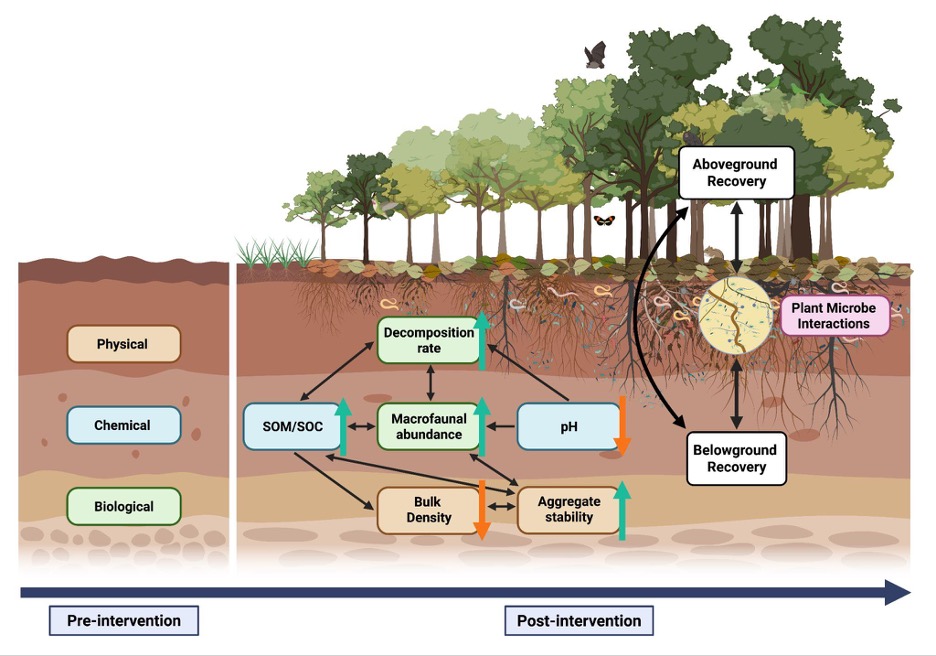
    Physical – 

    • Bulk density tells you how compacted the soil is – or how much soil is packed into a given space. When forests are cleared, machinery and/or grazing animals can compress the soil, making it hard for water to soak in and plant roots to penetrate. We measure this by pushing a metal cylinder of known volume into the soil, drying the sample in an oven, and dividing the dry weight by the cylinder’s volume. High bulk density means compacted soil; low bulk density means less dense, healthy soil with space for air and water that roots can grow into more easily.
    • Aggregate stability captures how well soil particles stick together in clumps, which determines whether rain soaks in or runs off, carrying topsoil with it. In the past, measuring this required laboratory equipment, but now there’s a smartphone app called SLAKES that guides you through the process. You simply just take photos of soil chunks before and after soaking them, and the app calculates an index of how well they held together.

    Chemical – 

    • Soil organic matter is often called the engine of soil fertility — decomposed plant and animal material that holds nutrients and water. It’s what gives soil its color and smell. When land is cleared and intensively used, the organic matter is often burned away or gets washed off. As forests regrow, leaves fall, roots die and decompose, and organic matter slowly builds back up. You can measure it by sending dried soil samples to a lab. 
    • Soil pH can be thought of as a whole bunch of soil chemistry compressed into a single number — it determines which nutrients plants can access. Low pH (acidic soils) can lock up nutrients and sometimes reach toxic levels of aluminum. You can test pH easily in the field by mixing soil with water and using a simple pH meter, or sending a sample to a lab. 

    Biological –  

    • Decomposition rate gives you a window into how active the soil’s living community is, all microbes that break down dead material and release nutrients for plants to use again. We suggest measuring this using “decomposition bags” — mesh bags filled with a standard amount of leaf litter (or even tea bags if available) that get buried in the soil and retrieved after a set time to see how much material decomposed. Faster decomposition usually means a healthier, more active soil community.
    • Macrofauna abundance is the count of larger soil animals such as earthworms, termites, beetle larvae, and others. These soil animals create tunnels that let water and air penetrate, mix organic matter through the soil layers, and their castings can contain  lots of incredibly fertile nutrients. To measure this, you dig a small trench, carefully sort through the soil and litter, and count all the macrofauna you find. It can take time, but these animals can be excellent indicators of soil recovery.
    From Toro and Werden et al. 2025 – Conceptual diagram of the importance of the status of soil properties pre-intervention in tropical forest restoration projects, and the six key dynamic soil indicators we suggest measuring. The black arrows represent known links among soil indicators and between soil properties and above- and belowground recovery processes. The color arrows indicate the expected direction of change: green arrows for increases and orange arrows for decreases. Recovery is also shaped by the reestablishment of plant-microbe interactions, which mediate feedback loops between vegetation and soil processes.

    A simple way to get started

    As part of our paper we also developed some recommendations for practitioners to start implementing belowground monitoring:

    • When to sample: Before restoration begins, set a baseline, then measure every 5 years or more frequently if possible. 
    • Where to sample: The top 10 cm of soil captures most early changes. 
    • How many samples: 5-10 cores per plot usually gives a reliable average. 
    • How to report: Use standard units so your data can be compared across sites and integrated into broader monitoring efforts. 
    • Other measurements: If you already measure above ground recovery indicators, keep doing that. Some aboveground patterns offer clues about what’s happening below, but in many cases, especially for soil carbon or microbial activity, what you see aboveground doesn’t tell the full story.

    Why below recovery matters for restoration

    Understanding soil recovery has immediate practical implications for understanding restoration outcomes. Healthy soils speed up seedling establishment, improve drought resistance, and support robust carbon storage that can make tropical forest restoration a viable natural climate solution. But soil recovery can also help projects make better management decisions in real time.

    If bulk density measurements reveal severe compaction, you could adjust your species selection to favor deep-rooted trees that can help break up hardpan layers. If organic matter is low, you could experiment with compost additions or mulching. But, without measuring this belowground information at the outset and as your project progresses, these management decisions can become educated guesswork.

    An invitation to what’s next

    Through the SNAPP Monitoring Restoration Effectiveness (MoRE) working group, we’re now building a collaborative network that connects researchers with practitioners on the ground. Among other things, our goal is to develop straightforward protocols for monitoring  belowground indicators. These protocols will be tested in real-world conditions and adapted based on feedback from practitioners. We’re also compiling longitudinal data from any tropical restoration project that has measured an indicator of below- or above-ground recovery for a global synthesis that aims to develop best practices for restoration monitoring.  

    If you’re working to refine your tropical soil monitoring practices, or if you just generally want to get involved, we’d love to hear from you. 

    Take our questionnaire on monitoring practices –  Here

    Learn more about our data synthesis –  On our website

    Get in touch with the SNAPP MoRE team –  snapp-more@umn.edu
  • The cost-effectiveness of fertilizing and irrigating tropical dry forest seedlings in an applied nucleation project

    The cost-effectiveness of fertilizing and irrigating tropical dry forest seedlings in an applied nucleation project

    By Dr. Laura Toro

    Laura is a Restoration Scientist at the Missouri Botanical Garden’s Center for Conservation and Sustainable Development, where her research focuses on dry tropical forest restoration (ltoro@mobot.org).

    Tropical dry forests are among the most threatened ecosystems in the world. Commercial agriculture, livestock farming, and mining have damaged and reduced the extent of this ecosystem type globally. Now less than 10% of the original extension of this ecosystem persists. The conservation and restoration of tropical dry forests are often overlooked because they are not as lush and well-studied as rainforests. However, restoring tropical dry forests can ensure the survival of thousands of unique plant and animal species that only exist in this ecosystem, and the protection of food, medicine, and livelihoods for millions of people. 

    Colombia has been one of the few countries that has invested resources to study the diversity and function of tropical dry forests across the country to ensure the conservation and restoration of the existing remnants of tropical dry forests. Since 2013 the von Humboldt Institute has been leading most of the research initiatives, and all the knowledge compiled about tropical dry forests has motivated the creation of a biodiversity offsetting policy. This policy establishes that for every hectare of tropical dry forest that is impacted by any kind of development project, 10 hectares (25 acres) of land need to be restored and conserved.

    Although our understanding of the ecology, function, and diversity of tropical dry forests has increased in the last decade, the unique characteristics of this ecosystem type including the lack of precipitation for up to 8 months, makes it challenging for seeds and seedlings to naturally establish in these forests. Therefore, restoring tropical dry forests requires extra investment, like seed purchasing, in situ seedling production, tree planting, irrigation, fertilization, and weed control. These extra steps translate into a large financial investment at the beginning of a restoration project. According to published estimates, the establishment phase (year 1) of a restoration project in a tropical dry forest can range from $105 – $25,830 ha-1 (Bodin et al. 2022).

    Irrigation and fertilization are among the most expensive management practices often implemented. When seedlings are planted in previously tropical dry forest areas, they are often irrigated to extend seedling access to water, and fertilized because most tropical dry forest soils are expected to be highly degraded from previous land uses. However, it is still unknown how much irrigation and fertilization seedlings need to be able to survive and grow. To answer this question, Fundación Natura, a Colombian nonprofit organization, Enel-Emgesa, an Italian electrical company, and researchers from the University of Minnesota established an applied nucleation project (where trees are planted in small patches to serve as focal areas of recovery) in a grassland area dominated by non-native species in southwestern-central Colombia that used to be a tropical dry forest. In this area, Enel-Emgesa built a dam, and as part of their biodiversity offsetting strategy the company committed to restore ~12,000 ha of degraded tropical dry forests in the next 10 years. 

    Ten-year-old grassland where tropical dry forests seedlings are not naturally establishing (photo: Laura Toro).

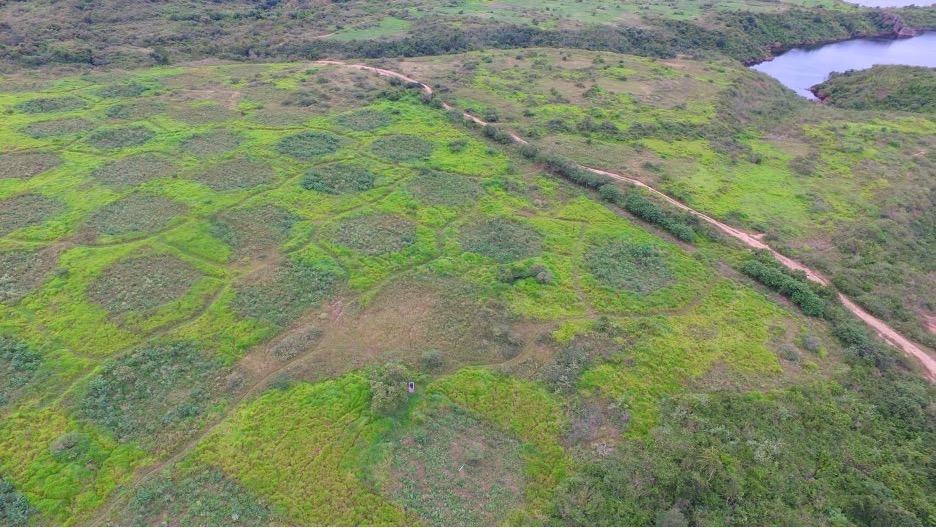
    The grassland, where the research project we report on here was established, covered 7 hectares (17 acres) and had little evidence of spontaneous natural regeneration, so we implemented an applied nucleation intervention. To do that, we cleared the existing vegetation of the area with machetes and scythes, tilled with a tractor to reduce soil compaction, and set up 42 hexagonal plots that had an area of 1000 m2 (0.25 acres) each. In each plot, we planted 271 seedlings belonging to 11 different plant species native to dry tropical forests of this region. Four of these species had the ability to associate with bacteria that can fix atmospheric nitrogen. The seedlings planted all received 1 kilogram of ant farm soil, 10 grams of hydrogel to extend the period of favorable soil moisture, and 50 grams of nitrogen – phosphorus – potassium (NPK) fertilizer, 25 grams of NPK, 43 grams of phosphoric rock, or no fertilizer, depending on the plot where the seedlings were planted. All seedlings were irrigated once they were planted to activate the hydrogel. The seedlings that received the irrigation treatments were watered two more times during the first month of the experiment. The control and the 50 grams of NPK without additional irrigation treatments did not receive any additional water. Once the seedlings were 6 months old, we started monitoring their survival and growth. In each plot,we recorded the height of every seedling that was still alive. Thereafter, we measured seedling height approximately every six months for two years.

    Aerial image of the 42 nucleation plots established in 2019 in El Quimbo, Colombia. The extension of the restoration intervention was 7 hectares (17 acres) (photo: Fundación Natura). 
    A close-up view of the experimental restoration plot. The orange lines represent the limits of the plot (1000 m2 = 0.25 acres), and each small dot represents a seedling planted (Photo: Fundación Natura). 

    Additionally, we decided to compare the costs among the different management strategies implemented. We documented the cost of seedling production, planting, fertilizers, irrigation, and monitoring. Finally, we estimated the cost-effectiveness of each treatment for any of the eleven species planted. We did that by first estimating the total cost of planting a hectare of grassland with a single tree species (a hectare is equivalent to six nuclei = 1,626 individuals) under a specific treatment, and then dividing that cost by the % survival of that species under that specific treatment after two years. The most cost-effective method was the one that yielded the lowest cost and had the highest % survival.

    An employee from Fundación Natura fertilizing a seedling of Vachellia farnesiana a shade-avoiding plant species common in tropical dry forests in Colombia (photo: Laura Toro). 

    We found that during the first two years of the project seedling survival was on average 73% across treatments. The seedlings that received 25 grams of NPK plus irrigation treatment had the highest survival (76%), while the seedlings that were fertilized with 50 grams of NPK and did not receive additional irrigation had the lowest survival (69%). However, when we looked at the survival across species, we found that survival varied across species and treatments. The plant species with the highest survival was Ceiba pentandra (99%), while Handroanthus coralibe had the lowest survival rates (5%). In terms of costs of planting seedlings, we found that the cheapest strategy was to not fertilize or irrigate the seedlings ($7,313 per hectare, $2,961 per acre), while the most expensive strategy was 50 grams of NPK plus irrigation ($11,689 per hectare, $4,732 per acre). Finally, when we compared the cost-effectiveness of the six fertilization and irrigation strategies implemented, we found that the control treatment was the most cost-effective management practice across the eleven species planted ($19,522 per hectare, $7,903 per acre) in part due to the low costs of no additional management beyond planting and monitoring, and the modest benefits to survival of costly irrigation and fertilization practices.

    Aerial image of nucleation plots in El Quimbo, Colombia in 2022. (photo: Fundación Natura).

    Even though restoration practitioners deal with a lot of uncertainty and restoration studies still lack information about how fertilizers affect the growth of native tree species and non-native grasses, there are multiple ways to improve restoration outcomes in tropical dry forests. We encourage partnerships between scientists and restoration practitioners to test how fertilizers impact different plant species growth and survival, and to estimate the costs of this practice across different tropical dry forests. Additionally, paying close attention to the soil fertility of the area, planting species that are found locally, actively weeding during the first year of the project, and fencing the restored area to ensure herbivores do not browse the seedlings will increase seedling survival and the success of the restoration efforts. Based on our results, we suggest that restoration projects should spend less resources on irrigation and fertilization, and more on plant species selection and weed removal.

    If you want to learn more about how fertilization and irrigation impacted the growth and survival of tropical dry forest seedlings, we invite you to read our recent paper in Restoration Ecology or contact Dr. Laura Toro.

  • Drones can help monitor forest restoration

    Leighton Reid is a postdoctoral fellow in the Center for Conservation and Sustainable Development.

    Hexacopter flying over a restoration site. The red, digital camera is visible between the landing bars.
    Hexacopter flying over a restoration site. The red, digital camera is visible between the landing bars.

    Monitoring restoration projects is important to demonstrate progress and learn what works and what doesn’t, but it can be time consuming and expensive. As such, restoration practitioners around the world are looking to automate tasks like monitoring, and one way this can be done is with unmanned aerial vehicles, or drones.

    Over the past two years I’ve worked with a research team in southern Costa Rica to test how well drones can monitor tropical forest restoration. We used hexacopter drones: helicopter-like contraptions with six rotors. Each drone had a consumer-grade digital camera attached to the bottom. We flew the drones over thirteen restoration sites and then used Ecosynth computer software to stitch the images together and create three-dimensional models of the vegetation structure.

    Drones accurately estimated forest structure

    Drone-based measurements of canopy height closely matched our hard-won field measurements (but with less sweat and insect bites). The drone-based system also detected canopy gaps, predicted fruit-eating bird movements, and estimated above ground biomass. The ability to accurately assess above ground biomass is particularly important; it suggests that drones could be used to monitor carbon accumulation in regenerating forests.

    Editors’ choice – a must read

    Our research on drones and forest restoration was published this week in the journal Biological Conservation. The editors selected it as the must-read choice of the month, saying:

    “The rapidly expanding use of unmanned vehicles to monitor vegetation and other aspects of biodiversity is an exciting development in conservation biology. This article also demonstrates that bird abundance can be estimated using data gathered by UAVs.”

    The paper is freely available for download through August 27, 2015 at the publisher’s website.

    Researchers Jonathan Dandois and Dana Nadwodny launch a drone at a site in Costa Rica [Photo courtesy of Karen Holl].
    Researchers Jonathan Dandois and Dana Nadwodny (University of Maryland Baltimore County) launch a drone at a site in Costa Rica [Photo courtesy of Karen Holl].