Tag: Wildflowers

  • Looking Back to Guide the Future: Evaluating 23 Years of Management History in Big Meadows, Shenandoah National Park

    Looking Back to Guide the Future: Evaluating 23 Years of Management History in Big Meadows, Shenandoah National Park

    By Jordan T. Coscia

    Jordan is a PhD candidate in the Restoration Ecology Lab at Virginia Tech and a Research Fellow with the Smithsonian’s Virginia Working Landscapes program whose research focuses on the characterization and restoration of Virginia’s native grasslands.

    An open landscape of grasses, forbs, and low shrubs meets the edge of a forest in the background. Three trees are in the foreground to the right, and forested mountaintops are visible in the distance.
    The western section of Big Meadows, Shenandoah National Park in June 2022. Photo by Wendy Cass.

    Located at the heart of Shenandoah National Park, the Big Meadows landscape is a site of both natural and cultural history. The 134-acre meadow is the largest open area in the Park, and it is a popular visitor destination boasting numerous walking trails and proximity to campgrounds, picnic grounds, and one of the park’s two visitor centers. Ecologically, the Big Meadows landscape includes two globally critically rare Blue Ridge Mafic Fen plant communities, and hosts plant and animal diversity not found elsewhere in Shenandoah National Park.

    Like other meadows and grasslands across the Southeastern United States, Big Meadows occurs in a climate that can support closed-canopy forests. Therefore, the open landscape and the species that rely on it only persist due to a combination of edaphic characteristics, such as shallow and poorly drained soils, and frequent disturbance, such as fires or the grazing of herbivores, that prevent the growth of woody trees and shrubs. In the post-colonial absence of large herbivores and the suppression of both cultural burning and wildfires, the open landscape of Big Meadows was maintained by livestock grazing before the establishment of Shenandoah National Park in 1935. Continuous efforts have been made to preserve the historic open landscape since the Park’s founding, including routine mowing, prescribed burns, and the targeted cutting and herbicide treatment of encroaching Robinia pseudoacacia (black locust) saplings and Rubus (blackberry) canes. While initially successful, management efforts appear to have become less effective over time, and the spread of woody and invasive species threatens the open landscape of Big Meadows.

    Close-up of a sedge with a terminal, brown, staminate spike and two lower, pistillate spikes of green, oblong perigynia sporting “racing stripes” formed by impressed nerves.
    A rare sedge, Carex conoidea, in Big Meadows. Common names for this species include the prosaic “field sedge” (Flora of Virginia) and the romantic “ancient prairie sedge” (Southeastern Flora). Photo by Leighton Reid.

    Since 1998, botanist Wendy Cass and The Inventory and Monitoring program at Shenandoah National Park have recorded land management actions and collected plant community composition data in Big Meadows. Big Meadows was split into three major management zones, and all three zones were treated with prescribed fire each spring between 2000 and 2003. In 2004, a new management schedule was created with the goal of maintaining a three-year burn-mow-fallow cycle in each zone. To determine how these management changes impacted Big Meadows, Leighton Reid (Virginia Tech), Wendy Cass, and I assessed changes in the plant community composition from 2000 to 2023 using multivariate statistics and the creation of statistical models through regression analysis.

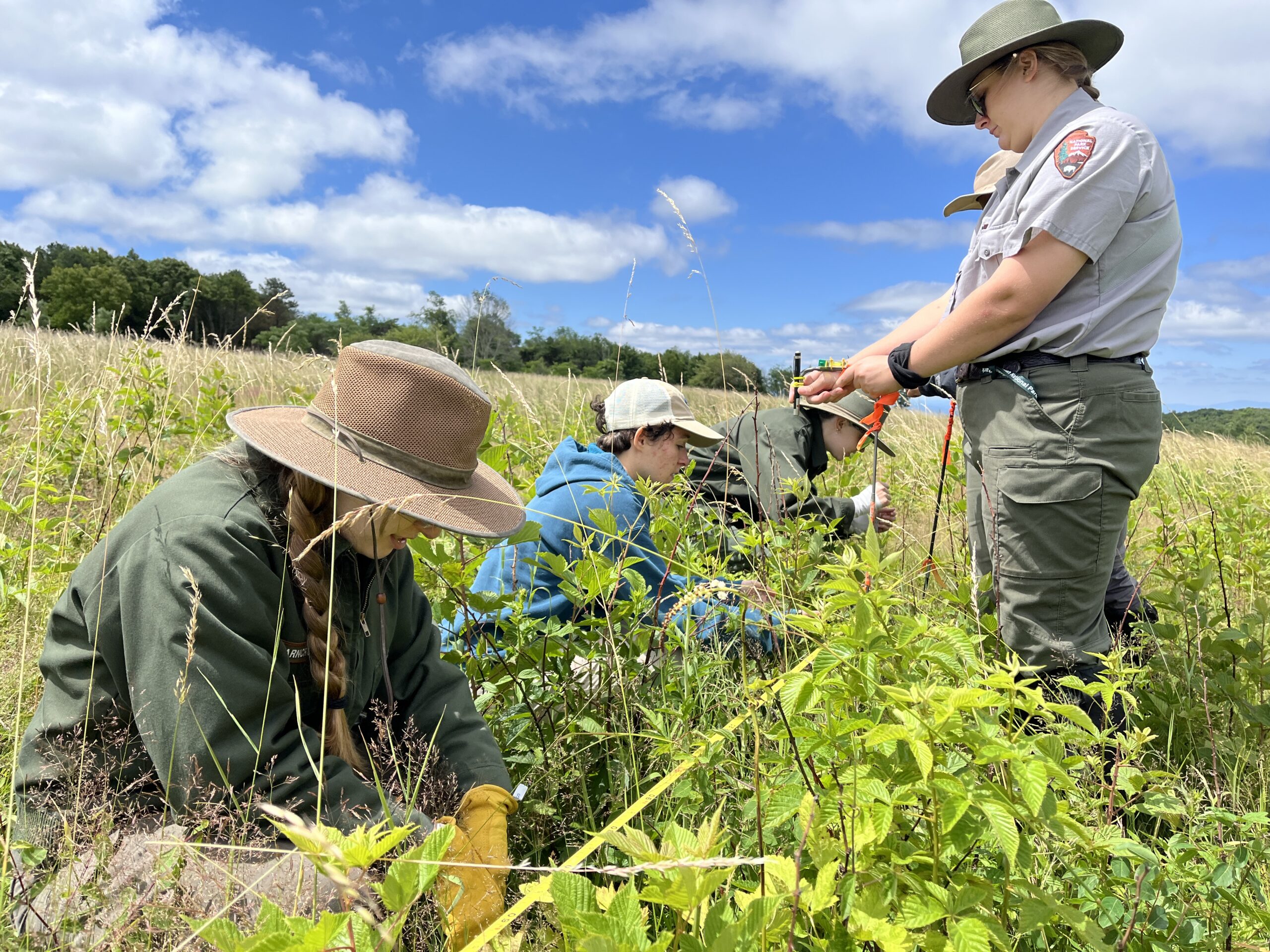
    Five people huddle around a field tape marking a vegetation transect through a grassland with white clouds and blue sky in the background.
    Jordan Coscia (second from left) and Inventory and Monitoring NPS staff measuring plant community composition in Big Meadows in June 2024. Photo by Wendy Cass.

    We found that the plant community composition of Big Meadows shifted over the past 23 years, with the original mosaic of shrubs within a grass and herb-dominated community experiencing marked increases in low shrubs, young trees, and other woody plants. Though the average percentage of graminoids (grasses, rushes, and sedges) encountered along each survey transect experienced little overall change between 2000 and 2023, the average percentage of forbs (non-woody herbs that are not graminoids) encountered decreased by over 50%, while the average percentage of woody plants encountered increased by 200%-400%. This increase in woody plants was partially driven by native Rubus (blackberry) species, which increased from less than 1% of the plants encountered along each transect in 2000 to 15-20% of the plants encountered along each transect by 2023. Multivariate statistics revealed that the trajectory of change in the Big Meadows plant community shifted abruptly after the three-year burn-mow-fallow cycle was adopted in 2004. The direction of this shift was correlated with an increase in the time interval between prescribed burns.

    An open landscape of green vines interspersed with brown, leafless stems. The sky is cloudy and Big Meadows stretches into the distance, terminating in a line of trees.
    Woody encroachment near the northern edge of Big Meadows. Bare stems represent Robinia pseudoacacia (black locust) top-killed by prescribed fire. Emerging beneath them is a green carpet of invasive bittersweet (Celastrus orbiculatus). Photo by Leighton Reid.

    Our statistical models provided evidence that both climate and changes in the timing of land management actions have impacted the plant community in Big Meadows. There was moderate evidence that later springs (as indicated by the date of the last spring freeze) are correlated with desired increases in forbs, however, this positive effect may be lost as climate change brings milder winters with fewer frost days to Shenandoah National Park. There was strong evidence that longer intervals between prescribed fires are correlated with unwanted increases in woody plants and decreases in forbs and moderate evidence that longer intervals between mowings are correlated with unwanted increases in Robinia (black locust) and decreases in forbs. Together, this evidence indicates that these unwanted changes may be mitigated by increasing the frequency of prescribed burns and mowing in the future.

    Overall, our analysis revealed that the changes in land management between 2000 and 2023 have negatively impacted the plant community composition in Big Meadows. Together, the shifts in community trajectory after 2004 and the evidence from our statistical models suggest that the change from annual burning to a three-year burn-mow-fallow cycle in 2004 has contributed to the declining landscape conditions in Big Meadows. Though ad-hoc changes to the three-year management cycle and gaps in the plant data make it difficult to determine an ideal burn or mow interval from the existing data, evidence from the past 23 years suggests that more frequent burning and mowing may aid the preservation of the Big Meadows landscape for future park visitors and wildlife alike.

    An open landscape with patches of dark green trees in the left foreground and the right background, surrounded by a low, shrubby wetland. The sky is pale blue with a few wispy clouds above a forested hill that rises on the right hand side.
    A line of gray dogwoods (Cornus racemosa) accentuates a shorter canopy of narrowleaf meadowsweet (Spiraea alba) shrubs in the wet, central portion of Big Meadows. Photo by Leighton Reid.
  • Bee-friendly beef: rehabilitating cattle pastures to increase pollinator habitat

    Bee-friendly beef: rehabilitating cattle pastures to increase pollinator habitat

    Dr. Parry Kietzman is a research scientist in Virginia Tech’s School of Plant and Environmental Sciences. Here she describes a new experiment aimed at improving Southeastern grazing lands to improve cow health, provide habitat for pollinators, and conserve plant biodiversity. A member of the bee-friendly beef team since 2020, her work focuses on the ecology and conservation of pollinating insects.

    Across the world, pastures account for over 20% of the Earth’s land surface, an area roughly the size of Africa. Many of these pastures were once species-rich meadows, prairies, and woodlands that offered abundant and diverse food resources for pollinators, but are now limited to a handful of species that provide forage for grazing livestock.

    Lanceleaf coreopsis (Coreopsis lanceolata), a native composite sewn into an active cattle pasture near Stuart, Virginia. Photo credit: Parry Kietzman.

    Pollinating insects such as bees, flies, butterflies, moths, and beetles are currently in crisis, as habitat loss from development, intensive agriculture, and other human activities have diminished the food sources and nesting sites they rely on. The conservation of pollinators native to each particular region is especially important, as many plants depend on native specialists for pollination. The widely-kept, domesticated, European honey bee (Apis mellifera L.), though of great importance to modern agriculture, is often not successful or at least not as efficient at pollinating certain plants as the bee specialists that coevolved alongside each particular species. Landscapes rich in a diversity of plant species native to that location are therefore needed to provide habitat for these native pollinators.

    Some types of beetles, such as the soldier beetles (Colanoptera: Cantharidae) pictured here, also visit flowers and can provide pollination services. Soldier beetles feed on nectar and pollen and do not damage their plant hosts. Photo credit: Parry Kietzman.

    Researchers at Virginia Tech, the University of Tennessee, and Virginia Working Landscapes are currently collaborating on a multi-year rehabilitation project to plant native North American prairie grasses and wildflowers in cattle pastures in Virginia and Tennessee. The project is based on the idea that a landscape can be supportive of healthy cattle production while at the same time providing ecological niches for pollinating insects. Bringing back diverse food sources for pollinators in pastures, however, presents some significant challenges. First, the plants must not be harmful to livestock that may graze on them. Second, they must be hardy and practical to establish in new and existing pastureland. Finally, they should be native to the region in which they will be planted, as this will be most beneficial to that region’s native pollinators and help prevent the accidental introduction of invasive species.

    Some of the wildflower species used in our experiment, such as this blanketflower (Gaillardia pulchella), are native to North America but not naturally found in Virginia or Tennessee. Photo credit: Parry Kietzman.

    Our team is currently working to identify and successfully establish seed mixes that thrive in Virginia and Tennessee without becoming excessively weedy or crowding out grasses grazed on by cattle. Once established, pollinator diversity and abundance will be measured in plots with and without wildflowers introduced. Herds of cattle grazing in the pastures will also be monitored for health and body condition.

    Bumble bees are common visitors at our wildflower-enhanced sites. Photo credit: Parry Kietzman.

    Results from this study, including critical information about best practices for establishing the seed mixes, optimal grazing regimes to promote blooms, and wildflowers as forage will be disseminated to growers and other stakeholders through extension services such as published fact sheets, protocols, and workshops. This foundational work will help inform researchers and land managers around the globe how to transform pasturelands into landscapes that can help save our pollinators.

    For more information on this ongoing study, visit the team’s website: beesandbeef.spes.vt.edu.

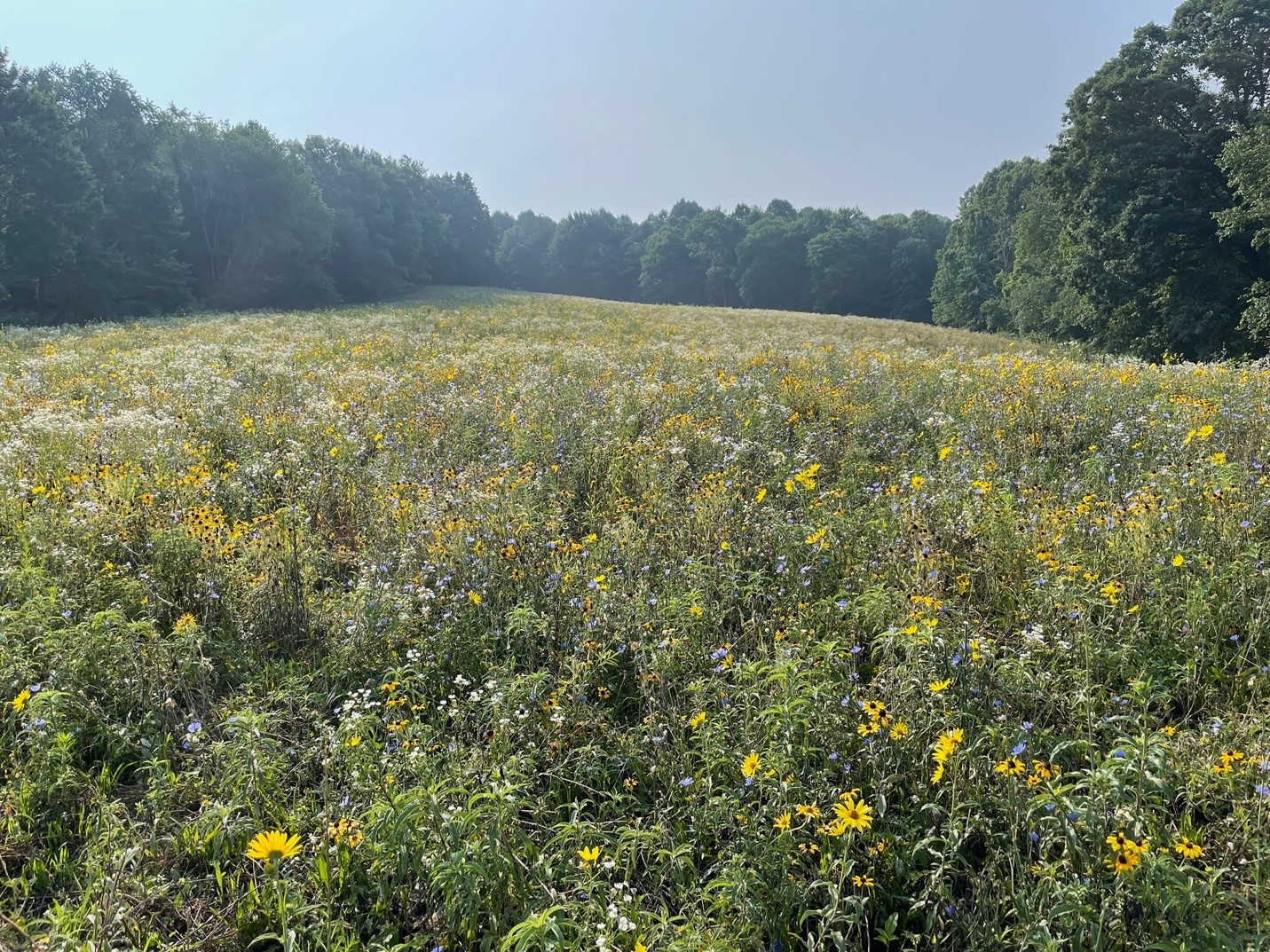
    A wildflower-enhanced pasture in southwestern Virginia in mid-summer 2021. Photo credit: Parry Kietzman.