By Rory Schiafo
Rory Schiafo is a PhD Candidate in Plant Biology and Conservation at Chicago Botanic Garden and Northwestern University. All images are taken by the author. rschiafo@u.northwestern.edu
In the Midwestern United States, oak woodlands are a diverse ecosystem characterized by tree densities intermediate between open grassland and closed-canopy forest. These woodlands are typically dominated by oaks (Quercus spp.), forming a single layer of overstory trees with a few scattered hardwoods like hickories (Carya spp.) and elms (Ulmus spp.) throughout. The midstory layer is sparse, but the herbaceous understory at ground level is dense and highly diverse. The loosely scattered oaks create canopy gaps with ample sunlight that provide habitat for sun-loving prairie species such as wild bergamot (Monarda fistulosa), as well as shaded areas containing forest species like bluestem goldenrod (Solidago caesia). Some plants in oak woodland understories, like heart-leaved skull cap (Scutellaria ovata) and starry campion (Silene stellata) are specialists uniquely adapted to these patchy conditions. This variation in canopy cover produces a remarkably unique and species-rich ecosystem where dozens of plant species can exist within just a few square meters.


Once widespread, the occurrence of open woodlands has been significantly reduced due to human expansion and land use changes. The oak woodlands that remain have been radically altered by factors such as fire suppression and invasion by non-native shrub species. Oak woodlands now typically exist in a degraded state, with closed, dense canopies of non-oak trees such as maples (Acer spp.), a dense shrub layer of non-native species, and an almost absent understory. As a result, many of the species in woodland understories are threatened or already missing from the landscape.
Ecological restoration aims to recover biodiversity by returning oak woodlands to a structure more similar to what was found before degradation. Restoration efforts often include a combination of techniques, but an important component is the removal of undesirable trees, particularly non-oak trees, to open the canopy and reintroduce the gradients of light that were once a vital part in maintaining diversity in the woodland understory. As a graduate student in Plant Biology and Conservation at Northwestern University and the Chicago Botanic Garden, my PhD thesis examines the importance of these gradients of light and the role that a changing canopy structure plays in the restoration of plant biodiversity in oak woodland understories. My three graduate research projects investigate 1) how understory plant diversity changes with canopy cover over multiple decades of management, 2) how canopy cover and addition of native species with seed mixes interact to influence understory diversity, and 3) how shading and order of arrival shape competitive dynamics among understory herbs.
Project 1.
I first wanted to understand how shifts in woodland canopy over the last thirty years have affected understory composition and diversity. Did increases or decreases in canopy coincide with changes in the diversity (i.e., number) of plant species in the understory? Further, were there other factors that might have influenced this relationship between canopy and the understory? To address these questions, I used data collected by the Illinois Natural History Survey’s Critical Trends Assessment Program. This dataset included 120 woodland sites scattered throughout Illinois. Botanists have meticulously surveyed these sites every five years for the past thirty years. During each survey, they recorded detailed information such as all plant species in the canopy, midstory and understory. With this dataset, I was able to build statistical models that characterize the relationship between changes in canopy and changes in the diversity of species in the woodland understory over the last thirty years.
I found that as forest canopies became denser, the diversity of plant species in the understory declined. In contrast, when woodland canopies opened, similar to what often occurs during restoration, understory plant diversity tended to increase. However, that increase in diversity wasn’t always guaranteed. It was most pronounced when non-native shrub species in the midstory were either absent or present in very low numbers. In contrast, sites with a high occurrence of non-native shrubs were less likely to experience increases in diversity with canopy opening. This has important implications for how we approach tree removal in oak woodland restoration. It suggests that opening the canopy is most effective at boosting understory diversity when non-native shrubs are managed first. This study also reveals thirty years of canopy closure and resulting loss of species diversity in the understory, highlighting the urgent need for interventions that restore the canopy structure required to support this diverse ecosystem.
Project 2.
Recognizing that canopy structure can profoundly influence understory diversity, I set out to explore how canopy openings might interact with our other restoration practices in oak woodlands. I was particularly interested in whether canopy openings influenced understory diversity in oak woodlands undergoing native seed additions, just as they would in woodlands without such interventions. Native seed additions are commonly used in restoration efforts to reintroduce species that have been lost from the landscape and to help overcome dispersal barriers imposed by habitat fragmentation. However, while native seeding is widely used to increase diversity and cover of native species, these seeded restorations may behave differently than restorations without native seed additions. It is possible that environmental factors such as light availability become less influential in driving diversity when species are being deliberately reintroduced as part of the restoration process.
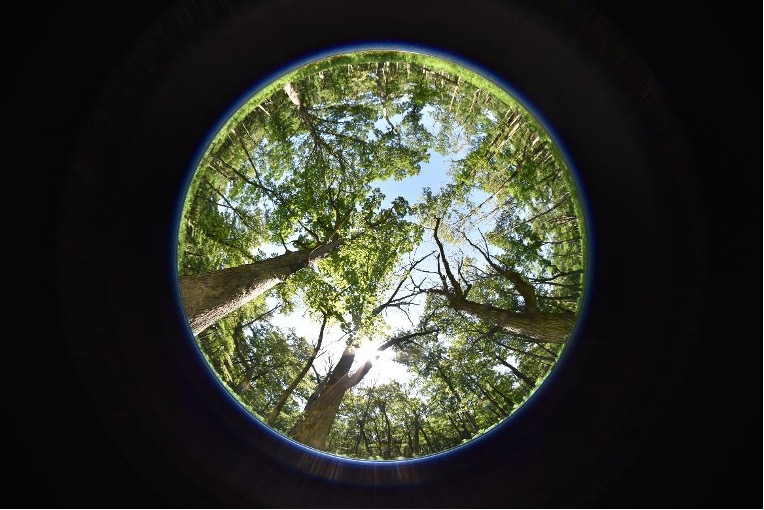
To address this possibility, I conducted surveys across seven woodland restorations sites in the Forest Preserves of Cook County, Illinois. These included both sites that had received supplemental seeding and those that had not. I used 1 m2 plots to systematically identify and record the ground-layer plant species, measuring how much of the understory each one covered. I was seeking to get a clear picture of the diversity, that is how many species there were in each plot, as well as the cover of each species. In total, I identified roughly 170 species. I also took hemispherical photographs with a fish-eye lens and digital camera. This allowed me to measure how open the canopy was above each plot and gave me a good understanding of how much light was reaching the understory plants.


I found, once again, that the canopy was important for driving dynamics in the understory. Canopy openness was positively associated with the cover of native species, meaning that areas with more open canopies had a higher cover of native plants. However, the relationship between canopy openness and the diversity of native species depended on whether the site had been seeded. In restorations that had not received seed additions, it seemed that native diversity increased with more open canopies. However, in seeded restorations, canopy openness had no clear effect on native diversity. The reasons for this pattern aren’t entirely clear, but it’s useful to recognize that seeded restorations may respond differently to canopy openings compared to unseeded ones. This underscores the need for further research into how various restoration strategies, particularly the use of native seed additions, influence plant diversity in woodland understories.
Project 3.
Finally, I wanted to explore how light availability might shape the way plants compete with each other in restored woodland understories. Competition, which can have negative effects on plants, occurs when they try to capture the same essential resources, such as light. In ecology, it is typically thought that the more resources there are in an environment, the stronger the competition between species will be. Thus, plant competition in woodlands may depend on how much light reaches the understory. To complicate things, the order in which species ‘arrive’ and have access to that light can also have a strong influence on competition between species. Referred to as priority effects, a species that arrives early—by dispersing, germinating, and beginning to grow before the other—may gain a competitive advantage.
To better understand how plants compete in woodlands, I tested whether competition was stronger with more light and whether arriving early gave species an advantage. I set up an experiment with 180 pots, each containing twelve native plant species commonly used in woodland restoration. These plants competed under three light levels, and I varied the order in which they arrived. The results were striking. Competition had the strongest negative impact on plant growth when light was abundant. I also found that when a species arrived twenty-four days before its competitors, it performed much better than when all species arrived at the same time. Interestingly, this early-arrival advantage was even more pronounced under high-light conditions compared to low light. Overall, this work helps us better understand the factors that shape species growth and success in woodland restorations. With this knowledge, we can continue improving restoration strategies that support diverse, resilient oak woodland ecosystems.

I used shade cloth to manipulate light in my competition experiment.


Together, these studies reveal how crucial canopy structure is for shaping plant diversity in oak woodlands. Light availability not only influences diversity and native cover but also mediates competitive interactions and priority effects. As restoration practitioners work to restore and protect biodiversity in this threatened ecosystem, understanding the complex interplay between canopy trees and understory diversity will be vital. My research highlights that while canopy thinning is a necessary tool to restore biodiversity in woodlands, there are areas to refine our knowledge and approaches to this restoration practice. In doing so, we can better ensure long-term resilience of oak woodland ecosystems and the many diverse species they support.
Results from the three studies will soon be submitted for publication to peer-reviewed journals. For questions about this research, please contact Rory at rschiafo@u.northwestern.edu.