By Matilda Essig
Matilda Essig is an artist and agriculturalist who has lived in the grasslands of southeast Arizona since 2006. She uses visual art, hands-on restoration and public outreach to express the resilience of wild ecosystems. matilda@mindspring.com

Nineteen years ago, I began a project to restore the native diversity of the grasslands on a badly damaged 5-acre residential parcel in southeast Arizona, in a region locally known as the Apache Highlands Grasslands, a.k.a. Madrean-Mixed Grass Prairie to botanists, naturalists and biogeographers. My journey was informed and inspired by landscape stewards throughout the American west – ranchers and conservation groups alike. My mission included restoring not just the amazing diversity of grasses in the region, but also using my experiences, expressed through the arts, to help restore the role of art as a visionary vehicle within our culture. Visual beauty, ecological, and spiritual beauty – we need to get in touch with all of them again.

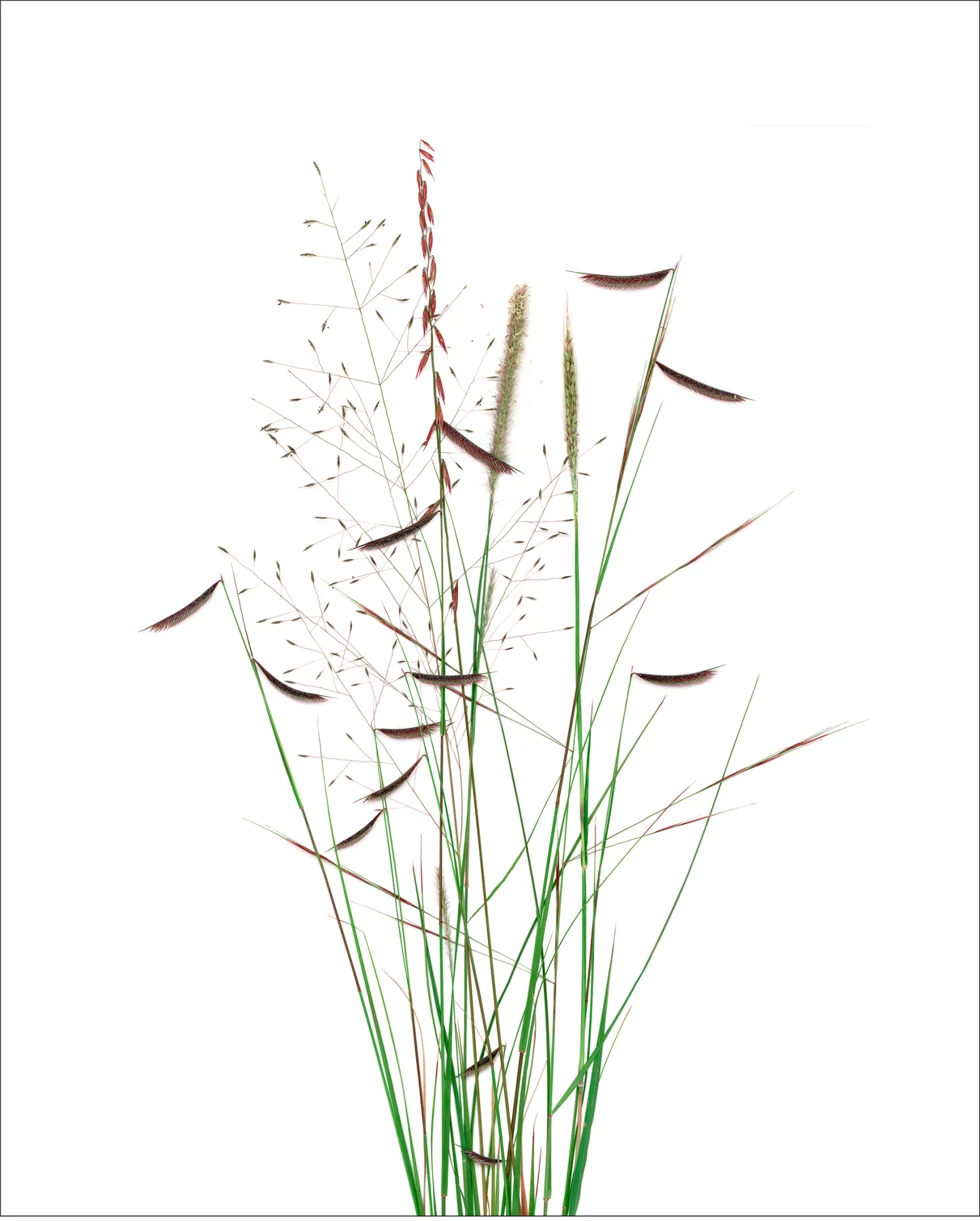
In 2008, I wrote an article for Ecological Restoration, with my friend, and then-editor Mrill Ingram, wherein I described the conditions and biological makeup of my land. This article, Portraits of Grasses, gave an in-depth description of the biological ingredients I had to begin with, and also the artistic process I learned to use to make direct images from nature, using digital technology.
At the invitation of my friend James Aronson, I am delighted to share an update here, in NHER, mentioning the methods that worked and failed, and highlighting native grass species, and sharing how my portraits of these grasses engaged new audiences. What I have borne witness to in my brief tenure as an artist and restoration steward on my small tract of land has given rise to meaningful dialogue across the spectrum of possible audiences, through exhibitions, residencies, studio visits, and the artist’s book that I produced, Native Grasses of the Apache Highlands, which is now available for use in five university library special collections.

The Apache Highlands grasslands – also known as the Madrean Mixed-Grass Prairie, which derives its name from The Madrean floristic region (named after the Sierra Madre Occidental) that occupies the arid and semiarid areas in the southwestern US and northwestern Mexico, at the northern edge of the subtropics. Sandwiched between huge basins and the rocky mountains, it’s a biodiversity hotspot. The summer monsoon delivers the most annual precipitation and is the primary (warm) growing season for the grasses. The San Rafael valley, which spans the US/Mexico border, is home to the southwestern-most intact stand of Shortgrass prairie in North America.

According to the late, great desert ecologist Tony Burgess, who passed away in 2022, these were the most characteristic native grasses in my region: Black grama Bouteloua eriopoda, Blue grama, Curly-mesquite grass – Hilaria belangeri, Vine-mesquite grass – Panicum obtusum, Cane beardgrass – Bothriochloa barbinodis, Purple threeawn – Aristida purpurea, Poverty three-awn grass – Aristida divaricata, Plains lovegrass – Eragrostis intermedia, Giant sacaton – Sporobolus wrightii and Arizona cottontop – Digitaria californica.
Over the years, I’ve come to recognize many more grasses, some of which I’ll mention below. Sadly, a plethora of invasive grasses and other plants now compete with the natives on my property which is in a subdivision carved out of what was, until quite recently, open grassland.

The slope is gently north facing, with the buildings situated on the flat area of the ridgetop in the SE corner of my 5-acre property. It has fenced pastures which had been overgrazed by an equine for 20 years, resulting in an abundance of amaranths (Amaranthus spp.) and various kinds of ‘tumbleweeds’ including Salsola spp. (Chenopodiaceae).
Among the invasive grasses I had to deal with were Johnson grass (Sorghum halepense), and Lehmann’s love grass (Eragrostis lehmanniana), Yellow bluestem grass (Bothriochloa ischaemum), and the infamous, cosmopolitan weed Skutch grass or Bermuda grass (Cynodon dactylon) that had been planted by previous owners for lawn and equine grazing. My first steps to control the invasives, and promote recovery of the pre-existing flora and vegetation, began with cattle and rotational grazing practices that I learned from neighbors. That was quite successful in knocking back the swarms of amaranths at the start of the monsoonal growing season, thereby allowing the slow-growing grasses to gain a foothold. While I had wanted to work with goats in subsequent years, I chose not to undertake the labor-intensive fencing that would be required to control them and their voracious grazing habits. The cattle had been easy to contain with single strand aluminum wire and a solar charged battery for electricity.

Instead, I invested in a high-quality mower and did a lot of pulling by hand of all the invasive species that I could. In the first few years, my progress was great – eliminating the amaranth completely around the buildings and well into the pastures, and completely extirpating the tumbleweeds, without any chemical assistance. Instead, I set out to learn about the root strengths and soil moisture of each invader species, so as to be able to pull each plant at the most appropriate moment in order to remove the entire root system with minimal soil disturbance. Working to reduce the invasives, I also learned about the natives, as I watched them rebound in the absence of competition.
Sensing and observing the effects of my role as a player in this ecological equation gave me great inspiration for creating the artworks – to celebrate the grass species that I was learning about, and to share the story of healing the landscape. By healing, I mean restoring the native grasses which I knew, in turn, would be nourishing soil health and ecosystem health.
The Grasses
Out of the more than 100 native Poaceae in the Apache Highlands, the most prevalent and iconic is Blue grama, a recognized keystone species and, now, a keystone also in the communications programs based on my artwork. It was the favorite of my first local mentor, senior rancher John Donaldson, who first taught me about the role of grasses in assisting the recovery of soil and watershed health on the nearby Empire Ranch, now the Las Cienegas National Conservation Area. This species has persisted and rebounded from the impacts of overgrazing on my property, and is notably much beloved throughout the interior western USA and northern Mexico, for its role as a pillar of many kinds of grassland communities, and because it is palatable and provides high protein content for feed for livestock.
I had immediate success in portraying the character of this species, and through the strong imagery, it served as a common denominator in rangeland discussion amongst the agricultural communities with whom I met at conferences. In particular, the Quivira Coalition’s 2009 conference on the theme of American conservationist Aldo Leopold was a great opportunity to engage in the dialogue about the role of beauty in land conservation. As I mentioned above, visual beauty, ecological beauty and spiritual beauty are all players, so to speak, in the determination of future land usage decisions based on human values. Sideoats grama, Rothrock’s grama, and Hairy grama were all present and easy to portray, with their vertical postures and showy inflorescence, but Black grama was a far greater challenge to find and portray, with tiny its slivers of seed head, and prostate growth patterns.

I’d searched for this species after hearing Brandon Bestlemeyer, ecologist and research leader at the Jornada Experimental Range, describe it as a critical species in the future of grasslands conservation. Many such inspiring collaborative conversations came about in the context of annual science meetings convened by the Malpai Borderlands Group, whose legendary accomplishments in bringing ranchers and conservationists together have resulted in biological protection for vast tracts of open range grasslands in the Chihuahuan desert. My friend Ben Wilder, a biogeographer and communicator with the Next Generation Sonoran Desert Researchers, chose the image of Black grama to draw an audience for a fundraising event for the UA Herbarium and the vast resource of its collections. The image spoke to them about spirit and resilience.
While my original focus had been to learn everything I could about how and where the individual grasses grow, the point of understanding multiple species was to illuminate the strength that biodiversity creates within the fabric of ecological communities. When the Land Institute, the Kansas-based agricultural research organization working to develop sustainable food crops, invited me to present as Artist for the 30th annual Prairie Festival (2010), they wanted an image for the theme of perennial polyculture. This challenged me to portray a group portrait that was inspired by a series that I collected, just as it occurred, from a pasture of a neighboring rancher, Rukin Jelks, who practiced holistic management methods: a mature rotational cell system designed byAlan Savory thirty years ago.

The Audiences
The audiences at conservation meetings and the Prairie Festival knew the subject and shared my love for it. I believe they even felt their passion for land and prairie conservation was being recognized and honored in a new way. At traditional art venues —museums and galleries —the subject matter was largely novel, reaching audiences in different, more intuitive ways. The resounding response was, ‘I will never look at grasslands the same way again’. The diversity of plant characters also brought out the diversity in my audience: some viewers related to chaotic images like Tanglehead grass (Heteropogon contortus) whereas others were repelled by it.

The audiences of the fine art world were ripe for the authenticity of nature based values, a light of climate change and then the pandemic. At Tucson Museum of Art, (2013) I worked with the curator to produce a large group exhibition called “Desert Grasslands”, which offered side events such as art-science panel talks about rangeland conservation, Buffelgrass (Pennisetum ciliare, formerly calledCenchrus ciliaris), the noxious and highly flammable invasive that now threatens the Sonoran desert.
At the Amerind Museum, I had a solo show for Native Grasses of the Apache Highlands,(2016) and was able to engage with Hopi and Navajo tribal members in a shared sense of spiritual and creative source in the natural world. At the Willa Cather Foundation my solo show focused on comparing the prairie grass characters to Cather’s meticulous human portraits of pioneer immigrants – studies in adaptation and resilience. At the Tucson Airports’ Center Gallery, in 2019, I was able to offer the work to the broadest audience yet, and also use the setting to meet with visiting classical composer Emerson Eads to discuss collaborative musical intentions, and also Indigenous author and botanist Robin Wall Kimmerer.
Over Time
While an extreme weather event in 2021 – 3 inches (75 mm) of rain in one hour – reversed years’ of hard work in a single episode, leading to the germination of an ‘avalanche’ of amaranth seed that had likely lain dormant for more than a decade, the subsequent two years of sustained drought allowed a favorite native grass of mine to appear – Sand dropseed (Sporobolus cryptandrus)- in uncanny abundance. Additionally, as I grew to learn the songs of grassland birds, my restoration priorities expanded to include the habitats of the avian species that also thrived from my work, Meadowlark and Scaled quail in particular. The meadowlark’s song is both ancient and evolving in this landscape, as we have eastern, western, and also a new Chihuahuan subspecies recently identified by its song. The invasive plants have also inspired their own folio, currently underway.
In conclusion, my intentions moving forward are to work with the folios in university settings, to challenge our culture-driven perceptual paradigms of the natural world, engaging the next generation with the inspiration of stewardship thinking, both from conceptual understanding through the stories of these many land managers, and also to inspire them to see their own potential hand in the process, to experience the role of healer, and to know that no matter how small or large a parcel or landholding they may be working on, five acres or fifty thousand, every gesture makes a difference. To that end, I look forward to further opportunities to collaborate with EHN and its partners, to help inspire acts of ecological restoration, and to offer the arts as a catalyst for all.

I would like to express my gratitude to James Aronson and Lauren Shew for editorial and technical assistance in creating this post.