Matías Barceló is an early career researcher at the Centre for Research and Innovation on Climate Change (CiiCC) at Santo Tomás University, Chile, SECOS Institute and at the Laboratory for Ecosystem Conservation and Human Well-being (LabCBH). His research focuses on local communities and the land-sea interface. In particular, he has worked on assessing the role of local knowledge in adaptive capacity in a rapidly changing world, as well as investigating the various perceived values of nature associated with the various practices of local communities. He is currently assessing how these values can reinforce various initiatives to restore and reconnect degraded and fragmented ecosystems at the land-sea interface.
Chile is often described through its contrasts: deserts, mountains, temperate rainforests, mediterranean-type climate ecosystems, fjords, kelp forests, and one of the longest coastlines in the world with 4,200 km from north to south, roughly the distance from Lisbon, Portugal, to Moscow, Russia. When accounting for its islands, fjords, channels, and intricate geography, its total coastal perimeter exceeds 80,000 km. These ecosystems also include areas of exceptional conservation value, including the globally recognized Chilean Winter Rainfall–Valdivian Forests Biodiversity Hotspot in central and southern Chile.
A map of South America showing Chile (in red) surrounded – and isolated – by the very high Andes mountain range and the Pacific Ocean. Image-generated by Matías Barceló.
Restoration in Chile is growing, but in what way, and in what direction?
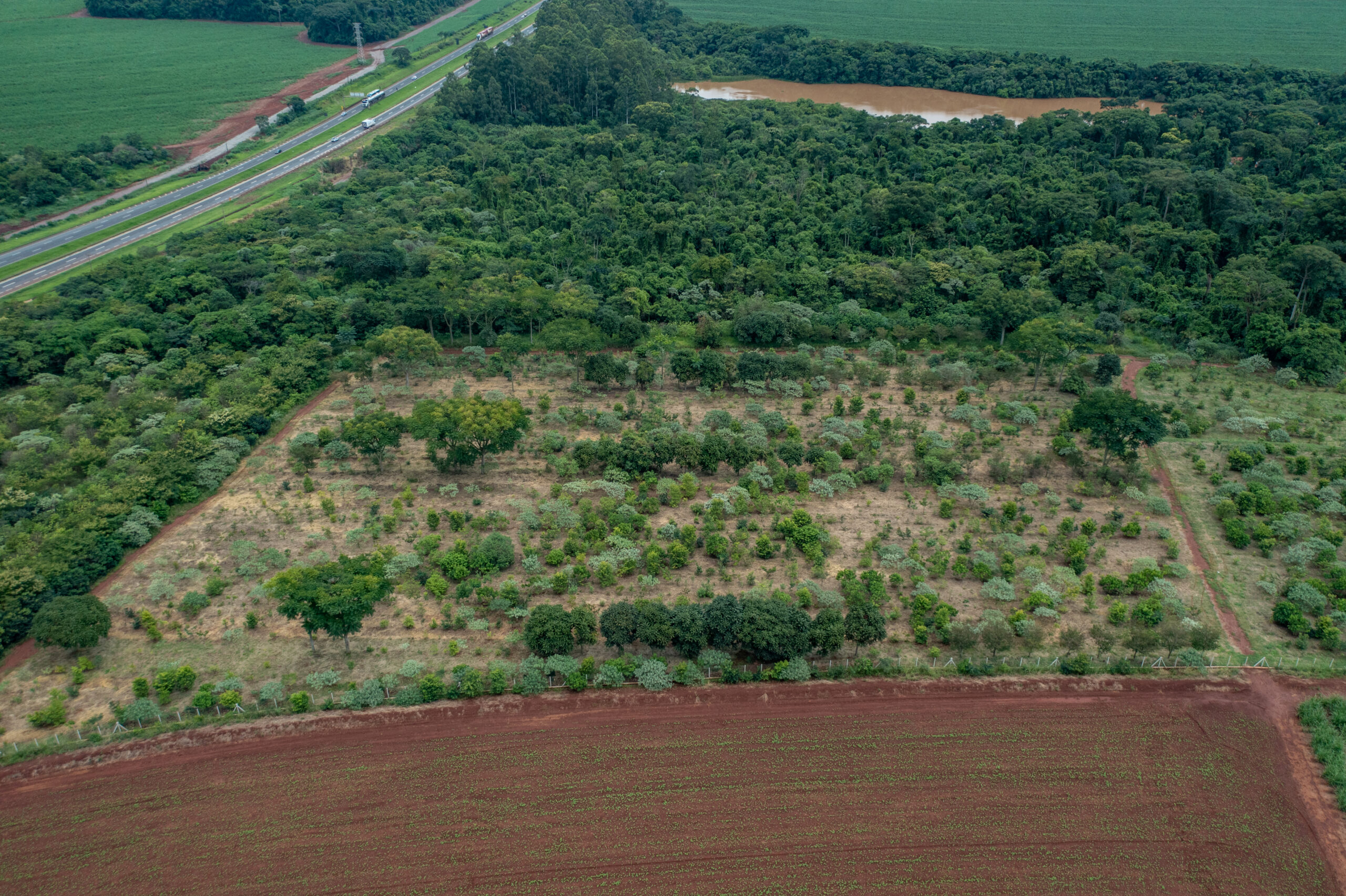
Our recent review of 95 restoration initiatives, that comes from a dataset compiled by the Chilean Ministry of the Environment, showed that most projects nation-wide are concentrated in terrestrial ecosystems, particularly in central and south-central Chile, where wildfires and forest plantations are among the main drivers of degradation and transformation (see Figure below). Our work showed that 94.7% of the initiatives were terrestrial while the other 5.3% represent wetlands and there are no initiatives in the database focused directly on marine ecosystem restoration, despite Chile’s extensive coastline.
This review also revealed a key social gap: only 35.7% of the initiatives explicitly involved local communities from the outset, and when communities were included, their role was often limited to operational activities such as planting, cleaning sites, or basic monitoring. In other words, people participated in restoration activities, but not necessarily in defining restoration goals, identifying priority areas, making decisions, or shaping governance processes.
The map on the left shows the restoration initiatives recorded by Chile’s Ministry of the Environment between 2010 and 2021, marked with red dots. The panels on the right summarize key features of these initiatives, including: (A) main causes of site degradation; (B) ecosystem type; (C) land use or land cover targeted for restoration; (D) whether actions involved water bodies; (E) whether local communities were involved; (F) whether seeds were collected from nearby areas; (G) whether seedlings were produced by the initiatives; (H) whether planting was carried out; (I) whether monitoring was in place; and (J) whether a reference ecosystem was selected or assembled.
This is relevant because as mentioned above restoration work should reach beyond ecological goals. If restoration projects focus exclusively on biophysical recovery, they may overlook local livelihoods, cultural values, traditional practices, historical relationships with species, and also the meanings that communities attach to degraded or transformed landscapes. A restoration project can be technically well designed and still fail socially if it does not engage with the people who live in, depend on, and care for those ecosystems. The challenge is to move toward social-ecological restoration, an approach that integrates ecological recovery with local knowledge, values of nature, community participation, and long-term human well-being.
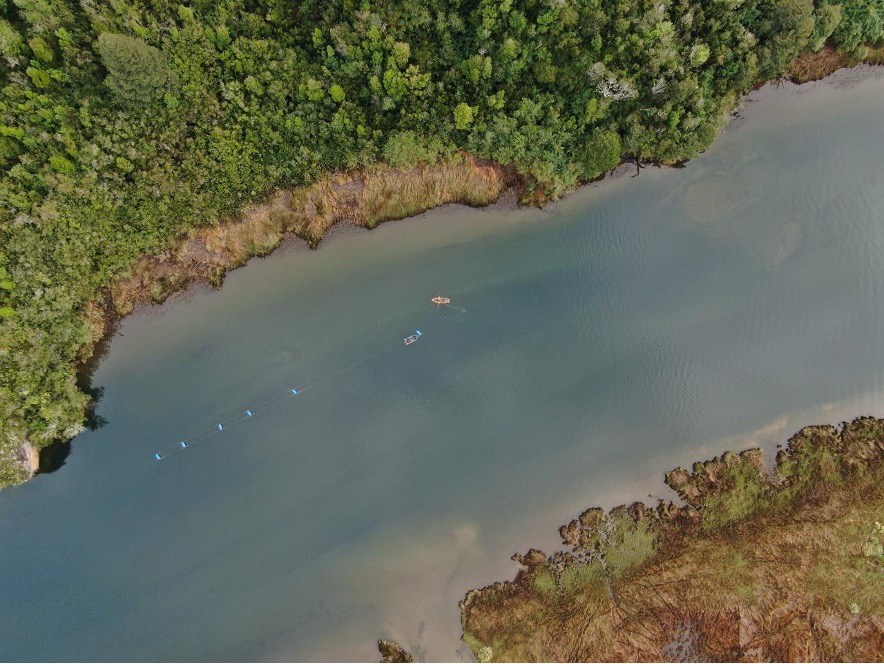
The mouth of the Chaihuín River where it flows into the Pacific Ocean is a highly representative location for studying land-sea interactions via the river. Chaihuín, Valdivia, Chile. Photo credit: Matías Barceló.
Why land and sea must be restored together
Although terrestrial and marine ecosystems are often managed separately, many communities experience them as interconnected territories. Changes in one part of the system can affect the others. Forest degradation can influence water quality, sediment flows, coastal habitats, and livelihoods. Marine degradation can affect food security, local economies, cultural practices, and people’s sense of belonging.
Drying red seaweed species for marketing purposes on the southern coast of Chile. Photo credit: Matías Barceló.Artisanal divers checking water quality monitoring equipment. Photo credit: Matías Barceló
For this reason, we have undertaken a project that focuses on representative coastal sites of southern Chile: Lenca, Puelo, and Cochamó (see Figure below). These places were selected because they represent different but connected expressions of the land-sea interface in the south-central Regions. Lenca combines temperate rainforest, proximity to Alerce Andino National Park, artisanal fishing, seaweed harvesting, and coastal livelihoods. Puelo connects mountain, riverine, freshwater, and marine systems. Cochamó brings together valleys, temperate forests, rivers, coastal areas, artisanal fishing, shellfish harvesting, and community-based tourism. Together, these sites offer a unique opportunity to ask and test how restoration can be conceived not only for “nature”, but also for people.
(a) Dots indicate the study site locations: Lenca (red), Cochamó (yellow), and Puelo (light blue) in Reloncaví (Llanquihue Province, Los Lagos Region), southern Chile. (b) Pink dots show the locations of the study sites in a subcontinental geographic context. Maps created by Matías Barceló.
From ecological restoration to social-ecological restoration
Our project starts with the idea that restoration priorities should be defined by integrating ecological evidence with local perceptions. It combines remote sensing analysis of native and kelp forest change with interviews with local actors about perceived environmental changes, key species, threats, and meaningful places. This information will be co-validated with communities mentioned above, recognizing that scientific data alone is not enough to guide restoration, and that local knowledge is essential to understand degradation and identify restoration needs.
Why values matter for restoration
One of the main contributions of this project is its focus on plural values. People value ecosystems in different ways: some values are instrumental like forests and marine ecosystems that provide food, income, materials, protection, or tourism opportunities; others are intrinsic: species and ecosystems may be considered valuable in themselves, regardless of their usefulness to people. But many values are relational: they emerge from identity, care, memory, responsibility, belonging, and connection to place. These relational values are especially important for restoration.
Our project will explore these values through photo-voice. Participants will be invited to take photographs of places and species that are meaningful to them. Each photograph will be accompanied by a short narrative explaining why the place or species may be relevant for restoration. This method will allow to communicate environmental change not only through words, but also through images, memories, emotions, and territorial experience.
Co-creating restoration futures
Our project moves from diagnosis to action. One approach is relevant here. Pockets of the past, which invite communities to identify values, practices, or ways of life from the past that they want to carry into the future. These may include forms of care, uses of species, relationships with rivers or forests, collective practices that remain meaningful for sustainable futures.
This approach suggests that restoration initiatives can be more legitimate and sustainable when they are grounded in local values, ecological evidence, and community priorities. In this sense, community-led pilot initiatives and methodological guides can serve as useful tools to translate plural and relational values into restoration practice. They offer a pathway for moving from diagnosis to action, while also generating lessons that may be adapted to other land-sea territories facing similar social-ecological challenges.
A window of opportunity: restoring relationships in southern Chile
Chile currently finds itself in a unique institutional moment. The National Landscape Restoration Plan 2021–2030 and the newly established Biodiversity and Protected Areas Service that opens a major opportunity to embed social-ecological restoration into national policy and planning. This opportunity will only be meaningful if restoration moves beyond narrow ecological targets.
Land-sea interface in southern Chile, showing an area used for mussel farming, which is subject to terrestrial environmental changes resulting from potential land-sea interactions. Photo credit: Felipe Torres.
Restoration is often imagined as the recovery of what has been lost such as forest cover, indigenous species, habitats, ecosystem functions. But degradation can also weaken what is relational: knowledge, memories, practices, livelihoods, and the sense of belonging that connects people to place. Restoring green and blue forests in southern Chile is not only about recovering trees or kelp. It is also about strengthening relationships that make restoration meaningful: relationships between people and nature. By placing plural values and community participation at the center, this project seeks to contribute to a broader transformation in restoration practice to build more sustainable, just, and place-based futures.
This research is funded by The National Agency for Research and Development of Chile (ANID) and it is just getting started; if you’re interested, please don’t hesitate to contact the first author at barcelo.matias@gmail.com.
I gratefully acknowledge the collaboration of my friends and collaborators Claudia Rojas & Alejandro Venegas‐González.These gaps and lines of research stem from our recent paper in Restoration Ecology.
I remember starting my PhD in 2012 with a strong desire to develop tools for recovering tropical forests around the world. My background was in ecosystem ecology, which had led me to spend time thinking about soil nutrient cycling and other belowground processes in different temperate forests across the Northeastern United States. What I didn’t realize at the time was that these forests were themselves an incredible regeneration success story.
As agriculture moved westward to more suitable land between the 1870s and 1920s, New England farmers abandoned their fields and pastures, and forests naturally regenerated at scale. This century of intensive agriculture left a patchwork of land-use legacies that continued to influence forest composition and recovery in fascinating ways. I stumbled into this living laboratory as an undergraduate student at the Harvard Forest Long Term Ecological Research site, measuring forest recovery across this patchwork.
One patch has stuck in my head since: a grove of the largest striped maples (Acer pensylvanicum) I’ve ever seen. Striped maple is typically an understory shrub that rarely reaches more than six meters (20 feet) tall. But in this tiny patch, about 20 individuals had ascended to the canopy and completely dominated the overstory. In chatting with one of the landscape ecologists on staff over lunch one day about this pattern, I learned that there used to be a farmstead there and the striped maples thrived on the elevated nutrients still present in the soil more than a century after the farm was abandoned.
Despite having collected hundreds of soil cores in my life, sieved roots out of soil for months on end, and counted tiny soil fauna, I had never fully grasped how strongly soil type and land-use legacy could shape plant communities. That grove of striped maples taught me to look belowground to understand plant composition. Years later, when I began working in tropical forest restoration, some colleagues and I grew to understand that we were missing the same understanding on a large scale — focusing almost entirely on what grows aboveground while largely ignoring what happens beneath our feet when restoring tropical forests.
This disconnect isn’t unique to tropical restoration. Across forest restoration projects worldwide, we count trees, measure canopy cover, and get excited to see the return of birds and dung beetles. These are important signs of recovery, but soils, roots, and the communities of organisms that live within are often overlooked. These living organisms drive water and nutrient cycling, contribute strongly to climate mitigation capacity, and also to long-term resilience that determine whether restored forests can withstand decades of droughts and other stresses to come.
The recognition of this blind spot led some worlds to collide. A group of academics passionate about tropical root dynamics (TropiRoot) began to collaborate with multiple research groups working on restoration science across Europe, Latin America, tropical Africa, and the United States. Our core question was: How can resource-limited tropical forest restoration projects measure belowground recovery in a scientifically robust way? In the fall of 2023, my colleague Dr. Laura Toro and I, along with several others, started a working group to tackle this challenge. We met for three days in October of 2023 at the Yale School of the Environment and brainstormed a project that aimed to distill decades of research on soil science into priority indicators that capture the essence of soil recovery.
Our belowground restoration group meeting at Yale University and online in October 2023.
A clear belowground monitoring gap
As we dug into global restoration monitoring frameworks and the scientific literature, the scope of this oversight became even clearer. A recent worldwide stocktake catalogued more than 4,500 indicators that restoration projects use to measure “success”. Of the 61 indicators chosen as highest priority, just one focused on belowground processes: soil carbon (Gann et al. 2022). Soil carbon is a notoriously difficult indicator to detect changes in, especially over the short timeframes most projects monitor.
We then systematically reviewed almost 200 scientific studies on tropical forest restoration. Only 28 — fewer than one in seven — directly compared above and belowground properties at the same sites. Without these paired measurements, it’s really difficult to understand whether the recovering vegetation reflects holistic ecosystem recovery or if it might be masking soils struggling to recover from previous degradation.
The problem extends beyond academic research. When we surveyed restoration practitioners across 14 Latin American countries, we heard a similar story: projects typically have only resources to evaluate aboveground recovery, and often only for the first few years after planting. This is despite having ambitious goals of restoring entire ecosystem processes and recovering biodiversity (Cole and Werden et al. 2024).The appetite to track recovery holistically is there, but accessible tools and protocols often aren’t, so we developed a short list of six indicators and some rules of thumb for belowground monitoring, lowering the barrier to capture belowground recovery (Toro and Werden et al. 2025). We summarize the indicators below.
Six indicators to track belowground recovery
The strength of these indicators is their simplicity, paired with the ability to robustly summarize belowground recovery over time. Most indicators can be measured with equipment that can be purchased at a hardware store, or analyzed by a basic agricultural soil lab, and the priority indicators selected all change over timescales that matter for restoration
Physical –
Bulk density tells you how compacted the soil is – or how much soil is packed into a given space. When forests are cleared, machinery and/or grazing animals can compress the soil, making it hard for water to soak in and plant roots to penetrate. We measure this by pushing a metal cylinder of known volume into the soil, drying the sample in an oven, and dividing the dry weight by the cylinder’s volume. High bulk density means compacted soil; low bulk density means less dense, healthy soil with space for air and water that roots can grow into more easily.
Aggregate stability captures how well soil particles stick together in clumps, which determines whether rain soaks in or runs off, carrying topsoil with it. In the past, measuring this required laboratory equipment, but now there’s a smartphone app called SLAKES that guides you through the process. You simply just take photos of soil chunks before and after soaking them, and the app calculates an index of how well they held together.
Chemical –
Soil organic matter is often called the engine of soil fertility — decomposed plant and animal material that holds nutrients and water. It’s what gives soil its color and smell. When land is cleared and intensively used, the organic matter is often burned away or gets washed off. As forests regrow, leaves fall, roots die and decompose, and organic matter slowly builds back up. You can measure it by sending dried soil samples to a lab.
Soil pH can be thought of as a whole bunch of soil chemistry compressed into a single number — it determines which nutrients plants can access. Low pH (acidic soils) can lock up nutrients and sometimes reach toxic levels of aluminum. You can test pH easily in the field by mixing soil with water and using a simple pH meter, or sending a sample to a lab.
Biological –
Decomposition rate gives you a window into how active the soil’s living community is, all microbes that break down dead material and release nutrients for plants to use again. We suggest measuring this using “decomposition bags” — mesh bags filled with a standard amount of leaf litter (or even tea bags if available) that get buried in the soil and retrieved after a set time to see how much material decomposed. Faster decomposition usually means a healthier, more active soil community.
Macrofauna abundance is the count of larger soil animals such as earthworms, termites, beetle larvae, and others. These soil animals create tunnels that let water and air penetrate, mix organic matter through the soil layers, and their castings can contain lots of incredibly fertile nutrients. To measure this, you dig a small trench, carefully sort through the soil and litter, and count all the macrofauna you find. It can take time, but these animals can be excellent indicators of soil recovery.
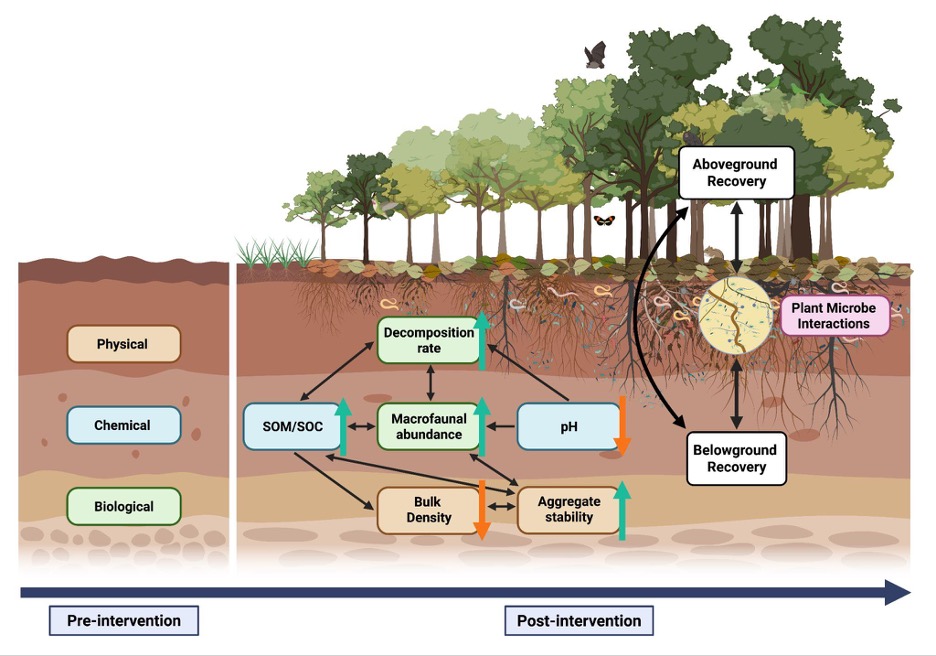
From Toro and Werden et al. 2025 – Conceptual diagram of the importance of the status of soil properties pre-intervention in tropical forest restoration projects, and the six key dynamic soil indicators we suggest measuring. The black arrows represent known links among soil indicators and between soil properties and above- and belowground recovery processes. The color arrows indicate the expected direction of change: green arrows for increases and orange arrows for decreases. Recovery is also shaped by the reestablishment of plant-microbe interactions, which mediate feedback loops between vegetation and soil processes.
A simple way to get started
As part of our paper we also developed some recommendations for practitioners to start implementing belowground monitoring:
When to sample: Before restoration begins, set a baseline, then measure every 5 years or more frequently if possible.
Where to sample: The top 10 cm of soil captures most early changes.
How many samples: 5-10 cores per plot usually gives a reliable average.
How to report: Use standard units so your data can be compared across sites and integrated into broader monitoring efforts.
Other measurements: If you already measure above ground recovery indicators, keep doing that. Some aboveground patterns offer clues about what’s happening below, but in many cases, especially for soil carbon or microbial activity, what you see aboveground doesn’t tell the full story.
Why below recovery matters for restoration
Understanding soil recovery has immediate practical implications for understanding restoration outcomes. Healthy soils speed up seedling establishment, improve drought resistance, and support robust carbon storage that can make tropical forest restoration a viable natural climate solution. But soil recovery can also help projects make better management decisions in real time.
If bulk density measurements reveal severe compaction, you could adjust your species selection to favor deep-rooted trees that can help break up hardpan layers. If organic matter is low, you could experiment with compost additions or mulching. But, without measuring this belowground information at the outset and as your project progresses, these management decisions can become educated guesswork.
An invitation to what’s next
Through the SNAPP Monitoring Restoration Effectiveness (MoRE) working group, we’re now building a collaborative network that connects researchers with practitioners on the ground. Among other things, our goal is to develop straightforward protocols for monitoring belowground indicators. These protocols will be tested in real-world conditions and adapted based on feedback from practitioners. We’re also compiling longitudinal data from any tropical restoration project that has measured an indicator of below- or above-ground recovery for a global synthesis that aims to develop best practices for restoration monitoring.
If you’re working to refine your tropical soil monitoring practices, or if you just generally want to get involved, we’d love to hear from you.
Take our questionnaire on monitoring practices – Here
Learn more about our data synthesis – On our website
J. Leighton Reid is an Associate Professor of Ecological Restoration in the School of Plant and Environmental Sciences at Virginia Tech.
The acid test of ourunderstanding is not whether we can take ecosystems to bits on pieces of paper, however scientifically, but whether we can put them back together in practice and make them work. Anthony Bradshaw, 1987
Ecological analyses in the Choco region are greatly complicated by the inadequacy of the taxonomic data base. Alwyn Gentry, 1986
In northwestern South America there is a long, thin strip of rain forest that stretches from western Ecuador through Colombia to eastern Panama. This area, known as the Chocó, contains some of the wettest rain forests on Earth, with certain areas receiving more than 11,000 mm (433 inches) of rain each year. The Chocó is isolated from the Amazon basin by the Andes, and as a result many Chocoan species are found nowhere else. Despite its relatively small size, the Chocó is home to about 3% of the world’s vascular plants and 63 endemic bird species. Morespecies are described each year.
A few Chocoan endemic species. (A) Amalophyllon miraculum(Gesneriaceae) – so called because it is a miracle that this little forb has survived in the tiny fragments of Chocó rain forest left in the Centinela near the city of Santo Domingo. This species co-occurs there with another Gesneriaceae, Gasteranuthus extinctus, so named in the early 1990s because it seemed inevitable that rapid and comprehensive deforestation in this region would cause its extinction. Photo: John Clark. (B) Little devil poison dart frog (Oophaga sylvatica) – individuals in a population just one hillside to the north are a completely different color. Photo: JL Reid. (C) Long-wattled Umbrellabird (Cephalopterus penduliger) – a beloved and much-studied disperser of surprisingly large seeds. Photo: Luis Carrasco. (D) Banded Ground-Cuckoo (Neomorphus radiolosus) – one of the rarest and most endangered (and most spectacular) birds in the Chocó. Photo: Murray Cooper. (E) Piedrita (Exarata chocoensis, Schlegeliaceae) – a canopy tree with very coriaceous leaves and one of the last species discovered by Alwyn Gentry before his untimely death in western Ecuador in 1992.
Although the Chocó rain forest has been relatively well preserved on the west slope of the Andes and in lowland Colombia, the section in lowland Ecuador is mostly gone. More than two thirds (68%) of lowland northwestern Ecuador has been deforested to make space for cattle pastures, oil palm plantations, and cacao plantations. Federally protected areas have had mixed success in preventing or reversing this decline. The Cotacachi-Cayapas Ecological Reserve in the higher elevations of the western slope is still about 99% forested, while the Mache-Chindul Ecological Reserve in the lower coast range retains only 61% of its forest.
Historical (left) and current (right) forest cover in the Ecuadorian Chocó. Source: Monitoring of the Andes Amazon Program (MAAP): https://www.maapprogram.org/choco/.
Several non-profit organizations are working to shore up protection of the remaining forest and ensure an evolutionary future for Chocoan biodiversity. One of these is the Foundation for the Conservation of the Tropical Andes (FCAT), an Ecuadorian non-profit committed to achieving durable Chocoan biodiversity conservation in collaboration with local residents and scientists, who call themselves the FCATeros. To advance their mission, the FCATeros are researching local ecosystems and socio-ecological systems, building bioliteracy through youth education, developing local capacity for science and conservation, and helping local farmers diversify their income through regenerative agriculture. FCAT is also purchasing land for conservation and to connect remaining forest fragments, with a goal of conserving 10,000-hectares (~25,000 acres) to sustain healthy populations of Chocoan plants and animals. They have already acquired 700 hectares (~1700 acres) – a mix of primary rain forest and regenerating agricultural lands.
FCATeros are local scientists and conservationists working tirelessly to understand and defend the Ecuadorian Chocó. (A) Jorge Olivo fires a nylon cord into the canopy of a piedrita tree to hang a camera trap and observe which animals disperse its seeds. Photo: JL Reid. (B) Domingo Cabrera presses a leaf and preserves fruits and seeds of Clavija eggersiana – a threatened and endemic Primulaceae. Photo: JL Reid. (C) Darwin Zambrano, Alex Gualan, Gregory Paladines, Thalia Duenas, and Cesar Munoz outplanting seedlings of a rare and recently described endemic species, Cedrela angusticarpa (Meliaceae), described this year by Walter Palacios and colleagues.
Some of the degraded land within the FCAT Reserve is regenerating quickly into secondary rain forest. This is particularly the case in areas that were deforested recently and retain many remnant trees, a seed bank, and resprouting tree stumps. Other areas were deforested longer ago and were used more intensively for cattle grazing and cacao production. These areas have more compacted soils, fewer remnant trees, and introduced African forage grasses that inhibit native tree regeneration. As the reserve expands, FCAT will need cost-effective ecological restoration techniques to fill gaps between forest fragments.
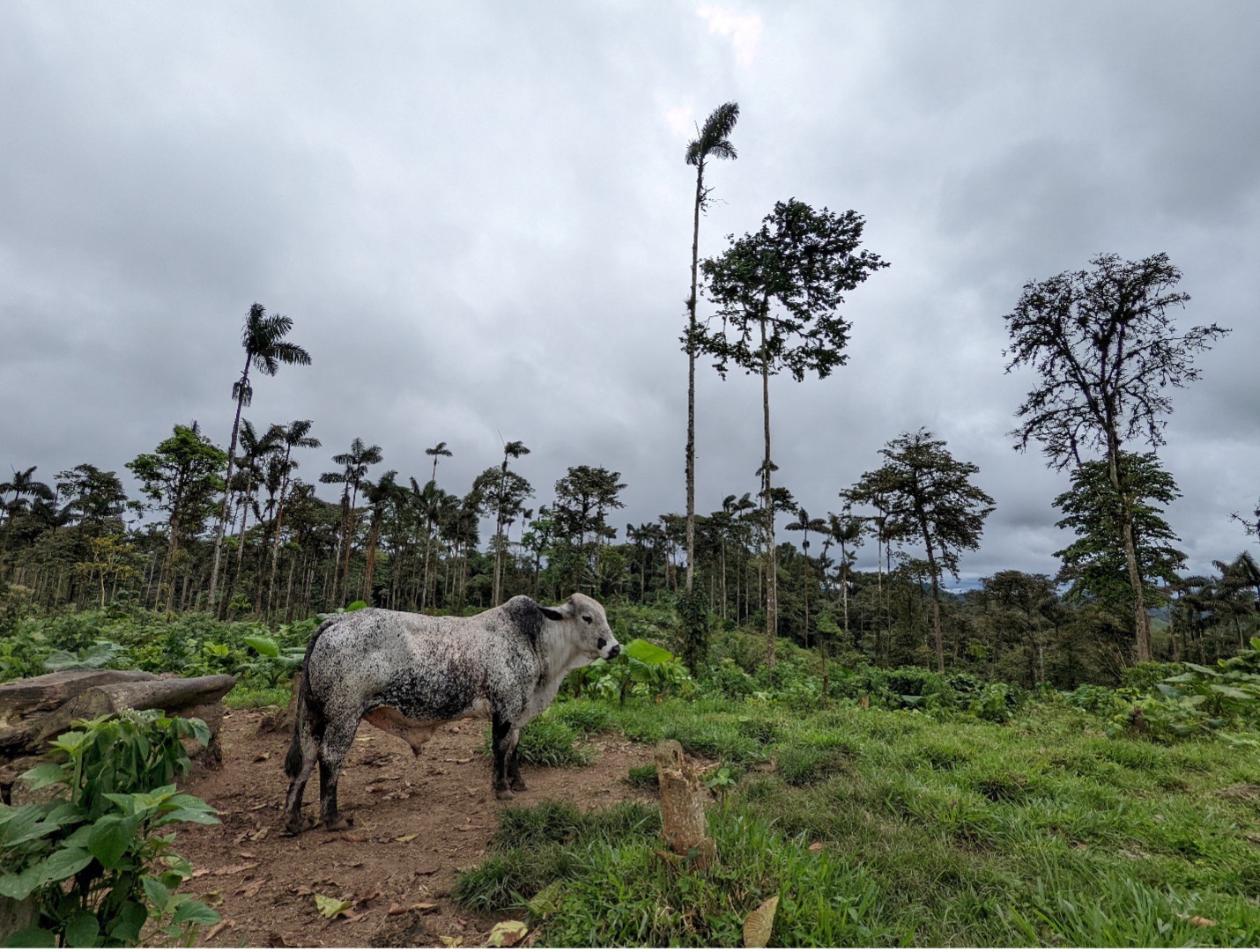
A soon-to-be-evicted bull standing amidst remnant trees and tree stumps in a recently deforested pasture in the FCAT Reserve. This area is naturally regenerating quickly. Photo: JL Reid.
The Choconexión Experiment
In 2021, FCAT invited me to help develop a restoration strategy to meet this need. We formed a collaborative local and international team of scientists and conservationists to recommend restoration strategies for about 80 hectares (~200 acres) of degraded agricultural land. For roughly two thirds of the land (the less-degraded part), we recommended a natural regeneration approach; cattle were removed and the area was allowed to regenerate without further intervention. On the remaining and more degraded area, we developed an experimental restoration study to identify a cost-effective strategy for FCAT to apply on other degraded lands. In doing so, we also took the opportunity to test a basic theory about how ecological communities assemble themselves.
Patches of pasture cleared with weedwhackers and glyphosate to prepare them for tree planting at the FCAT Reserve. Tree planting positions are marked with bamboo stakes. Photo: JL Reid.
For our restoration experiment, we chose a technique called applied nucleation, which mimics the patchy spatial patterning of natural forest regeneration. Applied nucleation is intermediate between natural regeneration and more extensive native tree plantations. I studied this method for my PhD research in southern Costa Rica, where over more than 20 years we have found that applied nucleation produced more biodiverse secondary forest more consistently than natural regeneration, and it produced nearly equivalent biodiversity recovery compared to more extensive tree plantations for about 1/3-1/4 the cost. At FCAT, we sought to test applied nucleation in the Chocoan context and to optimize some of the tree planting parameters – including how many species to plant, which particular species to plant, and how widely to space the tree planting patches.
Choconexión Project experimental design. Each plot is 125×125 m (1.65 hectares, ~4 acres). The aerial imagery was produced with a drone in April 2023. It shows (in negative) the tree planting patches, or islands, cleared within the degraded pasture.
In 2022-2023, FCAT installed the experiment by clearing pasture grasses and planting more than 3,000 native tree seedlings into 116 15×15-m plots (roughly 50×50 feet). Native trees were all of which were harvested as seed from mother trees in the surrounding landscape and propagated in hand-made nurseries at the FCAT field station. In half of the plots, we planted 19 tree species, and in the other half we planted four species to test the influence of tree diversity on forest recovery. Tree planting plots were separated from one another by either 10, 20, or 30 m to test the optimal spacing. We assumed that planted trees would be able to extend their branches to fill a 10-m gap within a few years, but that it would take many years for them to fill a 30-m gap.
Experimental treatments and planted species in the Choconexión Project. In each of the large treatment plots, only one type of tree planting composition is used.
Finally, in half of the plots we planted three fast-growing pioneer tree species that we knew would produce a lot of fruit, and in the other half of the plots we planted fast-growing trees that would not produce much fruit, either because they were wind-dispersed or because their fruits were not appealing to most animals. We built this test into the experiment because the vast majority of plants in western Ecuador have seeds that are dispersed by animals. We thought that if we planted trees that quickly produce many fruits, these trees would attract fruit-seeking animals that would visit the sites more often and deposit plant seeds from the surrounding rain forest. If we are right and that effect is strong enough, it might be possible to plant fewer trees or a lower diversity of trees and have animals compensate by planting more trees (and other plants) for us. This would save FCAT money and allow us to reforest larger areas or put more funds into land acquisition and other mission-driven activities.
Yellow-throated Toucan (Ramphastos ambiguus) in a Cecropia tree in lowland Costa Rica. Cecropias produce protein-rich fruits (right) that hang pendulously from beneath its large leaves and are available to fruit-eating animals of all sizes. We hypothesize that restoration plots planted with Cecropias, figs, and rubber trees will recover biodiversity and carbon faster than plots planted with other species that produce less desirable fruits. Photo: JL Reid.
By creating differences in early successional fruit availability, this experiment also represents a basic test of how the first trees to establish in a rain forest influence the types of trees that establish later. In other words, it is a test of priority effects in rainforest reassembly.
There are four high-level processes that determine which species will gain membership in a local ecological community. These are dispersal, selection, drift, and speciation. In many parts of the world, environmental selection imposes strict limits on which species can live in a given place. For example, there is no woody plant that can tolerate the combination of freezing temperatures and inundation in salty water. Thus, mangroves exist only in the tropical and subtropical latitudes and herbaceous salt marsh plants occupy similar environments closer to the poles.
Mark Vellend’s Theory of Ecological Communities posits that environmental selection, ecological drift, dispersal, and speciation are the four high-level processes that determine which species will gain membership in local ecological communities.
It is possible to make very good predictions about the kinds of plants that will form a local community if you know: (A) the traits of the plants in the community, (B) the relationship between those traits and a set of important environmental variables, and (C) the values or ranges of the important environmental variables at a local site. However, these models work best in places with relatively harsh environments, such as boreal wetlands and arid mountain ranges. Predicting rainforest community assembly is harder because the abiotic environment is more benign (generally warm and wet), and as a result, the particular species that arrive and survive may be more strongly determined by biotic gradients – potentially including fruit availability.
A tree planted island in the Choconexión Project in June 2024. After two years of growth, some of the balsa (Ochroma pyramidale) were already 21 cm (8.2 inches) in diameter. A young fig and cecropia are visible in the bottom left; these two species are expected to begin fruiting soon. This plot backs up to a living fence composed mostly of Erythrina berteroana; these and other pre-existing trees have been mapped throughout the experiment. In this part of the experiment, tree planting patches are separated by 10 m (32.8 feet); the tops of the balsas in the adjacent patch are visible at right. Photo: JL Reid.
As of October 2025, the Choconexión Project has been planted for 2-3 years (it was planted in two rounds in 2022 and 2023). Most species survived well (82% overall, range ~40-95%) and those that did not survive are being replanted. Some of the balsa are more than 10 m (32 feet) high after two years of growth, and a fig species (Ficus tonduzii) has begun to produce fruit. This year we will develop tree phenology and fruit availability protocols to characterize the effects that experimental treatments are having on the biotic environment.
A growing number of collaborators and students are monitoring a wide range of ecological variables within the experiment. Last year, an expert botanist, Milton Tirado, established a baseline of the initial woody plant community at 192 points throughout the experiment. Others have also described gradients in soil quality, identified and tagged remnant trees, produced LiDAR data from a flyover at the start of the experiment, and generated annual orthomosaics with a drone. Monitoring is underway for birds, frogs, and other wildlife. Studies have also begun to measure secondary seed dispersal and recovery of the plant-frugivore network. In addition, the experimental landscape is being used for several other projects, including studies of caterpillar predation risk, volatile organic compound composition, and bat disease ecology, among others.
An air sample collector built by Gabrielle Isaacman-VanWertz to collect samples for volatile organic compound (VOC) analysis. This summer two Tulane undergraduates conducted a pilot study to determine how well common VOCs like ethylene predict the abundance of ripe fruit and over what spatial scale. If effective, such detectors could be used to systematically monitor ripe fruit abundance across the experiment. Photo: JL Reid.
In the next few years, we plan to replicate this experiment in additional sites and to develop protocols to measure plant and animal functional traits, abiotic environmental gradients, and seed rain. These will allow us to rigorously test how much more information about rain forest reassembly can be gained when dispersal-mediated priority effects are considered in addition to environmental filters.
More importantly, the results of this experiment will provide pragmatic and timely information to FCAT and others working to preserve the Ecuadorian Chocó. By refining and optimizing applied nucleation designs for this unique landscape, we will make limited conservation funding go farther to restore trophic and landscape connectivity in the fragmented Mache Chindul Ecological Reserve.
A mixed-use landscape in the Mache Chindul Ecological Reserve, where FCAT seeks to re-establish ecological connectivity with a RAMSAR wetland, the Laguna de Cube. Photo: JL Reid.
The Choconexión Project is a collaborative effort that involves too many partners to fully enumerate. The experiment was co-designed by Zak Zahawi, Jordan Karubian, Luis Carrasco, and Carlos Aulestia, with support from many others. Carlos led the reforestation with a team of FCATeros. The restoration was funded by the US Fish and Wildlife Service to provide overwintering habitat for Neotropical migratory songbirds. Subsequent ecological monitoring is funded by the US National Science Foundation (DEB 2339839). Some of the graduate students who have worked on the experiment include Nicole Lussier (birds and bird-plant networks), Sebastián Aparicio Vera (tree seedling performance), Holden Jones (frogs), Phoebe Reuben (bats and their diseases), and Mareli Sanchez (soil). All of the scientific work performed within the Choconexión Experiment has been permitted by MAATE.
In the Midwestern United States, oak woodlands are a diverse ecosystem characterized by tree densities intermediate between open grassland and closed-canopy forest. These woodlands are typically dominated by oaks (Quercusspp.), forming a single layer of overstory trees with a few scattered hardwoods like hickories (Carya spp.) and elms (Ulmus spp.) throughout. The midstory layer is sparse, but the herbaceous understory at ground level is dense and highly diverse. The loosely scattered oaks create canopy gaps with ample sunlight that provide habitat for sun-loving prairie species such as wild bergamot (Monarda fistulosa), as well as shaded areas containing forest species like bluestem goldenrod (Solidagocaesia). Some plants in oak woodland understories, like heart-leaved skull cap (Scutellariaovata) and starry campion (Silenestellata) are specialists uniquely adapted to these patchy conditions. This variation in canopy cover produces a remarkably unique and species-rich ecosystem where dozens of plant species can exist within just a few square meters.
Somme Woods, Forests Preserves of Cook County, is a beautiful, restored oak woodland that clearly shows the single layer of canopy trees, with a diverse and vibrant herbaceous understory community.
Oak woodland species heart-leaved skull cap (Scutellariaovata) adapted to the dappled and patchy sunlight found in this ecosystem.
Starry campion (Silenestellata) are adapted to the dappled and patchy sunlight found in this ecosystem.
Once widespread, the occurrence of open woodlands has been significantly reduced due to human expansion and land use changes. The oak woodlands that remain have been radically altered by factors such as fire suppression and invasion by non-native shrub species. Oak woodlands now typically exist in a degraded state, with closed, dense canopies of non-oak trees such as maples (Acer spp.), a dense shrub layer of non-native species, and an almost absent understory. As a result, many of the species in woodland understories are threatened or already missing from the landscape.
Ecological restoration aims to recover biodiversity by returning oak woodlands to a structure more similar to what was found before degradation. Restoration efforts often include a combination of techniques, but an important component is the removal of undesirable trees, particularly non-oak trees, to open the canopy and reintroduce the gradients of light that were once a vital part in maintaining diversity in the woodland understory. As a graduate student in Plant Biology and Conservation at Northwestern University and the Chicago Botanic Garden, my PhD thesis examines the importance of these gradients of light and the role that a changing canopy structure plays in the restoration of plant biodiversity in oak woodland understories. My three graduate research projects investigate 1) how understory plant diversity changes with canopy cover over multiple decades of management, 2) how canopy cover and addition of native species with seed mixes interact to influence understory diversity, and 3) how shading and order of arrival shape competitive dynamics among understory herbs.
Project 1.
I first wanted to understand how shifts in woodland canopy over the last thirty years have affected understory composition and diversity. Did increases or decreases in canopy coincide with changes in the diversity (i.e., number) of plant species in the understory? Further, were there other factors that might have influenced this relationship between canopy and the understory? To address these questions, I used data collected by the Illinois Natural History Survey’s Critical Trends Assessment Program. This dataset included 120 woodland sites scattered throughout Illinois. Botanists have meticulously surveyed these sites every five years for the past thirty years. During each survey, they recorded detailed information such as all plant species in the canopy, midstory and understory. With this dataset, I was able to build statistical models that characterize the relationship between changes in canopy and changes in the diversity of species in the woodland understory over the last thirty years.
I found that as forest canopies became denser, the diversity of plant species in the understory declined. In contrast, when woodland canopies opened, similar to what often occurs during restoration, understory plant diversity tended to increase. However, that increase in diversity wasn’t always guaranteed. It was most pronounced when non-native shrub species in the midstory were either absent or present in very low numbers. In contrast, sites with a high occurrence of non-native shrubs were less likely to experience increases in diversity with canopy opening. This has important implications for how we approach tree removal in oak woodland restoration. It suggests that opening the canopy is most effective at boosting understory diversity when non-native shrubs are managed first. This study also reveals thirty years of canopy closure and resulting loss of species diversity in the understory, highlighting the urgent need for interventions that restore the canopy structure required to support this diverse ecosystem.
Project 2.
Recognizing that canopy structure can profoundly influence understory diversity, I set out to explore how canopy openings might interact with our other restoration practices in oak woodlands. I was particularly interested in whether canopy openings influenced understory diversity in oak woodlands undergoing native seed additions, just as they would in woodlands without such interventions. Native seed additions are commonly used in restoration efforts to reintroduce species that have been lost from the landscape and to help overcome dispersal barriers imposed by habitat fragmentation. However, while native seeding is widely used to increase diversity and cover of native species, these seeded restorations may behave differently than restorations without native seed additions. It is possible that environmental factors such as light availability become less influential in driving diversity when species are being deliberately reintroduced as part of the restoration process.
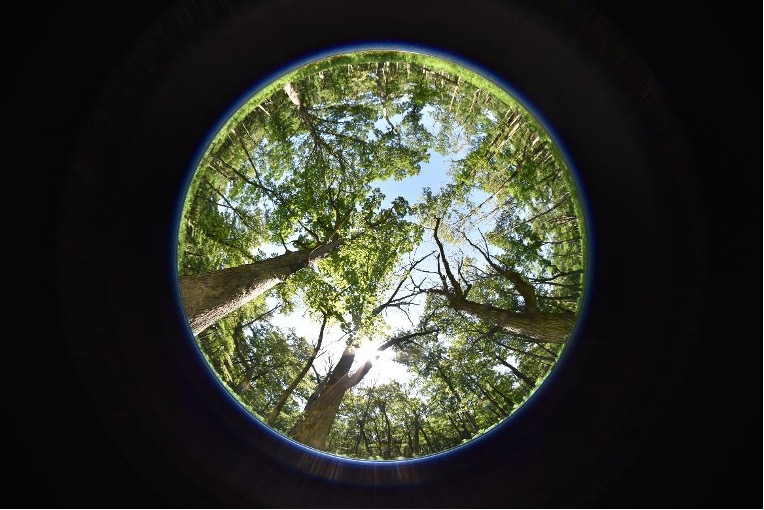
To address this possibility, I conducted surveys across seven woodland restorations sites in the Forest Preserves of Cook County, Illinois. These included both sites that had received supplemental seeding and those that had not. I used 1 m2 plots to systematically identify and record the ground-layer plant species, measuring how much of the understory each one covered. I was seeking to get a clear picture of the diversity, that is how many species there were in each plot, as well as the cover of each species. In total, I identified roughly 170 species. I also took hemispherical photographs with a fish-eye lens and digital camera. This allowed me to measure how open the canopy was above each plot and gave me a good understanding of how much light was reaching the understory plants.
A birds-eye view of one of the 1 m2 plots used to survey the plants in the understory of seven restoration sites in Cook County, Illinois. Northwestern University student intern, Kyndall Hadley, with a survey plot and the digital camera set-up used to capture hemispherical photos in the field. A hemispherical photo captured above a survey plot. These photos were then processed with a software package specifically designed to calculate metrics of canopy openness.
I found, once again, that the canopy was important for driving dynamics in the understory. Canopy openness was positively associated with the cover of native species, meaning that areas with more open canopies had a higher cover of native plants. However, the relationship between canopy openness and the diversity of native species depended on whether the site had been seeded. In restorations that had not received seed additions, it seemed that native diversity increased with more open canopies. However, in seeded restorations, canopy openness had no clear effect on native diversity. The reasons for this pattern aren’t entirely clear, but it’s useful to recognize that seeded restorations may respond differently to canopy openings compared to unseeded ones. This underscores the need for further research into how various restoration strategies, particularly the use of native seed additions, influence plant diversity in woodland understories.
Project 3.
Finally, I wanted to explore how light availability might shape the way plants compete with each other in restored woodland understories. Competition, which can have negative effects on plants, occurs when they try to capture the same essential resources, such as light. In ecology, it is typically thought that the more resources there are in an environment, the stronger the competition between species will be. Thus, plant competition in woodlands may depend on how much light reaches the understory. To complicate things, the order in which species ‘arrive’ and have access to that light can also have a strong influence on competition between species. Referred to as priority effects, a species that arrives early—by dispersing, germinating, and beginning to grow before the other—may gain a competitive advantage.
To better understand how plants compete in woodlands, I tested whether competition was stronger with more light and whether arriving early gave species an advantage. I set up an experiment with 180 pots, each containing twelve native plant species commonly used in woodland restoration. These plants competed under three light levels, and I varied the order in which they arrived. The results were striking. Competition had the strongest negative impact on plant growth when light was abundant. I also found that when a species arrived twenty-four days before its competitors, it performed much better than when all species arrived at the same time. Interestingly, this early-arrival advantage was even more pronounced under high-light conditions compared to low light. Overall, this work helps us better understand the factors that shape species growth and success in woodland restorations. With this knowledge, we can continue improving restoration strategies that support diverse, resilient oak woodland ecosystems.
Twelve species were planted together in a single pot so I could measure competition. I also manipulated the order that each species arrived in the pot. This picture was taken when the final plants were added to the pot. There were a total of 180 of these pots throughout the whole experiment.
I used shade cloth to manipulate light in my competition experiment.
Here, you can see the moderate (30% shade) and low (80% shade) light treatments .
Here, you can see the high light treatment (no shade cloth).
Harvest Day! At the end of the growing season, I, with the help of some awesome interns, harvested each plant growing in these pots, separated them by species, dried them and then measured their biomass. This helped me calculate how competition affected each species’ growth under different conditions.
Together, these studies reveal how crucial canopy structure is for shaping plant diversity in oak woodlands. Light availability not only influences diversity and native cover but also mediates competitive interactions and priority effects. As restoration practitioners work to restore and protect biodiversity in this threatened ecosystem, understanding the complex interplay between canopy trees and understory diversity will be vital. My research highlights that while canopy thinning is a necessary tool to restore biodiversity in woodlands, there are areas to refine our knowledge and approaches to this restoration practice. In doing so, we can better ensure long-term resilience of oak woodland ecosystems and the many diverse species they support.
Results from the three studies will soon be submitted for publication to peer-reviewed journals. For questions about this research, please contact Rory at rschiafo@u.northwestern.edu.
Katalin Török and Melinda Halassy are restoration ecologists specializing in sandy grasslands in Central Hungary. Katalin focuses on botany, ecology, and biodiversity monitoring. Melinda, formerly Katalin’s student, took part in their first restoration experiment and is likely Hungary’s first PhD in restoration ecology. Their research aims to identify barriers to spontaneous restoration and analyze long-term ecological processes triggered by various restoration methods to find the most effective approaches. Both contribute to international ecological research (eLTER) and restoration policy (SERE), working to link scientific knowledge with public policy in ecological restoration.
KIskun LTER Restoration Experiments site is located in a unique sandy landscape of central Europe. Situated at the center of a vast sandy region, the core area of Kiskunság National Park represents one of the largest of its kind in Central Europe, spanning approximately 7,400 square kilometers. This unique environment is especially accessible near the village of Fülöpháza, where visitors can experience an impressive range of sand dunes. The landscape features both open sand steppes and wind-blown dunes, offering a rare glimpse into one of the continent’s most distinctive and unusual natural habitats. Credit: Melinda Halassy, CER2021
The ecosystem
One of Hungary’s most distinctive geological regions is the Danube–Tisza Interfluve (Kiskunság), which is an important reservoir of biological diversity within the Pannonian Biogeographical Region of Europe. Situated at the westernmost edge of the vast Eurasian forest-steppe biome, this region is part of a bioregion that extends approximately 9,000 km from Central Europe to Eastern Asia, covering more than 4.7 million km² (Erdős et al. 2022). The Eurasian forest-steppe represents Hungary’s dominant vegetation type, covering more than half of the country. Although the grasslands in this zone are sometimes misinterpreted as being heavily deforested in historic times, ecological models that integrate climate variability, topography, soil conditions, herbivory, and natural fire regimes reveal that forests and grasslands naturally coexist in a dynamic mosaic within the forest-steppe zone (Erdős et al. 2022).
The largest and most ecologically diverse areas of the region preserve the characteristic ”puszta“, which includes both sandy and alkaline grasslands, sand dune forests, and remnants of former sodic pans, marshes, fens, fen meadows, and wet grasslands. The inland sand dunes, shaped by wind action, consist of coarse-textured, lime-rich soils that are low in water and nutrients, supporting unique vegetation, including specialist plant and insect species. The sandy forest-steppe of the “puszta” consists of poplar-juniper sand dune forests and thickets, as well as open oak-dominated woodlands forming complex mosaics with both open and closed sand grasslands, all of which are considered habitats of high conservation concern by the European Commission. The driest grasslands in the region, known as ”Festucetum vaginatae danubiale“ community, are found on the crests and southern slopes of sand dunes. These grasslands are characterized by tussock-forming grasses such as the endemic grass Festuca vaginataand the protected Stipa borysthenica, interspersed with cryptogam cover of mosses, ferns, lichens, etc. and frequent patches of bare ground.
Sandy Forest-Steppe Mosaic of the Puszta: Poplar-Juniper Stands and Open Sand Grasslands. Dominated by White Poplar (Populus alba), this landscape reflects the natural vegetation adapted to arid, sandy conditions. Credit: Evgeni Dimitrov, eLTER 2023
Throughout the 19th and 20th centuries, the landscape underwent significant human modifications, beginning with river regulation and drainage, followed by agricultural intensification and plantation forestry. As a result, the region is now predominantly covered by agricultural lands, forest plantations, and fragmented remnants of semi-natural grasslands. During the post-socialist transition (1987–1999), large-scale agricultural land abandonment occurred, particularly in low-productivity areas such as the Kiskunság (Valkó et al. 2016). While some native vegetation regenerated spontaneously, abandoned lands also became increasingly susceptible to invasion by non-native species. One of the most problematic invaders is Black locust (Robinia pseudoacacia), a fast-growing, nitrogen-fixing hardwood tree from eastern North America, which has spread extensively. Another notorious example is Common ragweed (Ambrosia artemisiifolia) that we will discuss below. The expansion of invasive species not only threatens native biodiversity and ecosystem health but can also have negative impacts on human health.
Land abandonment presents a valuable opportunity for the spontaneous regeneration of native sandy grasslands, it also introduces significant ecological challenges. One of the most pressing threats to natural recovery is the aggressive spread of invasive alien plant species, particularly Common milkweed (Asclepias serica, formerly A. syriaca). Credit: Melinda Halassy, CER 2021
Restoration experiments
For the past 27 years, we have been conducting restoration experiments at the Kiskunság Long-term Ecological Research site to facilitate the recovery of sandy grasslands on lands degraded by Black locust plantations and arable cultivation. Our research focuses on the long-term effects of various treatments aimed at overcoming barriers to spontaneous grassland regeneration, assessing the positive and negative influences of the surrounding landscape, and enhancing invasion resistance through seed-based restoration.
Our findings indicate that active restoration interventions can significantly accelerate recovery. Specifically, sowing a mixture of locally sourced grass and forb species has proven to be the most effective method for initiating restoration in dry grasslands and controlling invasive species (Reis et al. 2023). Additionally, carbon amendments and mowing can serve as valuable complementary measures; however, they should be applied cautiously in invaded landscapes to avoid unintended ecological consequences (Reis et al. 2022).
Seeding Native Species: A Key Strategy for Restoring Sandy Grasslands. In the restoration of dry sandy grasslands, sowing a carefully selected mixture of locally sourced grasses and forbs has emerged as the most effective strategy for initiating vegetation recovery and suppressing invasive species. Although remnants of native sand grasslands remain in the landscape, their specialist species show limited natural dispersal capacity. As a result, abandoned agricultural fields are often colonized by weeds and invasive alien plants, which significantly hinder the process of secondary succession. Research has shown that even the low-rate seeding of as few as five native species can have a catalytic effect, facilitating the establishment of characteristic grassland communities and accelerating the recovery of degraded former croplands. Credit: Melinda Halassy, CER2021
The success of restoration efforts is further challenged by the presence of other aggressively invasive species beyond Black locust, including the tree of heaven (Ailanthus altissimus) and the herbaceous Common milkweed (Asclepias serica (formerly A. syriaca), which are particularly widespread in forest plantations (Csecserits et al. 2016). Even after the removal of dominant invasive species, new invasions may occur, likely due to legacy effects and the high dispersal capacity of these non-native species (Reis et al. 2023). To mitigate these negative impacts, restoration efforts should prioritize areas with lower invasion pressure or integrate early seeding of native species as a complementary strategy for invasion control (Csákvári et al. 2023, Halassy et al. 2023).
Managing Invasive Species: The Limitations of Mowing in Invasive Species Control. Mowing is widely used as a method to control the spread of invasive alien species. However, experience indicates that mowing alone often fails to deliver satisfactory results. This is largely due to the persistent legacy effects of previous invasions and the limited natural dispersal capacity of native grassland specialist species. While mowing can effectively suppress certain targeted invasives, it does not prevent secondary invasions—the establishment of other non-native species that quickly occupy the disturbed space. To ensure successful and lasting restoration, mowing must be combined with the active introduction of native species, which can stabilize the ecosystem and reduce vulnerability to further invasions. Credit: Márton Kállai 2023
Restoration – human health links; research in progress
Enhancing public health through ecological restoration efforts can be of significant importance. Ecosystem services and direct contact with nature may contribute to this improvement (Millennium Ecosystem Assessment 2005, Marselle et al. 2021), but robust evidence is needed to establish clear links between biodiversity, ecological restoration, and human health at landscape, regional, and national scales.
In Hungary, a national project has recently been launched to investigate these nature–health connections using ecosystem condition maps and health data (https://termeszetem.hu/en). This initiative aims to identify correlations between environmental factors and various health indicators, such as the prevalence of allergies, depression, autoimmune and inflammatory diseases, and self-reported well-being. The research focuses on detecting these relationships at the sub-regional scale and in urban areas, as well as assessing the economic impacts of health conditions. A key initial focus of the project is the highly allergenic Common ragweed (Ambrosia artemisiifolia), which poses significant public health challenges throughout Europe and elsewhere.
Restoration as a Tool to Combat Common Ragweed and Its Public Health Impact. Abandoned croplands provide favorable conditions for the establishment and spread of Common ragweed (Ambrosia artemisiifolia), a highly invasive species known for its allergenic pollen. This plant poses a growing public health threat across Europe and beyond. In 2015 alone, ragweed allergy adversely affected the health of an estimated 13.5 million people in Europe, resulting in public health costs exceeding €7.4 billion (US$8.1 billion). Common ragweed thrives in open, disturbed soils, making abandoned agricultural lands particularly vulnerable to colonization. However, as natural vegetation succession progresses and plant cover becomes denser, ragweed populations tend to decline. This succession process can be significantly accelerated through active ecological restoration, which helps close vegetation gaps more quickly, thereby limiting the window during which ragweed can release its pollen and spread. Credit: Anikó Csecserits, CER 2020
Battling Common ragweed – for ecosystem and human health
Successes so far with reducing invasion of Common ragweed (Ambrosia artemisiifolia) are noteworthy. For starters, note that the disservices of Common ragweed are already serious and likely to get worse throughout Europe since its allergenic pollen affects one in ten people throughout the European continent. Schaffner et al. (2022) estimate that the health of 13.5 million people was adversely affected in 2015 by Common ragweed allergy in Europe alone, generating 7.4 billion euros (8.1 billion US$) in public health costs. Happily, our ecological restoration interventions have already demonstrated their effectiveness in battling this noxious annual weed (Fig. 1).
Figure 1. The decrease of cover of the highly invasive, and allergenic, common ragweed (Ambrosia artemisiifolia), under three different restorative treatments and control. The figure shows the pooled data of three experiments that included mowing (Reis et al. 2021), carbon amendment (Halassy et al. 2021) and seeding (Reis et al. 2023) between 1995 and 2019. Carbon amendment through addition of sucrose and sawdust reduced available N-levels in the soil. Mowing was carried out twice a year, and was followed by removal of dry plant biomass.
The successful reduction of Common ragweed invasion serves as a promising example of how ecological restoration can yield measurable benefits for human health. The new national-scale study aims to provide evidence-based insights into the potential interconnections between ecosystem health and human well-being. These findings could help inform policy decisions related to land management and restoration efforts not only in Hungary but also in other regions.
A potential next step is to investigate links between ecosystem conditions and asthmatic diseases. By analyzing data on general practitioner and specialist visits for asthma-related complaints, as well as the purchase of asthma-specific medications, we can correlate health trends with different ecosystem states across temporal and spatial scales (Nitschke et al. 2022). This approach will allow us to assess the broader health impacts of ecological restoration.
Moving forward, we plan to deepen our research on the relationship between ecological restoration and human health by collaborating with the Ecological Health Network and its member sites and hubs working on similar challenges. We believe that participation in an international social impact network will not only advance our research but also enhance its value and real-world impact.
Dr. Pablo Friedlander, Director of Acción Serrana has initiated and led pioneering restoration and intercultural education projects in Argentina, Brazil and Spain for more than two decades. He also organizes ethnobotanical research and expeditions to the Amazon and the Andes. pablofriedlander@gmail.com
Biologist Romina Torre is the executive coordinator of Acción Serrana, with ten years of experience in mountain restoration, research and educational activities involving rural communities, health practitioners and scientific institutions at bioregional and international levels. torre.romina@gmail.com
Introduction to the Polylepis forests
In the highest mountains of South America, remnants of vast stands of so-called cloud forests dominated by members of the beautiful Rose-family genus Polylepis are found throughout the Andes Cordillera, from Colombia and Venezuela to northern Chile and northwestern Argentina. In addition, in the much older Sierras Grandes de Córdoba, in central Argentina, the endemic Polylepis australis (locally known as Tabaquillo), occurs in scattered fragments of once extensive mid-altitude forests. At the continental scale, the canopies of these open, moist formations, or what remains of them today, comprise 45 recognized species and constitute the highest altitude forests on Earth (Boza Espinoza & Kessler 2022). Sadly, their range and integrity has been drastically reduced by logging, burning, and overgrazing since the 16th century, especially with the introduction of European cattle.Their moss- and lichen-covered branches collect fog, while their roots prevent erosion and regulate water runoff. These forests also contribute to climate change mitigation, by favoring carbon sequestration, and they support diverse endangered species dependent on these habitats. In all seven of the Andean countries where they occur, the restoration and conservation of these cloud forests is of vital importance to local communities and to protect. the headwaters of the main rivers and creeks (del Campo & Friedländer 2023).
This locally famous ‘Grandfather’ Tabaquillo (Polylepis australis) tree grows in the heart of one of the last remaining cloud forest fragments in Córdoba province.The Argentina anole, Pristidactylus achalensis, is an endemic lizard of the Pampa de Achala.
The hand-shaped Polylepis leaves and the soft, multi-layered bark of the trees, draped with epiphytes, mosses and lichens, collect fog and give rise to the compelling and accurate image of the forest “milking” the omnipresent mist and clouds. At a continental scale, these cloud forests when they are healthy and thriving contribute to the ‘biotic pump’ connecting the Andes- the Amazon-and the Atlantic Forest biomes (Beveridge et al. 2024) and regulating water and climate cycles and reducing the risk and severitry of wildfires. The savannas and cloud forests The recent increase of forest fires in all biomes of South – and Meso- and North America – demands more strategic and intercultural, public-private coalitions to increase restoration areas and protection of basins at multiple spatial scales for present and future generations (Argañaraz et al. 2015; Argibay & Renison 2018). Additionally, Polylepis roots and their mutualistic microorganisms retain and enrich soils. They also provide a ‘framework’ for regenerating forest communities undergoing active or assisted restoration. Indeed, when mature, these emblematic forests harbour very high biodiversity, including many endemic species of epiphytic orchids, insects, birds and reptiles, and also provide a wide range of ecosystem services to people at multiple spatial scales. Finally, they have huge cultural significance, and by working in synergy with local communities we aim to introduce and sustain biocultural as well as ecological restoration.
Conserving and Restoring the cloud forests with Acción Serrana and Acción Andina
In 2002, the project “Milking the Clouds” (Ordeñando Nubes, in Spanish) was launched, along with other local grassroots initiatives. Then, after a long learning curve in restoration methods and typical pioneering struggles, the five interrelated projects gradually scaled up their ‘footprint’ and their impact to a bioregional level over the next decade and a half. A big step was taken in 2018 when, together with the ECOAN (Asociación Ecosistemas Andinos) and Global Forest Generation, Acción Serrana was set up as a hub including 5 different local organizations to help in the launching of “Acción Andina” as a a new international ecocultural restoration consortium. In that context, Acción Serrana is now managed by the Fundación de Actividades Biosféricas as part of Acción Andina.
Currently working in Peru, Ecuador, Colombia, Bolivia, Chile and Argentina, with 23 member institutions, Acción Andina partners have planted more than 7 million Polylepis trees, of many different species, and this number is rising each year, as is the success rate of the plantings. In 2023, Accion Andina received the prestigious Earthshot Prize, and in 2024 we were named one of the 7 UN World Restoration Flagships for the UN Decade on Ecosystem Restoration 2021-2030.
Map of the 12 Acción Serrana restoration sites in the Sierras Grandes de Córdoba.
The 12 biocultural restoration areas in the Sierras Grandes of Córdoba under Acción Serrana management add up, at the time of writing, to a total of 3,170 fenced hectares.
The reforestation and restoration campaigns are made possible by 65 permanent staff members and over 1,500 volunteers per year on average. To date, we have produced and planted more than 860, 000 Polylepis australis nursery-grown saplings in consecutive seasons (see https://ecohealthglobal.org/network-sites/accion-serrana-argentina/). All of these trees were grown from seeds collected locally in each of the planting areas managed by the five different partnering organizations or local implementing groups For the 2024-2025 October 2024 to March 2025 planting season, 250,000 trees were propagated in the 29 plant nurseries we maintain, and at the time of writing most of the plantings have been very successful. Since 2023, Accion Serrana has been helping to replicate the same initiative in Northwestern Argentina, with the Project Arbol y Vida in Jujuy Province (in cooperation with various high-Andean communities) and the Germinar Project in Tucuman Province (working with Diaguita communities of the Tafi del Valle bioregion), advising on and synergizing actions and application of techniques and strategies. In addition to this biocultural restoration, another critical line of work is our environmental education program being run in local schools and municipalities for more than a decade already.
The ecosystems of Acción Serrana areSub-Andean and Chaco serrano forests and grasslands(sensu Cabrera 1976), composed of seasonally dry forests or open woodlands with 4 different altitudinal belts in the central Argentina mountain ranges, Sierras Grandes de Córdoba (Giorgis et al. 2011). The land tenure of the areas under restoration inside the Provincial Watershed Reserve of Pampa de Achala, which consists of private landholdings subject to Provincial Management & Conservation plans, or public protected áreas within the National Park Quebrada del Condorito. The numerous activities we carry out include: maintenance and fencing of new areas, native forest tree and shrub seed collection, construction and improvements of nurseries, germination of seedlings, transplanting of seedlings to reusable plastic forest tubes, high mountain transfer of seedlings to the planting areas and their planting in the intervention areas during the rainy season. We establish permanent plots for scientific monitoring and we support research carried out in the intervention areas. Workshops, public talks and training programs are also organized yearly to train and recruit more enthusiastic and qualified citizen restorationists for the work in the mountains.
Acción Serrana team planting the native Polylepis australis of Córdoba province.
Implementation of Acción Serrana with local partners in reciprocity
We work to generate ecological, economic, social and cultural sustainability by reaching agreements with landowners, communities, networks and institutions (municipalities of Mina Clavero and Villa de Las Rosas, the Ministry of Education of the Province of Córdoba, and others).
To help with the local matching needed to be part of the Acción Andina initiative, Acción Serrana had set up the Ayni Plan (“ayni” meaning “reciprocity” in the quechua language of the Andes). Basically this implies the commitment to generate 30% of operating costs through specific fundraising campaigns and by other quantified means. For example the constant one of inviting the public to participate by donations of the costs required for producing a forest (25 trees under monitoring), a tree or a volunteering activity. Then we promote the reception of donations of funds, lands, tools, materials, vehicles, etc.. In addition, we encourage ecotourism with a schedule for each area: summer plantations and seeds, winter transplanting of seedlings and fencing of restoration areas. Acción Serrana aims to increase reciprocity and abundance also throughout the different courses and events both virtual and in-person, and some special community parties, with raffles, concerts, talks, video screenings, and promotion of crowdfunding campaigns. Currently we are running our international matching crowdfunder campaign with the help of the Treeangle Foundation from the United Kingdom, as we have done each year from 2012, to complete the mission of this season January 2024 – March 2025. (See video here.)
In the years ahead, Acción Serrana will propagate and plant a wider variety of native trees and shrubs in pursuit of a Framework species approach to restoration such as that being tested by EHN partner Daniel Perez and his team in Caviahue, Patagonia (Perez et al. 2019; see also here and (here). As a new initiative, we aim to deploy 30% of funds raised to reintroduction of multipurpose Neltuma (formerly Prosopis) species and other framework species in lower altitudes of the mountain system, and 70% to ongoing Polylepis restoration in the high mountains. This year, we have begun studying how to propagate the obvious additional choices of “framework species” namely Maiten (Maytenus boaria), Escalonia (Escallonia cordobensis) and Molle (Lithraea molleoides).
Escallonia cordobensis a formerly common shrub now considered key to restoration.Co-dominant Maytenus boaria and Polylepis australis ‘giants’.
Next steps
Following decades of reforestation and cloud forest restoration, we are working with Indigenous inhabitants in these mountains, including the Comechingones (Henia and Camiare tribes) and Sanavirones peoples, who have been historically marginalized. We are cultivating intercultural bridges (Rojas et al. 2025) in áreas like nursery propagation, environmental education, and llama and alpaca reintroduction and ancestral practices of weaving with camelid wool. This collaborative framework aims to integrate and restore key zones around the Ansenuza Sea, Traslasierra Valley, Pampa Achala, and Pampa de Pocho.
In January 2025, Acción Serrana became a new member hub of the Ecological Health Network, following two fruitful visits from James Aronson. These visits facilitated knowledge sharing and collaboration, furthering our core purpose of scaling up watershed restoration, enhancing environmental education, and deepening intercultural collaboration for research projects. By integrating ecological, social, and economic perspectives and approaches, we aim to share our regenerative experiences across mountains, jungles, deserts and oceans within a quickly growing international network of networks. We are delighted to be part of this movement and consortium with a strong, clear set of values and shared purpose – something we all need to cultivate in these critical times. As a meaningful next step of Acción Serrana, we look forward to participating in multi-site research projects based on the simultaneous monitoring and evaluation of a series of ecological and human health indicators in areas undergoing biocultural restoration protocols. Through these efforts, we are committed to enhancing ecosystem health and strengthening our relationship with nature, ensuring the longevity and health of Andean cloud forests and lower buffer zones of Chaco serrano forests -as well as the local communities living there for generations to come.
The Mount Desert Land & Garden Preserve’s mission is to conserve and share the beauty of our historic lands and gardens, which it does by managing three historic gardens and approximately 1,400 acres (567 ha) of natural land on Mount Desert Island, Maine for ecosystem health. Also, as needed, we undertake restoration interventions, particularly in our post-agricultural meadows.
Mount Desert Island (‘MDI’, ~60,000 acres, 24,280 ha) is well known for its breathtaking, rugged coastal scenery and for holding the largest unit of Acadia National Park (~30,500 acres, 12,343 ha), one of America’s earliest (1916) and most visited (~4 million visitors/year) national parks. The two other units of Acadia National Park include part of Schoodic Peninsula (2,366 acres, 957 ha) and part of Isle au Haut (2,900 acres, 1,200 ha). The Garden Preserve’s natural lands are directly adjacent to Acadia National Park and mirror it ecologically; both are covered by spruce-dominated hills (primarily red spruce, Picea rubens), streams and wetlands.
Acadia National Park (shown in green on map) comprises three primary units. Mount Desert Island is home to the park’s largest unit. The yellow star shows the location of the Land & Garden Preserve’s natural lands (1,400 acres, 567 ha). Map courtesy of US National Park Service.
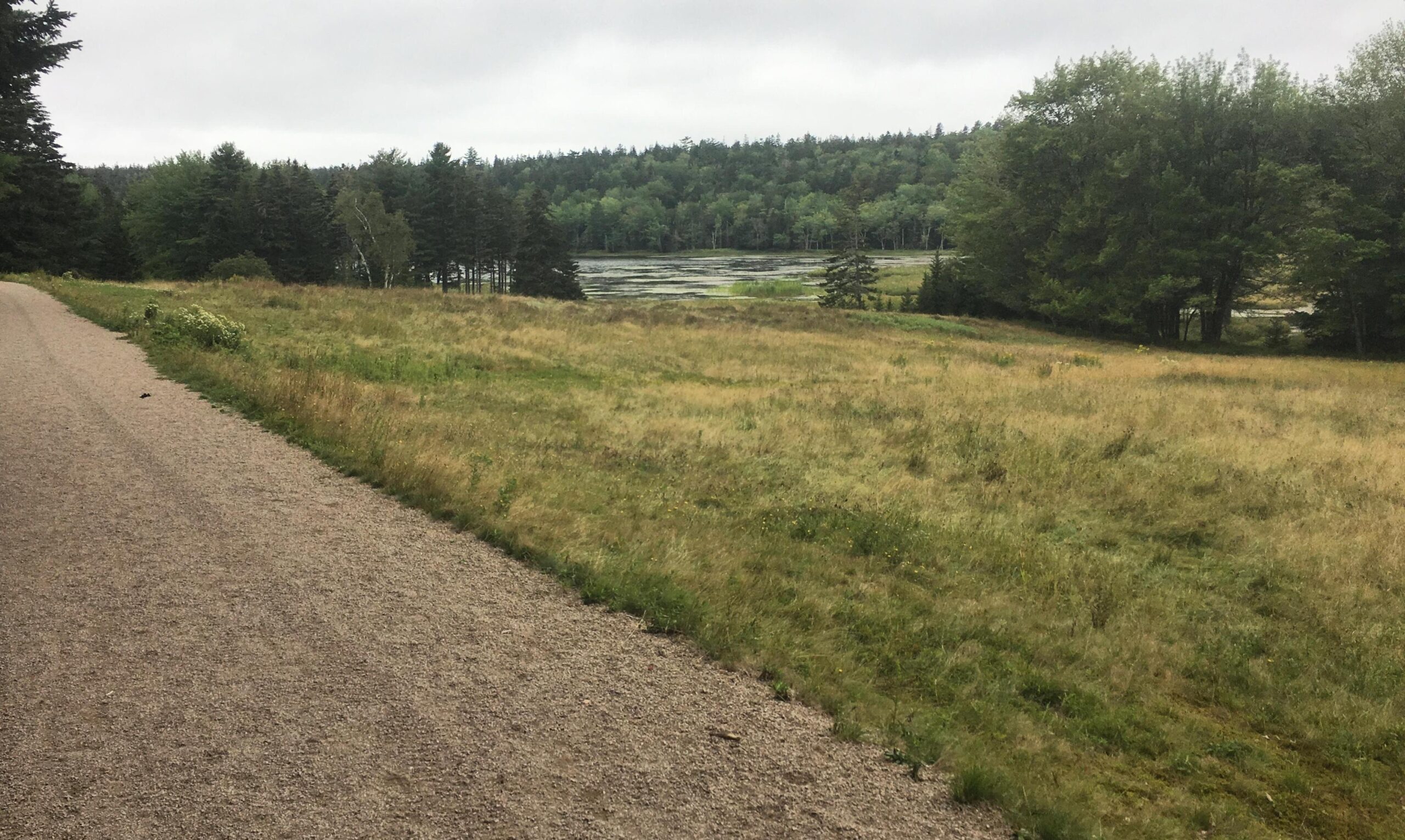
As the Land & Garden Preserve’s Director of Natural Lands, I am charged with conserving the ecological integrity of the natural lands while ensuring safe public access. Our ten miles of trails and ten miles of carriage roads see over 75,000 visitors per year. A twenty-acre, post-agricultural meadow sits at the heart of the natural lands, and from the nearby carriage road the meadow provides picturesque views of the surroundings, making this a popular destination for walkers, dog walkers, horseback riders, and bird watchers.
A ‘carriage road’ sits next to the 20-acre meadow. Because of its views, this road is a draw to thousands of walkers and nature enthusiasts. (This and all other photos are by the author unless otherwise indicated.)
I have focused management on Garden Preserve’s meadow because early successional habitats are uncommon on Mount Desert Island (Acadia National Park manages less than 100 acres of upland meadows on MDI) and because of the presence of invasive glossy buckthorn (Frangula alnus), invasive reed canary grass (Phalaris arundinacea), and some other weedy, nonnative plants. To establish a firm understanding of the plant community I commissioned a wonderful field botanist to conduct a survey of the meadow’s vascular plants (completed in 2020). From 2019-2021 we eradicated the canary grass from three monoculture patches (totaling 2,500 ft², 232 m²) and began restoring the area left behind. We have used a 130-year-old dataset – Flora of Mount Desert Island, Maine, published in 1894 – to better understand changes in the meadow’s plant community, and help us select a plant species list for our ecological restoration work. I also visited approximately 15 different meadows – ranging from 2-60 miles (3.2 km – 97 km) away – to develop a loose reference system. The goal of this restoration work was to 1) ensure long term eradication of reed canary grass and, 2) establish an enduring native plant assemblage that could provide habitat and other ecosystem benefits to the meadow’s fauna. I began with a conservative approach to ‘native’ and selected species according to this hierarchy:
MDI>Hancock County>Maine>New England. Most species we use in this restoration naturally occur in Maine.
Aerial photo of a portion of the Land & Garden Preserve’s meadow. Two patches of invasive reed canary grass are visible: center left (with hole in middle of patch), and center (some soil is exposed). Once the grass was eradicated, we restored the areas with native plants. Photo credit: Allison Bourke.
The 1894 Flora of Mount Desert Island, Maine by Rand and Redfield
The Champlain Society was a group of scientifically minded Harvard students who, starting in the early 1880’s, dedicated their summers to learning and documenting MDI’s natural history. Student Edward L. Rand headed up the society’s botanical studies and, along with John C. Redfield, published the Flora of Mount Desert Island, Maine in 1894. The flora is incredibly comprehensive, including nearly 1,500 species of vascular plants, marine algae, bryophytes, and lichen. Remarkably, MDI represents less than 1% of the state of Maine’s land area but supports more than half of its known plant species (Greene et al. 2005).
Members of the Champlain Society at their summer campsite on Mount Desert Island, 1880. These students from Harvard University summered on MDI starting in 1880 and documented the island’s natural history. Photo credit: Mount Desert Island Historical Society.
The 1894 Flora has proven to be a reliably accurate reference for late 19th century plant life on MDI. For example, by reviewing the herbarium vouchers, Greene et al. (2005) concluded that less than 45 taxa were misidentified. As a natural resource professional, this 285-page book serves me as a priceless reference. I even found an original copy signed by the authors in the Garden Preserve’s library!
Old datasets of this breadth, accuracy and credibility are rare, and therefore extremely valuable to understanding how plant communities change over time. When you compare the ‘Flora of Mount Desert Island, Maine’ (1894) to the contemporary ‘Vascular flora of Acadia National Park region, Maine’, (2005) as MacKenzie et al. (2019) did, you can see just how much has changed in approximately 120 years. They report that between 1894 and 2005, 15.8% of the original species are no longer found on MDI, 34.4% declined in abundance, 30.4% experienced no apparent change in abundance, 19.4% increased in abundance, and there were 205 new plant species in 2005.
In their 1894 Flora, Rand and Redfield left us wonderful notes about each taxa’s abundance, special occurrences and locations, which I’ve used to reconstruct something of an 1894 Flora for the Garden Preserve’s meadow (albeit incomplete). For example, many entries include location names where large populations of that taxa could be found, and location names such as ‘long pond meadows’ (the old name of our meadow), ‘Seal Harbor’ (the village where the meadow is found), ‘road to Jordan Pond’ (approximately ½ mile from meadow) provide a direct link to the Garden Preserve’s meadow of the 1880’s. To show how prevalent this anecdotal data is, ‘Long Pond meadows’ is included in 30 taxa entries and ‘Seal Harbor’ is included in over 100 taxa entries.
Where Rand and Redfield did not provide location names, I use their notes on habitat (e.g., ‘fields’, ‘meadows’, ‘open areas’) and abundance (e.g., ‘common’, ‘frequent’, ‘rare’), and what I personally know about these species’ habitats to infer which taxa were found in 1894 at or around the Garden Preserve’s meadow. For example, the entry for New York aster (Symphyotrichum novi-belgii) includes ‘Abundant everywhere in both wet and dry ground’ (pg. 115). Therefore, although Rand and Redfield did not tell us that New York American aster was found at the Long Pond meadows, I can assume that it was.
When I compared my 2020 meadow survey (340 taxa) to the list I recreated from Rand and Redfield’s 1894 Flora, I found that at least nine native forbs were likely present in the late 19th century but are no longer found on or around the Garden Preserve’s meadow. I call these ‘historic’ species. There are more than nine historic species, but for the purposes of this article, I only discuss the taxa considered for meadow restoration. The nine historic forbs I have identified are:
Although I conclude that these species are no longer found in our meadow, they have not been extirpated from Maine. For example, I see Anaphalismargaritacea growing on roadsides on MDI, and I infrequently see Eupatorium perfoliatum in Acadia National Park. Likewise, I see large swaths of Symphyotrichum lanceolatum on the mainland, just three miles from MDI. Other Symphyotrichum species were more difficult to find, but they still turned up when I searched similar meadows approximately 30-60 miles from MDI.
Natural resource professionals can be apprehensive by nature because we fear the slow creep of local species extinction. We understandably get nervous when our data reveal that we lost at least nine forbs in a 130-year span. The reasonable question becomes: ‘With viable populations of these historic species nearby, should we include these in our ecological restoration efforts’?
Using ‘historic’ species in meadow restoration efforts
Starting in 2021 we decided to incorporate eight of the nine ‘historic species’ into our meadow restoration efforts (Virginia virgin’s bower requires different habitat characteristics and was used elsewhere), via two different methods: 1) planting pint and quart-size live plants, and 2) seeding (with associated seed bed preparation). These eight historic species were among a larger group of approximately 25 species, all of which are native to Maine and/or New England and found in similar early successional habitats.
The author monitors the germination of native plants at a restoration site, August, three months after seeding. The site was formerly dominated by invasive reed canary grass. Photo credit: Christa Little-SieboldRestoration site, June, in its second growing season. We used a seed mix of twenty native species (13 forbs, 7 graminoids).Restoration site, August, in its second growing season.
The Mount Desert Land & Garden Preserve operates a propagation facility to support the needs of our three gardens, and the propagation staff enthusiastically grows native plants from seed for our restoration projects on the natural lands.
Staff propagator waters her plants in the Land & Garden Preserve’s propagation facility. Photo credit: Cassie Banning.
While obtaining the seed for the historic species, I employed a ‘local is better’ mindset regarding provenance. I collected seed from populations on MDI where possible, then as near as possible thereafter. Where I couldn’t collect the seed for a given species myself or obtain wild-collected seed from a trusted colleague in Maine, I purchased seed from the Wild Seed Project (Portland, Maine). Some of the asters were only available through larger, Midwestern nurseries such as Prairie Moon Nursery (Minnesota).
A pint sized wavy-leaved aster ready for planting in a meadow restoration site that was formerly dominated by invasive reed canary grass.
The only consistent impediment to historic plant reintroduction and establishment that we have observed has been deer browse, which impacted six of the eight species.
Staff planting native plants in a restoration site.
The National Park Service’s ecologists conducted forest health assessments in Acadia National Park, 2006-2013, and found that forest health is relatively good, and that deer abundance is within the carrying capacity of the park (i.e. tree regeneration is sufficient). In fact, for both of those metrics, the forests of Acadia National Park scored better than the seven other National Park forests in their ‘Northeast Temperate Network’ study. Acadia National Park’s forests may not be experiencing the detrimental effects of deer browse that many other forests in eastern USA are (yet), but my work in the Garden Preserve’s meadow suggests that forb diversity in early successional habitats is – at least in part – influenced by deer. Ask any gardener or farmer in the northeast USA, and they will agree that deer are an issue.
In New England, white tailed deer abundance has risen and fallen in response to landscape-scale land use changes since European colonization. The 1890’s saw the lowest historic deer population in the United States (only 350,000 animals). It is very likely that the flora documented by Rand and Redfield in the late 1800’s thrived in a period of low deer abundance, which allowed some of these more deer palatable historic species to survive.
White tailed deer browse on New England aster in a meadow restoration site. Notice that the terminal shoot has been chewed off.
It’s not currently realistic to manage the deer herd on the Garden Preserve’s natural lands so I have experimented with planting some of the deer-palatable historic species in areas that deer are less likely to access, such as behind pre-existing fences and near buildings and other structures. I have had good success with this.
This fence was erected to manage human and dog traffic entering a pond, but we have since used it to deter white tailed deer from browsing historic species.Here we are using historic species joe-pye weed (pink flowers) and boneset (white flowers) behind a fence where deer cannot reach it. In the absence of deer browse, both species have flourished.Virginia’s virgin bower, an historic species no longer found on Land & Garden Preserve’s natural lands. Here, we use the vine on a fence where it has space and support to grow and spread.
At the Garden Preserve, we are not attempting to recreate past ecological conditions. Incorporating some historic species into our meadow restoration would be nice if it were possible, but I am keeping an open mind going forward regarding which plants we promote versus which plants we try to remove. We have experimented with some (native to Maine) species not currently found on MDI or in the county. So long as deer browse remains an issue, we may need to use plant species that are not native in the strictest sense, and I personally feel comfortable with that. Our restoration work is benefitted by partnering with others in the Northern Appalachian/Atlantic Maritime hub of the Northeast Seed Network.
Eve Allen, Program Director for the Northeast Bioregion, James Aronson, President, and Sefra Alexandra, Educational Coordinator of the Ecological Health Network, share their trip report from a recent visit to Canada’s National Tree Seed Center (NTSC) in June 2024. (In collaboration with Melissa Spearing, Seed biologist, Mary Knockwood, Indigenous Seed Program Coordinator, and Lucie Lavoie, Coordinator and Senior Forester of the NTSC).
In Memory of Melissa Spearing
We dedicate this post to the loving memory of Melissa Spearing, our friend and devoted Seed Biologist at the National Tree Seed Centre, who graciously hosted our visit and played a key role in organizing it.
Melissa’s career was marked by a profound commitment to tree seed conservation. Her work in the collection, storage, and study of seeds from across Canada ensured the preservation of the country’s diverse tree species for future generations. Her contributions to the Centre’s research were invaluable, and her passion for advancing conservation and climate research was unwavering. Her sudden passing on August 19, 2024, has deeply affected all who knew her, both professionally and personally.
As many have shared, Melissa was not just a colleague or mentor but a dear friend to many in the seed conservation community. She was a proactive networker, working to build bridges between the Centre’s work in Atlantic Canada and our efforts in the Northeastern U.S. We are deeply saddened by her passing, yet profoundly grateful for the time we shared with her—experiencing her warmth, enthusiasm, generosity, and the passion she brought to her work. Like all who knew her, we have been significantly touched by her life and the enduring impact she leaves behind.
Melissa Spearing demonstrating tree seed collection at the “Seed Forecasting Walk & Trailer Tools,” workshop with the National Tree Seed Centre Staff at the Huron-Wendat nations Ekionkiestha’ National Longhouse in Wendake, Quebec Canada – during the Two-Eyed Seeing Seed Collection Workshop at the Society of Ecological Restorations RE3 {Reclaim | Restore | Rewild} Conference. June 10th 2023. Credit: Sefra Alexandra
Purpose of the Trip
In June 2023, at the Society for Ecological Restoration’s RE3 Conference in Quebec City, we connected with leaders from Canada’s National Tree Seed Centre (NTSC) during a Two-Eyed Seeing Seed Collection workshop they hosted. We shared a mutual interest in staying connected, as the Northeastern U.S. and Atlantic Canada together form a crucial ecological and cultural transition zone.
We made the trip one year later to visit our friends at the NTSC, Mellisa Spearing, Seed biologist, and Mary Knockwood, Indigenous Seed Program Coordinator, with the goal of testing the waters and appetite in this region to develop a regional hub of the Northeast Seed Network to serve and promote synergy in southern Québec, New Brunswick, Nova Scotia, and Prince Edward Island, as well as Maine, Vermont, New Hampshire, and upstate New York. A possible name for the hub is the Northern Appalachian/Atlantic Maritime Hub.
This region bridges temperate woodlands and boreal forests and is part of the smaller yet globally significant “Northern Appalachian-Acadian Wabanaki Ecoregion,” which holds high ecological and cultural value from a social-ecological perspective. A binational, biocultural consortium called Two Countries One Forest exists already, and EHN and the NTSC would like to work together. Fortunately, there are no significant legal or political challenges when it comes to sourcing or shipping seeds for research or use. A phytosanitary certification can be obtained through the Canadian Food Inspection Agency or the USDA’s Phytosanitary Certification Issuance and Tracking System (PCIT).
Overview of Canada’s National Tree Seed Centre
Canada’s National Tree Seed Centre (NTSC) is the principal national resource for forest seed science and conservation in the country. Located in the Atlantic Forestry Centre in Fredericton, New Brunswick, the center was established in 1967 by the Canadian Forest Service. Initially, the NTSC focused on collecting, storing, and providing native tree seeds of known origin primarily to support the timber industry in Canada. Over the past five decades, this mandate has broadened to include the conservation of genetic resources threatened by invasive pests, pathogens, and climate change.
In 2020, the NTSC underwent a significant renewal to enhance efforts to grow and maintain healthy forests in Canada as a viable economic sector and an effective strategy to address climate change. For example, in 2021, the Government of Canada committed CAD $3.2 billion to establish partnerships to plant two billion trees over ten years, aiming to ‘tackle the dual crisis of climate change and biodiversity loss.’ A 2023 press release reported that the project had exceeded its planting goals and now was intending to plant 56 million more. This project is just one among many ambitious undertakings for which the NTSC is at the helm.
The NTSC’s core function is seed collection management, encompassing the collection, processing, testing, documentation, and storage of seeds from tree and shrub species across Canada. Melissa Spearing organized a phenomenal tour of the facilities, which included a visit to the central laboratory with attached processing rooms, freezers that house seed collections, and cryopreservation storage, as well as greenhouses and on-site nursery installations. The NTSC also maintains an extensive digitized and readily accessible seed collection database.
The Atlantic Forestry Centre is a campus of innovation. Behind each door is an impressive array of machinery for seed cleaning, assessment, preservation, and research operated by enthusiastic teams of scientists and technicians. This centre is tackling the major issues that threaten the tree and shrub diversity of the varied landscapes of the ten provinces and three territories of Canada. Upon our arrival, the halls were bustling with a young, excited seed collection team, assembling their gear to head out on a week-long expedition for plant materials gathering to be safeguarded in the growing ex situ collections. The state-of-the-art greenhouses are propagating germplasm for utilization in restoration projects, and the surrounding grounds are teeming with pollinators dancing through the willows (Salix spp.) trials designed to determine which willow species thrive best for application in improving degraded soils. The dynamic atmosphere is fast-paced, and professional and instills an air of optimism in the face of the massive climate challenges facing the fields and forests of this country.
Overview of Canada’s National Tree Seed CentreStrengthening Indigenous Leadership in Seed Conservation
As mentioned above, while seed collections at the NTSC have predominantly focused on tree species of economic importance to Canada, the center is now placing a stronger emphasis on non-commercial tree species, particularly those of high significance to Indigenous Peoples. Through its Indigenous Seed Collecting Program, the NTSC is advancing Indigenous engagement and inclusivity to help meet Canada’s Two-Billion Tree program objectives (2BT).
In a 2023 press release, Natural Resources Canada confirmed that “Since 2021, the 2BT program has supported 179 tree-planting and capacity-building projects from coast to coast to coast. Ninety percent of these projects planted more than two types of trees, and one in five projects were Indigenous-led. Over 220 species were planted at more than 2,900 sites across Canada.”
Mary Knockwood, the Indigenous Programs Manager, shared how supporting Indigenous leadership and inclusion in seed conservation is the second priority in the NTSC Strategic Plan for 2021-2031, following the goal of supporting the two billion tree program with knowledge mobilization and capacity building. The NTSC recognizes Indigenous Peoples as the original caretakers of ecosystems across Turtle Island (North America) and the earliest seed collectors, processors, and distributors. This grassroots initiative, spearheaded by Indigenous communities nationwide, gathers and conserves tree seeds that hold economic value as well as significant cultural, spiritual, medicinal, and ecological importance to the Indigenous communities engaged in this work. Mary explained in a Simply Science article, “seed collection is important for our forest as it is important to the future of Mother Earth and all the creatures living upon her. It helps not only preserve flora species but also preserve the language, culture, and traditions of our Indigenous partners.” The program began with Mi’kmaq communities in Atlantic Canada, and as word spread, community interest grew. Today, over sixty Indigenous communities and organizations throughout the country are participating. The NTSC holds multiple-day-long workshops where Indigenous citizens come to share their knowledge and learn about seed conservation. To date, 56 field training sessions across Canada and seven lab training sessions at the Atlantic Forestry Centre have provided free training to over 200 members representing 70 Indigenous communities nationwide.
The National Tree Seed Centre regularly tests the viability of stored seedlots to ensure they can be germinated when needed for research or recovery programs. Credit: Sefra Alexandra. Over 1,900 Ash (Fraxinus spp.) seedlots are safeguarded in the -20 Celsius long-term storage seed bank at Canada’s National Tree Seed Centre, including backup collections from the USDA Fort Collins gene bank. This is part of a North American-wide effort to preserve the native species of Ash against local or global extinction from the accidentally introduced Emerald ash borer, Agrilus planipennis. Credit: Sefra Alexandra.
Strengthening Indigenous Leadership in Seed Conservation
As mentioned above, while seed collections at the NTSC have predominantly focused on tree species of economic importance to Canada, the center is now placing a stronger emphasis on non-commercial tree species, particularly those of high significance to Indigenous Peoples. Through its Indigenous Seed Collecting Program, the NTSC is advancing Indigenous engagement and inclusivity to help meet Canada’s Two-Billion Tree program objectives (2BT).
In a 2023 press release, Natural Resources Canada confirmed that, “Since 2021, the 2BT program has supported 179 tree-planting and capacity-building projects from coast to coast to coast. Ninety percent of these projects planted more than two species of trees, and one in five projects were Indigenous-led. Over 220 species were planted at more than 2,900 sites across Canada.”
Mary Knockwood, the Indigenous Programs Manager, shared how supporting Indigenous leadership and inclusion in seed conservation is the second priority in the NTSC Strategic Plan for 2021-2031, following the goal of supporting the two billion tree program with knowledge mobilization and capacity building. The NTSC recognizes Indigenous Peoples as the original caretakers of ecosystems across Turtle Island (North America) and the earliest seed collectors, processors, and distributors. This grassroots initiative, spearheaded by Indigenous communities nationwide, gathers and conserves tree seeds that hold economic value as well as significant cultural, spiritual, medicinal, and ecological importance to the Indigenous communities engaged in this work. Mary explained in a Simply Science article, “seed collection is important for our forest as it is important to the future of Mother Earth and all the creatures living upon her. It helps not only preserve flora species but also preserve the language, culture, and traditions of our Indigenous partners.” The program began with Mi’kmaq communities in Atlantic Canada, and as word spread, community interest grew. Today, over sixty Indigenous communities and organizations throughout the country are participating. The NTSC holds multiple-day-long workshops where Indigenous citizens come to share their knowledge and learn about seed conservation. To date, 56 field training sessions across Canada and seven lab training sessions at the Atlantic Forestry Centre have provided free training to over 200 members representing 70 Indigenous communities nationwide.
NTSC Coordinator Donnie Mcphee demonstrating cut testing for potential seed quality in the field with members representing Grand Conseil de la Nation Waban-Aki in Odanak, Québec with National Tree Seed Centre Coordinator Donnie Mcphee demonstrating cut testing for potential seed quality in the field with Laurentian Forestry Centre Frank Grenon Chief of Forestry Science, Luc Nolet Odnak First Nation, Nicolas Pinceloup representing Grand Conseil de la Nation Waban-Aki in Odanak, Québec. Credit: Mary Knockwood.
The concept of Two-Eyed Seeing (Etuaptmumk in the Mi’kmaq language), articulated and popularized by Mi’kmaq Elder Albert Marshall, is integral to the program. It involves combining the strengths of Indigenous knowledge with those of Western science and technology, using both perspectives together. In Marshall’s words, “Two-Eyed seeing refers to learning to see from one eye with the strengths of Indigenous ways of knowing and from the other eye with the strengths of Western ways of knowing and to using both of these eyes together” (Bartlett, Marshall, & Marshall, 2012, p. 335).” This dual approach forms the foundation of the program. Mary Knockwood emphasizes that Two-Eyed Seeing is about merging not just two methodologies but also two different ways of knowing and worldviews. The same idea is expressed with similar phrases from Indigenous cultures in Australia, Aotearoa/New Zealand, South America, and elsewhere. It is clearly a concept that holds critical importance for moving our global society from an extractive to a restorative culture (Cross et al. 2019).
We note that the Indigenous Peoples of Canada have a long history of seed collection, storage, and use, and NTSC staff are learning from this rich knowledge base while also co-learning and integrating Western scientific practices with traditional ways and wisdom. Concurrently, Indigenous partners are adopting aspects of Western science to enhance their traditional methods, thereby improving processes, extending storage times, and increasing seed viability.
The Indigenous Seed Collection Program aids in Canada’s reconciliation efforts with Indigenous Peoples by fostering deeper collaborations through community partnerships. As Donnie McPhee, Coordinator of the National Tree Seed Centre, explained: “At its core, the ISCP is a mutual network of knowledge sharing amongst Indigenous communities from coast to coast to coast. Different communities are working together and building a network, giving value to what they’re protecting.” The Indigenous Seed Collection Program is designed to listen to the needs of the Indigenous communities and provide training courses to help them reach their goals.
Conservation of Ash Species
The conservation genetics of North American Ash trees (Fraxinus spp.) provide a prime example of how the NTSC’s Indigenous Seed Collection Program is working to preserve cultural and ecological keystone species found in the forests of Canada and for some of them in much of the Eastern United States as well.
Young stand of Fraxinus nigra (Black ash) trees in New Brunswick on Peskotomuhkati lands near the Maine border. Photo credit: Mary Knockwood.
For the past 20 years, the NTSC has worked with a wide variety of collaborators to collect and bank viable seed of all five Ash species native to Canada: 1) Fraxinus americana (White ash); 2) Fraxinus nigra (Black ash); 3) Fraxinus pennsylvanica (Green ash), 4) Fraxinus profunda (Pumpkin ash), and 5) (Fraxinus quadrangulata (Blue ash). Their efforts to preserve native Ash from decimation by the relentless Emerald Ash Borer are especially focused on Black ash, which is of particular importance to Indigenous communities and is the species most at risk of all the native species.
Mary Knockwood explains, “Indigenous Peoples, such as the Mi’kmaw, Wolastoqey, Peskotomuhkati, in the Atlantic who are part of the Wabanaki Confederacy, all the First Nations part of the Haudenosaunee Confederacy, as far west to Manitoba and the Anishinaabek peoples have used and continue using Black Ash to this day. The importance of this species is not only for baskets, but it also carries a spiritual, traditional, and medicinal value to all of these groups. It is also a significant species to many of the Wabanaki Confederacy as it plays a significant role in many of our creation stories.” These trees are integral to their cultural practices, notably in the creation of black ash splint baskets of many designs and uses. Over dozens of generations, these communities have acquired extensive knowledge of locating ash trees, nurturing their growth, and using them for both practical and artistic purposes. Ash trees also play crucial roles in providing materials for firewood, snowshoes, tools for hunting and fishing, canoe paddles, lumber, and various additional types of baskets and woven containers.
Fraxinus nigra (Black ash) tree splints, prepared for use in traditional basket weaving. Photo credit: Mary Knockwood.
As of now, Emerald Ash Borer has spread to nearly 60% of the historic range of Black ash in Canada, expanding at an average rate of about 50 kilometers per year. Based on current projections, it is feared that more than 75% of the total basal area of Black ash will be lost across ~87% of its range in North America by 2035. Census data also indicate that in 2035, fully 98% of Indigenous populations residing within the Black ash’s geographic range in the US will be affected by the catastrophic losses of these cultural keystone trees (Siegert et al. 2023).
In 2019, as the threat of Emerald Ash Borer was seen to be imminently threatening all stands of ash throughout Central and Atlantic Canada, the Committee on the Status of Endangered Wildlife in Canada federally listed all native Fraxinus spp. as “threatened species of important cultural value.” Luckily, that year happened to be a “rare, once-in-every-five-to-seven bumper crop year for Black ash seed production throughout its range in Ontario, western Quebec, eastern Manitoba, and New Brunswick,” reported Donnie McPhee in the May 2020 Tree Seed Working Group News Bulletin. In 2019, during a five-week period, the NTSC’s collecting teams gathered:
648 Fraxinus nigra (Black ash) collections over an impressively large portion of the species’ Canadian range.
And 609 additional ash collections, including 380 of Fraxinus nigra, 210 of Fraxinus americana (White ash), and 19 of Fraxinus pennsylvanica (Green ash), all from different stands to ensure including as large a genetic range as possible for the seed bank.
Conclusions
We were deeply impressed by the NTSC’s robust programs and the dedication of its staff. The NTSC’s commitment to enhancing forest health and biodiversity through innovative seed conservation strategies is commendable and inspiring. In line with Siegert et al.’s (2023) call to support binational collaboration among scientists, resource managers, and Indigenous experts to mitigate Emerald Ash Borer impacts and preserve Black ash resources—given the species’ vulnerability and its cultural and ecological significance—the Ecological Health Network is committed to working with Canada’s NTSC.
A key goal will be to collaborate with new members of the Northeast Seed Network in Maine, Vermont, New York, and Atlantic Canada to establish a sub-regional hub. This effort will enhance our ability to work closely and learn from each other to conserve and restore forests and their woody plant biodiversity throughout the Northern Appalachian-Acadian-Wabanaki Ecoregion, spanning the US-Canada border. Our visit reaffirmed the importance of building networks that bridge political boundaries and ecological ecotones. It also highlighted the urgency of forming alliances to share and safeguard the ecologically and culturally significant species of these regions, ensuring the health of ecosystems for present and future generations.
In closing, we salute Melissa Spearing once again. She will be greatly missed by her family, friends, and colleagues both nationally and internationally. May she rest in peace. In her honor, please consider making a donation to the Kawartha Land Trust.
At Canada’s National Tree Seed Center (left to right): Melissa Spearing (Seed Biologist), James Aronson, Eve Allen, Martin Williams (Forest Genomics Research Scientist), Sefra Alexandra.
Rachel is a postdoctoral fellow in the Missouri Botanical Garden’s Center for Conservation & Sustainable Development whose research focuses on plant-pollinator interactions and using eDNA to advance the conservation and restoration of biodiversity.
Oak-dominated ecosystems occur in many areas of the northern hemisphere, support considerable biodiversity, and provide vast benefits to humans. Although notably absent from the southern hemisphere, oak-dominated or mixed-oak dominated forests are found across much of southern and central Europe, northeast Asia, and the eastern and central United States. Oak ecosystems range from closed forests with a dense midstory to open forests or woodlands with continuous canopy or widely spaced trees and dominance of herbaceous vegetation in the understory.
Around 80% or more of the plant diversity in oak forest and woodland ecosystems in the eastern US, including a large proportion of rare species, resides in the herbaceous layer, which contributes significantly to nutrient cycling and overall ecosystem function. However, these forests and woodlands have suffered significant degradation over the past century, resulting in dramatic shifts in species composition and structure due to human land-use activities, invasive species, and alterations in disturbance regimes. In particular, fire exclusion has led to the encroachment of fire-intolerant tree species and nonnative shrubs, decreasing both understory light availability and the abundance and diversity of herbaceous plant species.
Restoration of oak ecosystems usually involves prescribed burning or a combination of burning, canopy thinning, and control of undesirable woody vegetation. Although these restorative practices encourage the passive recovery of herbaceous flora, restored oak woodlands often lack conservative species in the understory. Unlike matrix or ruderal plant species, conservative plant species are those that depend on high-quality or minimally damaged sites and rapidly disappear with degradation. In addition, they often fail to recolonize sites naturally, making them potentially important targets for reintroduction.
(Top) Degraded oak woodland at Missouri Botanical Garden’s Shaw Nature Reserve infested with nonnative shrubs and fire-sensitive tree species and (Bottom) Adjacent restored oak woodland after mechanical control of woody encroachment and six prescribed burns. Note the minimal sunlight penetrating the woodland floor and lack of herbaceous species in the degraded woodland relative to the restored woodland. Photo: (Top) Brad Delfeld and (Bottom) Matthew Albrecht.
Conservative species are notoriously challenging to reintroduce in restoration projects, with soil microbes emerging as a key factor influencing their success. Arbuscular mycorrhizal fungi (AMF) are particularly crucial in this context; they enhance nutrient uptake and improve stress resistance, benefits that are especially valuable for conservative plant species with specific habitat requirements. For example, one study found that conservative species were more dependent on AMF and exhibited higher habitat specificity compared to less conservative species (Bauer et al. 2018). The practice of soil inoculation with whole soil, which presumably contains beneficial mutualists like AMF, is increasingly employed to boost plant growth and survival in restoration projects. Despite its growing popularity, though, the effects of soil inoculation on the establishment of herbaceous species in oak-dominated ecosystems remain poorly tested.
Another factor that may affect the establishment of conservative plant species is the timing of reintroduction. Environmental conditions are predicted to be more favorable for the establishment of conservative species later in restoration, in part because soil symbionts facilitating plant establishment may only be found in later-successional sites. Alternatively, early restorations may lack the establishment barriers potentially encountered later in restoration, such as competition with established vegetation or soil legacies from early-arriving species, but could be deficient in important microbial mutualists often required by conservative plant species.
To test these hypotheses, we examined the potential role of soil microbial communities on the performance of conservative herbaceous species using an oak woodland restoration chronosequence at the Missouri Botanical Garden’s Shaw Nature Reserve. First, we collected bulked field soil samples from three sites representing different restoration ages (young, intermediate, and old) based on their onset since restoration began (7, 16, 29 years ago) with prescribed burning, selective tree thinning, and non-native shrub control. We quantified several soil abiotic properties (e.g., pH, phosphorus, potassium, and nitrogen) and employed DNA metabarcoding to describe the microbial composition of the soil. DNA metabarcoding is a cutting-edge technique that identifies many taxa from an environmental sample by sequencing specific genetic markers from extracted DNA. This method provides a comprehensive snapshot of the microbial diversity present, allowing one to better understand otherwise cryptic below ground communities.
Conservative perennial forbs used in a greenhouse study to test the effects of soil inoculation young, intermediate, and old restored woodlands on plant growth: Geum virginianum (left), Solidago argute (center), and Solidago caesia (right). Photo credit: Gerrit Davidse (left) and Missouri Botanical Garden (center and right).
Next, we conducted a greenhouse study with three conservative forb species, Geum virginianum, Solidago arguta, and Solidago caesia, testing their growth responses to soil inoculum from sites that differ in restoration age. These species are components of the regional species pool, but absent from restored oak woodlands at Shaw Nature Reserve. We placed germinated seeds of each species in quart-sized pots filled with a sterilized topsoil mix that mimic oak woodland soils. Each sterile pot (270 in total) was then inoculated with 10 mL of the bulked live field soil (approx. 1% by volume) sourced from one of the three restored sites. Plants were grown for 12 weeks in standard greenhouse conditions and then evaluated for growth using nondestructive measurements.
Planting seeds of conservative forb species into soil inoculum treatments in a greenhouse study. Photo credit: Leighton Reid
Tree species and soil microbial communities in restored oak woodlands Not surprisingly, we found that younger restored oak woodlands, with historically fewer prescribed fires, had a greater abundance of fire-sensitive tree species (e.g., sugar maple, Acer saccharum) than the intermediate and older restored sites. However, younger restored woodlands also exhibited lower levels of soil phosphorus compared to older sites, consistent with previous studies that have shown greater levels of potassium and phosphorus in soils post-burning. Other soil abiotic properties, however, did not differ across the restoration chronosequence.
A grove of sugar maples (Acer saccharum) during autumn in the young restoration site at Shaw Nature Reserve. Photo credit: Mike Saxton
Bacterial and fungal communities varied in composition across the restoration chronosequence. For example, Firmicutes, a phylum of bacteria noted for surviving in extreme conditions, such as in severely burned areas, was more abundant in soils from the oldest restored woodland, which experienced a greater number of prescribed fires than the other sites. In contrast, the fungal phylum Ascomycota was more abundant in restored woodlands of young and intermediate age. Members of Ascomycota include decomposers that break down organic materials and endophytes that form mutualistic or commensal associations with plants.
Plant-soil interactions in response to soil inoculation After 12 weeks of plant growth in the greenhouse, we found that forbs tended to grow larger leaves when grown in soil inoculum from the younger restoration site compared to the intermediate restoration site. Additionally, S. arguta and S. caesia grew longer leaves in soil inoculated from the intermediate compared to the old site, while G. virginianum plants tended to produce longer leaves when grown in inoculum from young relative to the old restoration site.
Leaf length (cm) of three native forbs after 12 weeks of growth in whole-soil inoculations from young, intermediate, and old restored oak woodlands at Shaw Nature Reserve. Geum virginianum (GV), Solidago arguta (SA), and Solidago caesia (SC).
Results from the DNA metabarcoding provide a clue as to why the soil inoculum treatments induced different plant-growth responses. Soils from the young restoration exhibited increased relative abundance of mutualistic microbes, including AMF and cyanobacteria, and decreased pathogenic taxa after conditioning by each of the three species. In contrast, the oldest restoration site had the greatest relative abundance of pathogens and the lowest relative abundance of mutualists. This enhanced microbial profile in young restorations may facilitate better nutrient uptake, and disease and stress resistance in plants. From a practical perspective, early-stage restorations may provide the most favorable soil microbial community for the establishment of conservative plant species in these oak ecosystems. One possible reason for this could be a shift in the increased relative abundance of AMF-associating tree species (e.g., maple) from older to young restored woodlands. AMF-associating tree species may harbor unique AMF taxa that resulted in increased herbaceous plant growth and AMF colonization for plants conditioned with young soil inoculum.
Interestingly, although some microbial taxa exhibited consistent patterns across all plant species within an inoculation treatment, each plant species also associated with unique microbial taxa when grown in the same soil inoculum treatment. For example, the Glomeraceae, which includes AMF, was marginally more abundant after S. caesia was grown in young inoculum, whereas Ascobolaceae – fungi that feed on decaying and dead matter – was significantly abundant only when G. virginianum was grown in old soil inoculum. This means that species reintroduced during different stages of oak ecosystem restoration could influence key ecological functions by selecting for or against certain microbes, including pathogens that regulate plant community dynamics, decomposers involved in nutrient cycling, and mutualists that enhance plant performance.
Overall, our study demonstrates how restoration age can shape interactions between soil microbes and herbaceous plant species in restored oak woodlands. By better understanding these interactions, we can enhance the restoration and recovery of degraded oak ecosystems. However, an important and lingering question from our study is whether differences in plant growth and microbial communities observed in the greenhouse persist after the focal plant species are transplanted into the field. A study currently underway at Shaw Nature Reserve is addressing this question across different restoration ages and competition treatments. Our study reinforces global calls that emphasize the need for more research on the dynamic nature of plant-microbe relationships and interactions over time during restoration. Advancing scientific research on the relationship between the soil microbiota and ecological restoration practices is crucial for meeting local, regional, biome level and global restoration goals.
If you want to learn more about microbial-herbaceous plant interactions in restored oak woodland, we invite you to read our recent paper in Ecology and Evolution.
Ricardo Viani is a professor at the Universidade Federal de São Carlos, Brazil, where he coordinates the LASPEF (viani@ufscar.br)
The Atlantic Forest in Brazil is a highly diverse tropical forest, listed as a global hotspot for biodiversity conservation. It is also the home of the two biggest Brazilian cities, São Paulo and Rio de Janeiro, and it is where most Brazilians live; around 150 million people inhabit and depend on the Atlantic Forest for the provision of ecosystem services.
Originally covering about 1.2 million square kilometers (297 million acres), the Atlantic Forest now covers less than 20% of its original area because of centuries of degradation. It is no wonder that the Atlantic Forest stands out globally as a region where forest restoration is urgently needed and is being taken seriously. In recent decades, many large-scale Atlantic Forest restoration programs have been implemented and, in 2009, the Pacto (Atlantic Forest Restoration Pact), a coalition of hundreds of institutions working for Atlantic Forest restoration, was launched. For its work, the Pacto was recognized as a World Restoration Flagship by the United Nations Decade on Ecosystem Restoration, highlighting it as a global example of an ongoing, large-scale, and long-term ecosystem restoration effort.
Landscapes where forest restoration plantings are usually done in the Atlantic Forest in Brazil. A sugarcane plantation (left, photo: Paulo Molin) and a pasture matrix (right, photo: Ricardo Viani), with variable levels of scattered remaining forest.
After decades of Atlantic Forest restoration efforts, it is time to evaluate what we have done so far, not only to assess the outcomes but also to inform other large-scale restoration initiatives worldwide. Thus, we recently investigated which tree species were included in 1,073 forest restoration plantings implemented from 2002 to 2018 in the Brazilian Atlantic Forest by restoration programs carried out by the NGO SOS Mata Atlântica.
Overall, 423 tree species were included in the evaluated plantings, which represent less than 8% of the Atlantic Forest tree flora. In comparison with remaining forest patches, restoration plantings skewed towards nitrogen-fixing, non-animal-dispersed, and pioneer species. Plantings had poorly included endangered and endemic species as well as species that were previously indicated as priority for restoration based on their ecological interactions, carbon storage, and conservation values.
However, the more striking result is that restoration initiatives are planting the same set of limited tree species across the whole Atlantic Forest. Although the Atlantic Forest has three types of forests (the Araucaria Forest, the Rainforest, and the Seasonal Forest), each one with their own singular floristics, restoration plantings are overall more similar in species composition to each other than to the remnants of the type of forest of the region where they exist. In other words, we plant the same species without considering spatial variation in local and regional floras.
This pattern raises an uncomfortable question. Is large-scale restoration via tree planting contributing to biotic homogenization, that is, the tendency for distinct places to become more similar?
A tropical forest restoration planting in the Atlantic Forest in Brazil. Plantings tend to be done with a similar set of species across the whole Atlantic Forest. Photo: Ricardo Viani
Why should we pay attention to the trees we plant for tropical forest restoration?
One may say that our role in tropical forest restoration is to trigger ecological succession, and it is not relevant if we plant just a few tree species across a wide, diverse region. Actually, some argue that we should plant the same species everywhere, by selecting and planting the best species to accelerate early forest development . This is one explanation for the overrepresentation of pioneer trees in restoration plantings, and a reason to increase the representation of generalist animal-dispersed trees, which attract native fauna to restoration sites and favor natural regeneration under planted trees. Another argument may be that evaluating what we plant for forest restoration is not so important because non-planted species will naturally colonize planting sites later on and change their floristic composition. However, this statement and the previous one are acceptable only if regional tree species can colonize restoration sites in fragmented landscapes – a questionable premise in typical landscapes of southeastern Brazil.
The few studies available in rich tropical forests show that many non-planted trees species colonize restoration plantings, which is good news. However, some functional groups, such as slow-growing tree species dispersed by gravity or by larger animals tend to be bad colonizers, especially in fragmented or defaunated landscapes. In other words, if they are not planted, many tree species will not reach restoration sites on their own, and we should pay more attention to their inclusion in restoration plantings.
Finally, we need also to consider that restoration is a strategy to promote in situ tree species conservation. The Atlantic Forest has more than 4,000 native tree species, almost half of them endemic, and dozens threatened by extinction. However, few endemic and threatened tree species are included in restoration plantings and some of the ones that are included are only used infrequently and in low abundance. Probably, some of them are also rare, absent in fragmented landscapes, and not good colonizers, which increases the importance of their planned and careful inclusion in restoration efforts.
A practitioner planting a slow-growing tree in the understory of previously planted pioneer trees. This is part of an experiment in the Atlantic Forest in Brazil, aiming to answer when it is better to plant slow-growing species: together with pioneer trees or under their shade. Photo: Ricardo Viani
The way forward
Restoration initiatives have done great work for the Atlantic Forest in recent decades, but there are always points that could be improved, such as the representation of regional flora and of some groups of species currently underrepresented in plantings (e.g., animal-dispersed, endangered, high value species for conservation, etc.). Solving this issue involves much more than just recommending their inclusion in restoration initiatives. Many of these species are rare, lots of them do not have seeds or seedlings available for restoration and, many, if not most, are slow-growing trees. Knowing how restoration practitioners perceive the importance of species diversity, selection, and composition for restoration plantings and potential trade-offs in prioritizing diversity representation versus fast early recovery may give insights on strategies to overcome this challenge.
In addition, as many underrepresented species in tropical forest restoration plantings are slow-growing, it is worth studying ways of introducing these species in restoration plantings. For instance, should we plant slow-growing trees under full-sun or under the canopy of previously planted pioneer trees? How can we balance the composition of restoration plantings to include slow-growing species without losing the benefits of rapid forest development promoted by fast-growing species? All these questions are still to be answered and part of my ongoing research project Optimizing high-diversity restoration: perceptions and approaches to add tree diversity in tropical forest restoration plantings.
We are on our way, but there is still a long path to go before restoration will truly represent the diversity of complex and unique biomes.
Part of an Atlantic Forest restoration experiment in Brazil where different abundances of fast and slow-growing species are being assessed aiming to find the best strategy to add slow-growing trees in tropical forest restoration plantings. Photo: Paulo Molin