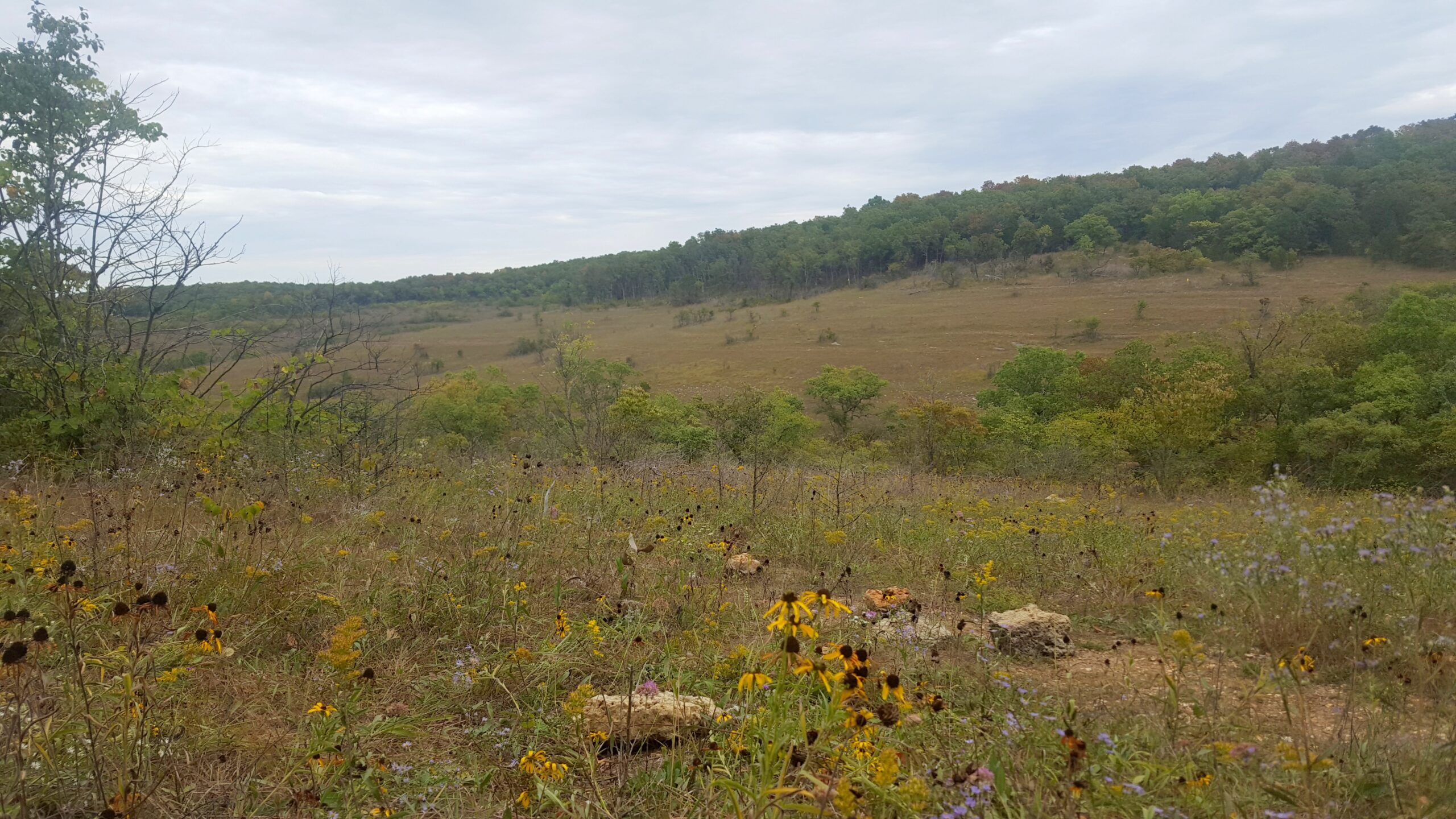
In early October, CCSD scientists Leighton Reid, Matthew Albrecht, and James Aronson and Shaw Nature Reserve naturalist James Trager toured several dolomite glades with Greg Mueller (Chicago Botanic Garden) and Betty Strack (Field Museum). We used the opportunity to discuss glade natural history and restoration.
In his book The Terrestrial Natural Communities of Missouri, Paul Nelson describes glades as:
“…open, rocky, barren areas dominated by drought-adapted forbs, warm-season grasses and a specialized fauna. They appear as small or large essentially treeless openings within landscapes primarily dominated by woodlands.”
Missouri glades are characterized by their geology. Many occur on southwestern-facing slopes with outcrops of sedimentary rocks, like dolomite and sandstone. But some also occur with igneous rocks in the St. Francis Mountains and Tom Sauk Mountain.
For some, glades seem like miniature deserts, complete with cacti, collared lizards, tarantulas, and even roadrunners in southwestern Missouri.
But glades are also like islands. To many of the organisms adapted to these sunny, rocky environments, the dark, duffy woodlands that surround them may seem like an oceanic barrier to movement. Dispersal events between glades can be rare. For collared lizards, dispersal is contingent on landscape fire to temporarily make the surrounding woodlands more easily traversable.
Glades are rarely cultivated, but many have been grazed. Cattle degrade glades by eroding and compacting their thin, precious soil. Some glades are also maintained by fire, which keeps woody trees and shrubs from crowding out the forbs and grasses. When people suppress fires, some glades become overrun with trees – especially eastern redcedar (Juniperus virginiana).
Shaw Nature Reserve contains a kind of chronosequence of glade restorations. Near the Maritz Trail House, Crescent and Long Glades were restored in the 1990s by clearing out the encroaching redcedar, establishing a fire regime, and reintroducing forbs and grasses – some of which were sourced from the remnant prairie at Calvary Cemetery in St. Louis. Other glades at Shaw Nature Reserve were restored in the 2000s and 2010s using similar techniques. So it might be possible to study changes in restored glades over time by comparing older restored glades to younger ones.
Could better-conserved dolomite glades serve as a reference to guide restoration at Shaw Nature Reserve? Beautiful dolomite glades are conserved at Valley View Glades Natural Area, Victoria Glades Conservation Area, and Meramec State Park. Some of these have plant species that are missing from Shaw Nature Reserve, possibly because they once existed at Shaw Nature Reserve and were extirpated, or possibly because glades at Shaw Nature Reserve lack appropriate ecological conditions for these plants. For example, prior grazing may have stripped the soil of some vital mycorrhizal fungi. Either way, the lack of some rare plants at Shaw Nature Reserve is probably exacerbated by fragmentation – a remnant plant population at Valley View Glades Natural Area would probably have trouble dispersing seeds 28 kilometers (17 miles) to Shaw Nature Reserve.
Further reading
Nelson P. (2010) Terrestrial Natural Communities of Missouri. 550 pages.


The quality of Valley View Glades Natural Area is evident in the abundant and diverse fall wildflowers that were present in early October. Could regional dolomite glades like this one serve as references to guide glade restoration at Shaw Nature Reserve?
Leave a Reply