August 31, 2026
By Qiming Liang
Qiming Liang holds an MSc from East China Normal University, with a background in ecology. He worked on biodiversity surveys for Shanghai’s environmental authorities and near-natural restoration design and long-term monitoring. In 2025 he joined WWF China as Project Officer for Grassland Conservation and Sustainable Pastoralism in Hulunbuir.
China’s grasslands are predominantly “working landscapes,” meaning that restoration efforts must be closely integrated with local livelihoods. In Northeast China’s Songnen Plain, this challenge is compounded by severe soil salinization and alkalization. These conditions create a hostile soil environment that traps the ecosystem in a degradation cycle, making passive recovery methods—like simply reducing grazing—insufficient. Active intervention is essential.
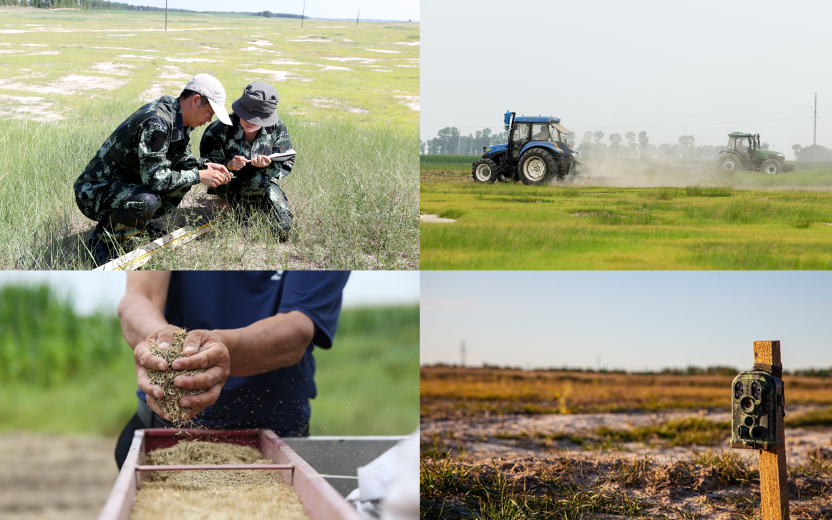
To address this challenge, WWF China, local communities, and partner organizations launched an 11.26-hectare pilot project in Qian’an County in 2019. The project’s core objective is to test whether a combination of native grass seeding, site-specific soil preparation, and protection from disturbance can successfully restore degraded saline-alkaline grasslands.
Diagnosing the site before applying treatments


The work began with baseline surveys of soil and vegetation conditions, which informed the delineation of the four restoration zones described above and the development of a restoration plan focused on rapid vegetation recovery.
The objective was to accelerate vegetation establishment while allowing subsequent plant succession to gradually shift the site toward a typical meadow steppe community dominated by Leymus chinensis and Elymus dahuricus. To achieve this objective, the restoration measures tried included site preparation, native grass seeding, fencing, and follow-up management. In areas where soil and vegetation conditions allowed it, the team used more active preparation before sowing. In alkaline patches, however, ploughing was avoided. Instead, direct seeding was used to reduce additional disturbance to the stressed soil surface.
Species Selection
The restoration design used four plant species in different seed mixtures: Leymus chinensis (Chinese rye grass), Elymus dahuricus (Dahurian wildrye), Melilotus officinalis. (yellow sweet clover), and Puccinellia tenuiflora(Alkalai grass). Each species was selected for a different restoration function.
Leymus chinensis is a characteristic grass of meadow steppes in Northeast China and represents the desired direction of long-term community recovery. Elymus dahuricus, a perennial grass, contributes to early vegetation establishment and provides valuable forage. Puccinellia tenuiflora is tolerant of saline-alkaline conditions and was especially important for the most degraded and alkaline patches within the site. Melilotus officinalis, a legume included in two of the seed mixtures, was expected to improve soil conditions, forage value, and functional diversity within the developing plant community.

Early ecological response
After approximately three years of restoration, vegetation recovery was visible at the pilot site, and monitoring in 2022 recorded 48 native plant species. This was important because it suggested that the site was not only being colonized by the sown species, but that a diverse native plant community was beginning to reestablish.
The faunal response also provided evidence of ecological recovery. Monitoring recorded 19 insect species, about twice the number recorded in 2021, as well as 26 vertebrate species. Common pheasants were observed, and a family of red foxes was also recorded using the site.
These observations need to be interpreted carefully. The presence of a fox family does not demonstrate complete ecosystem recovery. Foxes are highly mobile animals and may use many different habitat types. However, considered together with the increase in native plant species, insect records, and bird observations, these findings suggest that the restored site was beginning to function as habitat rather than merely as a planted area.


Livelihoods were part of the restoration design
The Qian’an pilot was not an isolated ecological experiment, but part of WWF China’s broader initiative in the Songnen Plain, where grassland restoration, sustainable production, and community engagement are being developed together. This context is crucial because the Songnen Plain is a “working landscape” intertwined with farming and livestock production. Restoration measures—like fencing, seeding, and mowing control—directly affect land use. If ecological efforts are not compatible with local production systems, they simply will not be maintained over the long term.
To address this constraint, WWF broadened the project by integrating demonstration plots and field training. One practical example was using earthworms to process cattle manure into vermicompost, successfully linking livestock waste treatment, soil improvement, crop production, and local income. This livelihood component showed local people how ecological recovery connects to land productivity and household decision-making. It also highlighted that restoration cannot rely on short-term protection alone; it requires a management systemthat local communities can understand, adopt, and maintain.
Ultimately, the Songnen Plain work relied on two necessary types of evidence. The first was ecological: tracking native plant recovery, insect responses, and improvement in habitat quality. The second was practical: demonstrating that restoration and sustainable production could actually be adopted by local communities. Both are indispensable. A technically successful restoration fails without local stewardship, just as a livelihood intervention provides limited conservation if it does not enhance biodiversity recovery. The true challenge is aligning them.
What the Songnen pilot shows
The Qian’an restoration pilot suggests several lessons for saline-alkaline grassland restoration.
- Targeted interventions: Site diagnosis must guide restoration treatments, as soil and vegetation conditions vary locally.
- Functional species selection: Native grasses should be chosen for their specific ecological roles (e.g., Puccinellia for its tolerance to saline-alkaline conditions and Leymus for accelerating succession).
- Active seeding: Direct intervention is crucial to restart succession where severe soil stress and seed limitations stall passive recovery.
- Comprehensive monitoring: Success should be measured by broader indicators of biodiversity recovery—including plants, insects, and vertebrates—not just vegetation cover alone.
- Livelihood integration: Linking ecological goals with sustainable production ensures local relevance.
Remaining questions
The pilot also identifies several critical areas for future research and action:
- Long-term stability: Continuous monitoring is needed to track whether missing functional groups, such as forbs and pollinators, naturally return or require additional seeding.
- Adaptive management: Post-establishment management regimes, such as grazing, mowing, or periods of rest, must be carefully balanced so that disturbance does not reverse recovery or alter community structure.
- Scaling challenges: Expanding from an 11-hectare pilot will require robust seed supplies, capacity, funding, and clear criteria for determining where active versus passive restoration is needed.
- Durable livelihood benefits: Long-term adoption relies on demonstrating that ecological recovery directly enhances forage quality, soil health, and household economic resilience.
From Songnen to Hulunbuir
The Songnen experience provides a foundational model for WWF China’s ongoing work in Hulunbuir. Unlike Qian’an, Hulunbuir is a largely intact, highly connected pastoral landscape vital for wildlife, supporting thousands of Mongolian gazelles and raptors using nest boxes, and traditional herding. However, challenges like degradation from long-term over-mowing remain. Here, the scale of intervention expands from restoring degraded patches to maintaining steppe connectivity, optimizing herd structures, and developing community-based co-management mechanisms. Recovery depends on aligning conservation goals with herder decisions and sustainable pastoral institutions.
WWF China is now developing community-based restoration approaches in Hulunbuir. Planned activities include establishing community committees, implementing locally adapted restoration measures, optimizing herd structure, promoting nature education, and fostering international collaboration. These activities are not separate from ecological restoration rather they are integral to its success. Because Hulunbuir’s grasslands are working pastoral landscapes, successful recovery depends not only on plants and soil but also on livestock movement, herder decisions, wildlife needs, and long-term management institutions.
Conclusion
While the Qian’an pilot successfully answered technical questions about restoring saline-alkaline soils using native grasses, its broader legacy is a paradigm shift: grassland restoration must be a dual process of ecological recovery and livelihood transition. Whether in the farming-pastoral ecotone of Songnen or the expansive steppes of Hulunbuir, the ultimate goal is not merely “greening” the land. It is to restore ecological function while ensuring the landscape remains economically and socially viable for the communities that depend on and manage them.
For more information on this project, please see the below resources or email the author at qimingwgs@gmail.com.
https://mp.weixin.qq.com/s/O5qeil5So8pEc3TiE77V-Q
https://mp.weixin.qq.com/s/rITURE2uA-FM6pUw-XF9tQ
https://mp.weixin.qq.com/s/jteuYetBeGCTLgLE3tREpQ
Leave a Reply