Estefania Fernandez is a Bascom Fellow who recently finished her master’s thesis at the University of Montpelier, France. Last year, Estefania wrote about her preliminary results on tropical forest restoration and vascular epiphyte reintroductions in Costa Rica. Here, she describes the final results, recently published in Restoration Ecology.
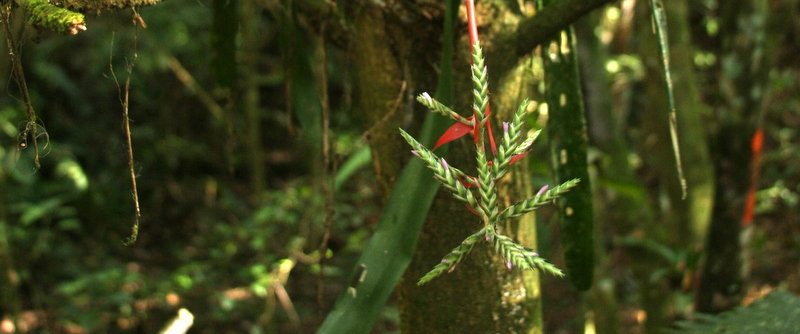
A transplanted bromeliad, Aechmea dactylina flowering in a 10-year old tree plantation.
Vascular epiphytes are plants that germinate and root on other plants without taking their nourishment from their host plant, and they represent 50% of the flora in some tropical forests and 9% of all vascular plants worldwide. If you are a plant lover, then you most likely have one or several vascular epiphytes in your house. Some of the most appreciated horticultural families include orchids (Orchidaceae), aroids (Araceae), and bromeliads (Bromeliaceae).
Vascular epiphytes also play key roles in our ecosystems. They are crucial to forest water and mineral recycling as they intercept rainfall and prevent rapid run-off and nutrient leaching. Vascular epiphytes are also exceptional microhabitats where invertebrate communities find refugia and birds and arboreal mammals forage.
Transplanted individual of Werauhia gladioliflora
Despite their importance in forest ecosystems, vascular epiphytes are rarely taken into account in forest restoration. This is problematic because vascular epiphytes are often among the slowest plants to recolonize regenerating forests.
In 2015-2016, I tested whether transplanting epiphytes into young restoration sites could be a viable strategy to accelerate their reestablishment. I used a bromeliad for my experiment, Werauhia gladioliflora (H. Wendl.) J.R. Grant, which was common in remnant forest but had not been found during epiphyte surveys in nearby restoration areas. In March-June 2015, I transplanted 60 bromeliads into three restoration plantations near Las Cruces Biological Station in southern Costa Rica. I revisited the sites in January-February 2016, nine months after transplantation, to monitor survival and arthropod recolonization.
Happily, over 75% bromeliads survived and the number of arthropods on branches with bromeliads was seven times greater than in branches without bromeliads. Additionally, I observed that bromeliads buffered the local microclimate; during the driest and hottest times of the day, the interior of the bromeliads was moister and cooler than ambient air.
Transplanted individuals of Werauhia gladioliflora (left) hosted considerably more arthropods in their rosettes than could be found on the stems of trees that had not received a transplant. GN, JG, and MM are three study sites near Las Cruces Biological Station in southern Costa Rica. Photo by Dave Janas.
Restoring arboreal refugia
My research suggests that transplanting fallen epiphytes onto trees in restored sites contributes to the recovery of vascular epiphyte diversity in these ecosystems and has the additional benefits of bringing back arthropod diversity to these sites. Epiphytes, and specifically “tank” epiphytes that retain water in their rosettes, help stabilize microclimatic conditions, a critical function in light of climate change, which may put arboreal communities at special risk. Indeed, the body temperature of many animals such as invertebrates entirely depends on ambient temperatures but rising temperatures could push arboreal animal communities to the ground. Epiphytes offer ideal refugia from high temperatures and drought and their presence in tree canopies and understory is critical to preserve arboreal animal communities. Transplanting other epiphyte families or even entire epiphyte communities found on fallen branches could be tested in the future to broaden this strategy.
Estefania inspects a flowering individual of an Aechmea dactylina transplant
This work was supported by a grant from the National Science Foundation.
En route to attending the 4th meeting of the Ecological Restoration Alliance of Botanic Gardens Conservation International, in Xalapa, Veracruz, Mexico, James Aronson stopped off to visit Beatriz Maruri Aguilar, a recent Bascom Fellowship recipient who works as Scientific Research Coordinator at the Cadereyta Regional Botanic Garden, and her colleagues, Director Emiliano Sanchez Martinez, and Research assistants Hailen Ugalde de la Cruz and Hugo Altamirano Vázquez in Cadereyta de Montes, Queretaro, north of Mexico City. Beatriz and Hailen describe the Garden’s work conserving an endangered, endemic cactus, and an innovative restoration project.
Main entrance to Cadereyta Regional Botanic Garden
Cadereyta de Montes is close to the southern end of the Chihuahuan Desert, in the semiarid zone of Queretaro and Hidalgo. The place is relevant for biodiversity because of its number of endemic arid plants. However, today some habitats have been definitively altered and several special plants are on the brink of extinction.
One of those emblematic species, popular among succulent plant collectors around the world, is under severe threat to its survival. Worldwide growing successfully in cultivation, Mammillaria herrerae Werderm. is facing tough conditions and could eventually disappear from its original habitat. Scientists from the Cadereyta Regional Botanic Garden have done a survey which indicates that there are only a few hundred individuals remaining in the wild, that the species shows very low recruitment by seed, and that seedlings grow on rocky substrates beneath nurse plants.
Expedition day: James and Beatriz descend the slopes where Mammillaria herrerae lives. Photo by Hailen Ugalde de la Cruz.
Observing the remaining individuals is a shocking experience that moves to reflection.
They look small and fragile, but these geometric, almost spherical, plants are a beautiful example of the precision of nature, which gives each organism the characteristics it requires to survive in its natural habitat.
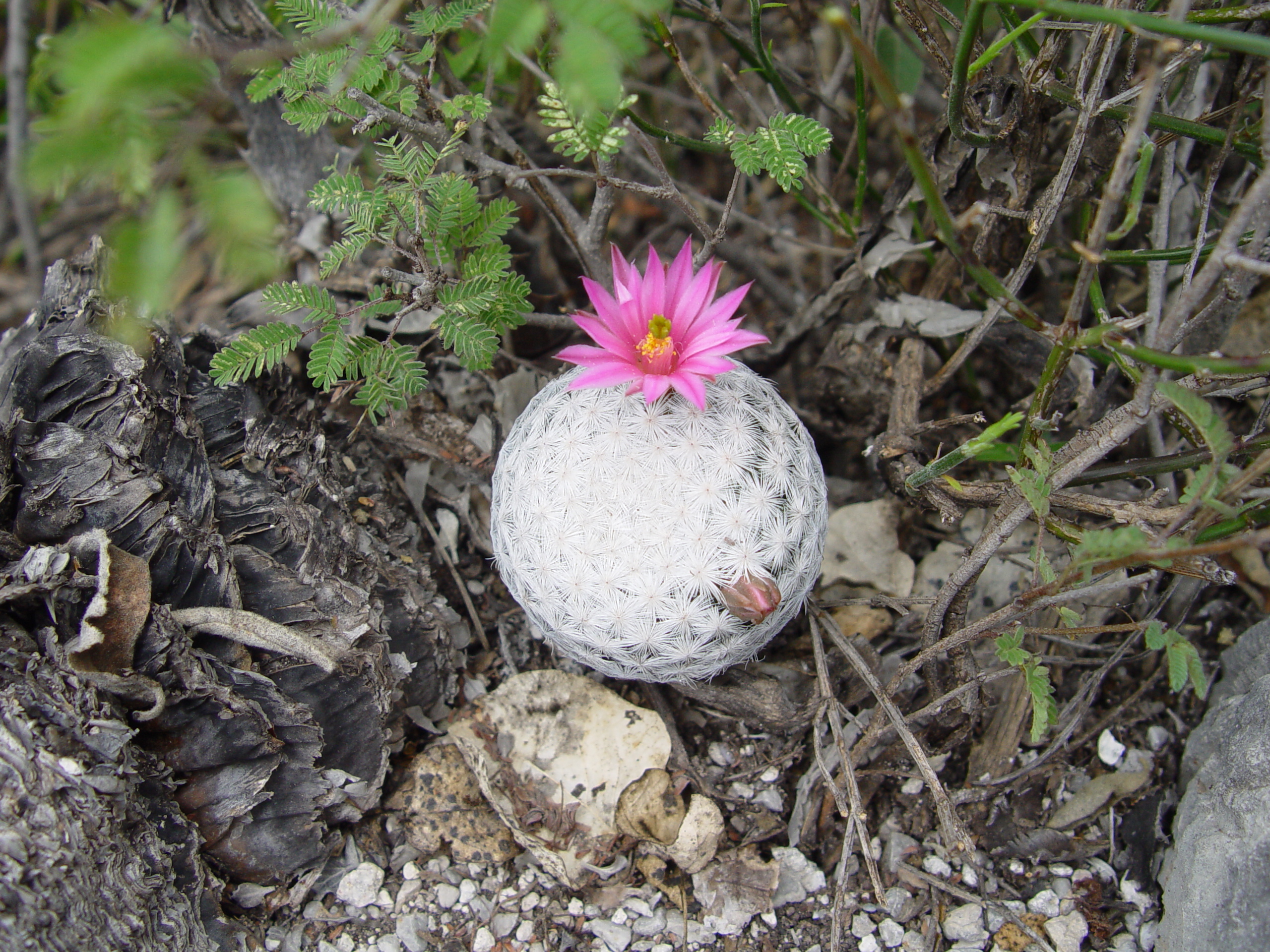
The beautiful Mammillaria herrerae Werderm., also known as “golf ball cactus” or “bolita de hilo” (small ball of thread). Photo by Beatriz Maruri Aguilar.
Densely covered with white spines and half-buried in the rock, Mammillaria herrerae hides its presence in the limestone soil. Its densely-distributed spines also help harvest fog at this elevation, where atmospheric moisture can condense. In an arid region like central Mexico, such adaptations provide species with strategies to reach the vital element.
A small group of Mammillaria herrerae struggle to persist on the steep slope. Photo by Hailen Ugalde de la Cruz.
The pipes of the “Acueducto II” Hydraulic system climb more than 1200 meters to reach an elevated point from which it carries water by gravity to Queretaro City. Photo by Beatriz Maruri Aguilar.In such a challenging environment, the construction of this infrastructure has severely damaged the landscape where Mammillaria herrerae lives. Photo by Beatriz Maruri Aguilar.As the aqueduct was constructed over several years, several efforts were conducted to relocate bigger native plants. Photo by Hailen Ugalde de la Cruz.
Efforts will continue. The Cadereyta Regional Botanic Garden team will conduct a 2-year demographic study, study the floral biology of the species, and describe plant community biodiversity at the specific distribution points. Stock propagation at the Garden will continue. The path is being prepared to, one day, return these jewels to their place in their natural environment, and to protect them better in situ.
Hailen Ugalde (left), Hugo Altamirano (center), and Beatriz Maruri (right), the staff of the Cadereyta Regional Botanic Garden, visit a remnant population of Mammillaria herrerae . Photos by James Aronson (left) and Hailen Ugalde de la Cruz (right).The landscape around M. herrerae’s natural habitat. The mountain in the background is the southern facies of the Sierra del Doctor, part of the Sierra Madre Oriental. Photo by Hailen Ugalde de la Cruz.Some of the globose companions of Mammillaria herrerae Werderm. Left: Astrophytum ornatum(DC.) Britton & Rose; Right: Mammillaria parkinsoniiEhreb. Photos by Hailen Ugalde de la Cruz.
“An unusual model of assisted ecological restoration”
At first sight, the arid scenery of the surroundings of the small city of Cadereyta, in Queretaro, Central Mexico, could transport us to past times.
Panoramic view from Cadereyta de Montes, and the ancient flavor of the streets. Photos by José Belem Hernández Díaz.
However, this semi-urban and semi-rural zone combines the features of ancient Mexican villages and landscapes with the unmistakable signs of the transformation that progress usually brings.
The peripheral landscape of Cadereyta de Montes (14,000 inhabitants) is showing signs of transformation. The urban area is gradually displacing the agricultural parcels and the native flora, giving rise to an interface formed of irregular patches that combine new houses and small agricultural parcels. A third type of ground, neither agricultural nor urban, is also present. This type of land is isolated from wild and agricultural areas, and can degrade easily.
The polygon of the Cadereyta Regional Botanic Garden, highlighted in yellow, in the vicinity of Cadereyta de Montes. Map prepared by Beatriz Maruri Aguilar.
In additional to its formal collections and buildings, the Cadereyta Regional Botanical Garden maintains an area that exemplifies the conditions found in much of the surrounding semi-arid region. Xerophytic shrub-dominated matorral is the main vegetation type which is generally highly degraded by human activities over the last decades, and surviving remnants in good ecological condition are only found quite isolated from agricultural areas. The vegetation comprises an interesting assemblage of native species in the Asteraceae, Poaceae, Solanaceae, Verbenaceae, Euphorbiaceae, Cactaceae, Fabaceae and other families, many of which are struggling to survive within large patches of invasive grasses.
A view from the top: looking down at degraded land to be managed by the Botanic Garden. Photo by Hailen Ugalde de la Cruz.Another view from the top: Hugo, Beatriz, and James observe the transformed landscape of Cadereyta de Montes from one of the Garden’s balconies. Photo by Hailen Ugalde de la Cruz.
In this area, the Botanic Garden is working on restoration models that will be of interest – and direct use – to local landowners. It is an unusual model of assisted ecological restoration, with an agroforestry approach. The core idea is that through the implementation and monitoring of native vegetation and economic plant mosaics, it should be possible to combine conservation of biodiversity, sustainable development for small farms, and ecological restoration of degraded lands.
The pilot project will have two different types of parcels for comparative and demonstration purposes. One type will be built following an ecological approach to restoration, using only native plant species; the other will have an agroforestry approach, combining a group of native species with some selected edible/useful species. The area of the plots where the two strategies will be implemented will be prepared by removing an invasive species of grass (Melinis repens Willd. (Zizka), or “pink grass”). The agroforestry model will also generate useful products, such as agave leaves, which are used in the region for several purposes including to make pulque – an ancient beverage made by the fermentation of the agave sap, highly popular in this region. This model will also include aromatic plants – such as the asters Matricaria chamomilla L. and Calendula officinalis L. and the mint Salviasp., as well as other useful plants as the euphorb Jatropha dioica Sessé, “sangregado”, commonly used as an ingredient in shampoos and formulas against gray hair. These human uses are valuable in areas like this, where some human populations are suffering from an elevated degree of marginalization. The Cadereyta Regional Botanical Garden has developed propagation protocols of native species, and part of the stock produced will be used in the model described.
Some of the stock of native species produced at the Cadereyta Regional Botanic Garden. Photos by Beatriz Maruri Aguilar (top) and Hugo Guadalupe Altamirano Vázquez (bottom).
At Cadereyta de Montes, some areas need a helping hand to keep the landscape in good shape. Other places hide extremely valuable living treasures that are currently struggling for survival. The Cadereyta Regional Botanic Garden is working every day to contribute to the conservation of the highly remarkable flora of the southern end of the Chihuahuan Desert, as well as to offer sustainable solutions for landscape use in a transforming environment. This way, the Garden intends to become an active participant for the achievement of Mexico’s goals for plant conservation.
Planting tree islands has many of the benefits of larger plantations, but entails significantly less cost. Karen Holl (University of California, Santa Cruz), Leighton Reid (Missouri Botanical Garden), and Zak Zahawi (American University of Beirut) describe recent findings on tree seedling recruitment in a long-term experiment in southern Costa Rica.
Over the past few years there have been a growing number of commitments at the global, national and regional scale to restore forests because of their importance to conserve biodiversity, sequester carbon, reduce erosion, and provide goods and services to people. For example, Initiative 20×20, led by the International Union for the Conservation of Nature, aims to restore 20 million hectares of tropical forest by 2020, an area roughly equivalent to the size of Uruguay or Nebraska.
A common strategy to restore forests is to plant trees. But, the big question is: where will the money come from to plant billions of trees when there are so many pressing needs? As restoration ecologists, we started thinking about how we could most efficiently allocate resources to get the best bang for the buck and restore the largest area of forest.
Trade-offs in forest restoration strategies. Planting fewer trees leaves more to chance and can require more time, but tree plantations are more expensive and leave a bigger ecological footprint. Our study tests an intermediate option, and after 10 years it appears to provide a good balance. Figure modified from Corbin & Holl (2012).
Starting over 10 years ago, we set up a large-scale tropical forest restoration experiment in southern Costa Rica to test two ideas.
First, we tried planting tree “islands”. The idea is to plant groups of trees that attract birds and bats, which disperse most tropical forest tree seeds. The tree canopy also shades out light-demanding grasses that can outcompete tree seedlings. In one experimental treatment, we planted tree islands that covered about 20% of 50 × 50 m plot of former cattle pasture. We compared that to plots where no trees were planted (natural recovery) and to the more intensive (and more typical) restoration strategy of planting trees in rows throughout the plot (plantation).
Second, we asked: is it only possible to restore forest near remnant forests or can you restore forest anywhere in the landscape? This is important information to help guide forest restoration efforts. To do this we set up our entire experiment at 13 sites, some of which were mostly surrounded by agricultural land and some of which were adjacent to the largest remaining forests in the region.
Then we monitored establishment of new tree seedlings in our research plots over a decade. We compared the number of seedlings, number of species, and types of species in the restoration plots with those found in the nearby forest to evaluate how well the forest is recovering.
The tree island planting method not only saves money on buying, planting, and maintaining seedlings, but it also results in a more heterogeneous distribution of trees, so it looks more like a natural forest.
Profuse tree seedling and sapling recruitment in the understory between two tree islands in southern Costa Rica.
We counted over 6000 tree seedlings, 88% of which have seeds that are dispersed by animals. On average there were many more tree seedlings in the tree island and plantation treatments than in the natural recovery plots. These results suggests that some tree planting helps the forest to recover faster, but that it is not necessary to plant the whole area with trees. The tree island planting method not only saves money on buying, planting, and maintaining seedlings, but it also results in a more heterogeneous distribution of trees, so it looks more like a natural forest.
Even though there were many tree seedlings in the island and plantation plots, on average there were less seedlings of tree species that have big seeds (>0.5 cm/0.2 inches across) compared to mature, reference forests. It seems that the larger-seeded species that are common in mature forests are much slower to colonize restored sites, likely because they are eaten and dispersed by a small number of larger animals, such trogons and agoutis. Many of those dispersers are less likely to visit early successional forest.
Small frugivores, small seeds. Most of the birds we see in these experimental plots are small-gaped omnivores (e.g., Yellow-bellied Elaenia, Elaenia flavogaster, left), but it usually takes large-gaped species to disperse larger seeds1. The figure at right shows the maximum fruit size that a bird species with a given gape size was able to consume in a cloud forest in central Costa Rica (modified from Wheelwright (1985)). In our experiment, small seeds were ubiquitous, but large seeds were mostly absent.
We were surprised that the amount of forest cover around the experimental plots had a weak effect on the number of seedlings establishing. In other words, isolated plots had just as many tree seedlings as plots right next to old-growth forests. We think that this is likely due to the fact that there are many trees in the agricultural landscape surrounding our plots; these trees include remnant trees, living fence rows, and riparian corridors. Trees in the landscape can serve an important role in both providing sources of seeds and stepping stones for the movement of seed-dispersing fauna. We anticipate that having forest nearby will be more important in future years as these forests build up greater diversity of rare, large-seeded species. Nonetheless, our results suggest that there are good prospects for restoring forests in many locations in this landscape.
Our key finding is that planting tree islands can be a cost-effective way to restore tropical forests at our study site in Costa Rica, but we hasten to note that the strategy should be tested in other locations, particularly areas with fewer forest elements in the surrounding countryside. Our study also demonstrates that tropical forests can recover some species quickly but it will take many decades, if ever, for forests to fully recover. So, preserving existing rain forests is critical to conserve biodiversity and the services they provide to people.
Diverse tree cover in an agricultural landscape in southern Costa Rica. Remnant trees in pastures, trees along fence rows, and riparian forests provide important sources of flora and fauna to speed up forest recovery.
1See Melo et al. (2009) for an example to the contrary: small-gaped animals dispersing fairly large fruits and seeds.
This work was supported by a grant from the National Science Foundation.
If you were at the MBG Fall Symposium, we want to hear from you! How did the symposium change your perception of restoration? Send us an email at leighton.reid@mobot.org.
On October 8th, Missouri Botanical Garden hosted its 63rd annual Fall Symposium. This year’s theme was Ecological Restoration in a Changing Biosphere. Author and journalist Paddy Woodworth moderated the day, and seven speakers presented contemporary perspectives on a core challenge in modern restoration ecology. Namely: in the post-COP21 world, when all three UN conventions call for scaling up and mainstreaming of restoration, it is clear that restoration will affect hundreds of millions of hectares – and as many people – over the coming decade. At the same time, we find ourselves in an era of unprecedented change where climate, ecological baselines, and future land-use changes are highly uncertain. This raises the question: What should large-scale restoration look like in the remainder of the 21st century?
2016 Fall Symposium speakers. From left to right: Peter Wyse Jackson, Curt Meine, Robin Chazdon, James Aronson, Leighton Reid, Pedro Brancalion, Karen Holl, Don Falk, Paddy Woodworth, and Jim Miller. Photo by Andrea Androuais.
Talks during the morning focused on tropical forests, where much of the international restoration dialogue is focused.
Leighton Reid (Missouri Botanical Garden) opened with a presentation on restoration longevity – the idea that some restoration projects create ecosystems that persist for more than a century (e.g., Floresta da Tijuca), while other projects fail quickly. Dr. Reid argued that how long restored ecosystems persist is quantifiable, predictable, and manipulable, opening the possibility for more ambitious restoration planning.
Robin Chazdon (University of Connecticut andbeyond) then spoke about forest landscape restoration, an approach that aims to regain ecological integrity and enhance human well-being in deforested, human-impacted, or degraded forest landscapes. Drawing on a wealth of large-scale studies, Dr. Chazdon made the case that natural forest regeneration is the most ecologically effective and economically feasible approach to forest restoration globally.
Karen Holl (University of California Santa Cruz) presented her take on research priorities for forest restoration in the Neotropics. She highlighted that researchers could make an impact by studying forest restoration at larger spatial scales, at longer temporal scales, and in collaboration with stakeholders. Improving information exchange and standardizing monitoring protocols were also among her top priorities. (Graduate students, take note!)
Dr. Pedro Brancalion (University of São Paulo) completed the morning session with a TED talk-style discussion of the linkages between science, technology, policy, and best practice in Brazilian Atlantic Forest restoration. Using Thomas Kuhn’s structure of scientific revolutions, Dr. Brancalion argued that restoration ecology is in a crisis period, in part because disciplinary research has predominantly created solutions at smaller spatial scales than the (growing) problems the discipline seeks to address. Perhaps restoration is ripe for a paradigm shift?
Dr. Pedro Brancalion (right) asks whether restoration ecology is ready for a new paradigm shift, as Paddy Woodworth (left) moderates. Photo by Robin Chazdon.
After lunch, the conversation turned towards a major academic debate in restoration ecology. Has global change outpaced the restoration approach? And is a new approach needed?
Curt Meine (The Aldo Leopold Foundation) drew on his long experience in the upper Midwest, and, in particular, his studies of author and environmentalist Aldo Leopold (1887-1948). He argued that Leopold avoided the simple polarities through which some contemporary restoration debates are framed. He viewed nature in a relative way, neither entirely wild, nor entirely domesticated in any given landscape. Although he practiced ecological restoration in some contexts, he also advocated soil conservation and sustainable agriculture – activities motivated by his core values, as expressed in The Land Ethic (1949).
James Aronson (Missouri Botanical Garden) followed with an elucidation of the reference ecosystem concept. Reference ecosystems, he noted, help determine the social and ecological vision for a restoration project or program – a critical issue for restoring historic continuity in degraded landscapes. Dr. Aronson described a family of restorative actions for achieving progress towards the reference system, drawing on examples from Jordan and South Africa. He argued we need to look deeper into the past and ponder our choices from many angles as we decide how to do more effective restoration at the landscape and larger scales.
Donald Falk (University of Arizona) delivered the keynote address. He painted a disturbing portrait: rapid climate change is driving a massive forest-to-non-forest transition in the southwestern United States. In particular, many ponderosa pine forests will not be able to persist in the future where they have been in the recent past and present. Perhaps restoration ecologists should transition too. Rather than “chasing the ambulance”, maybe we could get out ahead of disasters and ease transitions between stable ecosystem states. Anticipating ecosystem transitions could mitigate the loss of ecosystem functioning that accompanies major climate-driven forest fires, but it would require a shift in restoration thinking. Importantly, Dr. Falk noted that ecosystems do not care what words we use – ecosystems respond to actions.
With moderator Paddy Woodworth’s help, we finished the day with a panel discussion, inviting questions from the audience. Among the thoughts and questions that we were left with:
Is ecological restoration more difficult in places with greater population density?
Should restoration focus on policy, economic, or cultural motivations for engaging people?
Are values a better guide for land management than ecological history? Are the two complementary?
How can the reference ecosystem concept accommodate rapid biome changes, as we are seeing in the Southwestern USA?
What is the way forward to mainstream serious, multisectorial monitoring and evaluation with all these new factors to consider? Who will fund it?
To what extent can we move from restoring degraded ecosystems to avoiding degradation in the first place?
Can forest landscape restoration and natural forest regeneration bridge the gap between small-scale, past restoration experience and present, large-scale restoration needs?
PhD candidates Ricardo Cesar (University of São Paulo) and Leland Werdan (University of Minnesota) compare notes on seedling functional traits in dry tropical forest restoration. Leland was the recipient of the annual Delzie Demaree award. Photo by Robin Chazdon.More than 150 people registered for the symposium. They came from three continents, five countries, and seven US states.
James and Thibaud Aronson offer their third photo essay from South Africa, highlighting FOSTER, a dramatically successful community-based restoration program in the Eastern Cape, aimed at eradicating an invasive Australian acacia, and reducing urban wildfire risk, and a private restoration program at Kaboega Farm, situated in a megadiverse landscape of extraordinary conservation and educational value.
The Republic of South Africa is rightly famous for its 22-year old Working for Water program, WfW, and offshoots such as Working for Wetlands. These government-funded programs aim at restoring both natural and social capital, which are clearly the wave and the way of the future. They are also increasingly working with NGO implementers, private companies, and landowners in the Karoo, as we highlighted in two earlier posts (here and here). Teams, partnerships, and networks are essential here, given the complexity of the landscapes – both biophysical and political.
To close our trip in South Africa, we traveled to Cape Saint Francis, on the coast of the Eastern Cape, where our friends Richard Cowling and Shirley Pierce, who have lived there for more than 20 years, long ago founded a restoration project they dubbed FOSTER (short for Friends of the St Francis Nature Areas).
Richard, a top academic, communicator, and world expert on the ecology, biodiversity, and landscapes of South Africa has also worked closely with the WfW government programs elsewhere in the country, not only in the fynbos (the mega-diverse shrublands of the mediterranean-type climate region of the Cape) but also the karoo and subtropical thicket (on which, more below).
Richard Cowling and Shirley Pierce-Cowling in their adopted habitat, St Francis Bay. 2013.
In and around Cape St Francis, and St Francis Bay, one of the main issue is Acacia cyclops (known in South Africa as rooikrans), one of many fast-growing acacias intentionally introduced from Australia 150 years ago for sand dune stabilization.
In 1994, Richard and Shirley took up the challenge of developing a conservation plan and implementation strategy for consolidating 230 ha of municipal land and existing protected areas into a network that would sustain – among other things – faunal movement. More than 50% of this was densely invaded with rooikrans; only 38 ha was officially proclaimed a nature reserve. It was a slow process. Rooikrans grows quicker and taller than the native plants. But they had a very strong motivation. Indeed, “as a result of its greater biomass and more flammable foliage, rooikrans increases fire hazard by several fold relative to uninvaded fynbos” says Richard.
Over 20 years, they achieved near total success in removal of seed-bearing alien plants through the generous funding from the World Wide Fund (WWF) and residents’ donations, but only on the 132 hectares of public lands where they could work, often with the enthusiastic help of school groups and volunteers who learned much along the way.
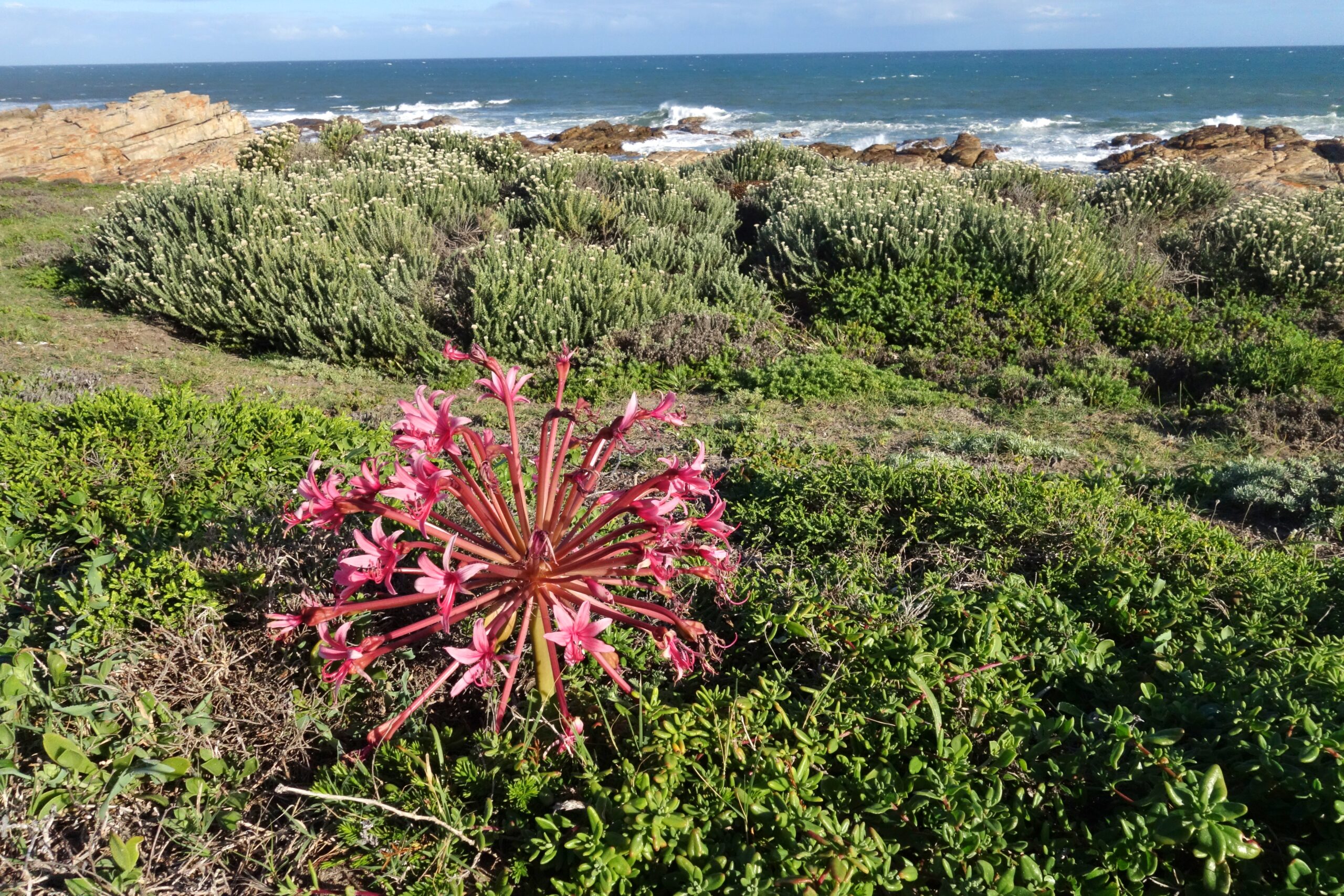
FOSTER restoration workers conducting follow-up removal of the alien invasive rooikrans, Acacia cyclops, in the Cape St Francis nature reserve. Photo. R.M. Cowling.A learner from a local school enjoying the leaves of Brunsvigia gregaria (Amaryllidaceae) during an excursion organized by FOSTER. Photo. R.M. Cowling.
Brunsvigia gregaria in bloom; this species is popularly known as candelabra flower. Cape St Francis, Apr 7, 2016.
But there were hundreds of hectares more to clear, both on public and private lands around the town. Then, in late 2012, a fire swept through, leaving severe damage and a wake-up call.
By that time, WfW was ready to help with restoration on private lands, provided that landowners contributed to the effort. The help from WfW and others much expanded FOSTER’s reach, and in only four years, some 1000 hectares of rooikrans were cleared from private lands in the area.
This of course dramatically reduced the township’s vulnerability to wildfire damage. As proof, when another massive wildfire swept through the area in January 2016, only three houses were destroyed. Notably, all three belonged to owners who had refused access to WfW workers seeking to eradicate rooikrans.
Other communities along the coast have taken notice and hopefully will follow the example of Cape St Francis.
Second landscape example: Kaboega farm
Finally, following Richard’s advice we drove two hours inland from Port Elisabeth, not too far from St Francis Bay, to visit a truly remarkable place where four different ecosystem types meet and intermingle in a property of only 6550 hectares: 1) fynbos, 2) the karoo desert, here at its southernmost limit, 3) the northernmost temperate rain forest fragments of the South East, of which the only important remnants are found in the Knysna region, and 4) subtropical thickets.
Outenieqwa-geelhout, or small-leaved yellowwood, Podocarpus falcatus. Outstanding specimen of the relict population growing near a perennial stream at Kaboega Farm.
What South Africans call subtropical thickets are in fact a remarkable tapestry of vegetation types, with as many as 116 distinct variants (Cowling et al. 2005). Of particular interest here is the so-called spekboom-dominated thicket, characterized by the spekboom (Portulacaria afra).
Fully mature spekboom, one of the largest individuals known
Spekboom-dominated thicket once flourished on approximately 1.4 million hectares (3.46 million acres), but today it occupies barely one-seventh of its former area. “The remainder has been degraded by over-exploitation, mainly through injudicious farming with angora goats……” (see the report Investing in Sustainability). However, spekboom is an extremely hardy succulent tree, remarkably fast-growing and readily propagated from cuttings, or even large stancheons.
This makes it attractive for large-scale restoration work. Indeed, it has been the focus of much attention from Working for Woodlands, another member of the Working-for family of government restoration programs. The manager and co-owners of Kaboega Farm, Ian and Sandra Ritchie, stopped all agricultural activity on their land 20 years ago, to allow the land to recover from an estimated 135 years of over-grazing by small livestock. They live instead by hosting visitors, including succulent plant lovers, drawn to this hotspot of Haworthias, and university groups led by Richard Cowling. Among other recent discoveries, Cowling and co-workers have shown that subtle difference in community-level frost tolerance can determine the boundaries between tightly packed biomes at Kaboega, where diversity is sky-high despite an average rainfall of just 300 mm per annum and frequent, extreme droughts.
Spekboom cuttings struggling to get going
Furthermore, Ian and Sandra Ritchie are attempting to restore swathes of spekboom thicket at strategic spots on their farm, as a part of an ambitious large-scale program with support of Working for Woodlands.
They plant spekboom cuttings, which over time create an enhanced micro-environment in an otherwise harsh and difficult environment for young plants, and thus try to kick-start the regeneration of the habitat, biological community, and ecosystem. Furthermore, spekboom traps large amounts of CO2, and the general hope is that carbon credits can help finance large-scale restoration in the future. In the meantime, this is a remarkably attractive destination for nature-lovers. In addition to the flora and landscapes, giraffe, kudu, and other game are added and allowed to roam free for the pleasure of visitors (and the owners). When numbers grow too high, however, there is a risk of exceeding carrying capacity, and some animals are captured for resale to other land-owners. This provides an additional income flow as game ranching linked to tourism and recreational hunting is increasingly popular in the region.
Portion of a thriving population of 28 South African giraffe or Cape giraffe (Giraffa giraffa giraffa) at Kaboega Farm. While some argue that giraffes are not native to the area, nearby millennial cave paintings indicate the contrary.
At this remarkable farm, science-based conservation and restoration are making progress in an attempt to enhance biodiversity conservation, tourism revenues, and ecosystem services of all kinds. Clearly, spekboom planting is not an all-in-one solution; for jumpstarting restoration and assisting regeneration in a complex landscape and land tenure situation like this one, where temperate forests, fynbos, thicket, and karoo shrublands all occur and interact, a landscape perspective on the challenges of ecological restoration is essential. We’ll be posting more on this challenge in the future.
CCSD restoration ecologist and PARTNERS member Leighton Reid spent 10 days collaborating with scientists and students in the Tropical Silviculture Lab (LASTROP) at the University of São Paulo. Epiphytes were a central theme of the visit.
Vascular epiphytes are plants that live non-parasitically on other plants. Readers from the tropics will be quite familiar with some epiphytes, like the ubiquitous Tillandsia of Neotropical powerlines, but temperate zoners will have seen many epiphytes as well, at the florist, the botanical garden, and the mall. These plants are incredibly diverse; by one estimate, epiphytes make up 9% of all vascular plants worldwide. But epiphytes also face serious challenges in today’s world. Habitat loss and overharvesting threaten some epiphyte species with extinction. Many epiphytes also have a hard time recolonizing new habitat in regenerating forests, but new studies on epiphyte restoration could help.
I spent the past 10 days in the State of São Paulo learning about epiphyte ecology, conservation, and restoration from students and scientists at the University of São Paulo’s College of Agriculture (Escola Superior de Agricultura Luiz de Queiroz). This part of Brazil was once covered in semideciduous tropical and subtropical forests, which hosted about 150 vascular epiphyte species. Today, only ~15% of the forest remains, but there is a large effort underway to restore 15 million hectares (nearly 58,000 square miles) of it by 2050.
Frederico Domene is a doctoral student studying epiphyte reintroduction in restored Atlantic Forest. Like his advisor, Pedro Brancalion, Fred’s interest in epiphyte restoration stems from a passion for orchids. He grows a variety of them at his house in Piracicaba, preferring true species over horticultural varieties.
Fred picked me up in his black pickup, “mamangava”, and took me on a tour of several tree plantations where he has been developing methods for reestablishing populations of epiphytic orchids, bromeliads, cacti, and aroids. Fred’s basic procedure involves collecting epiphyte seeds (or purchasing small plants, in the case of orchids), growing them out in a nursery, and then attaching them to trees using twine or plastic. He started his work in 2010 and has been monitoring his plants, and reintroducing new plants, every year since. He uses a ladder to put the orchids up high, out of easy reach for would-be poachers.
Atlantic Forest restoration plantations. Left: 60-year old plantation along the Rio Piracicaba near Rio Claro. Right: 12-year old plantation at the Anhembi Forest Science Experimental Station. The older restoration site had considerably more naturally recolonizing epiphytes than the younger site.
Late August is mid-winter in São Paulo, and while it doesn’t get particularly cold, it is quite dry. The restoration plantations were crunchy with desiccated leaves and twigs. These are harsh conditions for epiphytes, which do not have the luxury of soil to buffer to their roots from the sunlight and dry air. Some of Fred’s epiphytes have withered and died, especially during a 100-year drought in 2012. But others are thriving, thanks to special adaptations, such as the velamen of orchid roots, which wicks up rainwater when it drips down the tree trunk during storms. Many individuals have started fruiting and flowering, a good sign for the future viability of these reintroduced populations.
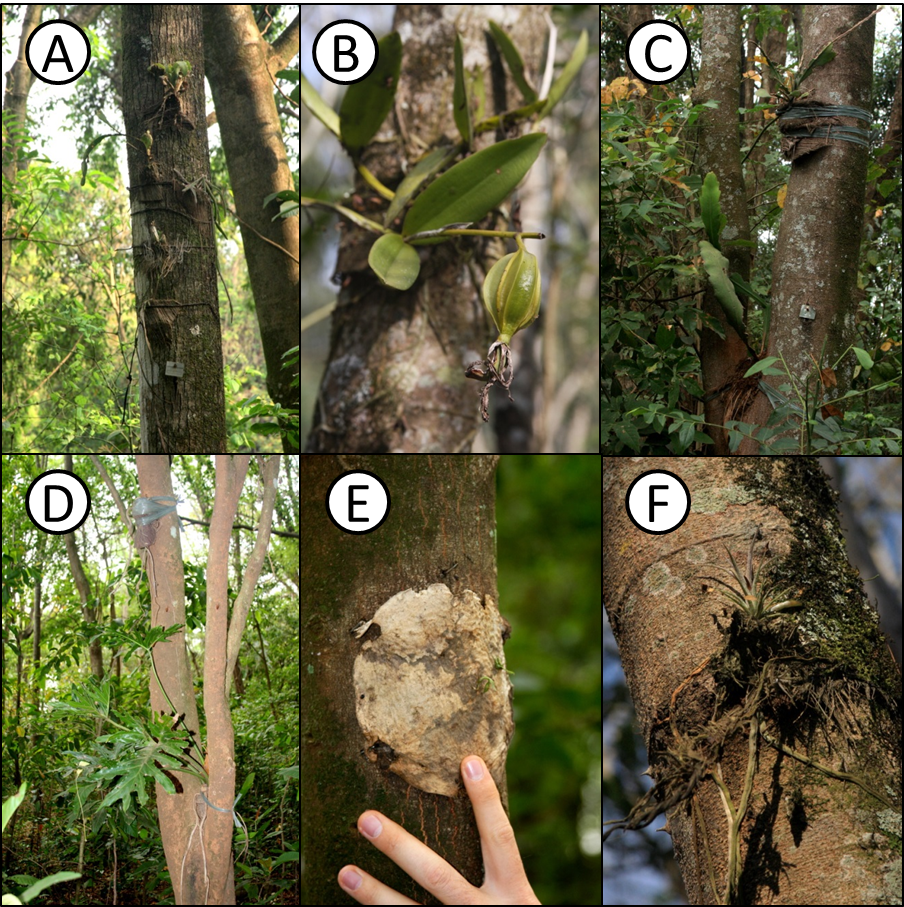
Epiphyte reintroductions in restoration plantations. (A) A reintroduced festoon of bromeliads, orchids, and cacti. (B) A fruit-bearing orchid (Cattleya forbesii), six years after reintroduction. (C) This reintroduced cactus (Epiphyllum phyllanthus) seemed to grow better in tree forks than on vertical stems, as did an aroid, (D) Philodendron bipinnatifidum. (E) Two tiny cacti have germinated in this direct seeding experiment, using seeds enrobed in paper discs. (F) Even where epiphytes have dessicated and died, experimental infrastructure continues to enhance epiphyte development; here a small bromeliad (Tillandsia recurvata) uses a piece of natural twine as a foothold.
To identify the key challenges for epiphyte restoration, it is also important to study epiphyte recolonization in naturally regenerating forests. Alex Mendes, an undergraduate researcher at ESALQ, is doing just that. On an unseasonably rainy morning, Alex, Fred, and I visited three regenerating forests near the sugar town of Rio Claro. We ducked under barbed wire fences and wandered through low, dense vegetation where Alex is systematically searching for vascular epiphytes. Two forests had rather few epiphytes – mostly generalist bromeliads – but one forest had a high density of orchids, which happened to be flowering spectacularly on the day we visited. Based on historical aerial photos, Alex knows that these three forests are at least 20 years old. They are part of a network of 75 sites that he will ultimately search for epiphytes. By the end of his undergraduate program, Alex hopes to be able to predict where epiphyte communities will regenerate on their own, and where they will need more assistance.
This secondary forest near Rio Claro might have felt like your average overgrown Psidium guajava patch had it not been decorated with dozens of Ionopsis sp. orchids.
These are early days for learning about epiphyte restoration, and there is still a lot of work to be done. The projects that I visited in Brazil are making headway, complementing our research in Costa Rica. It remains to be seen under what circumstances epiphyte reintroductions will be most successful. Perhaps an even more important issue will be convincing funding agencies and land managers to think beyond trees.
Fred Domene and Alex Mendes are making strides in the ecology of epiphyte reintroductions and community assembly. Here, they pose with a reintroduced bromeliad (Billbergia zebrina) at Anhembi experimental station.
During my ten weeks in Missouri, I completed a research project evaluating the role environmental conditions play in restoration at Shaw Nature Reserve. Specifically, I worked in the Dana Brown Woods management unit, a part of the Missouri Ozark foothills that features diverse plant communities across its heterogeneous landscape. Sixteen years ago, the Dana Brown Woods was a closed-canopy woodland highly invaded by eastern red cedar. However, restoration practices including reintroduction of fire and mechanical removal of woody shrubs like eastern red cedar have dramatically changed plant communities since 2000. I was very fortunate coming into this project because there was extensive data about the plant communities in the Dana Brown Woods from 2001-2012 while restoration was occurring. A local botanist, Nels Holmberg, monitored understory plants beginning a year before the first fire, creating complete information about the plant community before restoration and as it changed over time.
We wanted to see how different environmental conditions affect how plant communities change over time in response to restoration. To answer this question, we visited 300 points across the woodland and measured several environmental parameters, including aspect, slope, rockiness, elevation, and juniper stump density (juniper stumps decay slowly, so many of the trees cut in 2006 were still visible).
Fieldwork in Dana Brown Woods. Olivia makes friends with a hog peanut (Amphicarpaea bracteata).
Just from field observations, we could see noticeable differences in the environment and plant community composition across the woodland. Higher slopes were rockier, covered in old juniper stumps, and rich in sunflowers, whereas the lower regions near the Meramec River floodplain had deeper soil and more mesic plant species, like spicebush.
Data analysis confirmed that environmental gradients moderated plant community change over time. Higher, rockier areas experienced greater plant species turnover and greater increases species richness and abundance from 2001-2012, whereas shaded valleys changed relatively little.
Plant composition change from 2001-2012 increased with elevation, particularly during spring surveys. BC = Bray-Curtis dissimilarity, which measures the difference in plant species composition between a plot in 2001 and itself in 2012. Juniper, red oak, and white oak were subjectively determined habitat classifications at the outset of the study.
Our observations were likely driven by differential fire behavior across the woodland. Historically, fires were a frequent disturbance in the Ozark foothills. Four prescribed fires from 2001-2012 probably had larger impacts on the drier upland areas than in the wet lowlands, which would not have burned as well.
Quantifying how ecological restoration practices, like prescribed fire, vary across environmental gradients is important for land management planning, especially in the Ozark foothills where the landscape is so heterogeneous.
In this 4th post from southern Africa, James and Thibaud Aronson report on a pioneering, science-based restoration project, the associated private restoration company, and also a nature reserve, all founded by one pair of scientists in Prince Albert, Western Cape province, South Africa.
Last October, posting from SW Australia, we reported on Gondwana Link and some of the activities of the Australasia chapter of SER. These are just two of the thousands of independent non-governmental groups of people working for joint environmental and social change around the world, as celebrated in Blessed Unrest, Paul Hawken’s 2007 best-selling book dedicated to the “unnamed movement” to reimagine our relationship to the environment and one another. After a year and a half researching our book on arid and semi-arid land trees, and ecological restoration projects and programs in the world’s drylands, we still like our name for that “unnamed movement” Hawken referred to, namely a restoration culture for the 21st century.
Opportunities for grassroots or combined bottom-up – top-down efforts and synergies abound in South Africa, with its outstanding research, technology, and capacity-building from academics, think tanks, not-for-profit organizations, and small companies offering restoration services and counsel. In our last post, we described a few Working for Wetlands programs and the participation of SAN Parks (the body that governs South African national parks) developing new ways to restore natural capital and social capital at the same time. Here we move to the vast central drylands of southern Africa, known very broadly as the Karoo.
As compared to other inland arid regions, landscape complexity here is enormous and, remarkably, ecotones, a.k.a. frontier zones are largely visible, if not intact.
A klipspringer (Oreotragus oreotragus) in the Swartberg, near Prince Albert. This small antelope, which occurs throughout much of sub-Saharan Africa, is unusual in that it walks on the tips of its hooves, an adaptation to its rocky habitat.
This huge inland semi-desert has at least four sub-regions, and borders to the southeast an archipelago of more than 100 recognized types of subtropical thicket, a plant formation forming a key transition zone, in ecological and evolutionary terms, intermediate between forest and savanna. According to plant ecologist Prof. Sue Milton and ornithologist Dr. Richard Dean, the archeological and historical evidence indicate that the Karoo has been largely treeless for millennia. Trees are mostly prevented from growing in the Karoo, not only by the aridity (<200 mm precip./year), but also by shallow soils and cold winter temperatures. The Karoo was prehistorically grazed by nomadic ungulates that were hunted by hunter-gathers (San or Bushmen) and by transhumant pastoralists – the Khoe-khoe. Yet, a huge change came about when European colonization in the 18th century brought wire fencing, deep drilling and wind pumps for extracting underground water. As Sue and Richard put it, “combined with a large demand for wool in Europe, this led to a boom in sheep farming and the development of rural villages, mostly dependent on ground-water.”
We traveled to Prince Albert, a small town in the Karoo, where we met up with our old friends and colleagues Sue Milton and Richard Dean, who are the co-owners of Renu-Karoo Veld Restoration and founders of the Wolwekraal Conservation and Research Organization, a unique research site Sue and Richard acquired in 2007, very near the edge of this isolated town. After nearly 40 years of hard work as international researchers and teachers, Sue and Richard decided to focus their considerable energy for the remainder of their careers to their town, and a community-based restoration and revitalization program for the Karoo. Unlike many NGOs in the “restoration movement” theirs is firmly grounded in science. Prior to launching Renu-Karoo, when they first moved to Price Albert, they continued teaching part-time in Cape Town – a full day’s drive away, and ran the Tierberg Karoo Research Station, a long-term ecological research site nearby, for many years. They have also written or edited the major ecological textbooks on the Karoo, both for basic researchers and managers. And indeed, it is a complex area in need of serious restoration work.
The plant nursery is a key component for all of Renu-Karoo’s activities, producing indigenous Karoo plants and plugs for landscaping and restoration. Availability of indigenous plants in the village has also gradually led to increased popularity of water-wise gardening and to an awareness of local plant diversity.
Sue Milton and Richard Dean surrounded by native and ornamental plants at the Renu-Karoo nursery.One of the nursery’s 10 employees beginning the day with a round of watering.
As Sue and Richard explain:
“……the vast plains of the Karoo, the wooded drainage lines, the ancient gnarled trees of the dunes and mountains, and the elusive wildlife have been damaged by poor agricultural practices. The area is also currently threatened by development of solar and wind energy generation facilities, and uranium and gas mines that could convert the quiet Karoo into the ‘power factory’ of South Africa. A combination of conservation, education, and continuous active rehabilitation will be needed to enable future generations of people to benefit economically as well as recreationally and scientifically from this rocky and glorious desert landscape.”
When Sue and Richard established Renu-Karoo a decade ago, their goal was to grow and supply Karoo shrub and grass seeds and to provide consulting services on how to re-establish or “repair” Karoo vegetation. Through trial and error, research by students and interns, collaboration with other companies and not-for-profit organizations, and follow-up surveys of restoration and rehabilitation projects, they have produced valuable knowledge, made available both informally and in scientific publications. Additional services, such as contract growing of plugs and plants of never-before propagated veld (the South African name for the sparsely vegetated landscapes typical of the Karoo) plants have added to the interest and capabilities of the business. They also provide free environmental classes and natural history talks and walks to school children and adults. They are truly global citizens working locally to build a Restoration culture in their home, the Karoo.
As part of their work to advance the movement, and raise the bar in restoration and management work, Sue and Richard’s consulting work takes them to businesses and private farms throughout the Karoo. From Prince Albert, we traveled north- east, to visit one such place, the Plains of Camdeboo Nature Reserve, a privately-owned property on the edge of the Karoo.
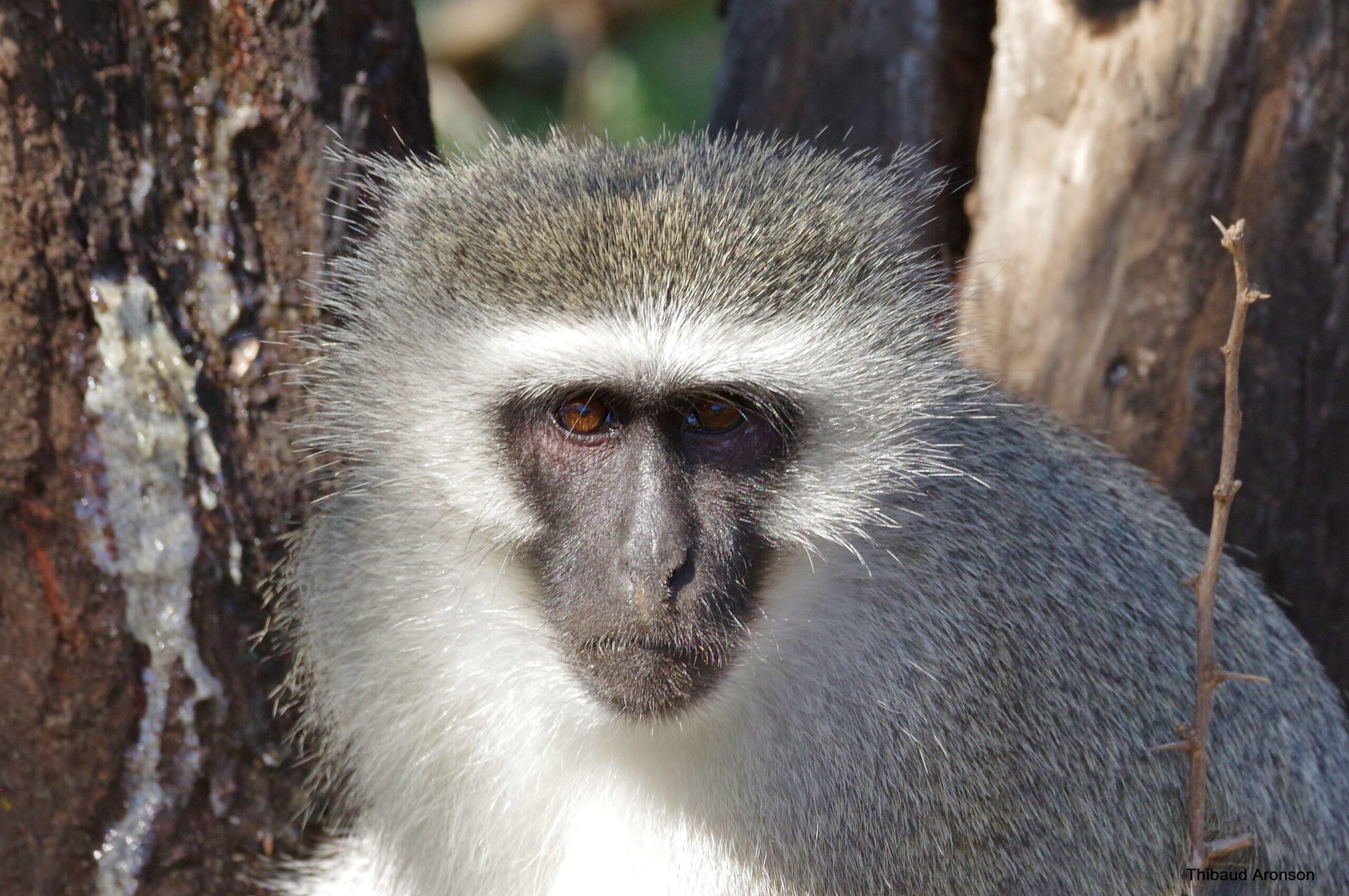
A male vervet monkey (Chlorocebus pygerythrus) feeding in an Acacia, at Camdeboo National Park.
This nearly 9000-ha property once encompassed three game farms, which were severely overgrazed for a century, if not more. The properties were acquired by Vincent Mai, a South African who lives and works in New York City, and his wife Anne. They wanted to help preserve a piece of the Karoo where Vincent had grown up.
As it was clear that overgrazing in the past had seriously damaged the land, a South African conservation organization, the Wilderness Foundation, was invited to help. For the past six years, this foundation has been carrying out restoration work on the reserve. Their main focus is on eroded and impoverished soils, and they have undertaken a range of approaches, from grazing native Zulu cattle, to using agave stems and hay to block erosion gullies. A number of mammal species were also reintroduced. Angus Tanner, the indefatigable manager, showed us the range of their work on the reserve. Money and manpower is limited, and there are still many obstacles, but they are making great strides. They rely on Renu-Karoo for advice and seeds and technical advice. They are also reaching out to cooperate with the nearby township and their neighbors. Stitch by stitch, and farm by farm, the restoration culture is spreading in the Karoo.
Traditional Zulu cattle in the Plains of Camdeboo Nature Reserve. They both break up compacted soil and fertilize it as the managers move them around the property.Two adjacent erosion gullies at the Plains of Camdeboo. The one on the right was plugged with a fence gabion and agave stems, in order to slow water flow and trap sediments. The gully on the left was not treated. A year later the difference between the two speaks for itself.
Meg Engelhardt is Missouri Botanical Garden’s Seed Bank Manager. She describes her ex situ conservation program and its applications for ecological restoration.
Seeds have been stored for food since the dawn of agriculture, but in recent decades seed banks have become an increasingly relied upon tool for plant conservation. Ideally we would conserve all plants in their natural habitats, or in situ. After all, when plant populations remain intact so do the relationships with other organisms in their ecosystems. Intact plant populations also maintain gene flow within the species, helping populations continually adapt to their surrounding environments. Unfortunately, it is not always possible to maintain wild plant populations. Even when resources are available, maintaining natural plant populations may be impossible due to habitat fragmentation or destruction, range shifts due to climate change, pollinator loss, or any list of known or unknown factors resulting in population decline. This is where seed banking, or ex situ conservation, may play a supporting role.
Collecting seeds from a dolomite glade in Franklin County, Missouri
Seed banks are long term storage facilities designed to keep seed viable for years and even decades. Those seeds can then be used for research, restoration, reintroduction, or education.
Maybe you have heard of the Svalbard “doomsday” Seed Vault, where seeds of more than 4000 plant species are stored deep below the permafrost near the north pole. Or perhaps the Millennium Seed Bank, which holds 13% of the world’s wild plant species and continues to collect the world’s threatened flora. Here in the United States we have the Native Plant Germplasm System, a network of 20 storage facilities across the country that store over 15,000 species, with a focus on agriculturally important species. On a more local scale, many small seed banks are used to conserve regionally important, threatened species.
Inside a very large freezer at the National Center for Genetic Resources Preservation in Ft. Collins, Colorado
The Missouri Botanical Garden has been seed banking for over thirty years. In 1984 the Center for Plant Conservation (CPC) was founded with Missouri Botanical Garden as a founding member. CPC is a network of 40 botanical institutions focused on ex situ conservation of rare plant material while also ensuring material is available for restoration and recovery efforts. Our CPC collection is currently maintained by staff who are actively seed banking, researching, and restoring populations of extremely rare native plants throughout southeastern US (Solidago ouachitensis, for example).
Additionally, seed collecting and short term seed storage has been going on for at least 25 years at Missouri Botanical Garden’s Shaw Nature Reserve. Horticulture staff at the Reserve are focused on local ecotype native plant horticulture and have been collecting seed from regional wild sources for use in small scale greenhouse propagation, use in the Whitmire Wildflower Garden, restoration projects throughout the Reserve, and various other partnerships that encourage native plant horticulture.
The Shaw Nature Reserve “seed closet” currently houses almost 500 different taxa ‒ most of which are local wild source (i.e., seed collected from plants growing in the wild) or second generation seeds (i.e., the first descendants of plants growing in the wild).
In 2013 the Missouri Botanical Garden Seed Bank was created with two main goals. First to advance seed banking at an institutional level by providing support and facilities. A new seed lab space was created at Shaw Nature Reserve which includes lab benches and space for processing collected seed and cleaning for storage as well as a refrigerator and freezer storage space. The second goal is to collect and store samples of Missouri’s entire flora, which includes roughly 2,055 taxa. Continually collecting and storing samples of all local species will ensure long term genetic conservation that can be made available for research, restoration, and recovery should the need arise.
Andres Santana is the graduate program coordinator at the Organization for Tropical Studies. During a recent fieldtrip in southern Costa Rica, he and CCSD restoration ecologist Leighton Reid compared notes on using fig stakes for ecological restoration.
Tropical beaches are many things to many people. To plants, beaches are hot, sandy, and salty – complicating their restoration.
Costa Rica has 1228 km (763 mi) of coast line – including 1016 km on the Pacific side and 212 km on the Caribbean. Along Costa Rica’s northern Pacific coast, the beach forms the natural edge of the dry forest. Farther south the adjacent forest is more humid. Giant trees, 40 m or more in height, grow right up to the high tide mark, particularly along the Caribbean.
But as with so many tropical ecosystems, Costa Rica’s coastal forests have been subject to human impacts. Many shoreline forests were cleared for cattle ranching, and exotic grasses were introduced as forage. Some of these grasses are fierce competitors and prevent tree seedlings from establishing, even long after the pastures have been abandoned.
Playa Hermosa, before (left) and after (right) planting 2-m long cuttings of a coastal fig species (Ficus goldmannii).
In 2009, a small non-profit organization, Costas Verdes, was formed to restore coastal forests along degraded shorelines, particularly wildlife refuges. The restoration work was initially challenging; tree seedlings were hard to establish along the coast because of the harsh environment – high temperatures and salinity and lack of freshwater were among the most significant obstacles. Not to mention the invasive cattle forage grasses.
Coastal restoration at Playa Hermosa
Playa Hermosa, a surfing destination on the Central Pacific coast, was among the most heavily deforested project sites. This area, part of a wetland and river estuary, was declared a national wildlife refuge in 1998. By 2009, very little forest had naturally regenerated. This led Costas Verdes to implement a restoration project at this beach. Planting plots were established where invasive grass was removed. In other areas, grasses left intact, as a comparison. It quickly became evident that tree seedlings were outcompeted by the grass. Those in the cleared plots grew better, but they still faced the other coastal habitat challenges.
Some native trees are resistant to hot substrates and high salinity, but these species were not available in tree nurseries, most of which focused on ornamental species. This meant that seedlings needed to come from locally collected and germinated seeds. We realized that this would take time to get going. Tree seedlings under 50 cm rarely survive, even if they have the proper coastal adaptations.
To accelerate the restoration, we decided to use tree cuttings rather than growing seedlings from seed. A colleague suggested Ficus goldmannii as a candidate species, so in 2011 we conducted a planting trial. We planted 225 2-m long cuttings. Of these, 195 (87%) survived their first year. By the second year all 195 survivors had become established and were quickly providing canopy cover and lowering the temperature of the sand.
An established fig stake with a dense canopy. Note the weak, patchy grass below it.
Once fig stakes created some canopy cover, we brought in other tree species – mostly from the coastal tree nursery that we created. Shade from the fig canopy also began to inhibit the invasive grasses, which require high sunlight to photosynthesize efficiently. Reduced competition with these grasses allowed other tree seedling species to survive.
In this instance Ficus cuttings turned out to be useful in promoting restoration. We have since used cuttings for other plots with similar success.
Coastal trees and shrubs growing below established fig cuttings at Playa Hermosa.