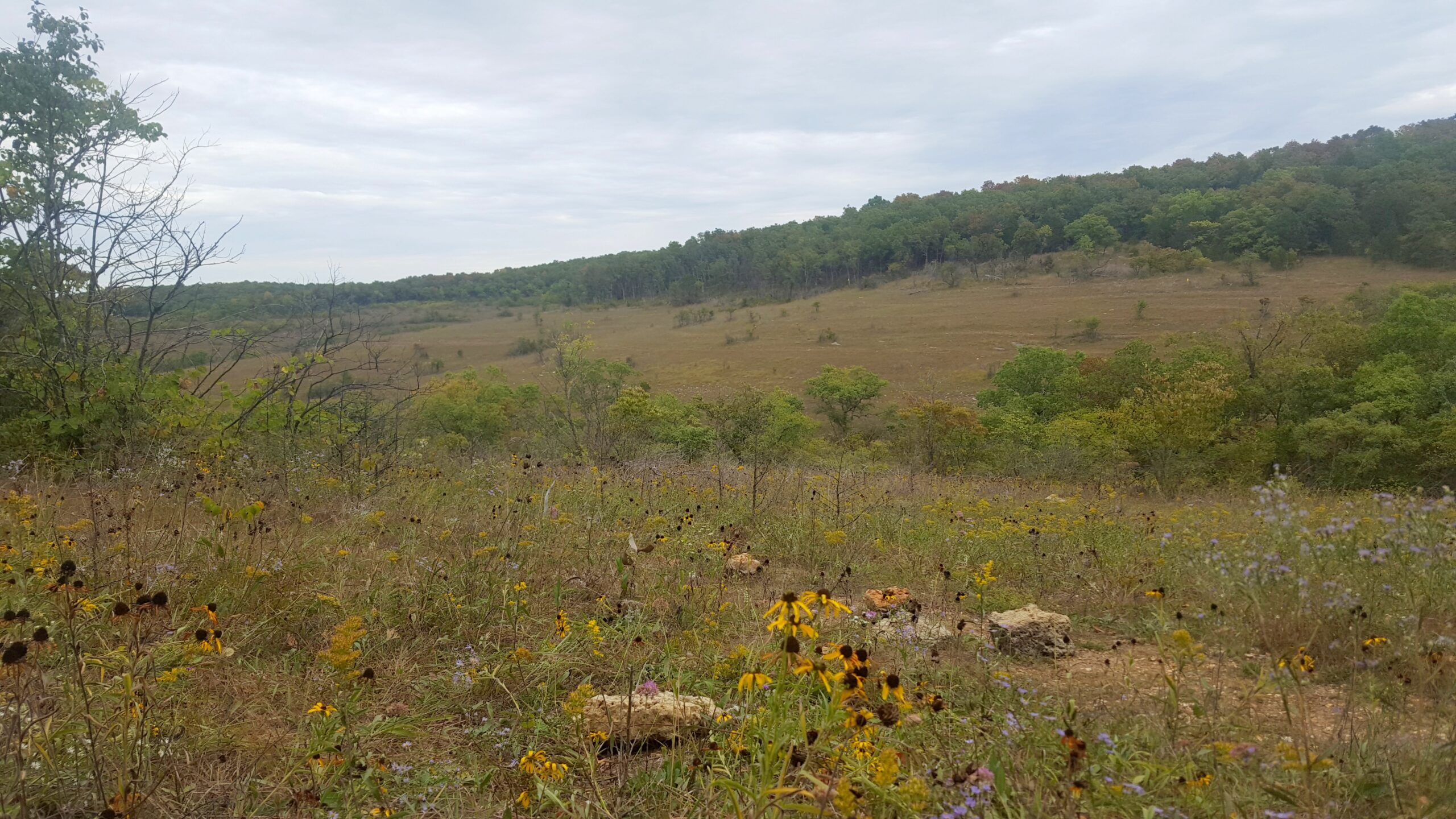
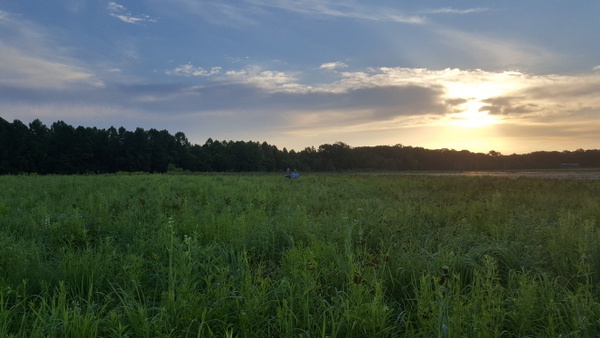
In early October, CCSD scientists Leighton Reid, Matthew Albrecht, and James Aronson and Shaw Nature Reserve naturalist James Trager toured several dolomite glades with Greg Mueller (Chicago Botanic Garden) and Betty Strack (Field Museum). We used the opportunity to discuss glade natural history and restoration.
In his book The Terrestrial Natural Communities of Missouri, Paul Nelson describes glades as:
“…open, rocky, barren areas dominated by drought-adapted forbs, warm-season grasses and a specialized fauna. They appear as small or large essentially treeless openings within landscapes primarily dominated by woodlands.”
Missouri glades are characterized by their geology. Many occur on southwestern-facing slopes with outcrops of sedimentary rocks, like dolomite and sandstone. But some also occur with igneous rocks in the St. Francis Mountains and Tom Sauk Mountain.
But glades are also like islands. To many of the organisms adapted to these sunny, rocky environments, the dark, duffy woodlands that surround them may seem like an oceanic barrier to movement. Dispersal events between glades can be rare. For collared lizards, dispersal is contingent on landscape fire to temporarily make the surrounding woodlands more easily traversable.
Glades are rarely cultivated, but many have been grazed. Cattle degrade glades by eroding and compacting their thin, precious soil. Some glades are also maintained by fire, which keeps woody trees and shrubs from crowding out the forbs and grasses. When people suppress fires, some glades become overrun with trees – especially eastern redcedar (Juniperus virginiana).
Shaw Nature Reserve contains a kind of chronosequence of glade restorations. Near the Maritz Trail House, Crescent and Long Glades were restored in the 1990s by clearing out the encroaching redcedar, establishing a fire regime, and reintroducing forbs and grasses – some of which were sourced from the remnant prairie at Calvary Cemetery in St. Louis. Other glades at Shaw Nature Reserve were restored in the 2000s and 2010s using similar techniques. So it might be possible to study changes in restored glades over time by comparing older restored glades to younger ones.
Could better-conserved dolomite glades serve as a reference to guide restoration at Shaw Nature Reserve? Beautiful dolomite glades are conserved at Valley View Glades Natural Area, Victoria Glades Conservation Area, and Meramec State Park. Some of these have plant species that are missing from Shaw Nature Reserve, possibly because they once existed at Shaw Nature Reserve and were extirpated, or possibly because glades at Shaw Nature Reserve lack appropriate ecological conditions for these plants. For example, prior grazing may have stripped the soil of some vital mycorrhizal fungi. Either way, the lack of some rare plants at Shaw Nature Reserve is probably exacerbated by fragmentation – a remnant plant population at Valley View Glades Natural Area would probably have trouble dispersing seeds 28 kilometers (17 miles) to Shaw Nature Reserve.
Further reading
Nelson P. (2010) Terrestrial Natural Communities of Missouri. 550 pages.
Lines of woody vegetation on dolomite glades correspond to the local stratigraphy; plants like gum bumelia (Sideroxylon lanuginosum) and eastern redbud (Cercis canadensis) accrue on slightly deeper-than-average soils. (Crescent Glade, Shaw Nature Reserve)In this regularly burned glade at Shaw Nature Reserve, there is a fairly seamless transition between the open glade with abundant Rudbeckia and Silphium and the adjacent oak/hickory woodland. In other places, such glade/woodland transitions are marked by a dense thicket of vegetation, often with a strong component of eastern redbud or eastern redcedar. (Crescent Glade, Shaw Nature Reserve)Gattinger’s goldenrod (Solidago gattingeri) is an open-panicled goldenrod found on dolomite glades in the northern Ozarks and, disjunctly, in the cedar barrens of central Tennessee. This one was growing just above a transition from dolomite to sandstone substrate on Crescent Glade at Shaw Nature Reserve.A short-winged meadow katydid (Conocephalus brevipennis) rests on a seed head of Missouri coneflower (Rudbeckia missouriensis). These black seed heads were abundant across Crescent Glade in early October.Barn glade has been restored much more recently. A line of green, resprouting brush (including invasive Lonicera maackii and Ailanthus altissima) is visible where woody vegetation was recently removed. Blue flags in the foreground mark an experimental population of endangered Pyne’s ground plum (Astragalus bibullatus).A denizen of barn glade – the lichen grasshopper. (Shaw Nature Reserve)
The quality of Valley View Glades Natural Area is evident in the abundant and diverse fall wildflowers that were present in early October. Could regional dolomite glades like this one serve as references to guide glade restoration at Shaw Nature Reserve?
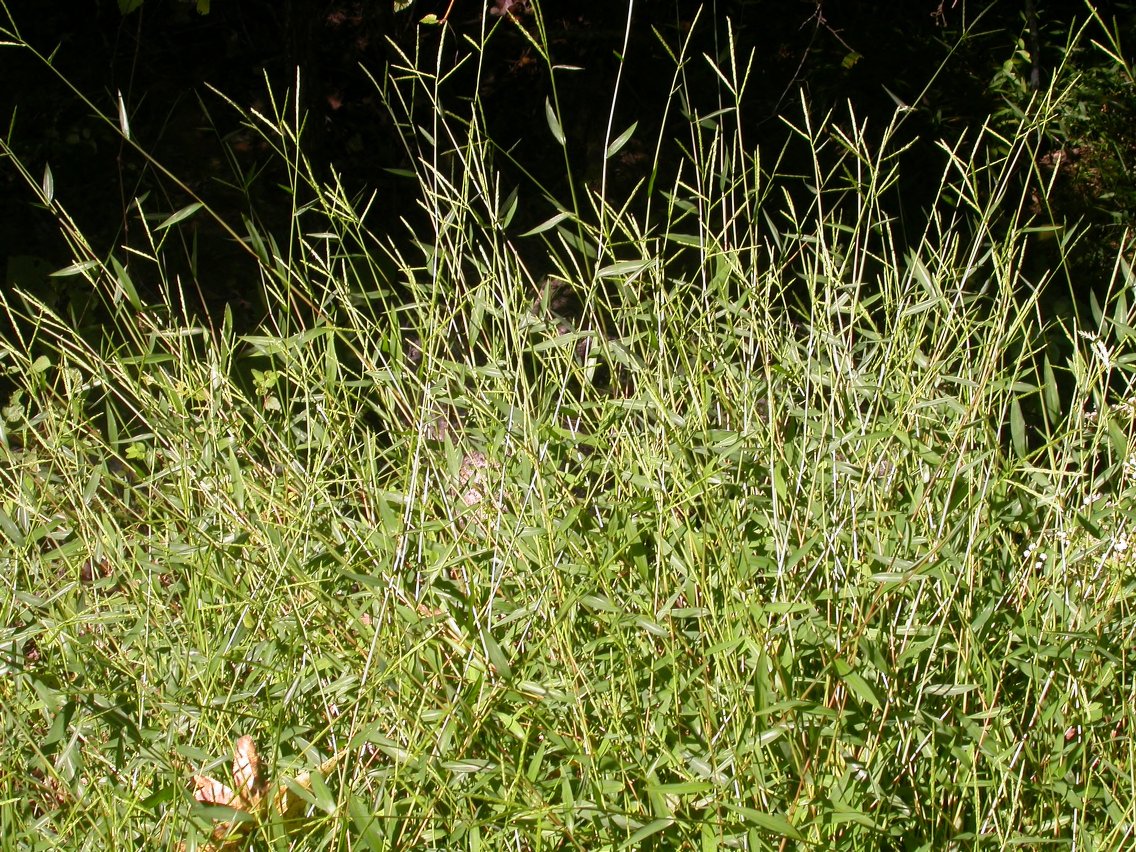
Restoration specialist, Mike Saxton, describes his observations on the distribution of invasive Japanese stiltgrass along a creek running through Shaw Nature Reserve.
Brush Creek (blue) runs eastward through Shaw Nature Reserve in Gray Summit, Missouri. Gray Summit Road is in the upper right.
July 28, 2017
Yesterday, Adam and I put in to Brush Creek at the Old Gray Summit Rd. bridge and headed upstream spraying Microstegium vimenium(Japanese stiltgrass). This was the second time through this area this year and I made this sweep solo 3 times last season. My first outing last season, I used 3 gallons of herbicide before I finished the first wetland cell…this year it’s been much, much lighter. Last year, with only 1 person spraying, I was hard pressed to leave the creek bed because there was so much to spray directly along the accessible banks. And in our first outing this season, Catherine and I stayed completely within in the creek, rarely going up on the banks.
However, yesterday Adam and I abandoned the creek bed and went crashing through the brushy banks, finding more Microstegium than I had anticipated. What was interesting was that pockets of stiltgrass followed a predictable pattern of distribution. In many areas, one creek bank will be severely down cut, perhaps 15 ft sheer banks, while the opposite bank is tapered with a more gradual slope. This is where you find the Microstegium. I posit that floodwaters do not over-top the high bank but rush over the lower bank depositing sediment and seed. Almost without fail, the lower bank, if totally brushy, would have scatted Microstegium. However, if the lower bank was open or had open pockets of sunlight, those pockets would be dense thickets of stiltgrass. We observed a nearly 1-to-1 correlation between bank height and stiltgrass presence/absence and open sunlit patches having dense patches of stiltgrass on the lower banks.
I was covering a roughly 20 ft swath out from the bank edge before it dropped into the creek bed. I did go further from the creek a number of times but wasn’t finding much (if any) the further I got from the creek.
Management considerations
Based on these observations, I believe that our current strategy of managing downstream from the “head waters” is prudent. Based on the diminished population this year and because the species has a 5-year seed viability, we should continue to see diminishing populations if we continue to be methodical and thorough with our management.
We repeatedly found dense patches of Microstegium in high light availability openings/tree fall gaps. This suggests to me that if we open up the brush creek corridor with forestry mowing/brush cutting, the increased light levels and soil disturbance might cause a spike in Microstegium populations. While the brush creek corridor isn’t priority #1, I know we’ll get there some day. Before we aggressively start clearing brush in this area, I’d like to have 3-5 years of aggressive Microstegium management under our belts. We have observed diminished populations in the wildflower garden, along Paw Paw Creek, and along Brush creek with just one year of management. Coupled this with a short seed viability…and we might have a winning strategy.
Large patch of Japanese stiltgrass (Microstegium vimenium) along Brush Creek at Shaw Nature Reserve.
Claire Waldman is a senior at Centre College. This summer, she worked with CCSD scientist Matthew Albrecht to study the legacy of burn pile scars – the ashy leftovers from burning thinned tree trunks – in a restored woodland at Shaw Nature Reserve as part of MBG’s NSF-funded Research Experience for Undergraduates (REU) program.
In December 2016, the staff at Shaw Nature Reserve began a major restoration project focusing on 60 acres of woodland that were heavily invaded by bush honeysuckle (Lonicera maackii), Japanese privet (Ligustrum japonicum), and other invasive shrubs. This work, funded by the Institute of Museum and Library Services, commenced with removal of the invasive shrubs and thinning the canopy through selective tree cutting to promote a more open woodland structure. An open canopy structure allows for future use of prescribed burns in the area to help maintain the open canopy and facilitate diverse understory vegetation.
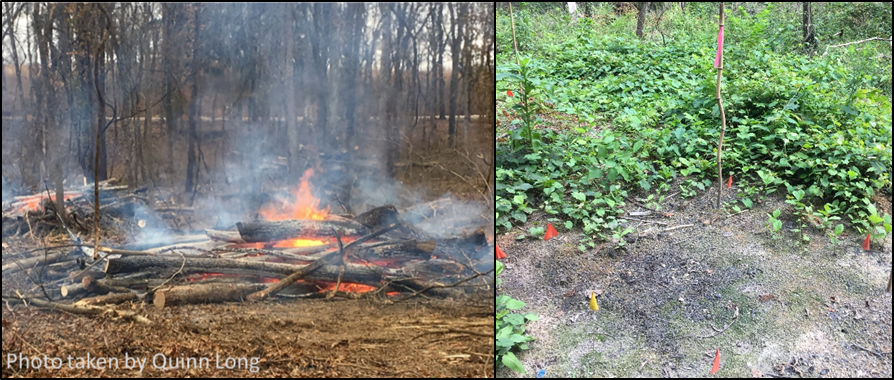
Canopy thinning left land managers with excess woody debris – that is, there were many large, fallen trees covering the forest floor. Rather than use heavy machinery to remove the logs (which often creates a large amount of soil disruption), the wood was stacked into piles and burned. These slash pile burns create an extremely localized but intensive disturbance. The soil at the burn site becomes sterilized and covered in a layer of ash. These sites are referred to as burn scars. The layer of ash that remains, as well as the absence of vegetation, make burn scars easily identifiable.
Slash pile burn at Shaw Nature Reserve, December 2016 (left). Barren sampling plot in a burn scar six months later (right).
Slash pile scars were distributed across the restored site at Shaw Nature Reserve. Previous research has suggested the combustion of biomass and extreme temperatures of the burns can be lethal to the soil seedbank, alter soil structure, moisture, and nutrient availability. The rate of native vegetation recovery on slash pile scars depends on burn intensity, pile area, and properties of the surrounding plant community. The native plant community in burn pile scars, without active seed addition by people, are expected to recover slowly. If the native plant community recovers slowly over time, it raises the concern that slash pile scars could serve as foci for the reestablishment and spread of invasive or undesirable species.
This summer, as part of the NSF-funded Research Experience for Undergraduates program at the Missouri Botanical Garden, I worked under the guidance of Matthew Albrecht to further our understanding of these slash pile burn scars.
First we developed a field experiment focused on native vegetation recovery in slash pile burns. In order to characterize the changes in soil nutrients, compaction, and moisture that occur in these burn piles, we took soil samples from the burn piles as well as adjacent control areas and sent them to the University of Missouri Soil and Plant Testing Laboratory. The results we obtained from this soil analysis were dramatic. Soil pH, P, Ca, Mg, and K were all significantly higher in the burn pile. Soil compaction and soil organic matter were both significantly lower in the burn pile.
Soil chemical properties from samples of the top 4 cm of burn pile and control soil (Albrecht et al. Unpublished data).
While there was an apparent flush of nutrients available in these burn piles, in the first growing season after a burn occurred, we found that burn scars remained essentially bare. We created experimental burn scar plots in which we seeded six native species. The six species sown into the plots were Bromus pubescens (grass), Chasmanthium latifolium (grass), Lespedeza violacea (legume), Senna marilandica (legume), Solidago ulmifolia (composite), and Symphyotrichum drummondii (composite). We also seeded these species in adjacent unburned control plots. We then monitored plant occupancy in these plots over the course of eight weeks.
Six native plant species seeded into the burn pile scars and adjacent control areas.
We found four of the six species established significantly better in the control plots relative to the burn scar plots. These results support that while there is a significant influx of nutrients in the burn scars, there are other factors that are limiting native species establishment in the burn scars.
Vegetation cover in a burn plot six months after a slash pile burn (left) and an adjacent, unburned control plot (right).Average percent native vegetation cover (± 1 standard error) in burned plots and unburned control plots (Albrecht et al. Unpublished data).
There are restoration implications of our results. We found, of the six species sowed into the burn plots, native grasses established best. While the microenvironment created by slash pile burns presents a barrier to the restoration of native vegetation in burn pile scars, seed additions of native grasses provide a practical management strategy for promoting native vegetation recovery in burn pile scars.
Average plot occupancy for six native herbaceous plant species in burned plots and unburned control plots. Error bars denote 1 standard error. P-values were derived from a generalized linear mixed effects model. Brpu = Bromus pubescens, Chla = Chasmanthium latifolium, Levi = Lespedeza violacea, Sema = Senna marilandica, Soul = Solidago ulmifolia, Sydr = Symphyotrichum drummondii. (Albrecht et al. Unpublished data).Claire Waldman recording plant occupancy in an experimental plot at Shaw Nature Reserve.
The following is an introduction by Leighton Reid and James Aronson to a special feature in Annals of Missouri Botanical Garden about ecological restoration in a changing biosphere. The eight papers described are derived from presentations last October at the 65th Annual Plant Symposium. The full issue can be found here.
Restoration efforts will affect large areas of the planet and hundreds of millions of people over the coming decades, but what will these actions look like, and what will they achieve? Debate continues about what constitutes appropriate restoration targets in our human-dominated and ever more rapidly changing world, and the outcome of this debate will impact the actions taken to conserve biodiversity, sequester carbon, and improve human livelihoods at large spatial scales. This special issue brings together eight scientific, historical, and journalistic perspectives to address these two critical questions about ecological restoration in a rapidly changing biosphere.
In the post-COP22 world, when all three of the UN’s “Rio Conventions” call for scaling up and mainstreaming of ecological restoration (UNCBD 2012; UNCCD 2015; UNFCCC 2015), and dozens of governments have made ambitious restoration commitments (IUCN 2016), it is clear that restoration programs will affect hundreds of millions of hectares – and as many people – over the coming decades. At the same time, we find ourselves in an era of unprecedented change where climate, ecological baselines, and future land-use changes are highly uncertain (Steffen et al., 2015). This raises the crucial question: What will large-scale restoration activities look like in the coming years?
Unsurprisingly, there are differences of opinion about the future of restoration and how to scale it up and integrate it with larger programs in an era of major, anthropogenic changes. Hobbs et al. (2011; pg 442) observe that “…the basic principles and tenets of restoration ecology and conservation biology are being debated and reshaped. Escalating global change is resulting in widespread no-analogue environments and novel ecosystems that render traditional goals unachievable. Policymakers and the general public, however, have embraced restoration without an understanding of its limitations, which has led to perverse policy outcomes.” [Emphasis added]
This perspective has received considerable attention (ESA 2016) and also pointed criticism (Murcia et al., 2014). Aronson et al. (2014; pg 647) retort that “…Restoration includes a wide range of practical possibilities for dealing with transformed ecosystems, including rehabilitation, reclamation, and remediation. Some will bring the ecosystem back to its historical trajectory, some will bring back only some attributes, but the intention is that the end product is better than the degraded ecosystem. Importantly, a label such as novel ecosystem implies no need for further intellectual exertion – and ignores the growing science of the young discipline of ecological restoration.” [Emphasis added]
The debate goes on about what we are trying to restore (Hobbs, 2016; Kattan et al., 2016; Miller & Bestelmeyer, 2016), with implications far beyond academia. Billions of dollars are now being spent to rehabilitate and restore degraded ecosystems, sometimes at large scales, and the science of restoration ecology must adapt to be integrated in larger planning and management schemes, wherein conservation, management, and restoration will all take place.
On 8 Oct 2016, we convened a panel of six scientists, one historian, and a journalist, all with long-standing involvement in the field of restoration ecology. The goal was to discuss ecological restoration in a changing biosphere at the 63rd Annual Fall Symposium at Missouri Botanical Garden. Each speaker has contributed a paper to this special issue.
The first set of papers focus on the question: Has global change outpaced and rendered obsolete the so-called “classical” ecological restoration approach? Aronson et al. (2017) say no, far from it; for example, the historically-based reference system ‒ a pillar of ecological restoration to date ‒ is more valid than ever and can indeed be adapted to landscape and higher levels of complexity. They emphasize that while restoration ecology has produced many useful ecological models, a participatory approach and consensus-building among stakeholders are crucial at these higher levels of integration. Falk (2017), in contrast, says yes: global change calls for radical rethinking of ecological restoration. He focuses on ponderosa pine forests in the southwestern US, which are undergoing a major, climate change-induced biome shift from forest to shrub land, and he concludes that a shift towards resilience-based management is necessary to supplement traditional ecological restoration. Meine (2017) takes the middle ground through an historical analysis; he notes that Aldo Leopold (1887-1948) would likely have concluded that a simple “yes” or “no” was inappropriate and that ecological novelty is neither novel nor absolute.
Whereas the first group of papers asks what we should restore, the second group focuses more on how we will restore at larger spatial and temporal scales. Brancalion & van Melis (2017) suggest that to bridge the gap between science and practice, we need to innovate; rather than refining current approaches, restoration ecologists must look outside of their disciplinary silos for fresh solutions to contemporary dilemmas. One source of new insights will be through joint research between scientists and practitioners. To this end, Holl (2017) presents several new directions for tropical forest restoration research (graduate students – take note!). She emphasizes that for research to best inform practice, it should be conducted at large spatial and temporal scales, research projects should be undertaken jointly with stakeholders, and resulting knowledge should be shared across regions. Chazdon (2017) argues that natural regeneration, more than any other method, is the key for scaling up to efficient forest and landscape restoration, and she emphasizes the need to identify priority areas where natural regeneration is maximally feasible and minimally competitive with alternative land uses. Finally, Reid et al. (2017) argue that however we restore ecosystems, we should plan to make them last; the longevity of restored ecosystems, they suggest, is variable, often finite, and determined to some degree by stakeholder preferences, environmental attributes, and the umbrella of governance. These papers emphasize tropical forest restoration, particularly in Latin America, which is appropriate given this biome’s global importance, yet the topics addressed will be of interest to readers with experience in many ecosystems.
The last word (for this special issue, at least) is left to Paddy Woodworth (2017), an international journalist with broad and optimistic perspectives on ecological restoration (Woodworth, 2013). Looking across the contributions, he observes that the words we choose have meaning and cautions against the use of the word “restoration” for anything less than the process of assisting the recovery of an ecosystem that has been degraded, damaged, or destroyed (SER 2004).
We hope that readers from many backgrounds, including researchers, practitioners, and policymakers, will find this special issue worth pondering as they move forward with our collective task to progress towards a more sustainable, just, and desirable future.
Joseph Smith is a rising senior at Lake Superior State University. This summer, he studied the effect of prescribed fire on Eastern Bluebird nesting success at Shaw Nature Reserve as part of MBG’s NSF-funded Research Experience for Undergraduates (REU) program.
Among the rich plant diversity at Shaw Nature Reserve are a wide range of animal species, including the Eastern Bluebird (Sialia sialis). The Nature Reserve is home to an extensive bluebird trail consisting of 86 nest boxes in the north-central region of the reserve. This summer, I have been working with Dr. Leighton Reid and a citizen scientist, Lynn Buchanan, in an effort to understand the effects that land management practices have on bluebird nest success.
Prescribed fire is one of the most important management practices used at Shaw Nature Reserve. In the 2016-2017 burn season, for instance, nature reserve staff set fire to 306 ha (756 acres) of woodlands, prairies, and glades to restore and maintain open vegetation structure and a high diversity of native plants. However, it was unclear what effect these fires might have bluebirds.
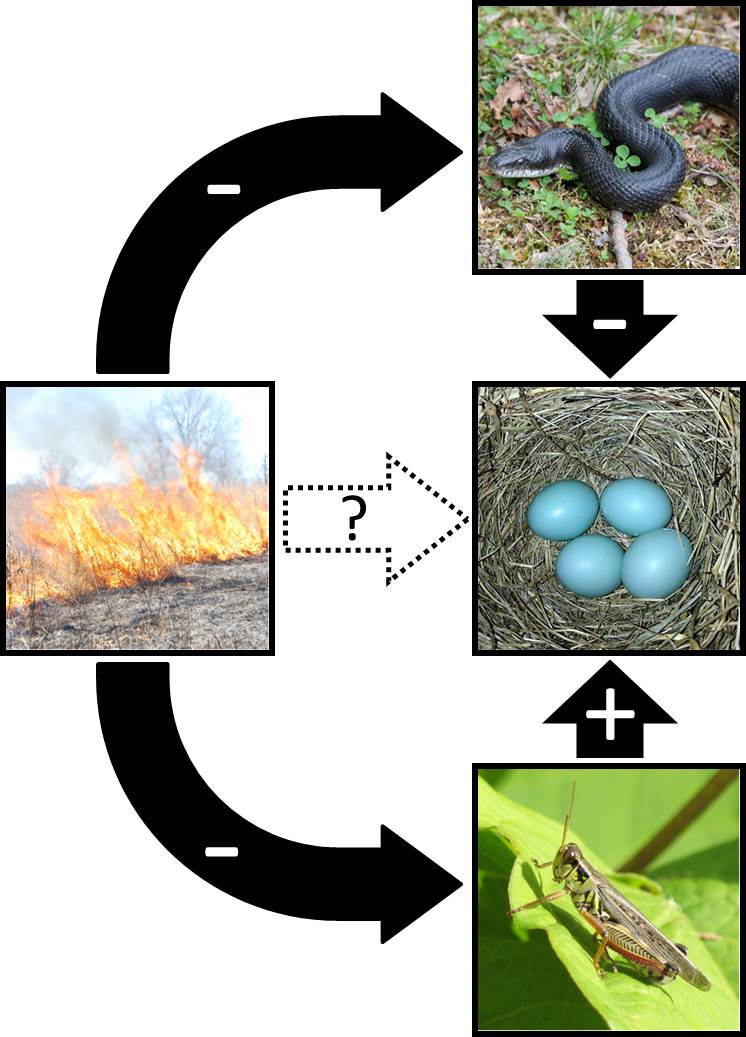
Hypothetical effects of prescribed fire on Eastern Bluebird nest success. +/- symbols denote the short-term effect of fire on snakes and arthropods, and the effect of snakes and arthropods on bluebird nest success. Photo credits: (1) Black rat snake (Pantherophis obsoletus) by John Mizel CC BY-NC-SA 2.0, (2) Bluebird eggs by Bailey & Clark (2014); (3) Red-legged grasshopper (Melanoplus femurrubrum) by Gilles Gonthier; (4) Prescribed fire courtesy of Shaw Nature Reserve.
We hypothesized that fire might affect bluebird nesting success in two ways. First, fire could reduce the food supply for nesting birds. When understory vegetation burns, many arthropods are also killed, and it takes some time for their populations to rebound. During the lag, bluebirds might have less to eat, which could result in poorer nest success.
Second, fires could increase nest success by reducing the risk of snake predation. Bluebird boxes at Shaw Nature Reserve are equipped with baffles to prevent snakes from getting in, but snake predation still occurs sometimes. After a fire, there is less vegetation to hide snakes from their own predators, like raptors, and we surmised that fewer snakes could mean more successful bluebird nests.
The Bluebird Trail at Shaw Nature Reserve. Bluebird nest boxes are shown in yellow.
We tested our hypotheses using a long-term dataset collected by volunteers. Over the past eight years, Lynn Buchanan and her team have monitored the nest boxes on the bluebird trail and kept records of their observations. Each week during the breeding season, they peek into all of the boxes and record the number of eggs and nestlings, how many nestlings fledged, and whether or not the nest was predated.
With statistical help from Washington University researcher Joe LaManna, we found that prescribed fire had little or no effect on bluebird nesting. We compared areas that were burned with areas that were mowed, and we also compared burned areas at different time intervals since the most recent fire (0-3 years). Likewise, we found no effect of prescribed fire on the rate of snake predation.
Species
Probability of nest success (%)*
Probability of snake predation (%)*
Did nest success change from 2009-2016?
Did prescribed fire have an effect on nest success?
Eastern Bluebird
90.8 ± 0.5
4.6 ± 0.3
No
No
House Wren
92.1 ± 0.1
4.0 ± 0.3
No
No
Tree Swallow
92.1 ± 0.1
4.8 ± 0.4
No
No
*Standard errors are shown
While the lack of significant results can be slightly disheartening after an entire summer of work, it is reassuring that the bluebird population is thriving at Shaw Nature Reserve. Overall, we calculated that 90.8 ± 0.5% of bluebird nests produced at least one fledgling. In addition, two other species (House Wrens and Tree Swallows) that commonly use bluebird boxes also had high nest success.
There are more aspects of bluebird nesting to look at. For instance, the time from when an egg hatches until the chick leaves the nest could be longer in recently burned areas if there is less food (i.e., arthropods) available. In the meantime it appears the bluebirds are living well at Shaw Nature Reserve.
Eastern Bluebird (left) and bluebird nest box (right) at Shaw Nature Reserve. Photo credits: (L) Bluebird by Andy Reago & Chrissy Mclarren; (R) bluebird nest box by Rachel Weller.
The best time to start a long-term dataset is 25 years ago. The second-best time is now!
Summer solstice is the height of the bird breeding season at Shaw Nature Reserve. Dozens of species are singing, from Dickcissels in the open prairies, to Prothonotary Warblers in the damp forests along the Meramec River, to near-ubiquitous Blue-gray Gnatcatchers, seemingly everywhere.
Chuck-will’s-widow (Antrostomus carolinensis) by Dick Daniels (CCPL)
Ovenbird (Seiurus aurocapilla) by Dick Daniels (CCPL)
Prairie Warbler (Setophaga discolor) by William H. Majoros (CCPL)
Northern Cardinal (Cardinalis cardinalis) by Eric Bégin (CCPL)
Eastern Kingbird (Tyrannus tyrannus) by USFWS (CCPL)
Eastern Bluebird (Sialia sialis) by William H. Majoros (CCPL)
Indigo Bunting (Passerina cyanea) by Dawn Scranton (CCPL)
Louisiana Waterthrush (Parkesia motacilla) by Kelly Colgan Azar (CCPL)
Red-headed Woodpecker (Melanerpes erythrocephalus) by Francesco Veronesi (CCPL)
Orchard Oriole (Icterus spurius) by Dan Pancamo (CCPL)
Dickcissel (Spiza americana) by ramendan (CCPL)
Prothonotary Warbler (Protonotaria citrea) by Dominic Sherony (CCPL)
Common Yellowthroat (Geothlypis trichas) by Wolfgang Wander (CCPL)
Blue-gray Gnatcatcher (Polioptila caerulea) by Kelly Colgan Azar (CCPL)
Northern Bobwhite (Colinus virginianus) by cuatrok77 (CCPL)
For six days this month, two students and I are counting birds systematically across Shaw Nature Reserve to learn how they are influenced by ecological restoration. Birds are a common focus for monitoring restoration projects because they can be observed efficiently over large areas, and because they often respond quickly to changes in ecosystem structure. Ovenbirds, for instance, prefer the dark shade of closed-canopy forests, whereas Kentucky Warblers replace them in woodlands that have been burned (fire is a common restoration strategy in many Missouri ecosystems).
Locations of bird counting stations at Shaw Nature Reserve. Each point is at least 100 meters from the edge of a management unit and at least 200 meters from any other station.
A typical bird survey goes like this:
4:20 AM. I pour a travel mug of coffee, pick up a student to help record data, and drive to Shaw Nature Reserve in the dark. There are way too many deer along the side of I-44.
~5:00 AM. We arrive at Shaw Nature Reserve in twilight and hear a cacophony of birds singing over one another. Indigo Buntings scatter from the loop road ahead of our car.
~5:15 AM. We arrive at the first bird counting station and record the temperature, cloud cover, and wind speed. For five minutes, we write down each bird that we hear or see. Sometimes during these early morning counts, nocturnal birds, like Chuck-will’s-widow, are still calling.
~5:30-10:00 AM. After we finish a point, I set my GPS to navigate to the next point on our route and we continue to record birds until mid-morning, by which time it is warm and many birds have stopped singing (although the Red-eyed Vireos are still going strong).
Leighton Reid (left) listens to Wood Thrushes and Northern Parulas while REU student Joseph Smith (Lake Superior State University, right) records data. As indicated by the abundant bush honeysuckle (Lonicera maackii; e.g., by Leighton’s right leg), this particular part of the reserve has yet to be restored.
This is our inaugural bird survey at Shaw Nature Reserve. Unlike many of my projects, this one does not have explicit apriori hypotheses; I’m not trying to “test” anything. Instead, I intend for these data to be used for monitoring and demonstrating progress. Over time, I hope and expect these observations to provide a record of biodiversity change as portions of the reserve are restored and managed.
Counting Common Yellowthroats, Dickcissels, and Red-winged Blackbirds at dawn at the Wetland Mitigation Bank.
For more information on breeding birds at Shaw Nature Reserve, you can explore citizen science observations on eBird, including this printable checklist of birds recorded in June during the past 10 years.
There are almost 3000 species of vascular plants in Missouri. Which ones should we conserve at Shaw Nature Reserve?
One of the most challenging questions in restoration ecology is what species should live in a restored habitat? When we assist ecosystem recovery by removing invasive species or applying prescribed fire, for example, some plant species reappear on their own. They emerge from seeds that were dormant in the soil, or they are transported in from elsewhere by wind, water, or animals. But other species require assistance.
In ecology, the set of species that could live in a given habitat but are currently absent is called “dark diversity”. Quantifying dark diversity can help set restoration targets by highlighting gaps in species composition. A starting point for calculating a site’s dark diversity is to take a regional species list and subtract out the species present at the restoration site.
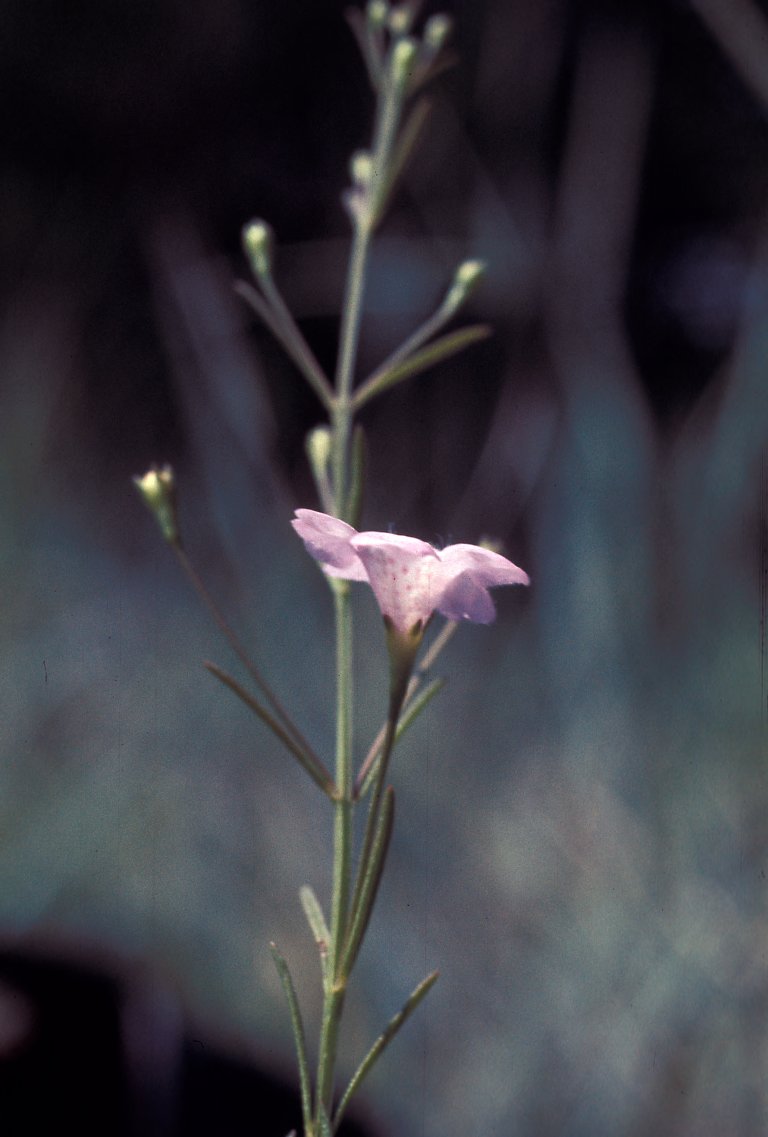
To take an example from near the top of the alphabet, at Shaw Nature Reserve, we have observed one species of false foxglove (Agalinis tenuifolia; the most common species statewide) out of nine that are known to occur in Missouri. Of the other eight, seven are known from the same county as Shaw Nature Reserve or from adjacent counties, and all occur in habitats like glades, woodland edges, and prairie swales, which we have restored or reconstructed. It may be reasonable to include these seven species in our enumeration of Shaw’s dark diversity and consider them as candidates for (re)introduction.
Why haven’t these seven missing Agalinis species appeared spontaneously? If they were once present at Shaw, were their seed banks depleted by decades of cattle grazing prior to Missouri Botanical Garden’s purchasing the property in 1925? Are they now unable to disperse to Shaw on their own? This seems likely as Shaw is situated in a fragmented landscape, and Agalinis species do not have any obvious mechanisms for long-distance seed dispersal. Another possibly, not mutually exclusive, is that local environmental conditions are unsuitable. Important symbionts in the soil might be absent, or appropriate host plants, since Agalinis species are hemiparasites that latch onto other plants’ roots to steal sugars.
Climate change makes it even more difficult to think about how to restore a site’s dark diversity. For instance, green false foxglove (A. viridis) is currently found far to the south of Shaw Nature Reserve, in southern Missouri, Arkansas, Louisiana, and Texas. But even optimistic climate models suggest that by 2070 Franklin County, MO may feel more like present-day Franklin County, AR – a county where A. viridis has been collected.
Agalinis fasciculata by Bob Peterson (Wikimedia Commons)
Agalinis skinneriana by Betty Nellums (tropicos.org)
Agalinis auriculata by Britton & Brown (1913) (Wikimedia Commons)
Agalinis aspera by George Yatskievych (tropicos.org)
Agalinis heterophylla by CameliaTWU (flickr)
Agalinis gattingeri by John Moore (Wikimedia Commons)
James and Thibaud Aronson post here their second report on ecological restoration in New Zealand, an island nation that seeks to eradicate non-native predators by 2050.
The government of New Zealand (or Aotearoa, as the Maori call it) has announced its goal to be predator-free by 2050, but the effort and expense required to eradicate the tens of millions of noxious animal and plant pests from the entire country is mind-boggling. One important development is technological in nature. Invasive mammal-killing traps are not very costly, but they do require regular maintenance. Some companies, such as this one, are designing and manufacturing automatic traps that humanely kill pest animals and then reset themselves.
Much of the native fauna has only survived to this day because, in addition to the two main islands, New Zealand also possesses many small offshore islands, some of which were never reached by introduced pests, like rats and stouts. Eradication campaigns have for many years been carried out on various islands relatively near to shore, to make them ‘pest-free sanctuaries’, where small salvage populations of rare and endangered species have been translocated and established successfully. Several ‘mainland islands’ have also been established, on North Island and South Island, completely surrounded by massive pest-proof fences, with ongoing trapping and poisoning efforts to eliminate any predator that might manage to get in.
We visited Tawharanui, one such sanctuary in the north of the country. While it is in an area that still has some native forest, the contrast is remarkable as soon as one passes the fence. The first notable difference is an audible one. The birds of New Zealand are unusual in that they sing all day long, and they are loud. James Cook, the first European to set foot on the islands, described the birdsong as “deafening”. Today, most of the forests are quiet, and the few birds that can be heard are exotic species, introduced by nostalgic, home-sick Europeans. Tawharanui gives an idea of what things once were like. Within minutes, we were struck by the diversity and abundance of life, another world entirely compared with the unprotected and second growth forests. Half a dozen endemic species thrive here that can hardly be encountered anywhere else on the mainland, and all of them display the characteristic fearlessness that has caused their downfall.
A North Island robin (Petroica longipes), displaying the typical inquisitive behavior that has caused the extinction of so many insular birds worldwide.
A few days later, we took a boat to Tiritiri Matangi (“a place tossed by the wind” in Maori). This small island, an hour away from Auckland, is one of the country’s most famous wildlife sanctuaries, and a remarkable experiment in ecological restoration. It was intensively cultivated and pastured until 1971, when it passed back to government ownership, with the intention of making it a nature reserve. However, as natural regrowth was very slow, a massive volunteer program was launched in 1984, leading to the planting out of over 250,000 native trees in the next ten years. Under the guidance of Dr. John Craig, and colleagues, 25 years of work at Tiritiri Matangi has led to much restoration of both natural and social capital.
A key component was a large-scale pest eradication program applied with great thoroughness. Once the habitat was deemed suitable, several endangered species were translocated from other more isolated islands where they persisted, nearly all of which have since established successfully. The regenerating forest offers great opportunities to view the wildlife, and tens of thousands of people visit the island every year. The success of the project has since led to similar projects on other offshore islands in New Zealand.
The stitchbird (Notiomystis cincta), the sole representative of its family, was once common throughout New Zealand. Within a century of the Europeans’ arrival, only a few hundred birds persisted on a single offshore island. It has since been translocated to Tiritiri Matangi and several other pest-free islands.
New Zealand’s best tool in this struggle is probably its people. Great efforts have been made in communicating to children the uniqueness of their endangered species, and how essential is the eradication of the introduced pests, no matter how cute and cuddly they may be. This was true at Tiritiri Matangi, and everywhere else. See the two key references cited at the end.
A sign describing one of many community programs we saw, where locals carry out conservation work, such as this eradication program along the Kepler Track, near Te Anau, South Island.
Invasive exotic plants are also a serious obstacle to ecosystem recovery, especially various species of introduced conifers that have escaped commercial tree crop plantations and become naturalized and out-of-control on native grasslands little prepared for such an encroachment. But the use of native plants has really taken off, with sophisticated, and inspiring native plant nurseries found throughout the country, and everywhere from city gardens to public works projects, native plants being used more and more every year. As a result, native species, from green geckos to tuis, the country’s most famous songster, can now be seen right in the middle of Auckland.
A Tui (Prosthemadera novaeseelandiae) perched on a native Hebe shrub on Stewart Island.
Stewart Island, the country’s third largest island at 1750 km2, is an example of what the country as a whole could aspire to. Royal albatrosses come into the harbor following fishing boats, blue sun orchids bloom on the roadsides, and kiwis come out at night to forage on the rugby field.
Oban, the only settlement on Stewart island. Walk in any direction out of town, and you quickly find yourself entering the surrounding national park.
A blue sun orchid (Thelymitra venosa), blooming on a roadside embankment on Stewart Island.
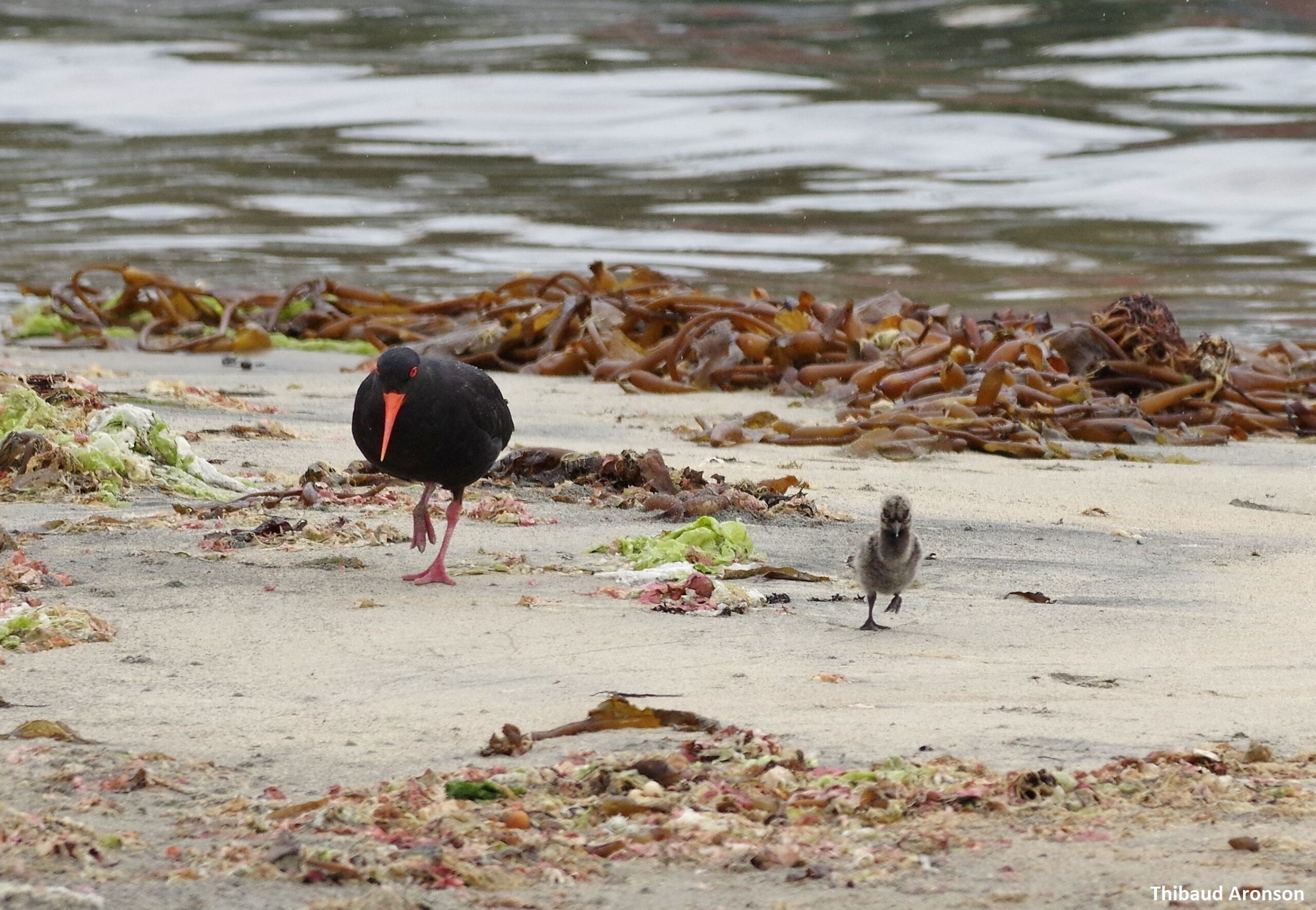
Now, of course, only 400 people live permanently on the island, 85% of which is a National Park, and most people on the island depend on tourism for income. The model obviously cannot be translated directly to the country as a whole. All dogs on the island must receive kiwi-avoidance training, and when a pair of variable oystercatchers decided to nest on the field in the middle of the primary school’s playground, the area was cordoned off, and several signs put up, telling children what a privilege it was that their school had been chosen by the parental pair, and to keep well away from the nest. The chick hatched while we were there, and happily crossed over the road safely, with his parents following the reckless chick, to the nearby beach. There too, even though people (but not dogs) are present every day and evening, except when it’s pouring down rain, these birds are nearly guaranteed a watchful and caring stewardship on the part of the locals and quickly tuned-in visitors. These simple things show a will on the part of the local people to exist within the native ecosystem, rather than imagining themselves outside it, and licensed to do whatever they will, and to hell with the consequences. The rest of the world would do well to take a page from NZ’s book.
Newborn variable oystercatcher (Haematopus unicolor) on the beach, 50 meters from Oban’s main hotel.
Additional recommended reading
Craig J, Mitchell N, Walter W, Galbraith M, & Chalmers G. 1995. Involving people in the restoration of a degraded island: Tiritiri Matangi Island. In: Saunders DA, Craig JL, & Mattiske EM, editors. Nature Conservation 4: The role of networks. Chipping Norton, NSW, Australia, Surrey Beatty & Sons. Pp. 534–41.
Craig J, & Vesely E 2007. Restoring natural capital reconnects people to their natural heritage: Tiritiri Matangi Island, New Zealand. In: Aronson J, Milton SJ, & Blignaut JN, editors. Restoring natural capital: science, business, and practice. Washington DC, USA, Island Press. Pp. 103–111.
James and Thibaud Aronson post here the first of two reports from New Zealand, where they spent the first three weeks of January 2017, learning about the remarkable restoration and conservation work going on there.
New Zealand, or Aotearoa (Land of the Long White Cloud, as the Maori call it), is one of the world’s leaders in terms of conservation and restoration. However, it certainly did not start off that way.
New Zealand was first settled by Polynesian sailors about 750 years ago, one of the last places on Earth to be colonized by humans. These pristine islands, which had stood in isolation for 80 million years, harbored a wealth of unique lifeforms, from the iconic kiwi (of which few people know there are in fact 5 species), to the weta (cricket relatives in one of several genera endemic to New Zealand, some of which are among the largest insects in the world), and the tuatara, large, endemic, lizard-like reptiles, the last survivors of an order that thrived 200 million years ago.
The island did not lack predators: just think of the now-extinct Haast’s eagle (Harpagornis moorei), the largest eagle to have ever lived, and the fierce, flightless moa (nine species in six genera; all extinct), giant relatives of the ostrich, the biggest of which stood fully 3.6 meters (12 feet) tall and weighed 230 kg (510 lb). However, Aotearoa harbored practically no land mammals, the only exceptions being two species of bats. Therefore, many native animals were flightless, absolutely unafraid of humans and their dogs, and thus very easy to hunt.
Faced with this incredible boon, the Maori did what humans have done on every single island and continent they have ever reached: they took and took without restraint. All 9 species of moa, the most rewarding of prey, were gone within 200 years. Seals, once abundant along all coastlines, vanished from many areas. Forced to change their ways, the Maori shifted to eating more fish and shellfish, and took to cultivation, burning down forests for cultivation, and also started eating the bracken fern that grew back in abundance after fires. However, and very unusually, having caused widespread extinctions, the Maori eventually introduced rāhui, a strict system of preventing all unauthorized persons to enter an area, or harvest a specific resource. The intention was to allow regeneration, such as certain animal food sources, or plant materials – such as wood from a certain tree species prized for carving, thus avoiding local depletion of resources or even further extinctions. This system is still in use today among Maori, and can also be declared by different agencies of the NZ government!
Billy Boy, a Maori guide in the Waipoua forest, whose connections to New Zealand’s wilderness is an essential part of his identity. Whenever one of his grandchildren was born, the first thing he did was to take them to the forest and begin their introduction to the natural world.
However, things took a significant turn for the worse 200 years ago, when Europeans reached New Zealand. They rapidly established large-scale logging activities, targeting the various species of native conifers, which can live for millennia and reach enormous sizes. For a few decades, whaling and sealing were vastly profitable as well, until populations crashed. What’s more, the Europeans brought with them cats, black rats, and later possums, stoats, and other carnivorous mammals. All of these species have since gone feral, and become one of the foremost ecological problems the country faces today. Since human settlement, 47 endemic bird species have gone extinct, about half from Maori over-hunting, and the remainder in the last 2 centuries, wiped out by feral predators, as were various species of reptiles, amphibians, and invertebrates. Many more species have no doubt suffered the same fate, disappearing before they were even documented.
However, in recent decades, New Zealand has made an impressive and inspiring commitment to preventing future degradation and in fact taken many great strides towards rolling-out restoration at a national scale. This merits celebration and emulation. During our 3-week trip, we got to see first-hand some examples of the conservation and restoration work underway.
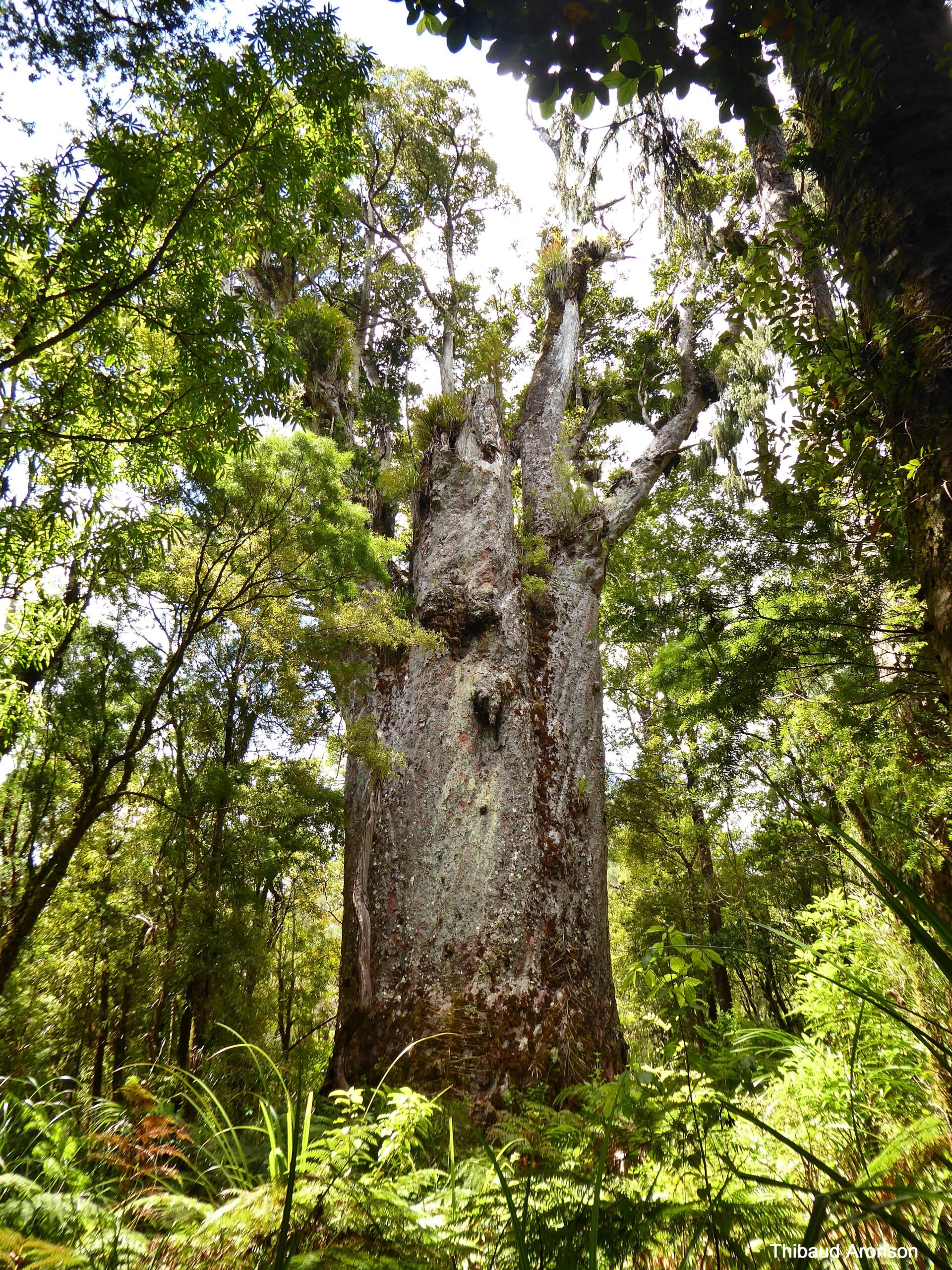
One of the most iconic trees of New Zealand is the kauri (Agathis australis). These massive conifers once dominated the forests in much of the warmer, nearly subtropical, northern part of the country. They can live well past a thousand years, grow 50 meters tall, and reach a girth comparable to that of the Californian sequoias. The largest individual known today is called Tane Mahuta, or Lord of the Forest, the name of one of the main gods in Maori cosmology. It is hard to describe how insignificant one feels when standing below these giants.
Te Matua Nhgahere (Father of the Forest), the oldest and second-largest remaining kauri in New Zealand. The age of this tree is variously estimated to be between 1200 and more than 3000 years old. Such longevity is exceedingly rare in tropical or subtropical rainforest trees.
The kauri also happen to yield excellent timber, once particularly valued for ship-building. Their logging was only banned in 1972, and less than 4% of the original kauri forests are left today. Happily, no native forest can be legally logged anywhere in New Zealand today, thanks to an election promise of the Labour government which passed into law in 2002.
Waipoua forest, on the north-west coast of the North Island, is the largest kauri forest left in New Zealand. Great efforts are being made today to preserve the remaining stands, particularly focusing on halting the spread of kauri dieback disease, a horrific, recently-arrived fungus-born infection that spreads through soils and kills every kauri tree it infects. Part of the campaign to save the tree entails education and consciousness-raising among all visitors to the kauri forests as to the importance of cleaning their shoes and boots both when entering and leaving the area.
Skeleton of a kauri killed by the dieback disease in Waipoua forest. Can the disease be stopped?
Some forest areas have fared better, such as the Nothofagus forests of Fiordland National Park, in the south-west of the South Island, well protected as they are by billions of biting flies, which have successfully prevented any significant human settlement in the area. However, stoats, rats and possums are not so easily deterred, and the whole area is a prime example of empty forest syndrome.
Southern Beech forest (Nothofagus spp.) in Mt Aspiring National Park.
Therefore, enormous amounts of money are being spent on large-scale trapping and poisoning throughout the country, to try and control these non-native pests which wreak havoc both on native fauna and flora. For instance, we visited the private Pupu Rangi Sanctuary, 100 hectares of forest south of Waipoua, in the North Island. Its owner, Octavian Grigoriu, and a diverse team of volunteers work tirelessly in the forests, maintaining traps and poisoned bait around the whole perimeter of the forest, and deep in the bush as well. Octavian hosts paying guests, which helps pay for the expensive traps and poison. As a result, native species, including the North Island brown kiwi, are doing significantly better than in the nearby Waipoua forest, which is much larger, and therefore exponentially harder to protect effectively.
In sum, all over New Zealand, many initiatives, both top-down and bottom-up, are doing excellent work, which we will discuss in our second blog post.
Octavian Grigoriu setting possum bait laced with cyanide in his privately-owned forest reserve.
James and Thibaud Aronson made a stop in Hong Kong recently, and post a report on what’s going on restoration-wise at the 60-year old Kadoorie Farm and Botanic Gardens.
After three weeks in New Zealand – about which we will report in our next two posts – we stopped recently in Hong Kong to visit the Kadoorie Farm and Botanic Garden (KFBG), which has just celebrated its 60th anniversary. Most visitors to Hong Kong never leave the city center, which has the second highest concentration of skyscrapers in the world and rivals London and New York for shopping, but also as a global hub for finance, trading, and marketing. But, we were lucky: through our friend Kingsley Dixon we had an introduction to Dr. Gunter Fischer, Head of the Flora Conservation Department at KFBG. Dr. Fischer came to Hong Kong from Austria, 7 years ago, and now oversees the vast – and gorgeous – botanic garden, the herbarium, the genetic and ecology laboratories and the various restoration and native plant recovery programs at the KFBG, which is the result of an exemplary public sector-private sector partnership. Behind the scenes, a key component is the large on-site tree nursery and enormous amounts of effort devoted to seed collecting and plantations of mother plant collections of rare native tree species for seed production. “In a changing world, resilience comes from diversity”, as Gunter so nicely puts it.
Ms. Chung Yick Kwan, an employee of the garden working in the KFBG tree nursery, handling one of the many rare native species propagated here.
Other departments at KFBG include the Sustainable Living and Agriculture, Fauna Conservation, Kadoorie Conservation China, and Education. Activities are devoted to developing and demonstrating sustainable small-scale farming methods for food production in South China, including new methods such as permaculture and traditional Chinese methods that have been lost or abandoned during the Chinese cultural revolution. There is also an extensive rehabilitation program for wild animals, notably many rare and endangered turtles, mammals, and birds that were seized by Hong Kong customs or delivered by animal rescue organizations.
All of these activities stem naturally from the original raison d’être of the organization. When Sir Horace and his brother Lord Lawrence Kadoorie founded the Farm 60 years ago, their goal was to help Chinese immigrants get established as small farmers.
Sir Horace and Lord Lawrence Kadoorie – the founders of KFBG. (Photo: KFBG archives)Text of one of the guiding principles of the charity work of KFBG in the early 1950s, which is still valid in the 21st century (NB. In the 1950s KFBG was called KAAA, Kadoorie Agricultural Aid Association). (Photo: KFBG archives)
To this day, the Kadoorie Foundation is the main funding source of the KFBG. But with vastly greater affluence in Hong Kong today, since the mid-1990s, a decision was made to transform the property into a world-class education and conservation center with a botanic garden at its heart. The conservation work comprises numerous projects in Hong Kong and mainland China but also parts of Southeast Asia, such as poorly explored regions of Laos and Cambodia.
Originally, Hong Kong was covered in tropical and subtropical forest, but it was completely deforested after the British took over in 1841; visitors in the 19th and early 20th century called Hong Kong a “barren rock”. As a result of centuries of cultivation with crops such as rice and tea, and ongoing urbanization in combination with more and more exhausted soils, many mountain slopes were left to their fate, completely denuded of any vegetation ongoing soil erosion, and high run-off during the annual monsoon seasons caused landslides and wreaked havoc.
Starting in the 1880s, successive governments undertook massive afforestation programs, as documented by the eminent ecologist Richard Corlett. However, during the World War II Japanese occupation of Hong Kong, most of the recently recovered forests were burned or devastated by harvesting of fuel wood.
After WWII, secondary forests began to recover, but of the 450 native tree species, only ca. 100 regenerated naturally, and the other species carry on sadly towards extinction. Moreover, there are huge problems with introduced grasses, many of which carry fire far better than anyone would like.
Upper area of KFBG’s restoration site devastated by a fire in 2004. (Photo: Dr. Billy Hau)
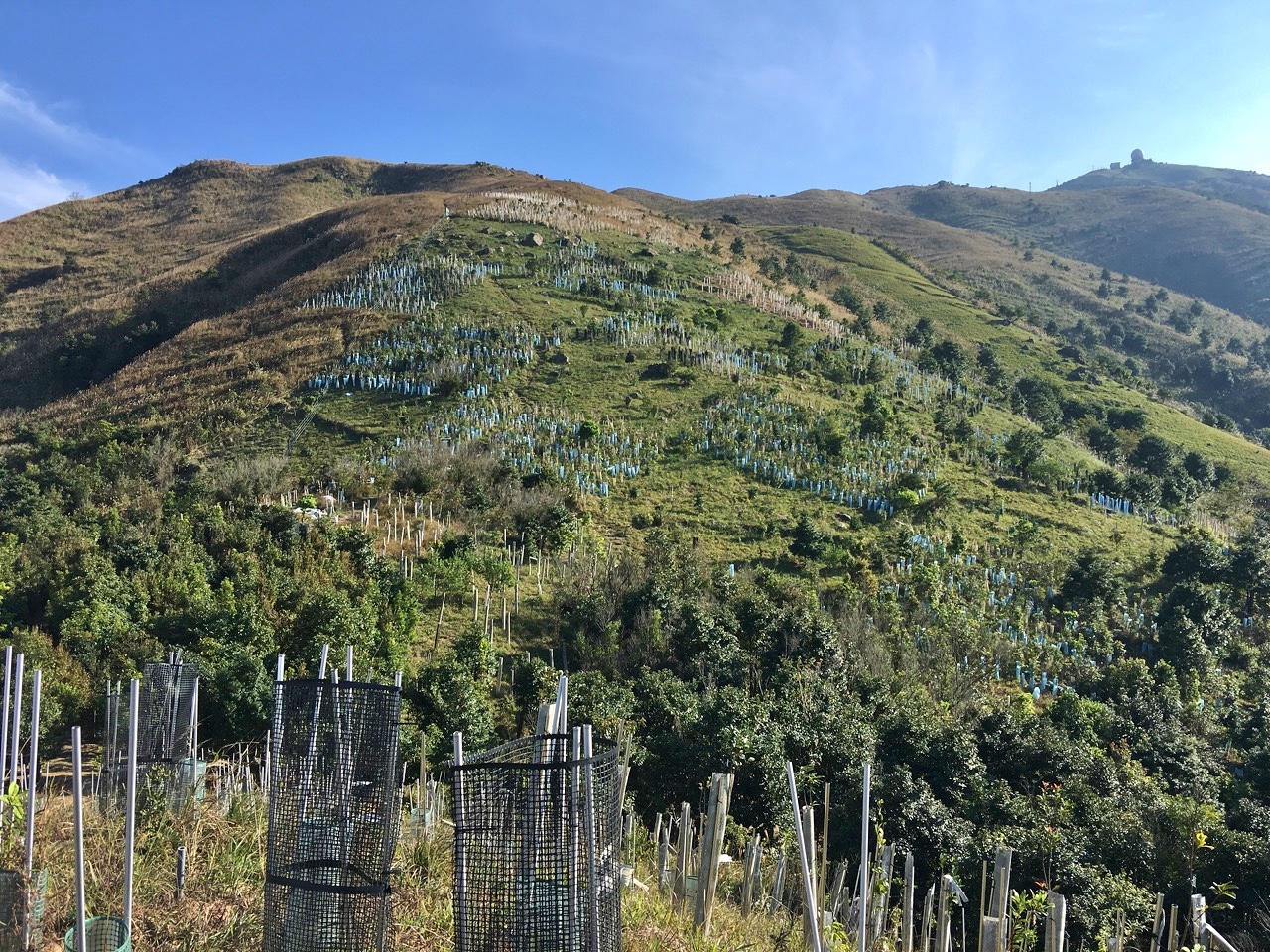
Thus the challenges for conservation and restoration are enormous. Indeed, the same is true at the regional scale. As Gunter told us, “most of the forests of South China have been trashed”; only tiny fragments of primary forest remain, and very little work on restoration of the original forest is going on. Since he arrived at KFBG, over 6 years ago, Gunter has done remarkable things in the botanic garden portion of the 159 hectare property, located on a steep slope of Tai Mo Shan, the highest point in Hong Kong (957 m or 3140 ft), including the launch of an ambitious restoration program on the recovering wilderness portion of the property that few visitors see. Rather than full coverage, a tree island, or assisted nucleation approach is taken, similar to that used in on-going experiments in Costa Rica, which Leighton Reid posted on last November.
Core area of the 15 hectare (42 acre) experiment restoration site at KFBG, showing tree island plantings of 2015 and 2016, with various soil preparation techniques and tree guards being tested. (Photo : Gunter Fischer)
The focus is largely scientific and conservation-oriented, given that most of the flora of Hong Kong is highly endangered. However, horticulture and arboriculture are as important as ecology here, Gunter assures us – an observation that jives well with the Missouri Botanical Garden’s approach to restoration as well. For example, Gunter and his colleagues not only plant ten thousand trees on average each year, all produced in the experimental KFBG nursery, they also prune and shape the trees they’ve planted to encourage upward growth rather than low shrubby formatting, which is what often happens with many trees after planting.
Structurally pruned Quercus edithiae, a rare canopy tree in South China.
A large proportion of the tree planting budget is devoted to plastic cylinders (tree guards/shelters) to protect tree saplings from barking deer and wild boar, but also from harsh climatic conditions.
Tree guards used to protect seedlings on a ridge from strong desiccating winds.
The KFBG restoration team also makes a big effort to study soil improvement techniques that will compensate for degraded soils and improve survival and early growth of the planted trees. One of the most interesting components of this experimental work concerns the use of Biochar prepared on site, by slowly heating wood in closed containers with almost no air. Much of the wood comes from stems and trunks of intentionally introduced and now invasive fast-growing trees, such as the appropriately named Acacia confusa, that are gradually being removed from the property. This approach to invasive woody weeds has great potential in many parts of the world and should receive a lot more attention and investment.
Invasive trees and those deemed hazardous to human safety are continuously removed and replaced with native species. The wood is used to prepare biochar.
Clearly, KFBG is one of the bright spots of plant and animal conservation, and ecological restoration in Asia today.
Native animals such as this bamboo pit viper (Trimeresurus stejnegeri) are recolonising the restoration site. (Photo: Gunter Fischer)
For more information, see the recent article published by Gunter and his colleague Jinlong Zhang. Also, if you’re travelling to Hong Kong, be sure to stop by. Even if you don’t trek to the higher slopes to see restoration work-in-progress, the Botanic Garden is also full of interesting natural and cultural sights and stories too, such as these elevated pigeon hotels. And how many botanical gardens occasionally have to close a road because a massive python is stretched right across it, digesting a deer for a week!
Dragon boat pigeon hotel on the KFBG grounds.
And there is the museum, theme gardens such as the Gloria Barretto orchid sanctuary, and lush forest gardens that appear to be native forest fragments but in fact are tropical gardens providing an exhilarating experience for thousands of visitors each month just a few miles from downtown Hong Kong.
Montane streamside forest garden with trees covered in epiphytic ferns.