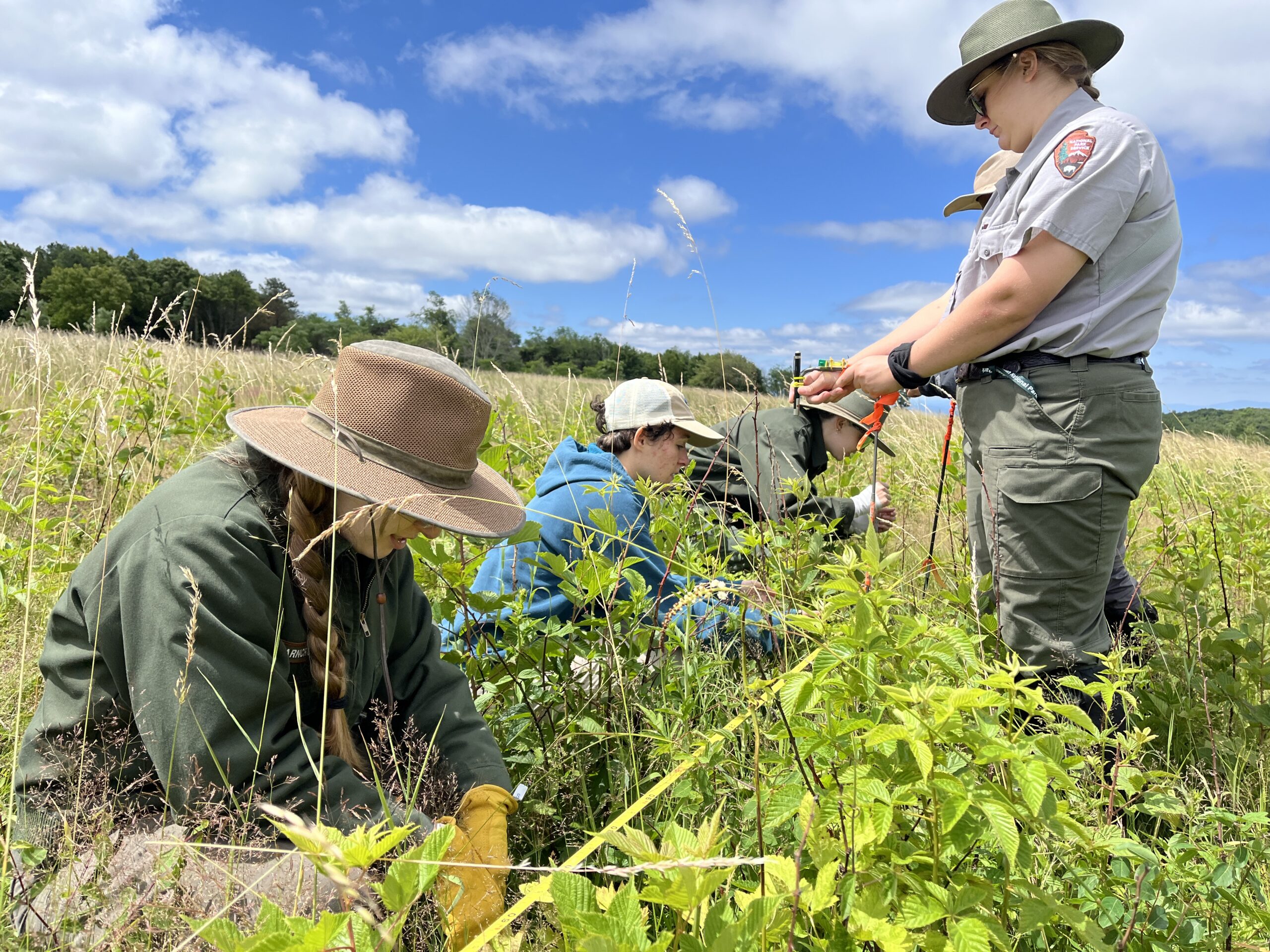
By Jordan T. Coscia
Jordan is a PhD candidate in the Restoration Ecology Lab at Virginia Tech and a Research Fellow with the Smithsonian’s Virginia Working Landscapes program whose research focuses on the characterization and restoration of Virginia’s native grasslands.

Located at the heart of Shenandoah National Park, the Big Meadows landscape is a site of both natural and cultural history. The 134-acre meadow is the largest open area in the Park, and it is a popular visitor destination boasting numerous walking trails and proximity to campgrounds, picnic grounds, and one of the park’s two visitor centers. Ecologically, the Big Meadows landscape includes two globally critically rare Blue Ridge Mafic Fen plant communities, and hosts plant and animal diversity not found elsewhere in Shenandoah National Park.
Like other meadows and grasslands across the Southeastern United States, Big Meadows occurs in a climate that can support closed-canopy forests. Therefore, the open landscape and the species that rely on it only persist due to a combination of edaphic characteristics, such as shallow and poorly drained soils, and frequent disturbance, such as fires or the grazing of herbivores, that prevent the growth of woody trees and shrubs. In the post-colonial absence of large herbivores and the suppression of both cultural burning and wildfires, the open landscape of Big Meadows was maintained by livestock grazing before the establishment of Shenandoah National Park in 1935. Continuous efforts have been made to preserve the historic open landscape since the Park’s founding, including routine mowing, prescribed burns, and the targeted cutting and herbicide treatment of encroaching Robinia pseudoacacia (black locust) saplings and Rubus (blackberry) canes. While initially successful, management efforts appear to have become less effective over time, and the spread of woody and invasive species threatens the open landscape of Big Meadows.

Since 1998, botanist Wendy Cass and The Inventory and Monitoring program at Shenandoah National Park have recorded land management actions and collected plant community composition data in Big Meadows. Big Meadows was split into three major management zones, and all three zones were treated with prescribed fire each spring between 2000 and 2003. In 2004, a new management schedule was created with the goal of maintaining a three-year burn-mow-fallow cycle in each zone. To determine how these management changes impacted Big Meadows, Leighton Reid (Virginia Tech), Wendy Cass, and I assessed changes in the plant community composition from 2000 to 2023 using multivariate statistics and the creation of statistical models through regression analysis.

We found that the plant community composition of Big Meadows shifted over the past 23 years, with the original mosaic of shrubs within a grass and herb-dominated community experiencing marked increases in low shrubs, young trees, and other woody plants. Though the average percentage of graminoids (grasses, rushes, and sedges) encountered along each survey transect experienced little overall change between 2000 and 2023, the average percentage of forbs (non-woody herbs that are not graminoids) encountered decreased by over 50%, while the average percentage of woody plants encountered increased by 200%-400%. This increase in woody plants was partially driven by native Rubus (blackberry) species, which increased from less than 1% of the plants encountered along each transect in 2000 to 15-20% of the plants encountered along each transect by 2023. Multivariate statistics revealed that the trajectory of change in the Big Meadows plant community shifted abruptly after the three-year burn-mow-fallow cycle was adopted in 2004. The direction of this shift was correlated with an increase in the time interval between prescribed burns.

Our statistical models provided evidence that both climate and changes in the timing of land management actions have impacted the plant community in Big Meadows. There was moderate evidence that later springs (as indicated by the date of the last spring freeze) are correlated with desired increases in forbs, however, this positive effect may be lost as climate change brings milder winters with fewer frost days to Shenandoah National Park. There was strong evidence that longer intervals between prescribed fires are correlated with unwanted increases in woody plants and decreases in forbs and moderate evidence that longer intervals between mowings are correlated with unwanted increases in Robinia (black locust) and decreases in forbs. Together, this evidence indicates that these unwanted changes may be mitigated by increasing the frequency of prescribed burns and mowing in the future.
Overall, our analysis revealed that the changes in land management between 2000 and 2023 have negatively impacted the plant community composition in Big Meadows. Together, the shifts in community trajectory after 2004 and the evidence from our statistical models suggest that the change from annual burning to a three-year burn-mow-fallow cycle in 2004 has contributed to the declining landscape conditions in Big Meadows. Though ad-hoc changes to the three-year management cycle and gaps in the plant data make it difficult to determine an ideal burn or mow interval from the existing data, evidence from the past 23 years suggests that more frequent burning and mowing may aid the preservation of the Big Meadows landscape for future park visitors and wildlife alike.


Leave a Reply